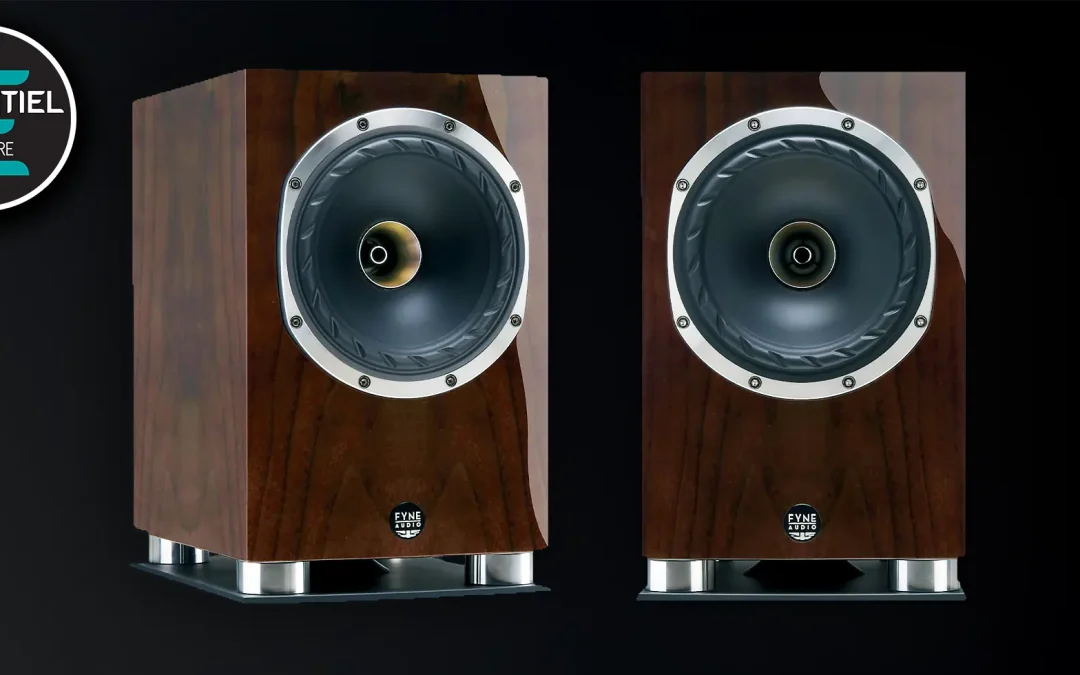
Faithful to its coaxial architecture, British manufacturer Fyne Audio is offering a new addition to its range. Called the Fyne Audio F500 SP, it largely incorporates the solutions already used on the previous-generation F500. Once again, Fyne Audio has succeeded in offering this latest model with its luxurious white, black or natural walnut lacquer finishes at a particularly attractive price.
If there are a few similarities between the F500 SP and some of Tannoy’s products, this is hardly surprising. Indeed, many of the members of Fyne Audio’s Research & Development department came from the former Tannoy teams, before the brand was sold to a major foreign group. It is therefore natural to find a coaxial architecture close to that which made the reputation of Tannoy’s consumer loudspeakers.
This coaxial arrangement of the drivers, where the tweeter is housed in the centre of the woofer instead of its core cover, has the advantage of offering perfect phase coherence between the sound emitted by the tweeter and that emitted by the woofer. This is a major advantage in giving the sound image incomparable relief and precision in the spatial location of each of its elements.
Titanium dome tweeter and FyneFlute suspension
Despite the small dimensions and compact size of the small F500 SP, Fyne Audio wanted to give them features worthy of the best equipment. The brand has therefore taken great care in the design and construction of its loudspeaker. It’s based on a 150mm diameter woofer combined with a tweeter with a titanium dome. This metal gives it an excellent balance between mass and rigidity. Its very low mass means that Fyne Audio can claim a frequency response of up to 34 kHz for its small loudspeaker, which is quite remarkable in this product family and, above all, at this price. Note that the coaxial structure of this architecture also allows the woofer membrane to act as a horn for the tweeter. This optimises high-frequency reproduction. For the ‘handover’ between the woofer and tweeter, Fyne Audio chose a relatively low transition frequency of 1.7 kHz. Special attention has also been paid to the design of the woofer. While it is based on a fairly conventional multi-fibre cone, it is the peripheral suspension that has benefited from the most in-depth studies. In fact, it’s more than just the traditional half-roll that gives the diaphragm plenty of travel. Oblique ribs stiffen it and, above all, optimise the movement of the cone during its greatest deflections. This specific feature ensures that the F500 SP holds up well in the deepest bass, while minimising the appearance of parasitic resonances. Finally, the woofer’s motor uses a double magnet, guaranteeing excellent hold during the most pronounced impulses and transients.
A vent at the base of the cabinet
The fact remains that, whatever the quality of the drivers used in a loudspeaker, the load associated with them determines their behaviour. Fyne Audio has opted for a bass-reflex type load. However, with such a configuration, there is always the problem of vent location. This parameter plays a fundamental role in the behaviour of the loudspeaker in relation to its location in the listening room. Here again, Fyne Audio has chosen an original solution. The vent is located under the cabinet. A counter-plate combined with a set of thick spacers ensures that there is plenty of space between the vent outlet and the floor or speaker support. In addition, a cone-shaped piece in front of the port optimises airflow movement and prevents the appearance of parasitic noise when reproducing the deepest bass frequencies. This choice guarantees excellent bass diffusion wherever the loudspeaker is placed.
Luxurious finishes
Finally, to match the interior design of the room where they will be installed, the F500 SP are finished to the highest quality. They are available in three versions: white piano lacquer, black piano lacquer or varnished walnut. Great care has also been taken with the terminals. There are four of them, to allow bi-wiring or even bi-amplification, and they accept both banana plugs and large cross-section cables.
The set up
Setting up the F500 SP is not particularly problematic. For them to express themselves fully, the ideal position is at least one metre from the corners of the room and about thirty centimetres from the wall. Ideally, they should be fitted with a quality, weighted stand. However, we found that they behaved very well whether placed on a piece of furniture or even directly on a rigid wall bracket.
The sound
As with any coaxial system, the strength of the F500 SP lies in its precision in the spatial localisation of the various elements of the soundstage. This was underlined by our traditional listening to William Russo’s ‘Three Pieces for Blues and Symphony Orchestra’ performed by the San Francisco Symphony Orchestra conducted by Seiji Ozawa. Despite the fairly pronounced reverberation in the San Francisco Opera House, each musician is perfectly located and stands out with great precision. The stereophonic space is thus rendered in a truly three-dimensional way, giving the sound image a seductive relief. The intervention of the triangle, heard during one of the work’s rare quieter and more subdued moments, is a perfect illustration of this behaviour. Not only is it perfectly positioned, slightly to the right of the centre of the sound space, but its crystalline note seems to come from far away, from the very depths of the hall, which it does.
This feeling of a lively, relief-filled sound image is further enhanced by the limpidity of the treble. The tweeter combines finesse and detail to illuminate the soundstage with a beautiful light. The sound reproduction is subtle and detailed without ever becoming aggressive. Vocals also have a precise and natural phrasing. The sensation of the singer’s presence is there. A presence that was highlighted when listening to Zaz’s ‘Dans ma rue’. We also noticed that the junction between the tweeter and the midrange was very smooth, without the slightest ‘hole’.
The listening experience thus benefits from excellent respect for the timbre of the voices. They are reproduced with a beautiful presence while retaining all their warmth, which is not always obvious.
Finally, the bass is surprisingly full and deep for speakers of this size. What’s more, it has the directness and impact usually reserved for models with larger diameter drivers. The woofer gives the reproduction an excellent foundation while retaining a great deal of liveliness. Here, the sound is straightforward and realistic, and never overly boomy, as is often the case with small units that want to be as big as the big ones and try to achieve this by delivering a bass that is in the foreground but lacks vigour. Far from this misleading behaviour, the F500 SPs deliver a realistic, well-structured bass. They even show great energy. Among other things, they provide the drum solo in Dave Brubb’s
Dave Brubeck’s ‘Take Five’ drum solo, for example, with a dynamic range more often found in large floorstanding speakers than in bookshelf cabinets.
Finally, the most recent musical styles do not destabilise them either. Listening to reggae tracks such as ‘Dis-le’ by Bazbaz or ‘Rafales’ by Bernard Lavilliers also proved that the F500 SPs knew how to ‘unleash the bass’ with a breadth that their low volume wouldn’t have suggested when the work called for it. Likewise, they willingly complied with the demands of electro music. A musical style that does not hesitate to explore the extremes of the audible spectrum. It’s a challenge that many loudspeakers, although well-suited to the reproduction of jazz or symphony orchestras, fail to meet.
Our conclusion
Simple to set up and versatile, these small speakers are perfectly adapted to meet the expectations of the most demanding enthusiasts. Despite their particularly small footprint, they offer a very high level of performance, which is sure to surprise fans of much larger units. Finally, Fyne Audio also offers the option of using them as satellite speakers, dedicated to reproducing ambient sound within a high-quality home cinema installation.
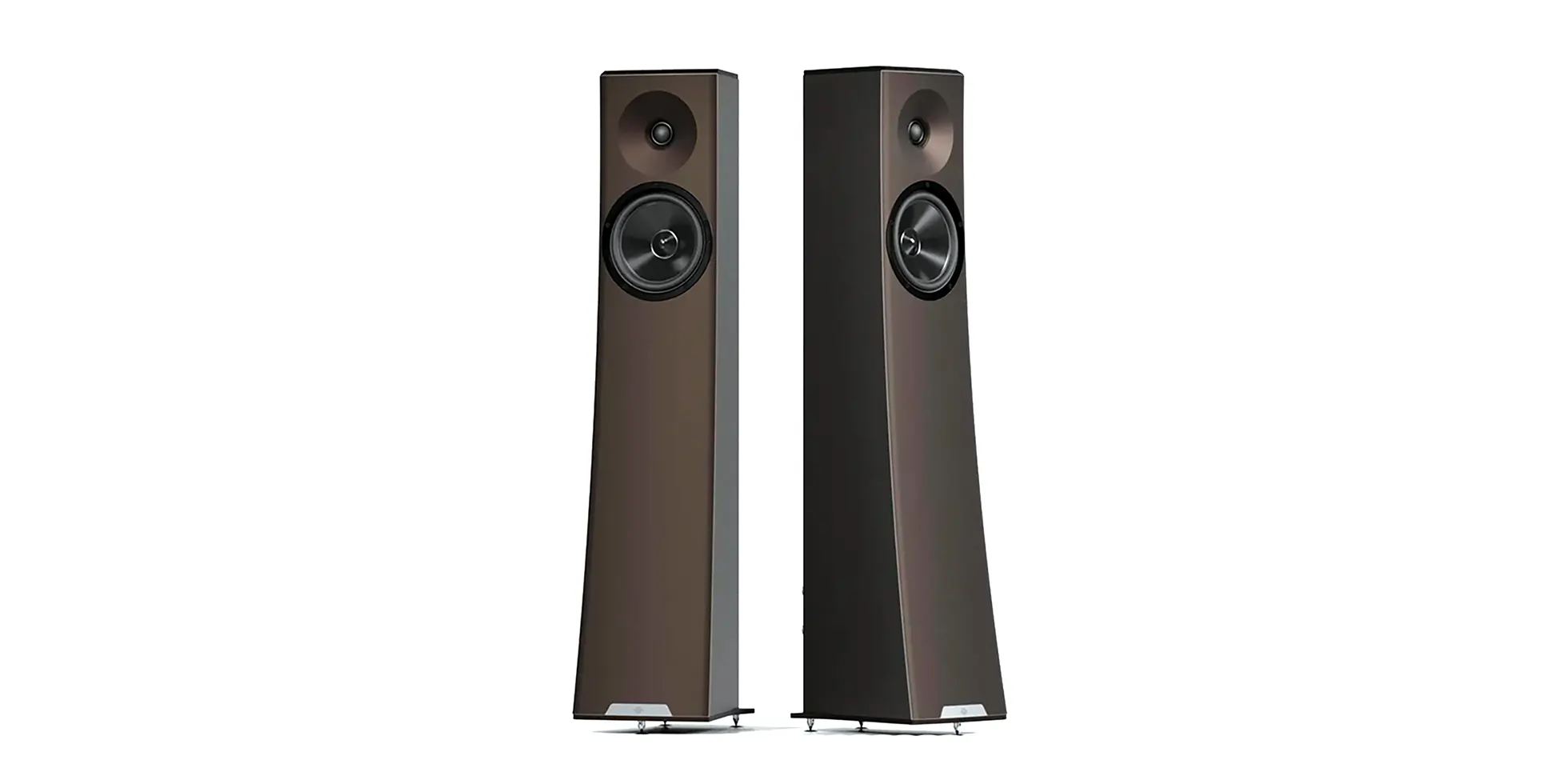
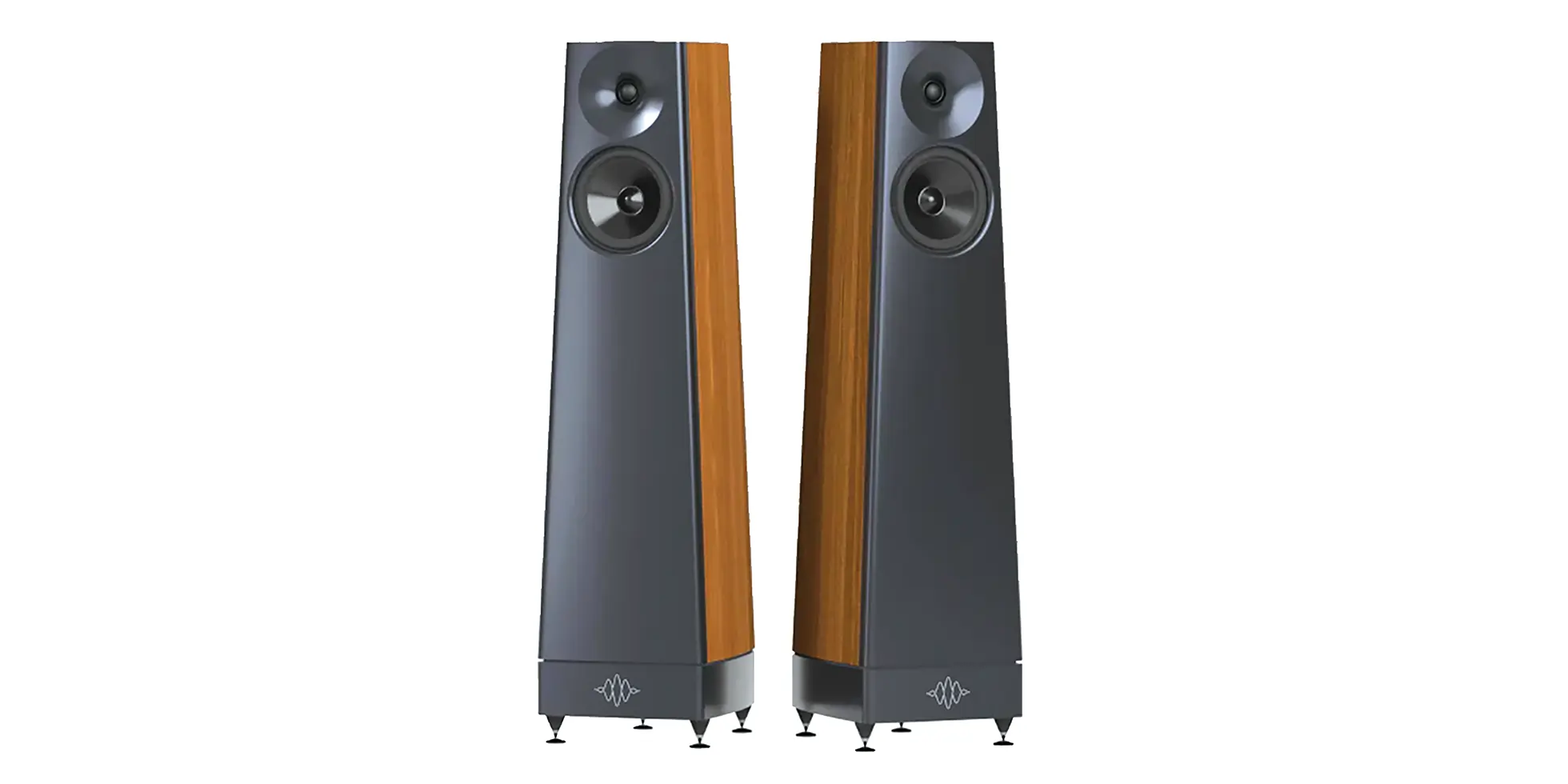
Recently reintroduced in France with its new Peak series, YG Acoustics dazzled the Munich High End 2024 with a demonstration of the XV 3 Signature from the Reference series, and the XX Live connected loudspeaker. Impressed by the quality of the phase and the purity of the sound, we wanted to put the brand back in the spotlight by testing a more affordable model from the Reference range. But rather than stop at a single model, we took advantage of the fact that the dealer Music Hall in Paris has several versions, to compare the two 2-way speakers in the catalogue: the Talus from the Peak series and the Carmel 3 from the Reference series.
YG Talus: back to the musical peaks
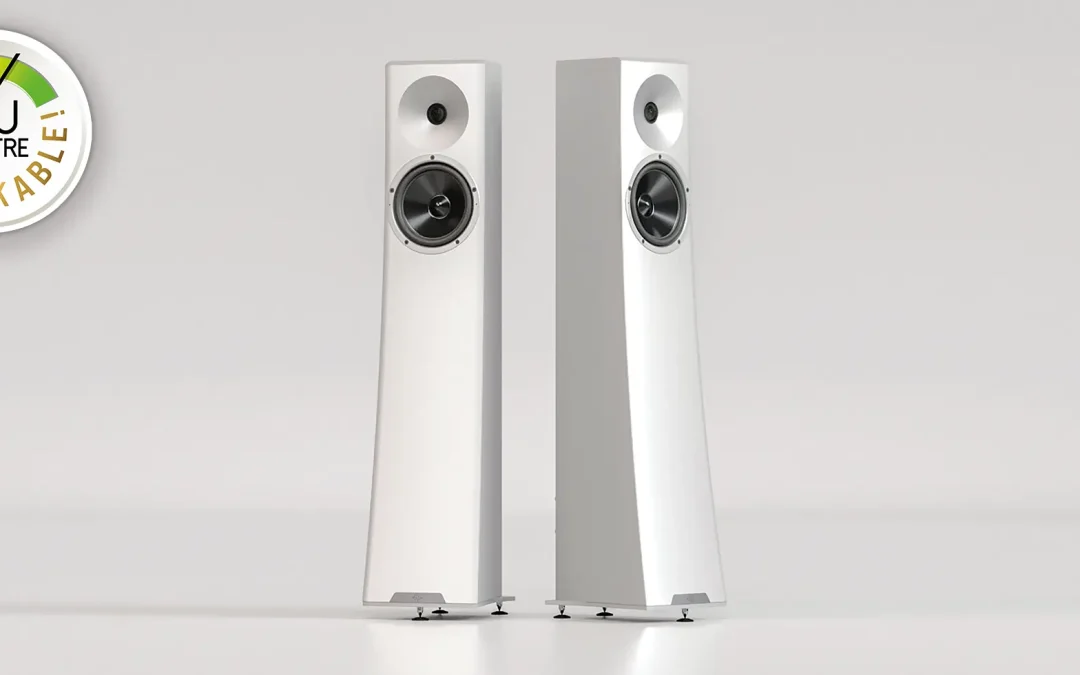
When we have tested the column Ascent (cf. VU#53; Remarkable) -the fourth model in a Peak series inspired by the mountains of Colorado -near the company’s headquarters- we had beside it the compact loudspeakers Cairn and Tor. The latter uses exactly the same drivers than the Talus, and an almost similar crossover structure integrated into the base of the cabinet. But as a floor-standing speaker, the Talus has a dense resin fiber enclosure with dimensions identical to those of the three-way Ascent: 101.5 cm high. A true two-way since it loses the woofer at the bottom, the Talus dips slightly lower but still reaching 32 Hz (compared with 26 Hz for the Ascent) and its aluminum front panel -still manufactured on the basis of 15 million points using computer modelling- is even more pleasing to the eye, as well as making the object more discreet.
The 18.5cm (7.25″) bass-midrange driver features the same BilletCore aluminum cone used on all the American brand’s models, while the tweeter is the same as that found on all the Peak series. Called ForgeCore, it is created from steel parts optimized by 3D geometry, and is therefore different from the Reference range tweeter. Like all Peak models, the Talus is handcrafted in the USA and benefits from special care and sumptuous assembly; it can be chosen in three wood colors: oak, ebony and rosewood. At 20 990 €, it costs 4 500 € more than the Tor (16 490 €) and 8 000 € less than the Ascent (28 990 €).
YG Carmel 3: the heart of the reference
At 39 990 €, the Carmel 3 is almost twice as expensive, but it is only the entry-level model in YG’s Reference series! Including nine speaker models and three subwoofers (with the very impressive Invincible 21.2), this series contains just one two-way speaker before moving on to four three-way models (Vantage 3, Hailey 3, Sonja 3.2 & 3.3) and then four four-way models, three of which feature two two-way speakers per side (XV Studio 3, XV 3, XV 3 Signature), with basses placed in another cabinet of the same height as the midrange and treble one. Only the XX is handled by a single pair of speakers, its four channels being managed by bass units placed in the side of the main cabinet, weighing 170 kg per unit.
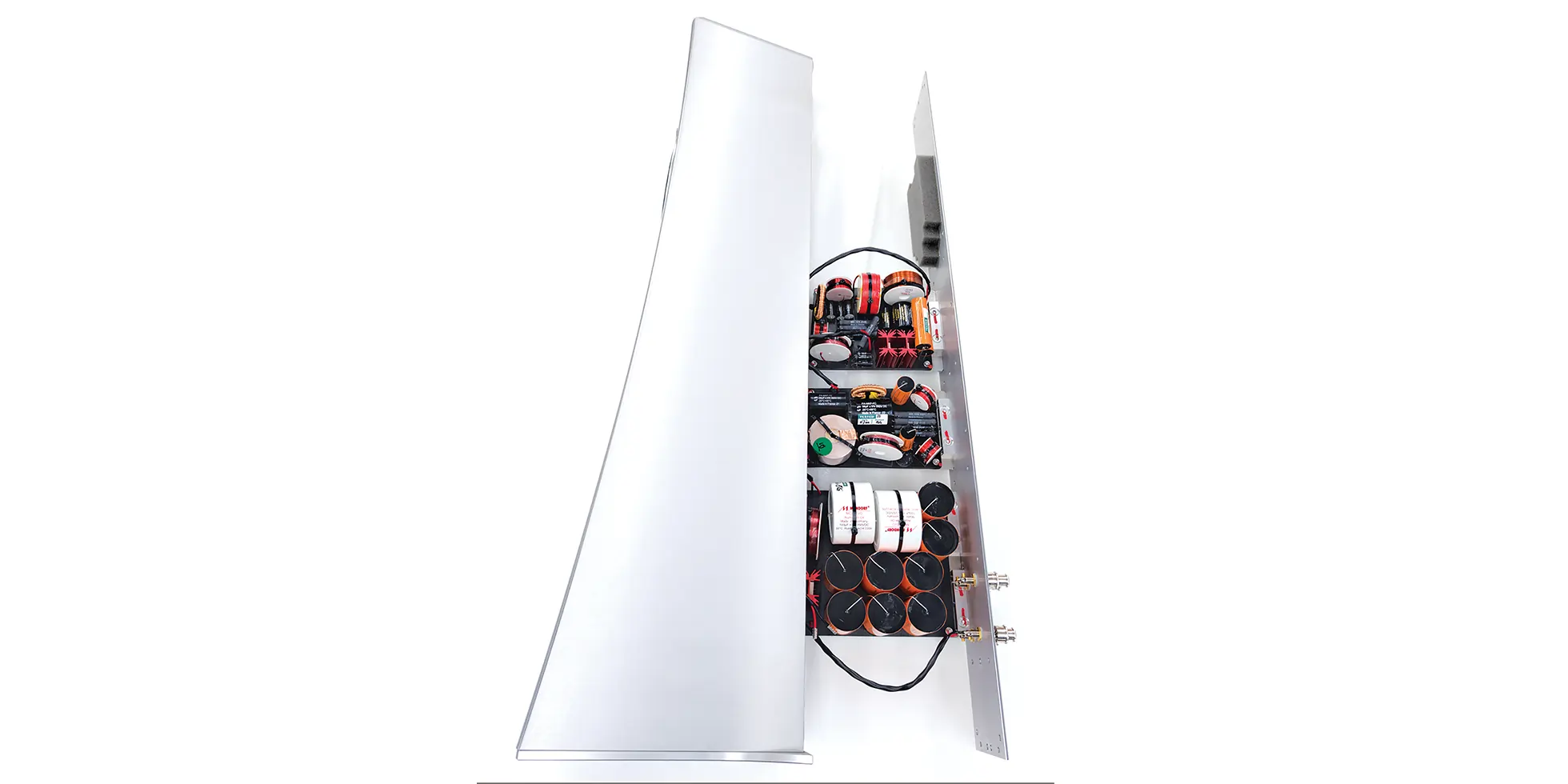
With a height of 103 cm, a width of just 23 cm and a depth of 28 cm at the base, reduced to just 20 cm at the top, the Carmel 3 still weighs 39 kg per unit. This is largely due to the solid, aerospace-grade aluminum walls, fitted to a precision of less than 0.1 mm, giving the speaker the effect of an exceptional object. Molded from an aluminum alloy, the BilletCore cones are machined into a thin 0.2 mm diaphragm weighing less than 30 g. But while the 7.25‘’ bass-midrange driver is the same as the Talus one, it is boosted on the Reference range by a more powerful and even more accurate neodymium motor. The tweeter features the same Lattice technology used throughout the Reference range, and is also made from aluminum alloy, with an 80 g ball machined using computer modelling and CNC machines to produce a final cell weighing just 0.03 g.
As for the crossovers, while those of the Talus are compacted in the base, those of the Carmel 3 occupy a large part of the enclosure, as you can see in the photo opposite. Chosen from among the best on the market, their often very heavy components leave no room for the slightest curve drift, with the aim of achieving the most perfect phase alignment and phase slope and transient response possible, for absolute synchronization between the two loudspeakers. Thanks to this structure, the closed Carmel 3 never lets anything protrude, releasing waves with a very high degree of linearity over a frequency range equivalent to that of the Talus (32 Hz-40 kHz), with a sensitivity of 87 dB (compared with 89 dB for the first). Supplied as standard in black or satin silver, this model, like all those in the Reference range, can be chosen from a wide selection of RAL colors, at extra cost.
The set up
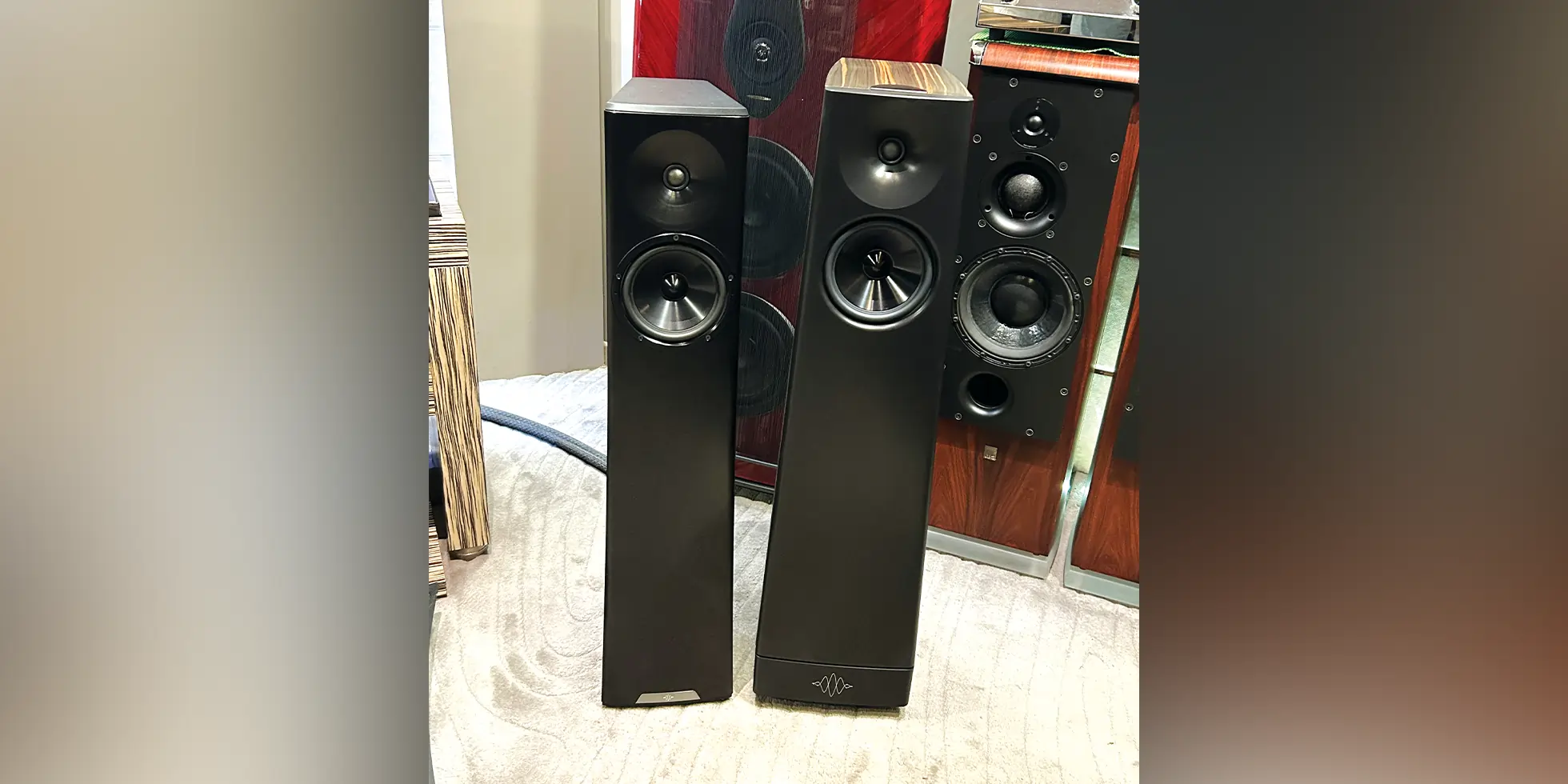
We warned you when we listened to the Ascent at Concert Home (Paris, 16th) that we would be going to Music Hall (Paris, 8th) to test a Carmel 3, as it is one of the only dealers in France and even in Europe currently in possession of YG Acoustics speakers from the Reference range. Once there, we were able to take advantage of the fact that the Tor and Talus were also there – as well as the Sonja 3.2, which we will be coming back to in a major feature on bi-amplification – to compare all these models, and more particularly the two two-way floor-standing speakers described above.
To begin the tests, we started as we did for the Ascent test with an Accuphase E-5000, but this time we were able to extend our listening upwards thanks to a couple of Accuphase C2300 preamplifier & A80 power amplifier. The source of rare clarity being the Accuphase DC-1000 DAC and the Aurender N30 SA streamer with MC10 external clock, we never went back to it. But to develop our tests and move towards more American sounds, we incorporated the McIntosh MA8950 and MA12000 integrated amplifiers at the end.
The sound
With the Ascent, we heard and therefore described the majority of YG’s characteristics and more particularly those of the Peak range, which we found again with the Talus: less present in the bass range since it loses a driver dedicated to this register, but more open than the Tor bookshelf and therefore better suited to a room of more than 25 m², this column immediately shows itself to be very refined and very neutral. From the very first seconds, the sound is reminiscent of the speaker’s closed-load technology, which can be disturbing for some listeners, as it takes a while for the impression of wave control to make the brain realize that it can nevertheless enjoy what it hears. Once these sensations have been released, all the registers extend without the slightest conflict across a well-developed soundstage, equally suited to rock and classical music.
As far as tonal balance is concerned, the neutrality already seems perfect on the Talus, but the phase management and phase slope further improved on the Carmel 3 demonstrate that YG’s engineers are always capable of going further. And if we knew from listening to the XV 3 Signature in Munich that they can achieve a mind-blowing level of precision, it is a pretty similar sensation that we get from listening to the Carmel 3. Although it is the first model in the range, it does the Reference series proud with its impeccable purity and even more neutral tones, although the midrange and treble lighten up a little, as they become more flexible thanks to the aluminum diaphragms and some of the most perfect crossover currently designed in the world. This flexibility, which is even greater than that of the Talus, becomes even greater as you move up the amplification range, with the connection to McIntosh amplifiers creating more bulk and therefore a little less precision, for a more rounded listening experience, to be chosen according to your hearing preferences. Because of its shallower depth, the Carmel 3 is more directive than the Talus and seems better suited to rooms between 20 and 35m², with the three-way Vantage 3 then taking over.
The Carmel 3 comes with two terminals as standard, but you can ask for four to bi-amplify it, which is what we did, integrating the A80 for the highs and the A300 Accuphase blocks for the mid-bass. Even more refined, the music once again managed to gain in clarity and fluidity, with even freer filters once they were no longer called upon to separate frequencies, but only to send those expected autonomously to the BilletCore membrane and Lattice tweeter. This gain also favored aeration, and therefore better placement of the elements in the soundstage. The voices of the best recordings (Kaufmann in the Wesendonck Lieder, for example) appear with even more relief and realism, as well as being more fleshy.
Our conclusion
From the small compact Cairn in the Peak series onwards, YG Acoustics speakers can be considered true luxury products. They are clearly very high-fidelity models, whose build quality and modelling offer some of the purest sound on the market. At 20 990 €, the Talus is not for everyone, but it has all the features of a YG floor-standing speaker, built into a wooden cabinet that is easy to install in almost any room and any style of furniture.
Even more ultimate, the Carmel 3 offers an all-aluminum design, developed primarily for music and high-fidelity passionate listeners, with a purity that is as perfect in terms of phase management as it is in terms of the reproduction of all tones, thanks to the two aluminum drivers. Magnificent, this remarkable object is nevertheless reserved for a handful of enthusiasts, starting at 39 990 €.
Where do you come from? I was born in Grenoble in 1979. My father was a sociology teacher and my mother a communications teacher.
So, there’s no connection with music? No. I lost my father very early on, but I inherited a guitar, and my mother played the piano as an amateur. There was a piano at home and we had a vinyl turntable.
What were your LPs? My parents used to listen to Here comes the Sun by the Beatles on the turntable. That’s pretty much the first memory I have of music. I used to play that record repeatedly. I must have been three or four years old. And my mother sang in the choir. In fact, she still does.
Did you ever play an instrument? I played the saxophone for two or three years as a kid. Then I quickly took up the guitar, self-taught. In fact, I’m still self-taught. When I was a teenager, I started a band and my relationship with music just grew and grew.
What did you like at the time, metal, rock? I’m from the 90s generation. So, Nirvana, Guns N’Roses and Slash’s solos that I’m trying to redo. But also Led Zeppelin, AC/DC, Eric Clapton, The Cure… It was also the advent of trip hop and techno with Daft Punk’s album Homework. And I suddenly realized that you could make sound with a computer, create a studio entirely at home and that the possibilities were limitless, which was not at all the case before. That’s what made me take the plunge in the early 2000s.
Is it true that you were destined for a career as a basketball player and then had an accident at a Body Count concert? I wanted to be a sportsman; it was a very strong desire. I played at a good level, but I could never have made it to the NBA, which was my dream. I herniated a disc quite early on in high school. But during a Body Count concert, there was a lot of banging and slamming and a guy fell on me from behind. It was like ‘Crack’, and a week later I was completely stuck. Then I dragged it out for several years and I still have the after-effects. It’s not operable, I’m a bit fragile, but I’m not handicapped in any way. And I’m very sporty now.
What are you doing after your A-levels? I’m studying sociology, following in my father’s footsteps, and I’m stopping my degree to devote myself to music. I’m not ready, but I’m convinced that my life has to be music and that you have to suffer and go through some difficult stages to succeed. Obviously, everyone around me advises me to continue my studies and do music on the side. But I firmly believe that you must go for it, learn, progress, find your identity, meet people. And get yourself into a bit of trouble, too. I’ve got a DEUG in social studies and a DEUG in psychology, but I don’t really have a parachute.
Are you still playing guitar or are you already into electro music? I’m still into guitar, but I’m a lousy guitarist. At the time, I was making demos and getting labels to listen to things they couldn’t hear. I’d turn up with my CD-Rs burnt and no one would be interested. And then I worked on the side, doing odd jobs.
Do you live in Paris? In the 18ᵉ. I tend to make soft music, a bit soothing, like Pink Floyd, Air, trip hop. I dabble, I tinker.
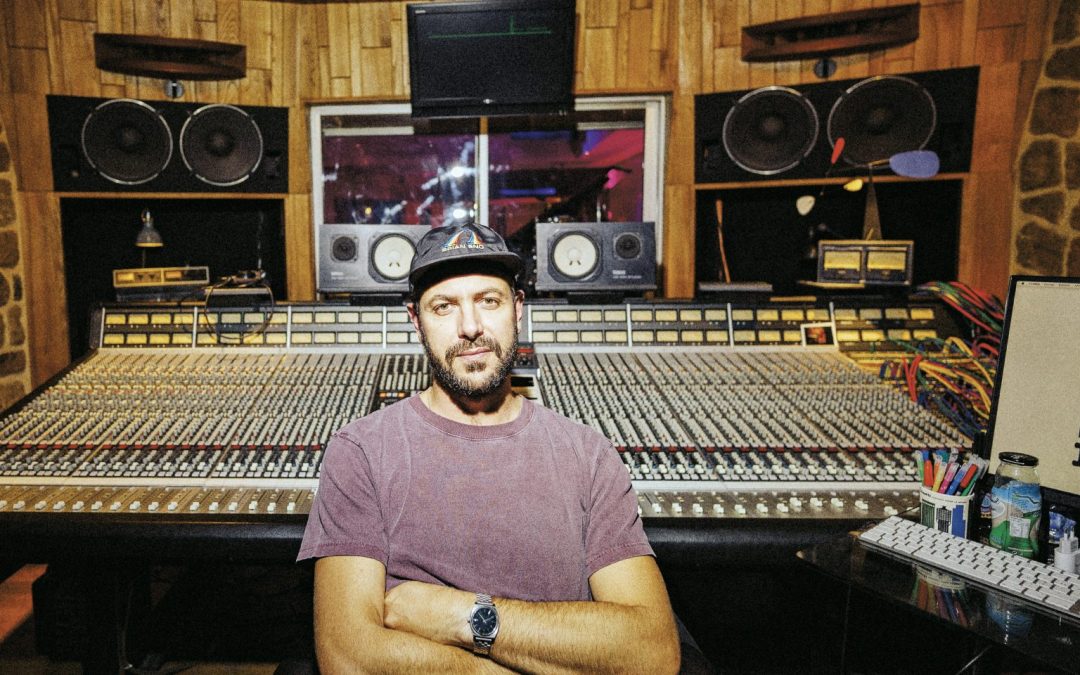
Do you already have any machines? Every Christmas, I try to buy something new. When I started out, I mainly had a computer with a sound card. I’ve got small speakers, Yamaha NS 10s and a master keyboard, which lets me control the sounds. And my guitar! I was also taking Indian sitar lessons at the time.
What do you do for a living? I work as a salesman in Pigalle, in a synth shop called Piano Show. I also gave music lessons, and then I started doing small concerts with my punk-electro band, Plan Nine from outer Space, the title of a bad Ed Wood film. During a concert at the Réservoir in Paris, an artist called Zad came up to me and introduced me to his manager, Ali, who looks after the group Saïan Supa Crew. That was the trigger. So, in 2005, I produced Zad’s album. A year later, I signed my first album, distributed by Pias, with my first concert and my first collaborations. I started working, producing, arranging, remixing, making instrumentals… I set up my own little label, a small structure, an association and a small techno shift took place. So, I started accumulating equipment: old analogue synths, drum machines, processing peripherals, amplifiers, compressors, slightly better speakers, ATCs, then Genelec. I tinker with them myself and learn from the people I meet. When I work for artists, I end up in big studios, working with well-known sound engineers.
Do you know that you’re on the right track? I never question my choice, but I have doubts and questions every day, every second even. My first album was not well received by the press. I started to lay the foundations and then it built up over time. But in the early 2000s, I already had this dream of setting off to sea, with my machines, a computer and my instruments. It’s a kind of dream to say to myself that I’m going to make music on a boat, to go towards that horizon.
Where does this dream come from? From a desire that wasn’t at all conscious or intellectualized. At the time, I loved sailing, being at sea. After my first few albums, I started talking to my manager about this desire. And then there was a turning point in 2011. I no longer had a manager; I stopped touring with the band I’d set up to play my albums live and I set about putting this project together. I’ve also just become a father. And I’m leaving in 2013…
Was the decision to leave also a way of testing yourself physically, of creating while suffering? I wouldn’t use the word suffering; I have more of a romantic vision of the artist who creates in difficulty. Basically, it’s this instinctive desire to create in the middle of the ocean. But I realize that it’s hard to spend five weeks on a boat.
Where were you? It was a fishing boat leaving from Saint-Malo. But during a fishing campaign, you know when you’re leaving, but you don’t know when you’re coming back. It was a big boat, with 50 sailors on board, and I recreated a studio in a small cabin, with all my instruments.
Were those five weeks at sea a revelation? It’s like something clicked, I’m where I need to be. And I tell myself that from now on, everything will be like that! I was scared, I cried and now I’m back with an album, 62 et 43 Nord, after those five weeks fishing for sounds. I’m defending it on stage, and I’m also coming back with some images, because when we were away, we’d managed to finance it so we could do a Thalassa. So, I’m bringing out a book, a sort of travel diary with lots of photos and the record inside.
Did the public follow? Thalassa made a big impact. The book was a hit, and we did our first concert at the Gaîté Lyrique in 360, for a digital art festival. It was a turning point in my career, everything started to fall into place at that point. And then I did the Transmusicales in Rennes, I signed with Pedro Winter and the media took an interest in me. Suddenly, I was on the move, going to Greenland, Nazaré, Portugal, Quebec…
I heard that you wanted to record silence. I wanted to work on silence when I got back from my boat trip, a very intense experience in terms of volume for my tired ears. I was reading a book by John Cage about silence, and I thought I’d like to go out into the cold, to Greenland in the middle of winter, with my microphones and all my synths. I’d been at sea for 34 days and I went to Greenland for five weeks. I rented a small hunter’s cottage in an Inuit village. I had five weeks to create an album entirely on the spot, with recordings of silence. It’s a bit mystical, but even when there’s nothing there, you can still hear, a very muffled, very high-pitched frequency.
Did you put contact microphones in the material, in the ice floe, to ‘hear’ this ice floe? Yes, and you can hear all kinds of sounds. I had a bit more specialized equipment, because I started working with the Sennheiser brand of microphones and one of their sound engineers. I’m also getting into binaural recording, with these little microphones that record what the ears hear. So, I recorded Le silence de la banquise and composed the album on location.
Has it been well received? I’ve had great promotion, I’ve been on TV, I’ve done some great concerts, I’ve toured for two years just about everywhere, in Texas, Japan, Moscow, Mexico…
Is there an ecological approach to what you’re doing? It’s not a militant project; I’m not going to Greenland to talk about global warming. I have my political convictions, but I keep them to myself. But these projects are about awareness and respect. As for me, through these projects I’m trying to reconnect, to re-establish a link I’ve lost with nature and the elements.
Is that why you moved to Brittany? I lived in Paris for twenty years and I wanted something different, to get closer to the sea, which is something I can’t live without. I had the opportunity to do so, so we left with my family.
After Greenland, there’s the giant wave project in Nazaré, Portugal? It’s a slightly different project because I didn’t write the whole album on the wave at Nazaré, because of the noise of the jet ski engine. It’s a collective project with a real collaboration with surfers. With Sennheiser, we worked for hours on prototypes beforehand and put microphones, binaural, in the surfers’ ears, on the boards, on a drone…. It’s a pretty fun project where I had the fright of my life. And I made the album in the process, in Biarritz, in front of the sea.
What are your latest projects? In 2021, I did something in Tévennec, in a haunted lighthouse at the end of the Pointe-du-Raz. I also worked on the Vendée Globe, where I put sixteen microphones on a boat and thirteen cameras, with a film about to be released. And I made my last album in Jamaica. I wanted to do a studio album, to get a bit of warmth and energy, before getting back to solo work.
What is the concept behind RE-201, the album you recorded in Jamaica? It’s a parenthesis in my adventures, not a turning point. I wanted to pay tribute to sound wizards like Lee Scratch Perry and King Tuby. When I record the silence in Greenland and I manipulate the sound to create the sonic carpet of a composition, I use what the masters and wizards of Jamaican dub have put in place. I use sound as a material that can be sculpted, that is malleable. In Jamaica, I worked with the singers who rocked my teenage years. And I realized that it wasn’t necessarily any easier than being on a boat in the middle of a storm.
There are several collaborations on the album. There’s a track with Étienne de Crécy, another with Hubert Boombasss (co-founder of Cassius, NDR) and lastly a track with Falcon, legendary artists of the French Touch. I really wanted to mix these two influences, reggae and French Touch. We worked with Alex Gopher, and then I mixed the album with Julien Delfaud.
You’re also resident DJ at Rex Club. Yes, I do two sets a year. My last date was last April. I did an All Night Long and mixed from midnight to 6am. My next date will be in the autumn.
We haven’t talked about your project with an artificial intelligence, in 2022. I was introduced to a new technology that basically allows you to send orders by looking at people. I used it to create an instrument, J.I.L., which can be played solely by looking at you, and whose sound is modulated in real time by your brain activity. It’s an instrument that sends out sound all the time. There are no notes, it’s a constant vibration, which is different for each user, and which is very sensitive to mood.
Among your adventures in somewhat hostile environments, there’s always the project of diving into the abyss, the Mariana Trench in the Philippines, at a depth of 11,000 meters? Absolutely, I’m working on it. But I’ve got into the habit of never talking about my projects because they’re long and tedious to put in place, and often depend on numerous authorizations and funding…
You played your first Olympia last February. What was that like? It was magical! I’m proud to have been able to enjoy the moment. It’s a venue that gives you incredible energy, it was beautiful and powerful. On this tour, I’ll be doing virtually nothing but the latest album, with a few nods to my past adventures. I’ve still got dates in June in Sète, then I’ll be at Les Vieilles Charrues, Le Cabaret Vert… There are about fifteen dates to come.
Why the name Molécule? I wanted a name that expressed the essence of things, the universality. It was soft, round, phonetically speaking. It was at a time when I was making quite soft music, like little lullabies. And now, with the somewhat techno-technological side of my projects and the techniques I use, it also fits in with my research side.
Can we talk about equipment? I started out with a pair of NS 10s for the studio and at home I had a little Aïwa system. When I was young, I was very into Walkmans, I had a little Sony Walkman. In fact, I’d like to buy another one and you can find some on Le Bon Coin. I bought a second-hand cassette player, with a nice VU meter, and I’ve brought out all my old cassettes. I have a Denon system, with a Technics MK2 turntable. For a long time, I had a Tivoli Audio, which is nice, but I don’t think it’s great in terms of sound quality. And now in my studio, I have ATC SMC 20s as well as my NS 10s and Genelecs, with four speakers for spatialized sound. At home, I have a Focal speaker system and a small subwoofer in the corner. The next step is to buy some old JBLs for my living room.
You listen to audio cassettes, but do you still listen to vinyl? Of course I do! I’m not really into current affairs. I listen to my collection of Pink Floyd, Rolling Stones, a lot of classical music, ambient, reggae… I must have 400 records. But I don’t necessarily listen to electro or the music I make. When I stream, I’m on Apple, and I listen to music absolutely every day.
At the end of the 70s, Marc Cerrone was considered – along with the American Nile Rodgers and the German Giorgio Moroder – to be one of the popes of disco, a musical movement born in the clubs that swept the world. More than half a century later, Cerrone is still with us. His hits, Supernature, Love in C Minor, Give me Love and Summer Lovin’ are standards, and have been sampled by Daft Punk, Cypress Hill, Public Enemy, the Beastie Boys and Run-DMC, remixed by every DJ in the world, including Bob Sinclar, and immortalized in film soundtracks, notably Gaspar Noé’s Climax. But Marc Cerrone has had more than one life and has constantly reinvented himself. Owner of a chain of record shops, drummer, composer, producer, film scriptwriter, writer, he is now a painter, DJ… And last October he released a new album, Cerrone by Cerrone, in which he revisits sixteen of his greatest hits.
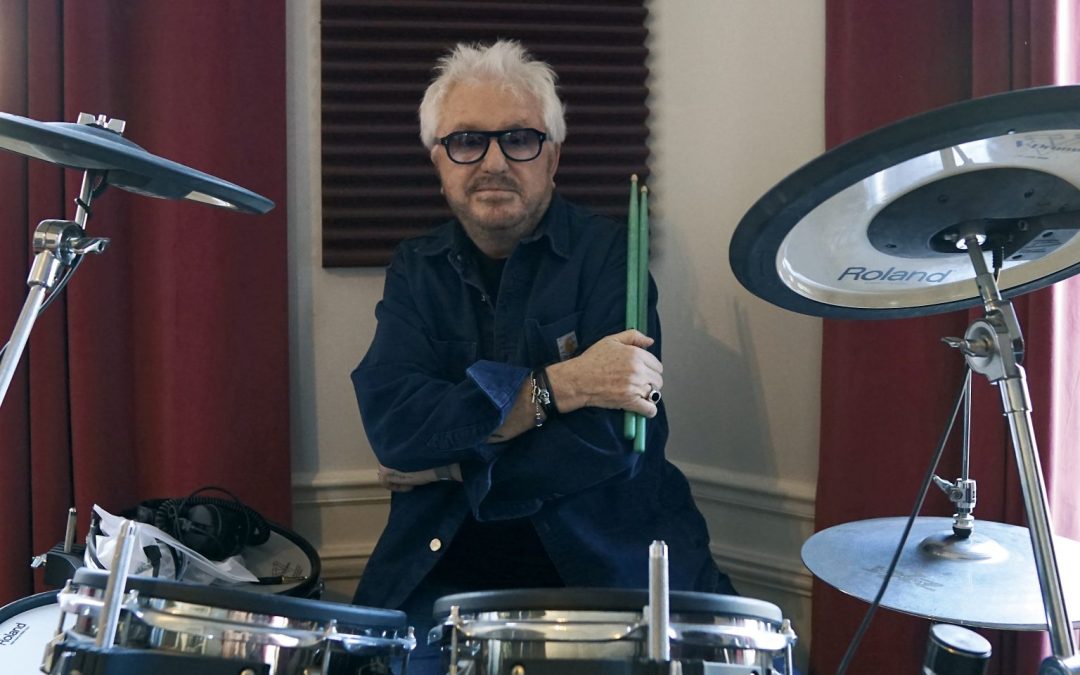
For VUmètre, Marc Cerrone opened the doors of his huge Parisian studio apartment to us. On the walls of the living room are his colorful paintings, his many gold discs, awards, photos with Nile Rodgers or the Dalai Lama, and of course, in a huge room, his sumptuous drum kit and a mixing console. Interview.
Do you remember the first sound you heard? The drums! I took up music by accident. I was a rambunctious kid, so you know the story…
To channel your energy and your emotions, your mother gave you a set of drums, even though you were permanently expelled from school. I was twelve. My mother promised me a drum kit, but even before she gave it to me, I was listening to the radio and concentrating on the drums, not the vocals. I listened to what the drummers were doing and it really got into my head. I kept practicing with my legs, without drums of course, to loosen up my limbs, because you must loosen up your limbs to play this instrument. Then my mother finally took me to the shop. When I sat down at the drum kit, I picked up the sticks. I started to make a rhythm. The shop assistant was flabbergasted: ‘But your son can play!
A long love affair began… As soon as I got my drums, I spent all my time on them. In the end, my mother didn’t just give me an instrument I hadn’t thought of, she gave me my best friend.
What were your musical tastes when you were a teenager? My first concert was Jimi Hendrix at L’Olympia. I was 15. I wanted to bang like his drummer (Buddy Miles). Then I saw Carlos Santana, jazz drummer Billy Cobhan, Yes, Deep Purple, Jimmy Page (Led Zeppelin guitarist), who I became friends with and who played on my fourth album.
When did you start forming bands? When I was thirteen. At fourteen, I had a great coastline in the Paris region, I left school, and at sixteen, things started to get serious. I went on to form several bands, and then I became artistic director and producer for Club Med. I set up bands for the holiday villages, I hired 20 bass players, 20 drummers, 20 keyboards, I chose the repertoires… I wasn’t even 18 and I had falsified my papers because I wasn’t of age. I’d left school at 15. I didn’t want to be famous; I just loved this instrument. Even when I wasn’t playing drums, I was tapping my thighs (he starts tapping in rhythm).
How long did you stay at Club Med? I did three seasons, and it was a big hit. I selected the best musicians and soon I said to myself that I was going to set up my own group. So, I financed my group by selecting the best musicians for Kongas. I finished my season for Club Med in March 72. We rehearsed in April, May and June. I met two talented percussionists and there were six of us. The group was ready by the end of June, we were good, and I told myself that I would find an agent in two months. In the summer, I set off to do the rounds with my drums in the port of Saint-Tropez. I’d play between 7 and 9pm and my girlfriend would come along in a bowler hat. It really worked, and one evening Eddie Barclay came by. He came back the next day and the day after that. He put a note in my girlfriend’s hat: ‘Come and join me at the restaurant when you’ve finished. Barclay was a VERY important person at the time. I took the drums apart and went to find him. He told me I had to put a band together and invited me to lunch the next day at his estate. I told him I already had a band and offered to audition at the Papagayo. A week later, my musicians met me in Saint-Tropez and we had a big hit at the Papagayo. We stayed there until the end of August. There were queues every night and Kongas and I were a big hit. At the end of August, I signed a contract with Eddie Barclay. In November, we released our first single, and boom, first hit. I haven’t stopped since.
What was your style of music with Kongas? It was afro rock. We all composed together. We released albums, played in the United States and Japan, and did 250 galas a year… It was a heavy burden, and I had a child. Then I got the feeling that we were reaching a plateau, that we weren’t going any further. And I was ambitious…
So you stopped working at Kongas? In December 1975, I opened a shop at Vitry-sur-Seine station. I lived there and my father was a shoemaker in Vitry. I took over his business and had the windows painted red, with lights behind them. The records were on wooden pallets, and I played the music very loudly, which was really new at the time. Above all, I came up with the idea of offering free credit for six months – it was the first time this had been done. I paid the 2% to Cetelem and the guys bought me huge quantities of records; instead of one LP, they’d buy 20, which they’d pay off in six months. It was an instant success! I bought my records via a wholesaler and set up an Import Music shop in Belle Épine. I had 400 m2 and I was a huge success, and within a few months I had the best return per square meter. I was approached by all the shopping centers and I opened other Import Music shops: Vélizy, Parly 2, Rosny… People would meet up in my shops and listen to music. I wanted people to find things in my shops that they couldn’t find anywhere else: an LP of jazz, funk… If you couldn’t find it at Import Music, you just couldn’t find it anywhere else! In a year and a half, I ended up with a chain of shops.
And yet you’re going to go back to music. I missed music too much and I decided to make an album, Love in C Minor, thinking that I would sell 12 of them in my shops. But as an import record salesman, I quickly sense that something is happening in the United States, that a movement is coming… I know how to get people moving with a very simple but effective drum beat (he taps in rhythm with his foot, NDR). I find a bass gimmick, On Broadway, by George Benson (he sings, NDR). I get help from Alex Constandinos, who writes all the lyrics for Kongas. He suggested I go to Trident where Peter Gabriel and Elton John were recording. We managed to rent the studio for three weeks. I arrived and had my drums set up very far forward, but it seemed logical because I’m a drummer. There are two Eratons, two square wooden speakers. And I start to get annoyed, and I ask for two sound columns. I had the drums dismantled so that all I had was the bass drum and the stand. I spent all day on it. The next day, I recorded only the snare drum. And so on. I’ve got a good arranger, I want Barry White-style strings, horns that sound like they’re in Chicago… And above all, there are no synths, everything is live! I got the best backing singers to sing just ‘Love me, love me’ for twenty minutes. Between takes, I play ping-pong with Phil Collins, Peter Gabriel or Elton. Then, one evening, I invited everyone to listen to the song, with glasses of champagne. We listened very loudly, and soon the girls were moaning to the music. We recorded them and mixed them into the song, which is 16 minutes 30.
But a single was three or four minutes long at the time. I wasn’t looking to please anyone but to please myself, I wanted to compose a soundtrack. The record companies all turned me down. I called the director of Trident and he advised me to press vinyl. But I had to press 5,000, and 5,000 was far too many! I needed a label, so I set up my own label, Alligator. And the 5,000 records sold like hotcakes. I didn’t calculate anything, everything just happened naturally.
What were your requirements in terms of sound? In my head, I didn’t want to become a famous guy. But I really wanted to make a demo record for people who had a good hi-fi system. There were very few quality records to show off to your friends. But if you put Love in C Minor in your living room, on your Hi-Fi, you’d get an earful. That’s why I surrounded myself with top people, like Peter Gabriel’s sound engineer. I tweaked all the sounds. That’s why we’re still listening to it 50 years later. There must have been 40,000 remixes, but when it comes to sound, come on, guys! I never set out to make hits, although I did make about twenty of them…
By chance, a box of your records was sent to the United States, and the track was an instant hit in record stores and on the radio. With Love in C Minor, American producers were looking everywhere to sign me. I went to Atlantic and signed. And the founder, Ahmet Ertegün (author, talent scout and legendary producer, NDR), who had me at heart, managed me for seven years. He taught me the business because I didn’t know anything about it. He wanted me to live in the USA and put me on a black label, alongside Quincy Jones, Ray Charles, the Jackson 5, Prince, Earth, Wind and Fire and Nile Rodgers, who would become one of my best friends. They were all so strong, I didn’t want to, but Ahmet insisted…
You then became a huge star. With Love in C Minor, my career took off. I couldn’t look after the shops anymore, so I sold them to the wholesaler I was associated with. He turned it into Nuggets and there were 50 shops, which were taken over by FNAC. If my career hadn’t taken off, I’d probably have set up a Darty record store. I had a head for business! Then I moved to California, my children went to school there and I was completely integrated. Atlantic called my music ‘French Sound’, long before the French Touch… For my second album, Cerrone’s Paradise, I fucked up the sound even more, even though I didn’t have enough equipment in the studio. For my third album, ARP sent me an Odyssey ARP, one of the first synthesizers. I didn’t even know what it was! I discovered electro and wrote Supernature. When I gave him the record, Ahmet Ertegün was dubious because I already had a sound. I suggested releasing the album in France and pressing 2,000 vinyl records to try it out. That’s what I did, without any B-sides, and it was another big hit. I produced La Toya Jackson, I did concerts with Earth, Wind and Fire… In 1979, I spent my evenings at Studio 54, in New York, in the VIP room with Andy Warhol, Jean Paul Gaultier, Jean-Michel Basquiat, Jean-Paul Goude… We were the enfants terribles, each in our own artistic field. We inspired everyone with our textures, fashion and colors. I sold millions of records.
Did you play your music at the legendary Studio 54? Are you kidding? I play at 54 all the time, I’m at home there. As soon as I arrive, they put me in the VIP room with Diana Ross or Grace Jones. We’re not part of the establishment; we’re ultra-hip provocateurs.
You became the ‘Pope of Disco’. With Giorgio Moroder and Nile Rodgers, we made music for discos. At the time, a record was a success if it was played on the radio. I didn’t want to get on the radio with my 20-minute songs. I wanted to sell records through the disco buzz.
Are you in competition with Giorgio Moroder or Nile Rodgers? Not at all. We’re record producers, so we’re in the same frame of mind. But Giorgio is more into pop, with his songs sublimely sung by Donna Summer. In fact, we’ve never crossed paths, except five years ago. As for Nile, he’s a mate of mine, and we were talking only three days ago. We’ve done concerts together, and even a jazz festival in Montreux, with Quincy Jones applauding us. They’re like family, I learnt the trade with them.
Let’s talk about equipment. They kept offering me new equipment. Dual preamps, Kenwood… In the studio, I always had the best. The best engineer, the best gear. Today, in the studio, I use Mackie. It’s a bit flattering in the midrange, but it’s still faithful, and I’ve been working with Mackie for twenty years. For 50 years, I’ve always had a home studio, with a sound engineer, even when I’m not working, because I’m recording all the time. I must. I have Sonos at home. I live in the south of France, in Ramatuelle, and I have a big set-up that sounds very loud. I like the idea that I can listen at any level and hear everything. I don’t like it when I change levels and all of a sudden, the bass goes back, or the guitars go forward or something gets saturated. With Sonos, it’s perfect. In the morning, I listen to American radio, jazz and hip hop, and the sound is always great.
The years have gone by and you’ve never stopped making music. The drums are still my best friend, and I still play them every day. I released an album, Cerrone by Cerrone, last October. It’s a live album, a one hour and one minute set that goes on and on, 16 tracks on which I have fun. On Give me Love, I used the horns from Je suis musique.
I have the impression that certain drum parts have been redone. All of them, absolutely all of them! Like the vocals. I don’t play the same way anymore, I ‘dance’…
You’ve also started a career as a DJ. Eight years ago, Emmanuel de Buretel, who founded Because Music, advised me to take over the turntables and do festivals. But for me, that’s almost an insult. I’ve got nothing against DJs, on the contrary, but I thought they weren’t for me. I try not to be too stupid, and I think about it, I talk to my son who’s a DJ, to some DJ friends. And I told them about my project, to play my tracks exclusively as DJs. Everyone pushed me! So, I started out with a little Ableton console, which I filled with samples. As I own my own label, I have all my masters, over 500 tracks, the guitars of Nile Rodgers, Jim Page, the horns of the group Chicago… It’s an insane library of sounds, a veritable Ali Baba’s cave. I send out a cappella with my Ableton and I produce music live, on my own tracks. I mix them up. And I really enjoy it, and it’s a big hit! I do sets in front of 25, 30 or 40,000 people, young people. They all know my repertoire and they come to listen to music that will thrill them, that they can let loose to. And I like that because it’s a performance. For years, the DJs thanked me because I had opened the doors, because they were considered artists thanks to me… Today, thanks to them, I do about thirty dates a year. But I don’t want to do any more than that: Seoul, Georgia at the end of December, often in London, Spain, Japan, the USA…
You have the word ‘Liberté’ inked on your skin. Why is that? I have quite a few tattoos. In my life, I’ve done everything outside the system. I’m a real influencer, but above all, I’ve always been free.
Marc Cerrone, the Life
24 May 1952: Marc Cerrone is born, the son of Italian immigrants who fled fascism. 1966: he left school and formed his first group. 1972: He forms Kongas, an Afro-rock group, and releases his first single, Anikana-O. 1976: He produced his first album in London, Love in C Minor, which won a Grammy Award. He was signed to the Atlantic label in the United States. 1977: He released two albums in a row, Cerrone’s Paradise and Supernature, which sold eight million copies. The song Supernature quickly became one of the great disco anthems. 1982: He published his first crime novel, Le Rat, followed by Névrose. He also wrote Dancing Machine, which was made into a film starring Alain Delon. 1989: Concert for the bicentenary of the French Revolution at the Concorde in front of 600,000 spectators. 2001: Release of the album Cerrone by Bob Sinclar. 2005: He signs the soundtrack for the Cirque d’hiver adaptation of Orange mécanique. 2014: He begins a career as a DJ. 2022: Release of the album Cerrone by Cerrone
With the rise of streaming and dematerialised sources, the Ethernet network is becoming a conveyor belt for audio content in its own right. Offering a higher and, above all, more stable data rate than Wi-Fi, it is even the preferred medium for the transit of latest-generation Hi-Res digital audio streams, which require a lot of network bandwidth. However, to take full advantage of Ethernet’s capabilities, you still need high-quality cabling. Welcome the Audioquest Ethernet Series!
Like analogue audio signals, digital streams can suffer degradation as they travel through the installation’s cabling. Although they are less ‘fragile’ than analogue signals, certain phenomena can affect their quality and, consequently, the quality of the sound reproduction. The appearance of jitter, among other things, or latency, can lead to inaccuracies during the digital/analogue conversion carried out by the playback equipment: DAC, network player, etc. These disturbances can lead to an increase in the rate of distortion or undesirable conversion artefacts.
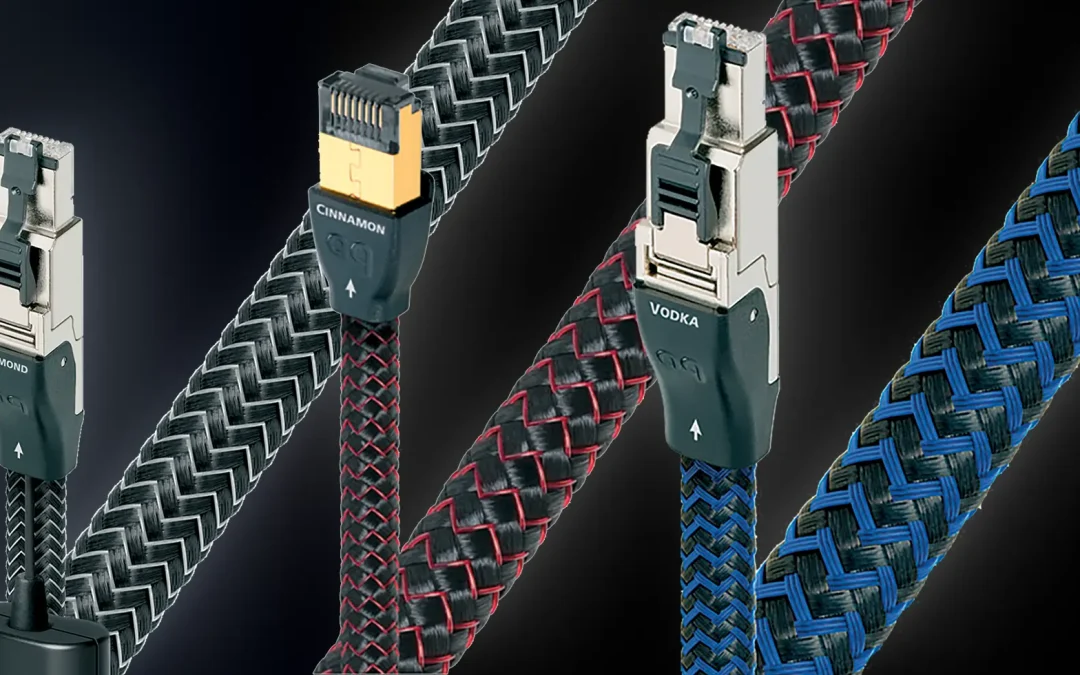
So Audioquest naturally put its expertise at the service of digital links, including network cabling. Very early on, the American brand realised that the quality of a cable was linked not only to that of the conductive materials used, but also to their arrangement within the cable, the insulation and its overall sheathing. The Ethernet cables offered by the brand take these observations into account. We looked at three models here: the Cinnamon, the Vodka and the Diamond.
Despite its low price, the Cinnamon is all about quality and rigorous selection of the materials it uses. It is based on solid 1.25% silver conductors. This choice eliminates the interaction between strands, a major source of distortion. Insulation is also provided by high-density polyethylene. This material guarantees the geometry of the signal pairs. Finally, arrows indicate the direction, source to destination, to be respected when cabling the installation for optimum quality of digital flow. The cable is available in six lengths, from 0.75 m to 12 m, at prices ranging from €99 to €389.
The Vodka is based on the Cinnamon, but uses 10% solid silver conductors.
It also features high-density polyethylene insulation and direction-of-use markings. In addition, shielding based on a triple carbon layer combined with metal-loaded synthetics form a shielding screen that protects the conductors and prevents most of the radio fog in which we live from reaching the ground plane of the equipment. Like its predecessor, this cable is available in six lengths, from 0.75 m to 12 m, at prices ranging from €449 to €2,349.
Finally, the Diamond is the most prestigious cable in this family. Based on 100% solid silver conductors, it delivers unprecedented clarity and dynamic contrast. It also features a dielectric polarisation system. Any insulating jacket slows down the signal inside the conductor. If the insulator is unpolarised, this slowdown is heterogeneous, varying from one conductor to another. This is a major problem for multi-octave audio, which is highly sensitive to time shifts. AudioQuest’s DBS creates a strong and stable electrostatic field, derived from a battery, which saturates, restructures and polarises the molecules of the insulator. This minimises both the energy stored in the insulator and the multiple non-linear delays that occur. The result is dynamic contrast and unexpected detail. DBS batteries provide years of autonomy. A test button and indicator allow the battery to be checked occasionally. As before, this cable is available in six lengths, from 0.75 m to 12 m, at prices ranging from €999 to €10,999.
The set up
We connected these cables in several places in the system, i.e. between the box and the switch, and between the switch and the various connected sources. Our various tests lead us to believe that if you have to favour one link over the others, give priority to the one between the box and the switch.
The sound
For a long time now, we’ve been noticing that improvements in Ethernet cords were making an obvious difference to the quality of music streaming. We’ve tested a number of models, all of which generally respect the brand’s personality. So far, no surprises. A comparison of the American manufacturer’s three models confirms the gradual gradation in performance as you move up the range. So there’s nothing mysterious here, just logic. The first model makes an impressive difference compared to a lambda cord. The bandwidth is wider, with the extremes of the sound spectrum much better defined and more extended. Focusing is better, giving the soundstage the opportunity to reveal itself to you with greater acuity. And above all, the quality of the timbres tends towards a much more natural listening experience. By switching to the Vodka model, you gain in listening comfort, a bit like upgrading from a small sports car to a powerful saloon. Overall, the basic qualities of the first model are still present, but much more assertive. The bass is denser, the treble brighter and the midrange more structured, with greater density of timbre. The image is vaster, with better punctuality of sound sources.
The perception offered by the Diamond is mainly characterised by sonic refinement. At this stage, the level of detail, and above all the quality of timbre, rises significantly. What could legitimately be considered excellent at the previous level is here adorned with a touch of delicacy that offers recorded music a higher degree of sensitivity. This is clearly evident in the rendering of ambiences, which at times become astonishingly credible.
Our conclusion
It makes sense to buy a quality Ethernet cable for a streaming music system. And the American manufacturer’s range is wide enough to satisfy you. The real question is which model to choose. And our comparison of the day is extremely instructive in this respect. Our recommendation is simple. We recommend that you base the quality of the cord on the quality of your system. Never has this rule been more true than in this context. Cinnamon is a tried and tested product that offers extremely attractive value for money. You can rely on it in all circumstances to make music more authentic and enjoyable. We strongly recommend it for all entry-level systems. And we’ll keep it successfully up to a very respectable level. The day you feel you’ve reached its limits, the switch to Vodka will come naturally. It will offer you a fuller, more dynamic vision of networked music. The Vodka can already be part of a top-of-the-range system without restricting it. As for the Diamond, it’s by far the best performer. However, you’ll only be able to hear it fully on an excellent system.
To sum up, buy a Cinnamon as soon as you can. Progress to the Vodka whenever possible, even if it means mixing the two models and placing them where they make the difference (which is what we did, with good results), and finally, go for a Diamond if you’re lucky enough to have a very top-of-the-range system and the budget to go with it…