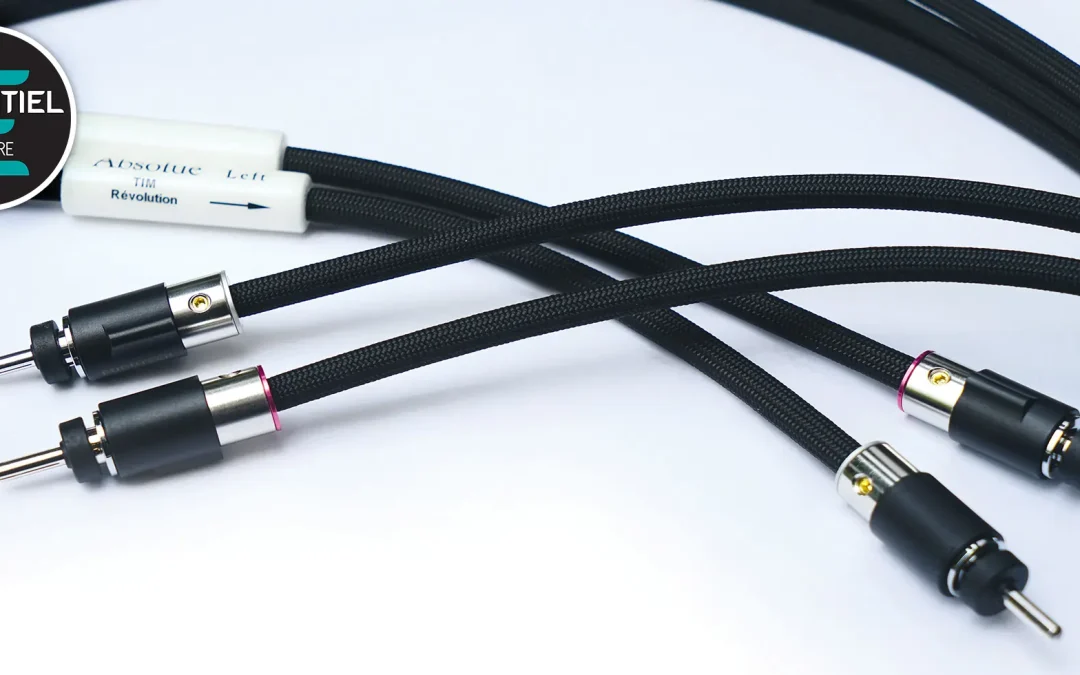
In our last issue, we gave you a sneak preview of the new generation of Absolue Creations cables. A far cry from the usual performance delivered by the big names in the market, we’re very pleasantly impressed by the naturalness of the new Absolue Creations Tim Power 2! Read all about it here!
Cables have a long history. We know perfectly well today that they are an absolutely essential link in a quality installation. To put it bluntly, a good system is not just about a good source, a good amp and a good pair of speakers. You also need good stands and cables. If you talk to a cyclist, they’ll tell you that it’s unreasonable to put the whole budget into the bike. You need to set aside part of it for shoes, clothing and accessories, so that you’re comfortable when you’re practising your favourite sport. But our elders in audiophily, the very first, the pioneers, didn’t see it that way. What’s more, since cable has become a juicy market where the best rubs shoulders with the worst, you have to be extremely careful. So yes, you need to invest part of your budget in good cables, without going overboard either. As well as the big international brands that are regularly imported, we are fortunate in France to have some good manufacturers, such as Actinote, Esprit, Hi-Fi Câbles et Cie, and of course Absolue Créations, to name but a few.
We all know them intimately, and we know the efforts they make to compete with, and even surpass, the big names in the market. In this respect, we’ve been very impressed by Absolue Créations’ latest deliveries. For some years now, Alain Yzembar’s brand has been developing and producing marvellous connections.
At the time of writing, the catalogue will have been completely redesigned, with new product lines, with the exception of the Es-Tim and Op-Tim series. Within this new offering, we have selected one of the most affordable, the Tim-Revolution. In terms of price, it is more or less on a par with the old In-Tim range. But, according to its designer, in terms of performance, it is more competitive with the Ul-Tim line. So it’s good news for consumers, who will be spending less to get more… Above Tim-Revolution, you’ll find Tim-Extrem, Tim-Infiny and Tim-Absolue!
As when it was founded, the manufacturer has developed all its lines at once: « We always develop the very top of the range first; we then pass on these advances to the lower ranges. »
The entire range is manufactured. The manufacturing time for the different models varies between 3 and 11 days, after pre-routing of course. The technologies developed for these new ranges require the manufacturer to carry out 150 hours of pre-build, followed by around 20 hours after assembly. This leaves the user with just over 50 hours of running-in time at home to get the best out of the machine.
The manufacturer’s decision in this respect is a very good one. It means that end-users don’t have to monopolise their system in running-in mode for an inescapable length of time. On the contrary, this procedure has been considerably shortened, to everyone’s delight.
The interconnect cable comprises two conductors with a cross-section of 0.08 mm2. The structure has 10 strands of 0.10 mm2, for a total diameter of 2.6 mm. The type of copper is proprietary. A great deal of work has gone into the various shields. This starts with a Teflon insulator, covered by a tinned copper spiral covering it 100%, followed by a conductive carbon screen. This is followed by successive films of silk, silicone and PTFE, finally covered by a nylon braid.
For the speaker cable, the polarities are completely separate. The ‘+’ on one side, the ‘-’ on the other. Each cable has a cross-section of 2.5 mm2. It is made up of 128 strands of 0.15 mm2 with a total diameter of 3.4 mm. Here again, the type of copper is proprietary. And we find almost the same succession of insulators: PTFE, silk, silicone, PTFE, and finally nylon braid.
The entire brand uses Furutech connectors built to specifications by the Japanese manufacturer for the French designer. The major technical differences between the previous generation and this one concern the new quality of copper, the insulators, and the deployment of appropriate technology.
The set up
Of course, there is an obvious synergy between Absolue Créations, SPEC and T&T; the two Frenchmen work closely together and are users of Japanese electronics. And of course we tested this configuration. But we were also able to try the Tim-Revolution in many other combinations with great success. Wherever the notion of neutrality and fluidity is called upon, these cables will be very welcome. Being as transparent as you could wish, they can be combined with a large number of different products, revealing their intrinsic qualities.
The sound of the Absolue Creations Tim Power 2
We’re spoiled audiophiles; we live with beautiful equipment. Within this arsenal, among other series of cables, a complete Absolue Créations Ul-Tim line connects our equipment. This little preamble just to say that we know this French manufacturer’s products well, and that we know perfectly well how they work depending on the environment in which they are installed. This is important. Indeed, when the new generation Tim-Revolution arrived at VUmètre for testing a few weeks ago, it was good to have a real point of comparison, so that we could assess the increased performance of the latest products developed by Alain Yzembar. We were very comfortable with our Ul-Tim, which we found to be fluid, transparent and open; cables that know how to take a back seat to the recorded music.
Our very first contact with the Tim-Revolution wasn’t without its questions, because – and this is the point of our clarification on running-in – the new series was brand new. We could feel the potential perfectly, but the listening wasn’t totally free. This point was the subject of an intense dialogue between Absolue and ourselves. And it was agreed that we would return the new cables and pick them up later once they had been fully broken in.
I humbly admit that when they came back, the sound was noticeably better, capable of blossoming fully in the listening room. With each new generation, with each superior series, you can recognise the Absolue ‘dynamic’ by the way it disconnects itself from the electronic and/or mechanical side of sound reproduction to recreate an experience that is above all human and sensory. That’s the brand’s main sonic characteristic: freeing yourself from the material to better enjoy the immaterial! Forget the technical, and appreciate the artistic. When we switched from our Ul-Tim series to the new generation Tim-Revolution, we took a decisive step forward in our understanding of sonic fluidity. We did a number of ‘old/new’ listening comparisons and realised that there was no going back. In fact, with the new generation of cables, we’re approaching a listening experience where all the wired connections no longer seem to have the slightest sonic signature. It’s as if the cables disappear. Generally speaking, it’s the links that are heard, in spite of everything. Even the best of them usually have a perceptible signature. The best manage to get away with it, but it’s far from the norm.
The most striking thing about the Tim-Revolution is the freedom of sound in the room. The 3D effect is a real success. You can fully grasp the structure of the soundstage on each recording. It changes every time. It can be incredibly intimate or totally unbridled. You can almost see where the microphones are placed. The notion of depth of field is fully appreciated in the circumstances. On well-crafted recordings, the number of layers and strata is clearly perceptible. The relief is palpable. This sensation is wonderful. It allows the system to construct a real panorama, different for each record. It opens up new horizons. As far as tonal balance is concerned, we remain with a deliberately neutral vision of sound reproduction. No register is emphasised. Everything is perfectly in its place. The treble is wonderfully integrated. It’s luminous, of course, but no more so than that. It never spins. The bass is just as measured. It’s deep, of course, very taut, dense when it needs to be, well timbred, which is noticeable on a double bass, and always in carnal liaison with a midrange that’s soft and dense at the same time. The timbres of the Tim-Revolution are natural, and that’s absolutely what we’re looking for.
Our conclusion
We’ve waited a long time for the new generation, but we also appreciate the fact that a manufacturer gives its products a long service life. This means that the durability of our purchase is guaranteed, but also that the Absolue Creations Tim Power 2 is capable of lasting without losing performance. When the investment is substantial, this is a very reassuring point. So the new Tim-Revolutions are here to stay. And that’s good news! They’re excellent products, particularly musical, and they take a back seat to the musician’s intention. So we’ll be reserving them for systems that go in the same direction, focused solely on the musical result and not on stylistic effects. As a result, you’ll be able to get closer than ever before to the notion of presence, that little extra soul that is the hallmark of great systems.
Author: Laurent Thorin
Technical sheet: Absolue Creations Tim Power 2
Origin: France
From:
795 € for 1 m RCA interconnect cable
955 € for 1 m XLR interconnect cable
2,165 € for 2.50 m loudspeaker cable Any length from 1 m, then in 30 cm increments
Housed in a cast-iron mould that is virtually impervious to vibration, Jern’s Danish speakers incorporate two drivers, the quality of which increases as you move up the range. One of the best is the Jern 15, which offers even more finesse and, above all, fullness than its predecessors, with a bass that’s all the more impressive for the fact that this 15.5 kg speaker is only 30 cm high.
Founded in 1975 in Aars by Holger Dissing, around 100 km from Aarhus and 200 km from Copenhagen, the Danish company Dansk Skalform was subsequently sold to the children, Søren and Peter Dissing. While manufacturing complex, extremely rigid cast-iron parts for the automotive and aerospace industries, the first son, Søren, also a hi-fi enthusiast, thought one day of using this material for loudspeakers. He developed the idea with Ole Lund Christensen, a graduate of the Technical University of Denmark (DTU) with a master’s degree in chemistry, an engineer who had devoted most of his life to research into improving hi-fi technologies.
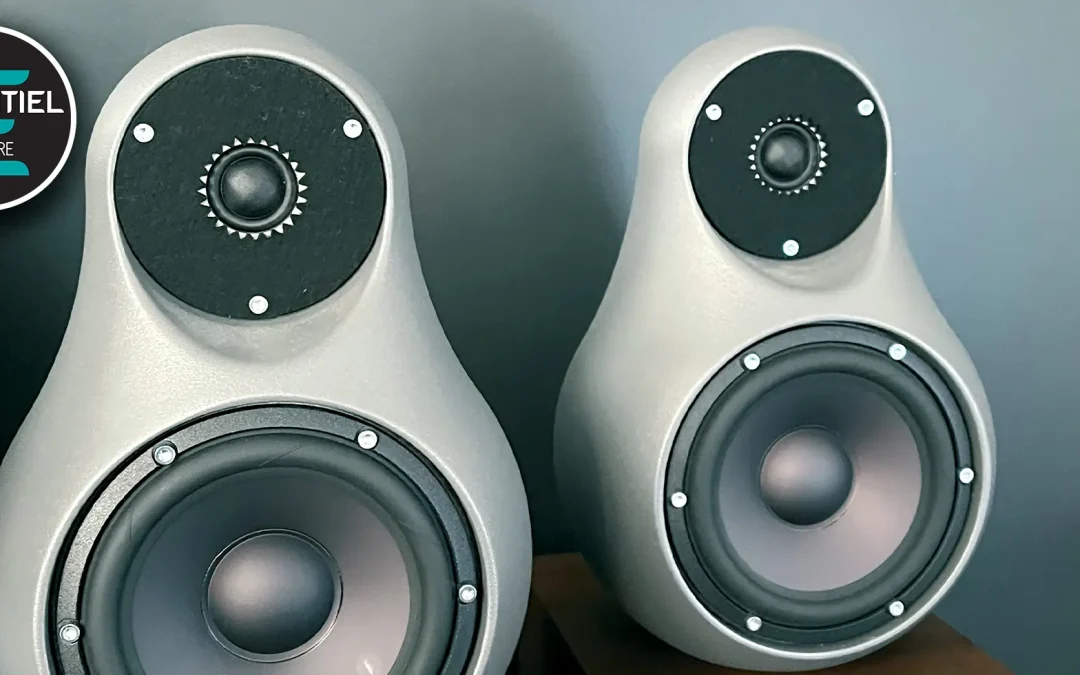
Thus was born the Jern brand (iron in Danish) and the 14 loudspeaker, the first in the range to inaugurate a mould that is still unique at the moment, created using state-of-the-art calculators and machines to enclose two loudspeakers in a cabinet 18 cm deep and 21 cm wide at most, for a height of 30 cm. Today, the range includes 11 models (see box), at the risk of getting lost in them all, but we’ve limited our review to one of the most accomplished: number 15. With an impedance of 4 ohms like all the others except the 14 (at 8 ohms), the 15 incorporates the patented Vibrakill cast iron mould, the brand’s benchmark. Obviously, this mould has to be non-magnetic to avoid interference. The cast iron uses an alloy whose main composition is graphite, while the cabinet contains a honeycomb design to interfere with the waves and limit interference even further. Very attractive, the little final object, whose design is reminiscent of the much classier MiniPod, boasts very high perceived quality and is particularly surprising when lifted, since while the Jern 11 already weighs 12.44 kg, the Jern 15 gains three more on the scales, for a total of 15.5 kg. But it’s when you tap on the speaker that the plumb effect is most impressive, as it’s as if you’re tapping on a rigid pebble.
More upmarket than the 11, 12 and the first two 14 models, the Jern 15, like the 11s, returns to a custom-made 22mm Wavecor tweeter, but switches to a long-throw SEAS bass/midrange driver, with a cone surface area more developed than the lower models, at 104 cm². The frequency response then expands downwards to 59 Hz, while models 11 and 12 start at 6 Hz. The treble rises to 2 kHz and benefits from natural felt damping of the tweeter, while the rest of the enclosure includes lambswool, known for its pure and very fine properties. A Mundorf Mcap capacitor is integrated into the system along with a 0.26 ohm crossover coil of the same brand. The internal wiring is all in shielded Teflon, and the pair of connection terminals are gold-plated.
The design is very different from that of more conventional compact speaker cabinets, but benefits from a Nordic style to which is added the possibility of choosing four colours: three matt (black, grey and white) and one gloss (red). Priced at €2,890, the Jern 15 costs twice as much as the entry-level 11, but its sound performance takes it much further.
The set up
Very compact, but also very heavy for their size, the Jern 15s need to be placed on a surface capable of supporting their substantial weight. Their flat base means that they can be placed directly on a piece of furniture or a flat surface, but depending on the size of the surface, it is advisable to purchase the multi-directional rubber buoys (€120), so that you can then orientate the speakers as required, vertically or horizontally. Wall-mounting brackets (€120) are also available, or to further enhance their Nordic look, small wooden and cast-iron tripods to place on a piece of furniture (€360) or on the floor (€760).
A stand is also available, which is expensive (€1,160) but has the advantage of being made of cast iron and filled with sand, weighing a total of 23 kg, with a choice of two sizes, 85 and 95 cm, the latter being particularly aesthetic and allowing the sound to be projected over a wider area.
In terms of amplification, the Jern woofer has a closed load and needs power to be energised. A minimum power of 20 W in class A or 70 W in class AB is therefore recommended, bearing in mind that before the speakers were collected for in situ testing, they were listened to and compared with the Jern 11, 12WS and 15H at Concert-Home and therefore associated with numerous amplifiers, always used at consequent volume levels, even the very powerful Heed Lagrange and Accuphase E-5000. At prices higher than those of the speakers (four times more expensive for the E-5000), these amplifiers were not really limited by the Jern 15s, so much so that the build quality and natural timbre of the latter were able to blossom without problem, particularly in the bass.
The sound of the Jern 15
A closed load and an ultra-rigid cabinet with damping claimed by the brand to be 100 times better than that of a solid aluminium cabinet – this is the secret of the Danish wizards who have succeeded in creating, from the Jern 11 onwards, a product with very impressive staying power, particularly in the lower end of the spectrum. The Jern 12WS goes even further in terms of treble quality, but it’s really with the 15 that the full splendour of an impressively deep soundstage emerges. In addition to the absence of vibration, which creates a pure, natural sound, the 15 boasts a perfectly balanced mass, as well as a very wide amplitude, even for large symphonic masses. The timbres are very well defined, and if the treble can still gain from the 15H, which is nevertheless much more expensive (€4,400), the very deep bass without the slightest overhang seems to have no competition of this quality at this price level.
Dynamics are also very pronounced, taking advantage once again of the resonance-free body and natural damping to allow strong variations without interference, developed over the entire frequency range, shorter than other loudspeakers yet perfectly controlled without the slightest risk of saturation. Detailed planes intermingle without one register taking over another, for example in large opera chorus scenes. R&B (Dr Dre, Tyler, The Creator) benefits fully from dense bass that is never distorted, just as electro music (Einstürzende Neubauten, Paul Kalkbrenner) finds a way to express itself without creating the slightest auditory fatigue, but on the contrary with a freedom exalted by the bass. The midrange does not lag behind and also benefits from the definition of the SEAS driver, while the Wavecor tweeter is undoubtedly less precise, but in the end achieves a particularly pleasant balance, for a listening experience that is always flexible.
Our conclusion
As we’ve said over and over again, the Jerns impress first and foremost with what makes them so special: the cast-iron cabinet, which is extremely rigid and resistant to vibration. So the Jern 15 makes full use of this technology, as well as incorporating some top-quality components, notably its SEAS loudspeaker, which takes the listener even further into a superbly full-bodied closed-load bass. Extremely well-balanced, this design object can be placed anywhere in a room and just needs a substantial power supply to deliver all its qualities, particularly dynamic ones. Still priced at an affordable €2,890, number 15 seems to be the perfect compromise between musicality and price in a range that is nevertheless already interesting, starting with the 11 and especially the 11S.
A bif family in a small mould
Very expensive to manufacture, the cast-iron mould of Jern loudspeakers is now identical for all models, of which there will be 11 by early 2022, following the recent integration of two products at the top of the range. Here’s a quick overview to help you distinguish between the components of each model:
• 11 and 11S : at the entry level of the range, the 11 models already incorporate the Vibrakill cast-iron cabinet, for a total weight of 12.44 kg. The drivers are from Wavecor, and the 11S stands out for its wool and natural felt damping and shielded Teflon cables, while the 11 uses more conventional foam and multi-strand cabling
• 12WP, 12WS and 12XF : The 12 range stands out above all for its higher-quality tweeter, made by SEAS for two of them and Scanspeak for the WS. The Scanspeak tweeter does not rise as high (20 kHz as opposed to 32 kHz), but provides greater finesse and more natural timbres at the top end of the spectrum.
• 14DS, 14EH and 14ES : Scanspeak or even Hiquphon for the tweeters, but above all Scanspeak for the midrange driver, which has less bass (90 Hz) and requires a separate cabinet, or the brand’s dedicated stand with woofer. This range has gone from 12 to 15 kg and, above all, to an impedance of 8 ohms, whereas the others are all 4 ohms.
• 15, 15H and 15S : This is a top-of-the-range model, even if the initial 15 costs less than the 14EH and ES. The 15 models use a Wavecor (15) or Hiquphon tweeter with gold (15H and S) and switch to a wider SEAS woofer to get down to 59 Hz and 55 Hz. The two best also use a high-quality Mundorf capacitor and coil, and Nextgen WBT terminals for the 15S. This range is particularly impressive in terms of the breadth of its soundstage.
Asserting its reign over the British hi-fi scene once again, dCS continues to expand its catalogue, this time tackling a whole new world: headphone listening.And while the Bartok – an incredible all-in-one DAC/pre-amp/network player – summed up all the brand’s expertise in a single device, the new DCS Lina set takes the opposite approach, separating the DAC/streamer, the headphone amp and even the clock in an uncompromising three-headed monolith. The new benchmark for the genre?
Founded in 1987 in Cambridge, England, Data Conversion Systems (or dCS to its friends) offers top-of-the-range digital systems designed for demanding and wealthy enthusiasts. Its products are often classic in form, but revolutionary in substance, reminiscent of another great name in British high-end, Chord Electronics – born just two years later.
Led by its founder Mike Story, an engineer who had just graduated from the prestigious University of Orford, the company first made its mark in the world of aviation and aerospace thanks to its unique expertise in the fields of electrical signal processing and modulation. Their work was crowned with success, leading them to develop the Blue Vixen radar, used by the UK Ministry of Defence in its fighter planes.
But it was two years later, on the eve of the summer of 1989, that Mike and his friends achieved their second masterstroke, announcing the dCS 900: the world’s very first 24-bit analogue-to-digital converter. It was an ADC that was to make a real splash, establishing the brand in the biggest recording studios for a long time to come, and was endorsed by the likes of Bob Ludwig (Gateway Mastering Studios) and Tony Faulkner (Green Room Productions).
Then, in 1993, came the dCS 950, the first 24-bit digital-to-analogue converter, a direct extension of the work undertaken on the 900. A new entry, driven by the first version of the Ring DAC, whose sonic explosion was echoed as far afield as the Land of the Rising Sun, where the DAC beat the biggest players in the sector to the punch.
Its success has never been denied, with dCS working year after year to perfect its art with a view to blurring the boundaries between analogue and digital. So much so that in 1997, the manufacturer introduced the 972, the first digital-to-digital converter to offer… upsampling. An avant-garde process for its time, it was soon to become the standard for many competitors years later.
Then, 18 years after founding it, Mike Story left the company, handing over to the late David M Steven, who was replaced by his son David J in 2009, and Andy McHarg, a new team who reoriented the brand towards a new audience, far from the recording studios. This second birth led to a total visual overhaul, without ever betraying the original leitmotif of ‘moved by details’.
This change of direction was successfully implemented, and dCS has since established itself as THE standard, taking the top step of the podium every year with its extraordinary systems, such as the Rossini (previously tested in our columns), the immense Vivaldi ensemble (Vumètre No. 1) and the Bartok, the quintessence of English sound.
Now complete with a new entry, the Lina, a network streamer and DAC… but not only.
The DCS Lina
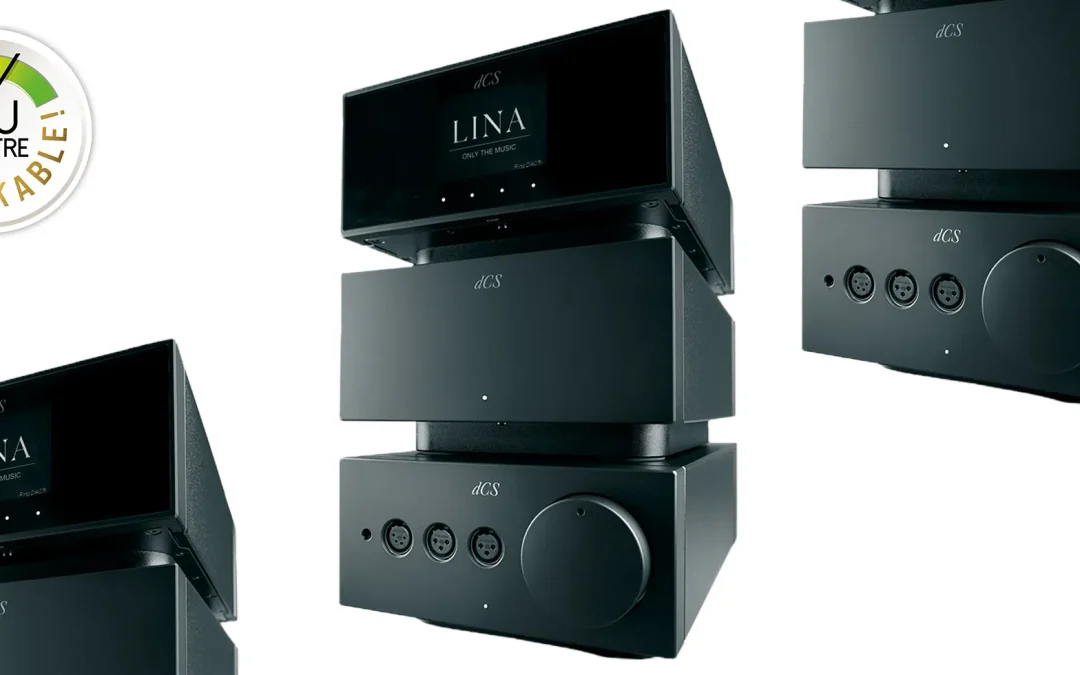
ELike the Vivaldi or Rossini, the Lina is much more than just a DAC. A true hi-fi system under a single name, it brings together no less than three devices designed to work in concert, for better reproduction.
The brain of the operation, the Lina DAC takes the broad lines of the Bartok in a more compact, but no less dense chassis, still carved from a solid block of aluminium, reinforced with an internal damping system capable of blocking both vibrations and parasitic waves. At its heart is the indestructible patented in-house converter, the Ring DAC, powered by a Xilinx Artix 7 FPGA processor – a process obviously reminiscent of Chord, another British manufacturer using a proprietary system.
At the opposite end of the spectrum from a conventional DAC, the Ring DAC is built entirely from discrete components, using a symmetrical schematic and a very high sampling rate, the absence of an integrated circuit freeing the converter from any limitations induced by an IC circuit. This technological feat enables the Lina to oversample and then filter each of its inputs, before encoding them again on the Ring DAC model and finally transmitting them to the Analog Board, where a set of 48 switches shape the analogue signal.
In practice, the dCS Lina DAC will be able to decode all the files on the market, whether PCM or DSD streams, either via its extensive digital connectivity or via its network input – the Lina DAC is, let’s not forget, a genuine network streamer.
Backing up the DAC is the iconic (Lina) Master Clock, the beating heart of the DAC, designed to eliminate any risk of jitter, thanks to its two Quartz oscillators oscillating at 44.1 kHz and 48 kHz. Also directly inspired by the prestigious Vivaldi, a legacy of a glorious past in the world of professional studios, it relieves the Lina DAC of the thorny task of ensuring perfect precision of the digital signal. The +/-1ppm figures indicate that the probability of the signal shifting is less than one femtosecond over one year!
The Master Clock is equipped with oscillators that guarantee precise synchronisation for all audio samples and all frequencies. It allows the Lina Network DAC to be locked to a single master signal for improved audio performance. It minimises the risk of jitter and synchronisation irregularities that can affect playback. It provides a significant increase in sound quality when streaming or listening via USB.
Finally, the self-contained design with isolated chassis and power supply protects the clock signal from external interference.
To give voice to this duo, we have the eponymous Lina Headphone Amplifier, which will have the onerous task of bridging the gap between the DAC and our headphones. Designed to power the most energy-hungry models on the market, it shares a common base with the Bartok and boasts some quite exceptional figures: output impedance of less than 0.090 ohms, frequency response covering five times the audible spectrum and an infinitesimal level of harmonic distortion (<0.005%… at 6 V!).
The circuit design provides Class AB operation with a DC servo system that offers high power, formidable efficiency and excellent linearity. The all-semiconductor construction provides consistent, clean performance.
The latest extras
The Lina DAC features the new Expanse processing platform, which brings the headphone experience closer to the studio listening experience. Its unique processing method reproduces the effects of studio listening, where sound is projected into the space around us, rather than inside our heads, without altering the reverberation of a recording or affecting the performance of a system.
This new technique allows the recreation of the original soundscape in a recording, while preserving its unique tone and timbre, giving a heightened sense of realism when listening to a wide range of music. This optional feature has been created to provide a more immersive experience and natural alternative to traditional cross-feed optimisation.
All audio DACs require a range of filtering and processing operations to reconstruct the audio waveforms. dCS has developed a range of bespoke filters for different audio formats and sample rates. This means that customers with a dCS DAC such as the Lina can select the filter that best suits their chosen audio format and listening preferences.
Creating bespoke filters is a complex and time-consuming process, but it ensures that DAC performance is not compromised due to inflexible filter responses, and that all dCS customers get the best possible sound from their system. This gives dCS customers greater flexibility, allowing them to choose the filter that best suits their tastes. The Lina Network DAC offers a choice of three filters, accessible via the Lina DAC’s touch-screen user interface or the dCS Mosaic Control application.
The set up
Entirely designed, produced and assembled in the UK, each module is the result of meticulous work, with every element scrutinised with maniacal care to match the brand’s standards.
Supplied in three separate boxes, the dCS Lina set is a real eye-catcher. Sharing almost identical dimensions (only the amp is taller), the combo measures almost 40 cm high, 22 cm wide and 35 cm deep, weighing a total of 23 kg when stacked. A sober-looking monolith, but one that will leave no one indifferent.
It’s worth noting that the brand explicitly indicates a precise order, should you, like us, have the idea of stacking them. The amp at the base, the clock in the centre and the DAC at the top, to ensure better heat dissipation while limiting parasitic vibrations.
Once installed, it’s time to plug everything in. And, once again, a precise order is required to get the best out of the trio:
– First, connect the Master Clock to the DAC, using the two BNC cables supplied; – Then connect the DAC to the amp using the two XLR cables, via the inputs on the left (unbuffered); – Finally, to activate the Power Link function (identical to video CEC), connect the RJ45 port on the left of the DAC to the Master Clock, and the right to the amp.
Once you’ve done that, all you need to do is connect each module to the power supply, via an IEC cable, before connecting your sources to the DAC, which boasts a plethora of connectors: three SPDIF inputs, two USB ports compatible with UAC 1.0 and 2.0, plus two XLR AES ports, compatible with dual AES to confirm the signal’s parity.
As for the amplifier section, the Lina does even better than the Bartok, offering no less than three headphone outputs. A classic 6.35 mm (unbalanced), accompanied by the usual XLR 4-pin (balanced) and two XLR 3-pin outputs, again for balanced connection. The Lina ‘amp’ has been designed with the main objective of being able to power the most difficult headphones on the market. So don’t panic, you can connect it to any model…
Finally, while it is possible to operate the Lina via the front panel controls, we strongly advise you to install the dCS Mosaic application, which will enable you to fine-tune the (very) many playback options – from filtering to upsampling mode – as well as updating the internal software.
The sound
‘Somewhere, something incredible is waiting to be known.’ – Carl Sagan
Sensational, the Lina is quite simply the best DAC/Ampli combo our team has ever tested. Fitted with our venerable Audeze LCD-X, it only took ten seconds or so and as many notes for dCS to overturn everything we’d come to expect, proving once again the mastery of its teams.
A true goldsmith of sound, the Lina gracefully distils the most subtle nuances, without ever losing its authority. An iron fist in a velvet glove, this monster of detail highlights the incredible work accomplished by these men and women from Cambridge, a tribute to the passion that unites us all: music.
Relegating all the DACs in our collection, the Lina is a direct descendant of the Rossini, boasting mind-boggling definition without ever compromising on musicality. On each track, from the very first notes, the dCS immerses us in an unprecedented ocean of sound, with abysmal dynamics, reinforced by the incredible liveliness of the rendering, then magnified by a precision almost unheard of before on a headphone DAC.
Melodious but never syrupy, powerful without being aggressive, the DAC/Ampli liberates voices, makes strings vibrate and, note after note, breaks down the wall of doubt. Yes, the Lina doesn’t use a conventional DAC, but that’s its strength, as the oversampling works wonders, sweeping away all our preconceptions.
Better still, the addition of the amp and clock completes an already idyllic picture. Almost superfluous, the ensemble transforms the unheard-of into the phenomenal, obliterating any colouration or emphasis and magnifying even the most discreet timbre, from the rosin of a bow to the ivory of a keyboard.
A blend of elegance and refinement that the Meze, undoubtedly one of our favourite headphones, brings out superbly thanks to its large isodynamic diaphragms, servo-controlled as never before. Whether we’re talking about the polyphonic electro of Infected Mushroom or the candour of Stacey Kent’s jazz, we’re captivated by the inconceivability of the sound.
The same is true of the BeyerDynamic DT 900 Pro X, a pair of headphones whose reputation in the studio is well established, with the amp once again demonstrating its ability to reproduce, almost photographically, the ambience of the recording. Taking advantage of the Lina’s incredible dynamic range, the alchemy of sound works at every moment, even when fed from sources as basic as… Spotify.
In short, the dCS Lina is unrivalled in its price range and size, even by our former tenor, the Chord Dave. What’s more, it’s a 100% made-in-UK feat.
Our conclusion
Sumptuous, marvellous, prodigious… we have nothing but praise for this new dCS creation! A real coup de Trafalgar, the DCS Lina is a total success, establishing itself as the best headphone listening solution ever, propelling the manufacturer, already a benchmark, to the firmament.
Its atypical format may disconcert some, but that’s the only complaint about this system, as the whole subjugates with its prowess, head and shoulders above anything we’ve heard to date. And while the price remains high, once you’ve plugged it in, it’s impossible to take your eyes off it! An essential that you must listen to, if only once, but beware, there’s no turning back.
Author: Haja Randrianarison
Technical sheet: dCS Lina – DAC/streamer
Origin: United Kingdom
Price : €14,250
Dimensions : 121.5 mm x 220 mm x 339 mm
Weight : 7.4 kg
Converter : Ring DAC (proprietary dCS converter)
Managed streams: CM 16/24/32 bits – 44.1 kHz/384 kHz/DSD 64/128
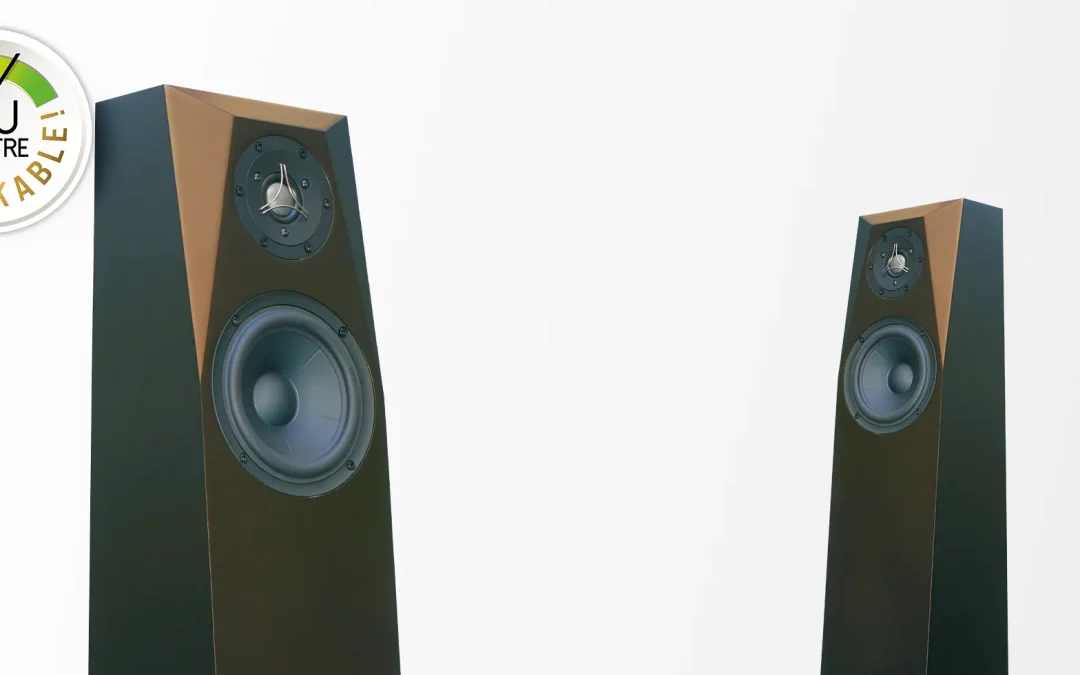
A compact floorstanding speaker that’s easy to store, the Nel is highly musical and comes in a range of performance levels. As its designer admits, this is a model that is particularly well-suited to upgrading. The three versions offer higher and higher levels of performance, right up to exploiting the full potential of a two-way configuration. The result of the Nel line, the Extreme version pushes the capabilities of this design to the limit. Officially available in the T&T catalogue from the end of 2021, the Nel Extreme represents the quintessence of the compact two-way floorstanding speaker, designed to work in the finest systems. And we’re well placed to tell you all about it…
I’m a bit sad. My Nels will be gone for a good month. After more than two years of loyal service, they’re going back to Valence, to the T&T factory, where they were born, to get the finishing touches that will turn them into ‘official’ Extremes. Why this obscure formula, you ask? Let me explain.
Storytelling
We acquired a pair of Nel Ultime from the editors of VUmètre in the summer of 2019. Totally won over by their potential during the test bench carried out at the time, I was convinced that they had their place alongside our other reference loudspeakers in order to form a homogeneous array with complementary qualities.
The Nel Ultime soon proved indispensable in our arsenal. Capable of bringing out the finesse of the best sources and the flexibility of the best amplifiers with great acuity, they gave us great satisfaction and a great deal of sonic and musical pleasure. At the same time, we had spontaneous and easy discussions with their designer about their behaviour in different contexts. And it was quite naturally during one of these exchanges that everything went wrong!
– This speaker is a real winner. – … – But could it be improved to go even further? – It’s true that on paper it has the potential. – Would it be possible, for example, to graft the beryllium tweeter of its big sister onto it? – Technically, it’s possible. But there would be a significant price difference if such a model were produced. – Yes, but is it worth a try? – If you like, I can modify your pair.
And that was it, the worm was in the fruit. From then on, I kept thinking that my Nel Ultime with the Nora tweeters would be a kind of acoustic pinnacle.
But changing transducers also meant changing the filtering and optimising the internal load. In short, a further study. But Pierre Faverieux was very willing to play along.
And finally, at the end of February 2020, I received in my auditorium my new Nel, whose name has yet to be found!
Itinerary of a spoilt child
It’s always a great privilege to work closely with equipment manufacturers. This complicity allows us to go further in the exploitation and optimisation of the equipment, but also, if the dialogue works really well, to give birth to products that are a little out of the ordinary.
On the eve of the first lockdown, a magnificent toy arrived in my auditorium. I don’t know what it is yet, but I’m going to have plenty of time to get to know it, understand it, make it my own, and get the very best out of it.
At this stage, these special Nels are a unique model. But not for long… Alain Yzembar, the boss of Absolue Créations, with whom Pierre Faverieux has an excellent relationship, got wind of the project and also asked him for an equivalent modification of his own pair of Nel Ultime! So here we are, two privileged beta-testers.
For my part, I’ll be able to test them with all the sources and electronics imaginable. As for Alain, he’s going to try a very advanced optimisation in terms of internal wiring, to go even further than the Ul-Tim conductors used.
Meanwhile, Pierre is continuing his development work, in particular with the Joy model and its Extreme version. The latter benefits from the infernal tandem of beryllium and new Absolue Créations internal wiring.
Each time he visits Alain and me, Pierre is always surprised by the performance of the Nel ‘XXL’.
And finally, having completed the entire ‘Joy’ programme, he set about building his own pair of Nel Extrême.
Q.E.D.
The Nel Extreme retains exactly the same cabinetry as its smaller brothers, the Nel and Nel Ultimate. The cabinet is 22mm thick MDF, except for the baffle, which is 30mm thick. Plywood reinforcements are strategically placed inside to increase rigidity. The front panel is angled to phase the drivers, and is also designed to smooth the response of the tweeter in the 1 to 2 kHz range.
The internal damping combines several qualities of damping depending on the zone, and quantities finely optimised to curb internal resonances and not restrict dynamics. The decompression port for the bass-reflex load is located underneath the speaker and ‘breathes’ thanks to the three stainless steel feet on which the cabinet rests. The rear spike is positioned directly on the lower end of the rear panel, effectively dissipating any residual vibrations. The vent is large in diameter (68 mm) to release maximum energy without compression or flow noise. It is perfectly sized for the speaker’s internal volume of 18 litres.
The two-way configuration includes a 17cm woofer chosen for its excellent low-frequency extension in a moderate volume. Its aluminium diaphragm is both rigid and lightweight, and guarantees excellent midrange performance thanks to a smooth response curve throughout the useful range.
The tweeter is equipped with a 29 mm beryllium dome and a neodymium magnet. It is very well motorised, but above all it has a large emissive surface (9.6 cm2), which guarantees a low resonance frequency (700 Hz) and excellent linearity right through to the extreme treble. Finally, it descends fairly low in frequency, working as a piston right down to the midrange.
The crossover schematic has been optimised to provide an even smoother overlap between the two loudspeakers. The crossover is wired in the air, isolated from the cabinet, and uses only components from the prestigious Mundorf M Suprême and Jensen Audio Alumen series. The progressive torque screw terminals are from the Furutech catalogue.
The exclusive internal cabling is, of course, developed by Absolue Créations: these totally bespoke conductors ensure very strict temporal respect for the music and eliminate any oscillation.
The set up
We tested a large number of sources, amplifiers and cables with these speakers. What we learned from these tests is that the Nel Extrême do not lend themselves to the game of compensation. They will therefore be at ease with products that get straight to the point without trying to coat or embellish. When it comes to sources, you simply have to look for the best ones for your budget. Turntables, converters, network or CD players will be chosen above all for the widest bandwidth and good linearity.
When it comes to amplifiers, we’ll also be opting for products that are as straightforward and dynamic as possible. Over the months, we’ve had excellent results with Aavik, Bricasti, Copland, Electrocompaniet, Jadis, SPEC and other electronics. The Nel Extreme is an easy load for an amplifier. But because it has no compression or distortion, it encourages loud playing and flirts with the limits of amplifiers. So don’t hesitate to offer them power, but above all a reserve of energy (a good power supply).
When it comes to cabling, there’s a natural fit between T&Ts and Absolue Créations cords. However, this is not a systematic choice, as we were able to test the Nel Extrême with other brands and obtain excellent results, such as with certain selected models from Audioquest or Furutech, for example.
Finally, as far as decoupling is concerned, the original stainless steel feet do the job well. But over time, we’ve identified two even better alternatives. The first is to use Centaure Nessos. The second is to use Hifistay Ballerino 45s. It’s with this latter option that the Nel Extrême give their all. The small Korean mounts allow them to offer the ultimate in precision and bandwidth extension.
The sound of the T&T Nel Extreme
To make this test bench as exhaustive as possible, Pierre Faverieux came to our auditorium with his final pair of Nel Extrême. We were able to compare them at length with the Nel Extrême prototypes we’ve been using for the past two years. The fundamental difference is the internal cabling (Absolue Créations Ul-Tim for us, Absolue Créations latest generation for the definitive model) and the fine optimisation of filtering and loading. On paper, it looks like nothing, but in reality, the difference is very noticeable. In fact, we’re more in the realm of Formula 1 than that of a production ‘vehicle’. And every little touch of fine tuning makes a big difference to the listening experience.
We have to say quite frankly that over the last two years, we’ve been delighted with our prototypes. Everything comes through with disconcerting ease, astonishing speed, and an ability to play very loudly without any compression. However, finding a loudspeaker that will totally satisfy you is no easy task. Of course, the bigger the budget, the easier the quest. But what really counts is the match between the way you listen, what you like, your perception of sound, and what the product can offer you.
Personally, I’ve always liked very dynamic speakers, with a wide bandwidth and as little coloration as possible. The coherence and intelligibility of vocals or piano playing, for example, have very often led me towards excellent two-way configurations. They may have their limits, but the homogeneity they offer is often successful. Because filtering where the human ear is most sensitive is always a compromise. Finally, I like to listen loud. And often, when the sound level is high, annoying phenomena linked to poor acoustic control appear, inducing distortion or compression. Needless to say, with Nel Extrême, none of that has happened in two years. Of course, their natural transparency doesn’t make them particularly forgiving of upstream links. It’s hit or miss. And it’s not always a question of money. We’ve achieved some particularly harmonious marriages with products that weren’t necessarily out of our price range. For example, with the Spec RSA 777 EX amp, the Nel Extrême are already singing with remarkable conviction and can express themselves loudly without compensation. In a large room, of course, you’ll have to opt for the big brother. But this is a top-of-the-range product that needs to be considered very carefully in relation to the context in which it is used.
On a beautiful, purely acoustic piece like the first track on Bojan Z’s album Xenophonia (a benchmark in recording), the listener instantly recaptures the ambience of the room, its colour, the three-dimensional space in which the musicians are moving, and their exact position. The pianist’s playing is reproduced with exceptional acuity. The strike of the hammers on the strings is vigorous, powerful, sometimes violent, as it must be in reality. It’s quite rare to find a hi-fi system that reproduces the sensations you can experience in real life. But here, frankly, we’re not far off.
A large orchestral mass such as Falla’s ‘Siete canciones populares’ is reproduced with all the power required, but also with all the finesse that allows you to appreciate its diversity and subtlety. Of course, the power of the crash on the forte is there to attest to the very fine dynamic behaviour of the Nel Extrême. But that would be pointless if the power of resolution and, above all, the stability of reproduction were not guaranteed. And in this case, the smallest details can be perceived without hesitation, even at fairly high modulation peaks.
Speaking of managing dynamic differences, nothing beats the cover of Björk’s ‘It’s Oh So Quiet’ (originally performed in 1951 by Betty Hutton). On this track, the difference in level between the end of the verse and the chorus is simply explosive. Many systems break their teeth here. You need to be able to cope with a phenomenal ratio between the different parts of the track, which range from ‘calm’ to ‘explosive’. With Nel Extrême, intelligibility remains supreme whatever the level. And even when the level is terribly high, there’s no distortion to impede the clarity of the audio. Everything passes through with serenity.
The last difficult test was Melody Gardot’s live album on vinyl, which is not appreciated for its spectacular side – quite the opposite, in fact – but for its subtlety. A long, elegant track like ‘Lisboa’ is magnified by Nel Extrême, who can instil an atmosphere like no other: serene, limpid, magnificently fluid, with an unsuspected level of grain on the vocals and acoustic instruments. The density is marvellous, and all the more welcome because it serves the presence of the performance without trying to flatter the ear with colour. Nel Extrême always play with nuance and finesse. They never try to force their way through.
Our conclusion
In the end, it all comes down to the same thing. Consumers have the choice of turning to the big, well-known generalist manufacturers, distributed throughout the world, with a wide range covering every conceivable need. On the other hand, there are the small manufacturers whose only chance of standing out from the crowd is to offer the best product, demonstrating a high level of creativity and ingenuity to make up for the massive difference in R&D budgets. To conclude, we can legitimately ask ourselves whether a creation by a single person is not more satisfying than the work of a team made up of several talents, but who have to deal with their respective individualities. Where does the greatest coherence lie?
For our part, we’ve come across some superb creations from major brands and smaller manufacturers. But if there’s one thing we feel is absolutely essential, it’s that this T&T, conceived and designed by a single man, has absolutely nothing to envy most top-of-the-range products at its price level, and sometimes even up to twice as expensive. This loudspeaker is a total success, capable of some quite exceptional sonic prowess for its size. As part of a perfectly optimised system, it will deliver unique musical reproduction.
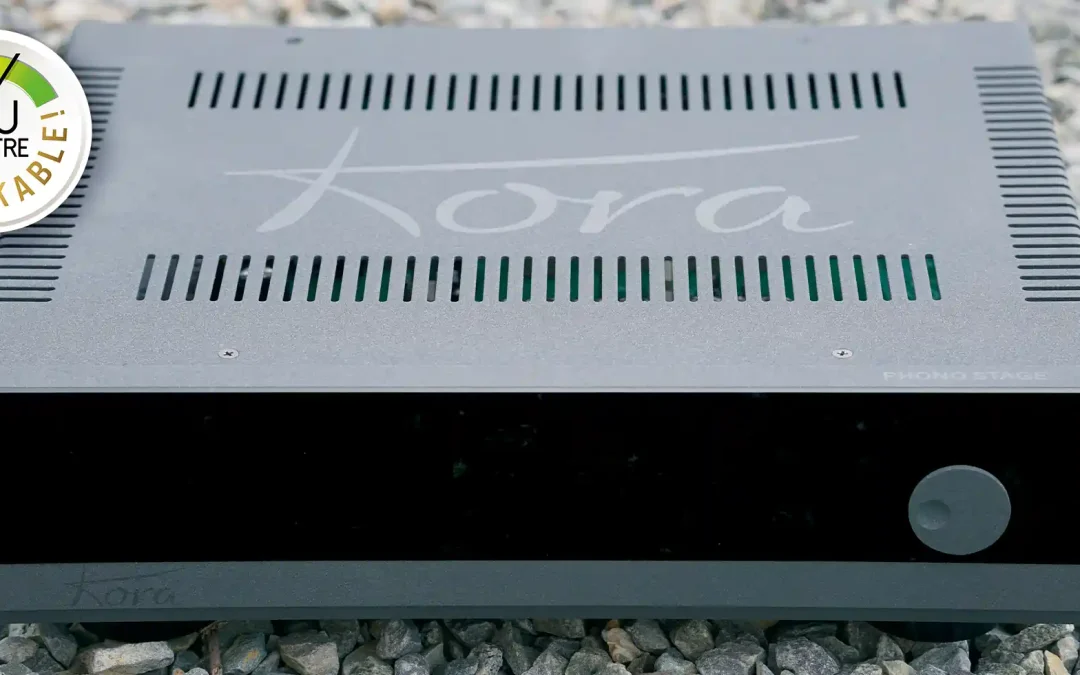
For several years now, under the impetus of its eminent technical director Bruno Vander Elst, Toulouse-based manufacturer Kora has been enjoying a new lease of life. The products are increasingly ambitious and, above all, feature new, practical functions. A case in point is this brand new phono preamplifier, as clever as it is musical, which left us wondering when we heard it at the last High End in Munich, and which we are delighted to present to you as a preview: the Kora Phono Stage.
Over the last few years, we’ve had the opportunity to test the TB140 integrated amplifier (VUmeter no. 27) and the TA480 power block (VUmeter no. 38), two infinitely musical products. The new Phono Stage uses the same chassis as the TB140 for an elegant, compact visual effect.
It is the brand’s first independent phono stage. Previously, Kora had only developed a pre-amplification section for moving-magnet (MM) cells found in its integrated amplifiers.
The specifications that governed the design of the Phono Stage are in keeping with the spirit of Kora: to meet the technical requirements of the phono format in order to obtain an uncompromising result without giving in to any fashion. The requirements defined by the developers were firstly to obtain the lowest possible noise level, without circumventing the problem with an input transformer. Secondly, the team wanted to maintain great respect for the RIAA correction, but also offer excellent flexibility of use.
Finally, of course, as with all Kora devices, to guarantee the quality of the components and manufacture, without ostentation, but without compromise.
The most delicate part of the development was undoubtedly the input stage. To achieve the lowest possible noise level, Kora used some of the quietest input transistors on the market. In addition to the ultra-low-noise operational amplifiers, all the resistors in the signal path use ‘foil’ technology, guaranteeing the lowest possible noise level and absolute precision. These are Vishay VSRJ resistors, offering accuracies down to 0.01%.
This stage has a gain that can be programmed to 50 or 100. It is a fully symmetrical stage that can also be used with an unbalanced input. Noise theory predicts a 3 dB reduction in noise in this case.
Once properly amplified by the input stage, the signal is less fragile. Still symmetrical at this stage, it will be converted into an asymmetrical signal by an analogue subtraction operation. This eliminates some of the so-called ‘common mode’ noise, which is the whole point of balanced cabling. We take advantage of this stage to apply a gain of 3.
It is within the RIAA correction that the first part of the signal correction is implemented. This section processes the high end of the spectrum and is therefore essential for the overall quality of the preamplifier. This first correction is totally passive, essentially entrusted to precision capacitors in polystyrene technology, the best according to Kora. An active circuit handles the second part of the correction, which deals with the low end of the spectrum, again using polystyrene capacitors.
The output stage intervenes when the signal is restored in its entirety. It gives the signal all its strength to ‘attack’ the links to the amplifier. The output is unbalanced on two RCA sockets, but an additional circuit (called a phase shifter) will create the second signal in phase opposition which will feed the two XLR output sockets. Both RCA and XLR outputs can be used simultaneously. This last stage has four programmable gains (1; 3.33; 5 and 10). All these gains distributed along the amplification chain allow you the wide range of gains of the preamplifier, always taking into account the noise and requirements of each stage.
The set up
The Phono Stage allows you to meet all the requirements of your cartridge(s), as it has four inputs. Two are equipped with XLR sockets, allowing you to connect the cartridge in balanced or unbalanced mode, depending on your needs. Each input can be individually programmed to best suit your requirements. The configuration is stored in memory and will be recalled automatically each time you select that input.
The various programming choices available to you concern the input impedances and the total gain of the device. For your cell, select the value given in the manufacturer’s manual if it is specified. For moving magnet (MM) cells, the value 50 kilo-ohms is standard. For moving coil cells, the value is often given as ‘> 40 ohms’. In general, the value of 200 ohms meets all requirements!
Don’t hesitate to do a few tests, there’s no danger to either your cartridge or your Phono Stage. The selection of the capacitance of each input is valid for all types of cartridge. Your choice covers from 100 pF (0.1 nF) to 1.5 nF in steps of 0.1 nF, i.e. 0.1 nF; 0.2 nF; 1.3 nF; 1.4 nF; 1.5 nF. Here again, either the manual for your cartridge recommends a value, in which case you choose the closest value (for example, if the recommended value is 470 pF, program 500 pF), or the manual doesn’t specify anything, in which case you can try things out ‘by ear’ to fine-tune your listening!
The Phono Stage has a wide range of gain settings to match your installation. This output voltage value should be in the order of magnitude of the sensitivity of the following amplifier.
Kora comes with two handy extras. A Demag function allows you to demagnetise your pick-up if necessary. Finally, for a record that’s a little foggy, you can use the Rumble function, which eliminates very low frequencies outside the audio range.
The sound of the Kora Phono Stage
It doesn’t take long to realise that the Phono Stage is a rather special product. Once you’ve set it up according to the indications of your cartridge, all you have to do is let the sound blossom in the room to understand what kind of product you’re dealing with. Listening to these electronics is truly ‘liberated’.
You instantly feel the way the energy takes over a space in the room. Obviously, analogue media favour physical listening. But here there’s a little something extra, a little extra soul. Firstly, the notion of control is very palpable. The energy is there, very much there, but it’s channelled to perfection. Do you want to vibrate to your favourite tunes? No problem, but with an above-average level of demand. So, lots of spontaneity, beautifully controlled.
This is the powerful foundation on which Kora builds its musical edifice. Because this flow gives a superb sensation of carnal presence. On a double bass, the material waves are present and vibrant. If we reason coldly in terms of bandwidth, it’s worth pointing out that the bass descends very low, with astonishing aplomb and superb legibility.
In the various rhythmic lines, it’s easy to distinguish between the playing of each instrument (bass, drums, etc.). The timbres are natural, accurate and never overly brushed. The treble runs very high with a delightful smoothness. What’s also very striking about this device is the notion of space it imposes. Depth is unusually great, with a very legible gradation of the different planes.
The result, obtained with a very fine cell, is of remarkable quality. But what’s far more astonishing is that the Kora manages to push the performance of a simple MM cell to unsuspected limits. With our trusty Nagaoka MP150 (under €400), the Kora surprises in terms of fluidity, attack and perspective. Never before have we heard this cell sound so realistic and effective.
In other words, its potential is much better exploited by the Kora. With our Dynavector XX-2, the performance is superb. The coupling between the two products is very successful. The preamp makes full use of the resolving power of the cartridge, which seems to scan the bottom of the groove as rarely as possible. The tonal colour of the different recordings is immediately apparent. The vocals are suave and delicate, the instruments highly embodied. The swing is formidable and the dramatic intensity of each disc is perfectly rendered. Each time the tonearm is lowered, a new world of sound is revealed.
Our conclusion
This compact, elegant product conceals mature technology and great adaptability. With its four fully configurable inputs, the Phono Stage offers uncommon operational flexibility. But what really counts is its lively, powerful, controlled and extremely subtle sound reproduction. This is Kora’s first separate phono preamp (with the exception of the MM stage of integrated amplifiers), but it has already made a very strong impression on us. In a field where the offer is wide and sometimes very well made, the Kora should have no trouble making a place for itself, as its flexibility and musicality are absolutely indisputable.
Author: Laurent Thorin
Technical sheet: Kora Phono Stage
Origin: France
Price : €6,600
Dimensions : 315 x 90 x 260 mm
Weight : 5 kg
4 fully configurable inputs :
2 balanced
2 unbalanced
Input impedance :
MM: 50 kΩ
MC: 10 Ω to 1,270 Ω in 10 Ω steps
Input capacitance : 100 pF (0.1 nF) to 1.5 nF in 0.1 nF steps