Released at the end of 2015, B1 quickly became a key element in the arsenal for optimising our hi-fi systems. But in 2017, Stéphane Even went back to the drawing board and re-launched research to improve his process. Five years later, he has identified an essential element: the behaviour of the water molecule has a strong influence on the perception of sound reproduction. According to him, B1 solved 90% of the problem and now, with Neodio Origine B2, the effect is much stronger.
Just because you can’t see them doesn’t mean the problems don’t exist. In fact, when you compare the two, you can hear them perfectly well! With Origine B1, French manufacturer Neodio offered an interesting solution to the problems of micro-vibrations that interfere with your hi-fi system back in 2015, but that’s not all! The B1 also solved the problem of sound degradation on subjects that we can’t perceive because we can’t see them. In fact, with the arrival of the Neodio Origine B2, the name has changed. Neodio now calls it an acoustic purifier rather than an anti-vibration support. Because the B2’s range of action goes beyond the simple function of support. It’s almost more of an interface.
And the transition between B1 and B2 is where the designer has played his cards right. Not only has v1 benefited from a long lifespan, but the brand is also offering a v1/v2 upgrade that will allow you to progress at a lower cost, while perpetuating your initial purchase. This is an intelligent way of combating obsolescence. The B1 cost €250 each. So did the Neodio Origine B2. Transforming a B1 into a B2 costs €120, including return postage.
The only slight difference is that the B1 upgrade is called B1 Evo, because the manufacturer is not going to modify its very attractive laser screen printing. They’re just adding an ‘Evo’ sticker. But the performance of a B1 ‘Evo’ and a B2 is identical. The B1s are dismantled in the brand’s Bordeaux workshop to incorporate the new technical solution.
Stéphane Even, the brand’s creator, describes his product as revolutionary. ‘Our field is full of scientific anomalies and unexplained phenomena: the sound of cables, the importance of supports, the lack of correlation between what we measure and what we feel, the variations in musicality depending on the day or the time… I have carried out more than 1,000 experiments since 2015 with the aim of understanding and building a theory to explain the observations.After many disconcerting and unsuccessful attempts, I finally identified what it was all about ‘.
To put it simply, it’s the water molecule. It is present throughout our environment and, as far as we are concerned, in terms of audio, it is responsible for these oddities.Its collective behaviour obeys unknown laws and it interacts with the functioning of our hi-fi systems. This is precisely where the B2 outperforms the B1, because it tackles the problem at source.
This 100% made-in-France audiophile toy measures 65 mm in diameter by 32 mm in height and weighs 370 g. It’s beautifully crafted, with an impeccable fit and laser-engraved silkscreen. If required, an M6 insert can be used to attach it to an appliance. On paper, the Neodio Origine B2 is compatible with all types of equipment.
The new packaging is made entirely from recycled materials. Whether in terms of this or the upgrade and recycling programme, the Bordeaux-based brand, which is already sustainable and made in France, is aiming to become France’s leading eco-responsible hi-fi brand.
The set up
Having carried out a large number of tests, the manufacturer offers various solutions that it has validated itself.
The first configuration consists of two B2s placed under the power strip. The second uses four: two under the power strip and two under the speaker cable where the cable exits the speaker and touches the floor.The third uses five: two under the power strip, two under the speaker cable where the cable exits the speaker and touches the floor, and one on the wooden cabinet (head down). For our part, after repeated testing, we find that the most effective basic configuration is to use four B2s: two under the power strip and one at the top of each speaker. It really is a super-efficient configuration. But everyone will have to investigate their own interior with their own configuration, because each case is unique.
The sound of Neodio Origine B2
We’re entering shifting, sensitive territory here. Whereas the B1 was designed as an anti-vibration support, the B2 is not quite the same: it is presented as an acoustic purifier. And this concept may seem abstract to most of our audiophile friends. Yet the B2’s effect is even more acute and obvious than that of the B1.It works to compensate for certain shortcomings: lack of naturalness, dissonance, harshness, absence of harmonics. In a way, it doesn’t improve the qualities of your system, it combats its faults and neutralises its weaknesses. It seeks to rebuild and reconstitute the homogeneity of sound reproduction. It acts as a facilitator. It makes the sound much more perceptible to your ears, easier to grasp. It does this by reducing the pollution that adds parasitic noise, blurring the lines that structure the sound image and diminishing the quality of the attacks. The immediate sensation of the action of the Neodio Origine B2 is the reproduction of a clear sonic relief. The sound is no longer flat. On the contrary, it materializes along the three axes with a strong presence. The notion of a stereophonic image takes on much greater meaning. In the same vein, the notion of dynamics goes up a notch with the development of a real hierarchy in the melodic lines. Rather than a quantity of compacted sonic matter, we are witnessing the dissemination of a kaleidoscope of well-coordinated sonorities that are perceived with great overall coherence. You go from the whole to the part, rather than from the part to the whole. And then there’s the silence of your system’s operation. In this respect, B2 is quite astonishing. But in the end, what you really need is to be able to carry out the tests yourself at home, in situ, so that you can assess the positions in which the B2s will be most effective for you.
Our conclusion
We were very fond of the B1s, which we’ve been using since they were first introduced. After trying out the Neodio Origine B2, we immediately sent our models back to the manufacturer to have them modified, and we bought a number of extra ones. As far as we are concerned, this device is really effective and brings an overall improvement to the sound reproduction of all our systems in a clearly convincing way. We fully understand that for some enthusiasts, the process may seem strange. We are clearly not versed in esotericism, but we are convinced that this product works sensitively and with obvious reproducibility in various configurations.The manufacturer doesn’t hesitate to say that, given the investment, it knows of nothing that can compare: ‘ A well-made mid-range system, equipped with B2, will undoubtedly be able to outperform many top-of-the-range systems. ’ In all sincerity, we’re not far from thinking like him… Tried and adopted!
A network player made in France? That was enough to intrigue us. Because while our teams are fond of high-end DACs, exceptional CD transports and high-resolution portable music players, we are above all driven by a passion for beautiful sound. Octavio, a young French start-up that also intends to make its mark thanks to Octavio Stream, no doubt shares this passion. So here we have a well-designed, well-thought-out audiophile network player that we couldn’t wait to try out!
Founded in 2018 in Lille, France, Octavio was born, like many inventions, out of frustration. That of two student friends, David and Victor, music lovers in their spare time, unable to enjoy the joys of connected music on their vintage but quality system. The solution? A network player, of course! But while there are plenty of top-of-the-range products on offer (from the famous Bluesound Node to the majestic dCS Lina, tested in the last issue), it’s hard for the less fortunate to find what they’re looking for. This is the challenge our two companions have taken up by developing their own in-house network player.
It’s an original idea that will take shape in their flats, before coming to life – in prototype form – in the Plaine Images incubator, a veritable European hub dedicated to the creative industries. The gestation period will last a year, from January to December 2019, until the first system is created: the Octavio Stream.
In March 2020, everything accelerates. Thanks to a successful Kickstarter campaign, Octavio leaves the concept phase to become a real brand, ready to offer the world the fruit of its efforts: a compact network player, designed and assembled in France, capable of being combined with both an amp and a dedicated DAC, at a condensed price.
It’s an audiophile project with real meaning, supported by a young team who are fully aware of the new climatic and technological challenges from the first to the last kilometre, thanks in particular to the Hipli packaging designed to be returned and reused!
And while we had been following the project from a distance, one fine morning we decided to pay closer attention: have we finally found our French network player nugget?
Introducing Octavio Stream
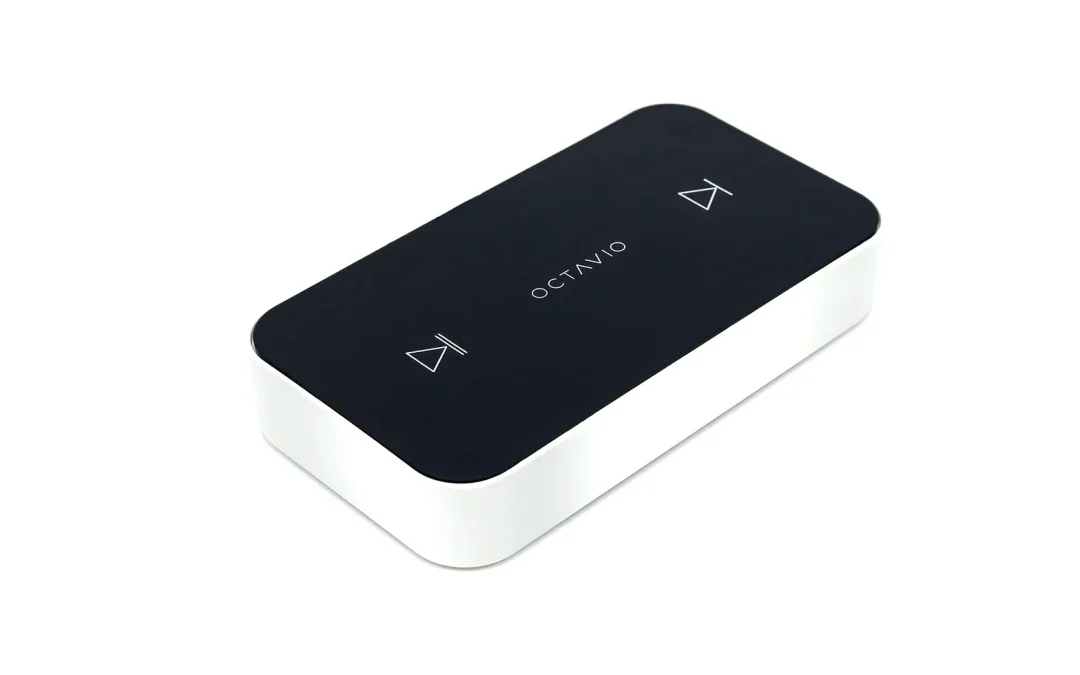
Following in the footsteps of Google Chromecast Audio, the Octavio Stream plays the simplicity and sobriety card. A recycled plastic chassis with a black and white bitonal finish, a single USB-C socket for power, a 3.5 mm jack output that doubles as a mini Toslink, and two control buttons directly accessible on the top panel.
A no-frills presentation, then, guided by the desire to offer a 100% French design: the case is moulded and assembled in the north of France, the pad printing done in Haute-Savoie, the screws in the Rhône. Even the manual comes from a printer based in France, in Villevieille (Gard) to be precise. The only limit to this system is the electronic board, which is produced in Asia, the undisputed leader in this high-tech sector.
For the latter, Octavio called on a major player in the sector: Linkplay. A major player that has successfully deployed its offerings throughout the sector. Triangle, AudioPro, Marshall and even Harman Kardon all rely on the Chinese solution, which continues to expand. A logical choice, then, especially as for its Stream, the brand has decided not to integrate the old A96 chip, but the new A97/A98, which are far more upgradeable.
At the heart of the Stream is an Amlogic A113x DSP, specifically designed for connected hi-fi systems, backed up by a quad-core ARM Cortex-A53 processor that ensures perfectly smooth navigation. The icing on the cake is the adoption of ARM Neon architecture to accelerate audio processing and facilitate the playback of high-resolution audio files.
A winning bet that will not only enable the addition of numerous functions simply by updating the software – AirPlay 2, hi-res streaming, multiroom – but also and above all ensure perfect synergy with the audio PCB. This time it’s a circuit designed entirely in-house by Hugo, developer and engineer, based on a Texas Instruments PCM5102A chip.
This digital/analogue converter is perfectly suited to this application, thanks in particular to its integrated phase-locked loop, which does not require the addition of an internal clock, and its ability to decode all 16- and 24-bit PCM streams. Added to this is minimal power consumption (no need for an active heatsink), ensuring excellent chip life in closed environments.
In use
Delivered in a striking black cardboard box, the Octavio Stream has a real charm all of its own. It’s a small block with a sober but neat appearance that blends in perfectly with its surroundings. Measuring just 118 mm wide by 64 mm long and 21 mm thick, it slips easily between the elements of our test system, adding a discreet touch of fantasy.
Connecting the player takes just a few seconds: you connect the USB-C cable to the mains power supply supplied, then to the appropriate port on the back of the player. Then all we need to do is connect our streamer to our amp, either via a jack-RCA cable or via a mini-Toslink to Toslink connector, which bypasses the Octavio’s built-in DAC. The brand offers a choice of three cables: jack-jack, jack-RCA and mini-Toslink-Toslink.
Installation itself is very straightforward. Octavio guides us step-by-step through the Stream’s configuration – whether via the myriad of dedicated videos on their website or the Virtuose application developed for the purpose. And for those of you who are paper addicts, the brand hasn’t forgotten the classic user manual, included with every device, and printed on recycled paper, wow!
In terms of network connections, the Stream is powered by a Broadcom BCM 43456 chip, compatible with the 2.4 GHz/5 GHz Wi-Fi bands and 802.11 b/g/n Wi-Fi protocols. This configuration is more than sufficient for hi-fi needs, even at 24 bit/192 kHz.
However, should the quality of your Wi-Fi network prove inadequate, the brand also offers an ingenious Ethernet adapter, enabling you to connect the Stream in a wired configuration. Once connected, the Stream can be controlled at the touch of a button via the dedicated application, designed to bring together all your sources: Deezer, Spotify, Qobuz, Tidal, Amazon Music and even Apple Music. Once again, the brand offers a set of explanatory videos, which is particularly appreciated. What’s more, the streamer also supports the Bluetooth protocol, which may not be as high quality, but it’s handy for a guest who’s just passing through.
As the icing on the cake, the brand is also developing a new application called Virtuose. Although available in beta version, we were able to test several of its features, including omnichannel search, which combines all the results from each platform on a single page.
After all these positive impressions, we can’t wait to see what this little box can do.
The sound of the Octavio Stream
Touted as the bridge between the old world and the new, the little Octavio Stream doesn’t fall short, quite the contrary. Connected to our pair of KEF LS50 Wireless speakers, direct comparison with the Google Chromecast – our previous streamer on these speakers – shows a clear advantage for the little French player.
As the listening progressed, the Octavio gradually found its way into each of our systems. Behind the LS50s of course, but also connected to our Cayin set, where it naturally found its place, powered by the USB port of our iDAC-6. The synergy works quickly and direct access to Qobuz, combined with Gapless playback, means we can rediscover many tracks such as ‘City Fade’ by Against All Logic.
Whether in terms of overall airiness, clarity of rendition or simply output level, the Stream does better on all counts. An excellent surprise given its contained price, even if, logically, it will not be able to compete in this respect with its top-of-the-range, but also much more expensive, rivals.
Nonetheless, let’s not get carried away: the Stream puts in a very fine performance here. The lower end of the spectrum, in particular, takes full advantage of its high output level, perfectly reproducing the lowest fundamental frequencies. A real treat for older systems, which are often at a disadvantage in this respect, even when combined with a modern source. Especially as it will be possible to overcome the inherent limitations of the small TI chipset. How do you do this? By connecting a higher-end DAC via the small Stream’s optical output, concealed within the 3.5 mm jack. In this way, the box becomes a true audiophile streamer, capable of conveying a raw digital signal that can be decoded by a higher-end converter.
A welcome feature that unlocks a whole range of functions, particularly for music lovers with an old, unconnected top-of-the-range system. Connected to our Devialet D-Premier + Atohm GT set (the finest of its time), the Octavio Stream gives you access to the joys of dematerialised music, in HD.
A sound alchemy that works without a hitch, with no jitter and no digital interference – the Octavio team having done a remarkable job in this area. A fine achievement, and one made in France to boot.
Our conclusion
Practical and fun, the Octavio Stream is the perfect entry point for any music lover looking for a compact, high-performance audiophile streamer. Perfectly in tune with the times, notably through its commitment to sustainability and its French short distribution channels, the player also has the luxury of filling a real gap in this price range.
And with the disappearance of the Google Chromecast Audio and the democratisation of streaming offers, Octavio is the obvious solution, especially as the brand makes a point of offering regular updates. A new player to keep a close eye on. The brand also offers a connected amplifier! A word to the wise…
A year ago, the Montalban-based manufacturer brought us its DP 107, a wonderfully musical loudspeaker in a relatively small footprint. It was a breath of fresh air for isodynamic speakers. But Diptyque was already working in secret on a new uncompromising creation. Previewed at the recent Munich show, the Diptyque Audio Reference is the quintessence of its research. With its elegant lines created by Anthony Henry, a new recruit to the team, and equipped with a patented new technology, the new Référence is one of the most ambitious creations on the high-end planet.
Diptyque Audio was born of the combined efforts of two hi-fi enthusiasts, Gilles Douziech and Éric Poix. Constantly on the lookout for the ultimate sound, over the years they have explored the various technologies that can be applied to its reproduction. From classic electrodynamics to electrostatics and conventional ribbon technology, none of these technologies fully met their expectations. Only isodynamics, also known as magnetostatic loudspeakers, seemed a promising choice. All the more so as Éric Poix’s mastery of ultra-resistant structures offered the possibility of envisaging new mechanical solutions for designing such transducers. The design of extremely rigid frames allows, among other things, perfect diaphragm tension, which is essential for exceptional reproduction quality.
What’s more, Diptyque Audio has constantly improved this technology as it has designed numerous prototypes. One major modification involves the use of powerful bipolar magnets placed on either side of the membrane so that the magnetic circuits it carries are bathed in a constant field as they move. This architecture, known as Push Pull Bipolar Magnet, guarantees perfect control of the membrane’s movements.
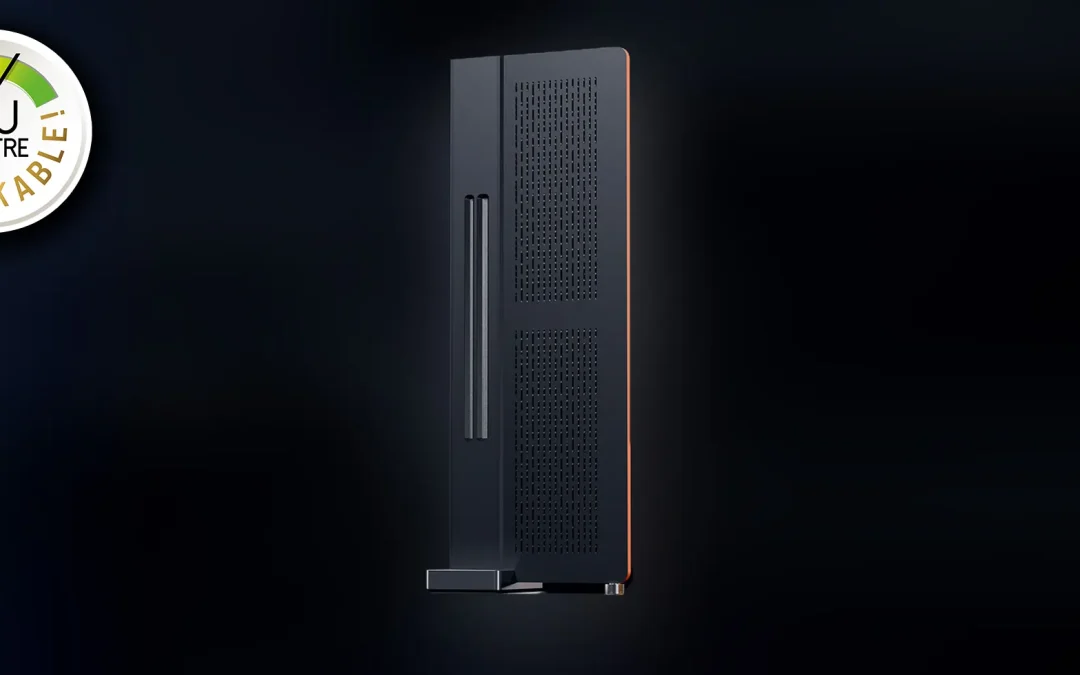
Although this technology is very tricky to implement, it has a number of advantages when it comes to designing large, flat loudspeakers. Firstly, the diffusion of a plane wave from a large surface moving homogeneously guarantees a sensation of sound immersion without the effect of sound projection. In addition, the dipole operation of such loudspeakers recreates the spatialisation of sound necessary to recreate the behaviour of a concert hall. What’s more, the use of ultra-thin, 12-micron-thick Mylar cones guarantees a lively temperament. Finally, the absence of cabinetry, and therefore of acoustic load, eliminates the ‘box’ effect at the root of certain undesirable colourations.
Was the ideal loudspeaker born? Not yet, at least in the eyes of Gilles Douziech and Éric Poix. It was during the period of confinement in March 2020 that their minds, freed of all urgent considerations, began to wander once again, to design the ultimate loudspeaker, without compromise, capable of reproducing the entire audible spectrum, from infra-bass to ultrasound, with all the naturalness, speed and transparency that only isodynamic technology is capable of delivering consistently. As chance would have it, it was precisely at this time that sound engineer Philippe Teissier du Cros, a long-standing friend, had the idea of getting back in touch with Gilles Douziech and Éric Poix to discuss their latest research. At their request, he enthusiastically took part. The Reference specifications were drawn up. All the existing solutions, particularly in terms of bass reproduction, were called into question and optimised until powerful, controlled bass was achieved.
This research and innovation led to the development of a brand new patented technology known as ‘Crossed Push Pull’. Each bass cell is driven by two independent coils, one vertical and one horizontal. This exclusive technology allows the mylar membrane to be set in vibration by hundreds of small square motors. This choice of ‘cross push-pull’ allows the vibration of the membrane to be controlled without distortion. What’s more, these dual coils optimise the filtering so that the extreme low and low frequencies operate in a cross push-pull mode, while the low-midrange is progressively driven by a single coil.
CThese specific features guarantee highly linear, distortion-free low frequencies, while offering far greater efficiency than existing isodynamic systems.
For the midrange section, as is traditional at Diptyque Audio, a specific midrange transducer has been designed. It is based on a new 20 mm isodynamic ribbon that covers a wide spectrum from 600 to 7,000 Hz. Finally, to reproduce the extreme high frequencies, an 8 mm pure aluminium super tweeter ensures reproduction beyond 24,000 Hz.
The set up
We had the opportunity to listen to the Référence in an appropriate environment at Philippe Teissier du Cros, in the company of Gilles Douziech. Our warmest thanks to them. The entire system was particularly well thought out. The sources consisted of a Bergmann Galder turntable (with its Van Den Hul Condor cartridge) and a Nagra CDP CD player, combined with a Devialet 1000 Pro amplification system. In these conditions, the Reference performed optimally. But we know, thanks to the various tests carried out by the brand, that it is possible to use a good number of other amplifiers to obtain a quite remarkable result. The only real precaution to take is to make sure you have a large enough listening room. We estimate that the Reference will perform ideally from 50 m² with a good ceiling height. That’s the prerequisite for getting the most out of these new speakers.
The sound of the Diptyque Audio Reference
Since we started out in hi-fi, we’ve had the opportunity to listen to most of what’s being done on the planet in terms of acoustic panels, those large flat speakers that operate in dipole mode, whether electrostatic, isodynamic or ribbon. So when a French brand like Diptyque Audio decides to create isodynamic loudspeakers capable of competing with the best in the world, we can only applaud with both hands. We loved the little DP 77s, we adored the new DP 107s just over a year ago, and now we’re discovering the majestic Référence. First of all, we are struck by the progress that the French manufacturer has made between its very first model and its contemporary products. Whether it’s the DP 107 or the Référence, we’re in the presence of a particularly accomplished and successful technological model. We had the very pleasant opportunity of a long and varied private listening session with the Référence. This experience allowed us to realise just how capable this huge transducer is of reproducing recorded music on a large scale. The way you think about sound reproduction in your own home has been turned upside down. Your points of reference are bound to be turned upside down. In this case, the listener is no longer confronted at all with the experience that electrodynamic loudspeakers can provide. With the Reference, sound occupies the listening room on a very large scale and without limitation. It is very large, very airy, extremely individualised, in the sense that each of the multiple components of the sound message is perfectly placed in space according to the choices made by the sound engineer. In fact, this above-average transparency provides a significant differentiation between the various recordings you can enjoy with these loudspeakers. Each new track corresponds to a very specific sound universe: the one that the musician wanted to explore and share. For example, on one of our favourite recordings, of Jean-Louis Trintignant beautifully declaiming a Boris Vian poem, on Daniel Mille’s album L’Attente, the sound experience is inimitable. And yet we were able to try out this track on a multitude of different loudspeakers. But this is the first time we’ve experienced it with such intensity. This is probably because the Reference is capable of reproducing the human voice with an innate lack of colouration. We’ve had exactly the same impression listening to an album by Laurie Anderson with Lou Reed, or madrigals by Claudio Monteverdi. The sensation of presence is remarkable, because not only do all the voices have a particular substance, but the differentiation between the different planes and backgrounds is phenomenally precise. The absence of distortion and compression means that you can listen very hard to sometimes harsh passages without any harshness. Which is totally paradoxical! As the listening session goes on, you get the unique sensation of enjoying fantastically airy, intelligible listening. The soundstage reproduced by the Reference is unique. This sense of immersion and involvement in the spatial architecture of the sound reinforces the understanding of the profound nature of the recordings. Listening to a symphony in concert allows you to perceive the sound of the hall, the ambience, the atmosphere, with exceptional acuity. If we had to point out just one flaw in the masterly performance of these extraordinary sound reproducers, it would not be something directly linked to their operation, but to its consequences. Indeed, the transparency is such that this acoustic system does not do any favours to poor sound recording. Recordings that are a little contentious are immediately identified.
Our conclusion
Listening to these isodynamic panels is a unique and highly addictive experience. Once you’ve started, it’s very hard to stop… You go from record to record in a frenzy, and from delight to delight. First and foremost, we must pay tribute to the technical achievement that went into the creation of the Diptyque Audio Reference. The research and development work has been long and thorough. Our congratulations go to the creators of this extraordinary product. What excited us most about listening to this product was its ability to make us forget the hardware and plunge deeper into the heart of recorded music. It goes beyond the simple concept of hi-fi equipment to become an emotional vector. This is a major achievement at an elitist price, but one that represents a major advance in French acoustics. The new Reference systems are obviously not for everyone, far from it. They will inevitably be out of reach of the greatest number, but they are also aimed at discerning listeners ready to grasp the treasures of refinement of which they are capable.
French manufacturer Davis Acoustics has been developing and manufacturing loudspeakers for 36 years. In 1990, Davis presented Kristel, the kit that really launched the brand. In 2002, it was with César, the first loudspeaker equipped with a 31 cm woofer, that the manufacturer from Troy set itself apart from the competition. After further milestones, in 2022, the brand launched the Davis Stellar, its new flagship, designed ‘from scratch’ using the company’s philosophy and expertise, with drivers that were 100% made in Troyes!
I wouldn’t take too many risks in declaring that the Stellar is the most accomplished loudspeaker ever developed by Olivier Visan, the boss of Davis Acoustics. It incorporates some unique technological advances, but above all it stands out for its very special design. Artistically leaning backwards, it is nevertheless absolutely stable. Firmly anchored to the floor by a cast aluminium base weighing just 20 kg, the Stellar seems to float in mid-air. This column is fitted with height-adjustable machined decoupling cones.
It arrives at your home protected in its flight case on wheels. Its original livery is lacquered black, but you can choose any finish you like for an extra €5,000 and three weeks’ lead time. That said, I’m sure you’ll be able to customise your speaker to your heart’s content. Davis offers a rich range of colours and textures: granite, glitter, acid, metallic, anything is possible!
On the rear panel, two substantial WBT NextGen screw terminals allow connection to your amplifier. Just above, you can see the decompression ports of the bass-reflex load in the low register. But it’s at the front that the show is complete.
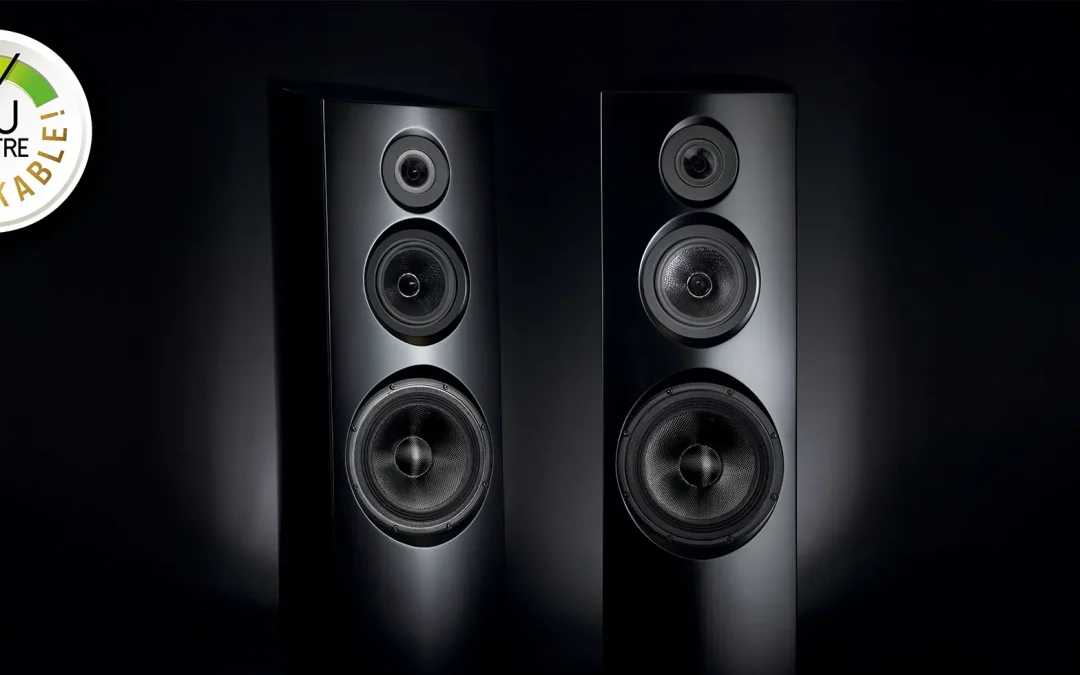
The Stellar is a three-way loudspeaker equipped with three particularly well developed and totally proprietary drivers. Continuing on its technical path, Davis has opted for the latest generation of its cone tweeter.
In the 1970s, Davis founder Michel Visan, then technical director at Siare, designed the TWZ. This tweeter used not a traditional dome, but a cone made of cellulose pulp, then aramid fibre – a woven material, like the membranes of other ‘in-house’ loudspeakers.
It wasn’t long before Davis created the TW26K. This was followed by a double-ferrite version, found on the Kristel range, and a cellulose pulp model, the TW26G. In 2009, the new TW20K2FR was launched on the Karla. A model with a smaller diameter coil, capable of higher frequencies.
The Stellar’s tweeter is the latest version of a renowned transducer. To increase its transparency, a great deal of work has gone into the bonding between the diaphragm and the voice coil. The result is near-perfect linearity between 2,500 and 25,000 Hz.
What’s more, as the geometry of this tweeter resembles that of the midrange, it is easier to merge the midrange and treble registers.
The midrange frequencies are entrusted to a 17 cm diameter Kevlar™ cone driver with a decompressed aluminium chassis. This is an improved version of the excellent 16 GKLV6M. This time it has a super-powerful TiCoNAl magnet, which generates ultra-fast diaphragm acceleration, enabling transparent sound. The voice coil is mounted on a kapton support.
For bass, Olivier Visan opted for a 25 cm driver, ideal for this type of register. Its membrane is large enough to displace a lot of air, but light enough to withstand high accelerations. To achieve this, the membrane is made of carbon fibre. It was Michel Visan who first worked with this material to produce a hyper-rigid cone.
For this made-to-measure model, Davis had 10 mm thick field plates machined to a hundredth of a mm. The long winding ensures perfect control of the movement of the moving part, even during long excursions. The centring and return elements (small pleat and spider suspensions) have stiffness constants that are ideal for lowering the frequency, but also for containing its displacements.
To harmonise the operation of these excellent transducers, we obviously needed a crossover to match. And while designing and building your own loudspeakers naturally simplifies the task, the fact remains that the crossover for a three-way loudspeaker remains a challenge in terms of development.
In fact, during our visit to the factory, we were able to photograph a table covered with prototypes of the various stages in the development of Stellar crossovers. It’s quite impressive! Several dozen filters were made from some of the most transparent components on the market. Numerous in-depth listening sessions followed, leading to the creation of an appropriate filter. The midrange works over a wide range of frequencies (150 to 2,800 Hz). Each of the loudspeakers is used in its initial frequency range. It has little or no effect on the other transducers, because Olivier Visan has used steep filtering of up to 24 dB/octave. This means that there are very few overlap zones between each loudspeaker. The levels are designed to give a linear frequency response curve.
To optimise the loudspeakers and filtering, the internal cabling uses different sections of Van Den Hul conductors.
The set up
Although we first listened to the Stellars at the Munich high-end trade fair last May, it was in the Davis Acoustics auditorium in Troyes that we were able to sample them at length and in the best possible conditions. They were powered by the excellent Gryphon Essence power amplifier, to which was connected an Atoll ST300 Signature and Meitner MA3 DAC/network player/preamplifier. Cabling was handled by Esprit’s Eureka series. At Davis, the listening room is vast, comfortable and neutral, allowing the speakers to express themselves at very high volume without the slightest acoustic ripple. As a result, we were able to enjoy a very fine session in which a wide variety of musical styles followed one another with delight.
The sound of the DAVIS Stellar
After several minutes of uninterrupted listening to Stellar, the first notion that immediately springs to mind is ‘ease’. You listen to one track after another, and everything comes through with disconcerting ease. That’s it: Stellar speakers are easy, even facilitating. It’s an unusual compliment, but one we value highly. Nothing is more difficult than reproducing recorded music so that it flows naturally, as pleasantly as possible. There are a multitude of criteria involved. All the components have to be at their best for the reproduction to be at its best. Nothing could be more complicated! And yet, with Stellar, the notion of naturalness takes on its full meaning. Whether you’re listening to a complex work or a very simple one, at a totally unbridled sound level or virtually muted, you’ll be able to enjoy a result that’s as elegant as it is realistic. Listening to the wonderful Hadouk Trio disc recorded live at FIP, we are treated to a surprisingly clear, light and airy sound spectacle. The sound perfectly fills the listening room, which in this case is very large, without ever straining. ‘Effortless, easy, always easy’, as one of our listening companions said to us in Munich… And we understand! The percussion, the plucked and scraped strings, the perception of metal, the impact on the membranes, nothing escapes our ears. On our favourite Radiohead track, In Rainbows, the base is highly detoured, the voice powerful, modulated and soft. It’s all the more astonishing because we’re listening at a particularly indecent noise level. The drums hit us in the plexus, the physical sensations are Dantesque.
All this with a very nice stereophonic effect. On ‘Unfinished Sympathy’ from Massive Attack’s first album, the differentiation of planes in the sense of depth is very precise. You could almost count the layers of sound. Yet you can sense that the Stellars are asking for more. So the organiser of our listening session decided to connect an even more powerful converter, in this case a Meitner MA3. As a result, the Gryphon Essence amp seems to let itself go and delivers a muscular modulation controlled to the millimetre. The immediate lesson of this anecdote is that the Stellars deserve the best at every level, from the source to the amplification. Duly noted. There’s an obvious improvement in the way the notes are held, with considerably improved legato and a delightful sense of modulation. On the Police’s ‘Roxanne’, the rhythmic tracking is simply extraordinary, with an energetic strike and a lively chanted melody. On the inimitable ‘Walking On The Moon’, we’re treated to great depth, with a deep, nervous bass, a clear voice totally devoid of any extra thickness, and always a beautiful spatialization.
Our conclusion
‘What is well conceived is clearly stated, and the words to say it come easily’. Nicolas Boileau’s maxim sums up the Davis Stellar’s admirable behaviour in all circumstances.
As we said, these speakers are easy. And it’s very difficult to make sound reproducers that make listening to your favourite records so easy. It took an enormous amount of work by Olivier Visan and the team at Davis Acoustics to achieve this. A multitude of filtering, transducer and acoustic load tests were necessary to achieve such a natural balance. Because if there’s one quality that these speakers embody more than any other, it’s naturalness, and you can say what you like, but it’s the cardinal virtue of any good hi-fi system. Add to that the fact that the Stellars provide a hyper-wide sound spectrum without any compression, and that we’re dealing with a 100% French product, and we’re not far from the perfect equation. We loved these new Davis Acoustics speakers. They embody a kind of sonic perfection and prove that the manufacturer from Troyes can match the most ambitious designs. Highly recommended!
Telos Audio Design specialises in developing highly sophisticated optimisation products that emulate a reference ground so that connected audio devices perform to their full potential. The first step towards this clever ecosystem is the Telos Audio Design Macro G, which we have tried and adopted!
Telos Audio Design has been studying the concept of active grounding for several years. It is a fundamental realisation of the environment in which our hi-fi systems now operate. Since the end of the 20th century, our homes have become overloaded with electrical devices equipped with high frequency switching power supplies that use their connection to earth as a discharge for the interference they generate.
With electrical terminals often serving hundreds of homes, your hi-fi system’s earth connection may be linked to thousands of devices polluting the earth line.
However, the earth connection is the absolute reference for all vital voltages in your system. It must therefore be as quiet and stable as possible. The best way to eliminate noise from the earth line is to use a clean, dedicated earth, but this poses regulatory problems, and people living in flats have no control over this aspect.
Thanks to its advanced grounding technology, the Telos Macro G creates a more stable and quieter electrical environment. It is a noise reducer specially designed to optimise the performance of your digital devices. It incorporates an energy-efficient power supply module specially designed to provide stable power to your transport/network player processor. When the processor is supplied with a stable power supply, it can provide a more accurate ground reference point. In the age of ubiquitous streaming, this grounding solution developed by Telos is highly relevant.
The Telos Audio Design Macro G features its proprietary digital noise reduction device. It also incorporates a Schumann generator, like Junilabs’ Juniwave 2, making it a truly comprehensive device. Schumann resonance (named after the scientist who theorised it) is a wave that revolves around the Earth, whose frequency is proportional to the diameter of the planet and the thickness of its atmosphere.
It has cradled all terrestrial bodies (mineral, vegetable, animal) since their existence. However, the use of satellites, mobile phones, television, electricity, computers, Wi-Fi, Bluetooth, etc. drowns this wave in ambient noise. The Schumann generator enhances this naturally existing wave and provides a feeling of well-being to all living beings.
Finally, the new Macro G is housed in a rigid case that attenuates sound effects caused by resonance frequency issues in the materials.
More and more Ethernet filters are currently appearing on the market. This is not one of them. Its active noise reduction works in a completely different way, so you will use the Macro G differently too.
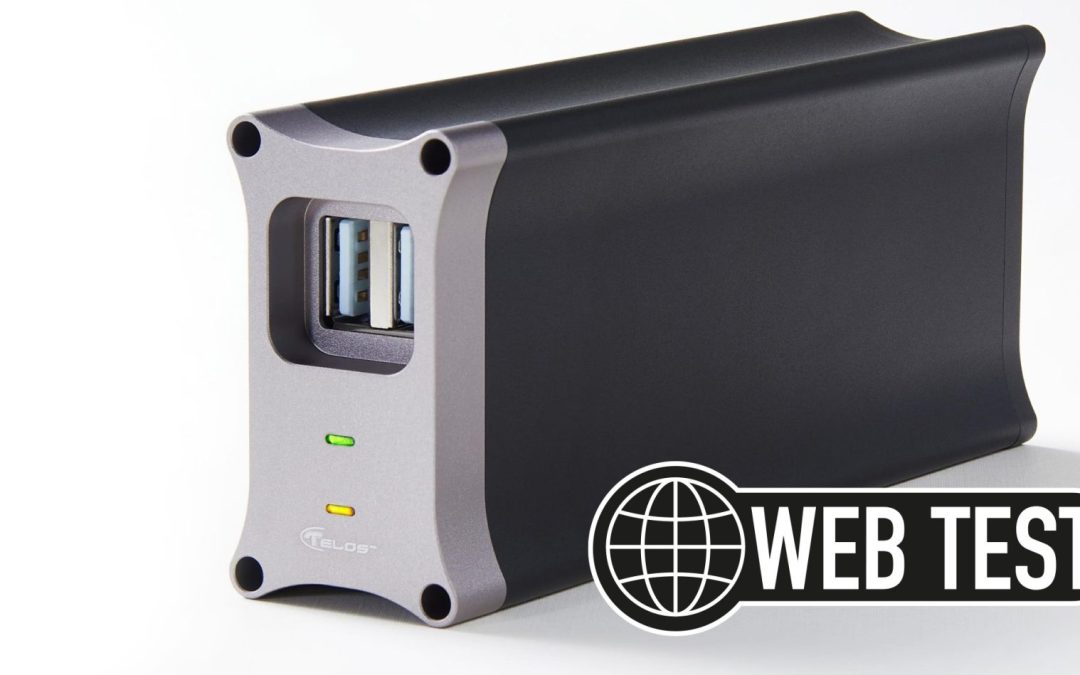
Although each Macro G has two Ethernet (or USB or HDMI) sockets, it is not a device that can be connected in series. The two ports are intended to be connected to vacant sockets on two of your digital components. The Macro G is connected to the ground connections of your network. It is not in the signal path at all.
Installation
The Macro G product range has three connection options: RJ45, USB and HDMI. All these connection options work in the same way with the same performance characteristics. Each Macro G has two digital connection sockets for use with two different digital components.
The Macro G should be placed close to or on your system rack so that the installed grounding cables are close to the components you will be connecting.
Finally, it is essential to connect the Macro G to a wall socket for a direct connection to the power supply. Any type of network conditioner or mains filter may cause your Macro G to malfunction.
The sound of the Telos Audio Design Macro G
There is undeniably a before and after ‘Macro G’. Even though our network playback protocol is already particularly sophisticated, the contribution of the small Telos box is indisputable. We had already had a positive experience with the Juniwave 2.
We understand many of our customers may be sceptical about this type of product. And yet they work. It is important to realise that in 30 years, the amount of electrical and electromagnetic noise has exploded, putting a strain on the fragile audio signals that pass through our hi-fi systems. Just because you can’t see them doesn’t mean they don’t exist – quite the contrary.
They are even more harmful because they are hidden. What the Macro G does is make your network playback system incredibly smoother and more nuanced. It does not seek to add anything. Instead, it removes a layer of electromagnetic fog that distorts the information delivered by your system. The bandwidth is the same, but it flows more smoothly. Other important benefits include a soundstage that opens convincingly in all three axes.
The sense of depth is significantly improved. There is air in your listening room. The density of the stereo triangle increases, but so does its openness. There is no doubt about how the musicians are moving on stage. Now it is much clearer.
This excellent device does not only improve the sound. Telos very cleverly sent us one RJ45 model and a second HDMI model. We connected the latter to our Pioneer BDP-LX 88 Blu-ray player and were shocked. While the differences in sound are sometimes subtle, the visual differences, on the other hand, are quite striking. Not long ago, we had a great experience with the Silent Power HDMI iSilencer.
With the Macro G HDMI, the improvement in the picture and sound of our Blu-Ray discs is even more impressive. Not only does the colour palette seem more subtle, with much more natural tones, but the depth of field and sharpness in the backgrounds are unmistakable. We feel like we’ve traded in our DLP video projector for a latest-generation SXRD; I’m hardly exaggerating.
Our conclusion
We clearly have a lot of work to do to clean up our electricity supply and all the pollution it causes. It’s a bit like the Danaids’ barrel. A radical change in society would be needed to achieve this. In other words, it’s a lost cause. Consequently, in this context of structural pollution from waves, every responsible audiophile will be keen to find ways to make the modulation of their precious equipment as pure and unpolluted as possible.
In this context, the work of a manufacturer such as Telos is to be commended. It offers a wide range of solutions, the smallest of which, such as the Telos Audio Design Macro G, are still affordable and highly effective. But for the most determined among us, Telos can take you infinitely higher.