In less than 10 years, Meze has legitimately established itself as one of the most reputable manufacturers of its generation. With a limited catalogue made up almost exclusively of bestsellers, the brand has managed to breathe a welcome breath of fresh air into the closed circle of audiophile headphones, whether thanks to the iconic 99 Classics or the sumptuous Empyrean, as expensive as it is generous. And if the latter was already considered the pinnacle of the genre, now the brand is unveiling the Meze Elite, the ultimate version of the already highly select Empyrean. A simple variation or a genuine evolution? Let’s find out.
Founded in 2009 in Baia Mare, Romania, Meze Audio occupies a very special place in the world of headphones. The company was founded by its eponymous creator, Antonio Meze, a music lover and musician who was frustrated at not being able to find the same connection with headphones that he felt with his guitar – a Fender Stratocaster. And, as we all know, frustration breeds obsession. Finally, he decided to set up his own team to produce the object of his desire: the perfect headphones.
First via OEM, picking and choosing from the (very) many Asian producers. But it was in 2015 that the brand pulled off its first major coup, developing its first entirely in-house model, the 99 Classics. A closed, nomadic headphone with a bold design that makes the most of noble materials such as raw wood, leather and steel. A complete aesthetic and technical success, this is still one of the only helmets that can be completely dismantled and repaired. The promise? A virtually unlimited lifespan, with each part produced on demand for immediate replacement.
Elegant, solid and comfortable, they quickly rose to the top of their genre, surprising audiophiles and the biggest players in the sector alike. It was a total success and the reviews were unanimous, so much so that six years after its release, it continues to dominate the charts, systematically establishing itself as one of the best references for nomadic headphones.
In 2018, Meze is back with a sedentary headset: the Empyrean. A true standard-bearer, it arrives on an already well-established market with rivals who have nothing left to prove. And yet, the mayonnaise takes hold once again and Meze delivers, once again, a very high-flying, truly status-enhancing helmet. Isodynamic transducers produced by Rinaro, exceptional acoustic performance, all served up in a luxurious case worthy of its price claims.
But how can you do better when this model is already reaching for the sky? It’s a tricky question, and one that Meze intends to answer with the new Elite, a discreet variation in form but profound in substance.
Introducing the Meze Elite
A true work of art, the Meze Elite retains the excellent build quality that the Romanian team is renowned for. And for good reason: with a stratospheric price tag for headphones, they had to have at least the same level of construction and finish as their predecessor. So it benefits from the same meticulous attention to detail, although from the outside it’s hard to tell them apart.
And for good reason, the Empyrean was already a textbook case. Sculptural headphones, as complex in appearance as they are simple in design, thanks to the massive use of CNC-machined parts. Note, for example, the very large ear cups, cut from a single piece of aluminium and fitted with holographic grids, also produced by CNC.
Now silver instead of gold or black, the external surfaces are engraved with the brand’s emblem, a blackbird, accompanied by the Elite logo, the only direct differentiating element from its little brother. As for the rest, the patented suspended leather headband ensures perfect weight distribution over the head, while the double-arm carbon-fibre yoke and support rods are now jet black.
The gargantuan dual-coil transducer, still produced by Rinaro Isodynamics in the Ukraine, can be seen in full view. This masterpiece benefits from a number of innovations, including a new ultra-low-mass diaphragm called Parus, capable of reproducing an even wider frequency range, if that were still possible. The promise of this new transducer? Ten times less harmonic distortion (0.05%) and the ability to seek out high frequencies worthy of a super tweeter (up to 112 kHz). An evolution rather than a revolution, then, Meze is aimed at a tiny fringe of enthusiasts, ready to confirm the adage that quality has to be paid for. But it doesn’t matter if, in practice, the headphones show probity. And without spoiling too much, we have to admit that Meze has achieved another feat here.
But first, let’s take a look at how this behemoth behaves on our heads.
Comfort and bundle
With transducers measuring no less than 100mm high and 73mm wide, it’s hardly surprising that the Elite’s earpieces are among the largest on the market. And with good reason: apart from Hifiman and Audeze, few headphones boast such a large surface area.
Fortunately, Meze has learnt a lot from its experience with the 99 Classics, and once you’ve got them on, you’ll almost forget you’re wearing them. The suspended wing system, although a little strange at first glance, works surprisingly well and despite a venerable weight of 430g (excluding cables), the Elite almost floats on your head.
On contact are the ovoid shape memory cushions, ensuring optimal intracranial pressure to accommodate prolonged listening sessions. It’s worth noting that the brand now supplies two sets: the first in leather, 30 mm thick, ideal for the Empyrean, accompanied by a second hybrid set, combining Alcantara for the contact area and leather for the outer seams.
Once again, Meze pays particular attention to the cable, the primary link between the Elite and the source. Assembled by hand, these are available in pure copper or silver-plated copper versions, but always in partnership with the excellent Furukawa company, renowned for its expertise in this field. Unsurprisingly, all terminations are possible: 6.35 mm TRS, 2.5 mm TRRS, 4.4 mm Pentaconn and even XLR 4 pins.
To complete the package, the brand offers a genuine aluminium carrying case with its headphones, capable of holding the headphones, cables, two sets of foam and even a source such as an audiophile walkman. Which we did.
The set up
Surprisingly sensitive for a model of its kind, the Elite will require an excellent source. Its relatively high sensitivity, combined with its low impedance, makes it particularly sensitive to residual noise. In our very long list of portable audiophile players, only a few finally succeeded in this difficult challenge.
The new iBasso DX300 lends itself particularly well to the game, but we prefer the balanced 4.4 mm output, without which it will quickly run out of steam. As usual, this system is best paired with Sabre ESS or Cirrus Logic MasterHiFi chips.
The dynamics offered, combined with a particularly wide frequency response, produce sensational results.
On a living room system, a high quality DAC is essential, as the Elite is very sensitive to both good and bad recordings. Tested on a Chord Dave + ALO Audio Studio 6 set, the results were mostly masterful, but a few tracks were real sinecures. But enough chatter, let’s get down to the sound.
The sound
From the very first notes, the Elite surprises with its soundstage. While psychoacoustic effects such as Dolby Atmos and other software modulations have made giant leaps forward, Meze cuts through all the artifice and sets the record straight. We are literally enveloped by the music. The stereophony invades our senses like a devastating tsunami, leaving us stunned by such mastery.
That’s the magic of the Elite, its ability to recreate an almost physical presence, usually reserved for living room speakers. The bass reaches abysmal depths, so much so that a Pavlovian reflex seems to compress our ribcage, while the treble soars high without ever seeming to stop. It’s true that our young ears can still distinguish life after 15 kHz, but beyond that, a new spectrum of nuances has always been forbidden to us.
Fortunately, not this time, as the headphones tickle our ears with discreet but very present notes, carried by sumptuous harmonics. The imposing isodynamic transducer is not there to make up the numbers. Ultra-saturated electro layers, bass drums, double bass… the headphones systematically respond to every sound.
And with good reason: apart from Stax and their electrostatic diaphragms, no other diaphragm offers such clean, chiselled transitions. The incredible speed of the MZ3SE transducers is reflected in every attack, every breath. It’s impossible to fault the headphones when paired with a suitable source, as each voice seems to materialise right inside your head.
The exceptional resolution, combined with excellent dynamics, quickly makes you want to turn up the volume. On the iBasso DX300, with balanced 4.4 mm output, you get a pair of nomadic speakers capable of competing with a very high quality sedentary system. The depth of sound, its firmness and the prodigious aeration demonstrated by the Meze easily place it in the top 3 of the best models of its kind to my knowledge.
But, to answer the original question, does the Elite outperform the Empyrean? Yes and no. More refined, more balanced and above all more precise, if that were still necessary, the newcomer reinforces the touch of madness already present in the previous model. Superfetatorial? Perhaps. But once you’ve tasted it, it’s impossible to forget.
Every nuance, every aspect seems to be magnified by this Elite, and while the good recordings come to life, the bad recordings are a flash in the pan. The overall homogeneity makes it a real jack-of-all-trades. Orchestral music, uninhibited dubstep, vocal jazz – there’s nothing he can’t handle, and it’s almost with envy that we look for the fault. In vain, the headphones confirm the adage that, sometimes, the bird in the hand is as good as the bird in the bush.
Our conclusion
Superb in both form and content, the Meze Elite hits the nail on the head, confirming once again the mastery of the Romanian manufacturer. An ode to excess, this newcomer hits hard and true, a fatal blow delivered by a David who is no longer really afraid of Goliaths. Admittedly, the Empyrean was already exceptional, and given its price, the Elite may seem secondary to those who already own its predecessor. But as we listened to it, it became clear that the technical contribution of this Elite over the Empyrean was real, especially on electronics of the same calibre.
So, if passion trumps reason and you’re looking for a no-compromise solution, the Elite once again lives up to its name. A must-have for those who can afford it.
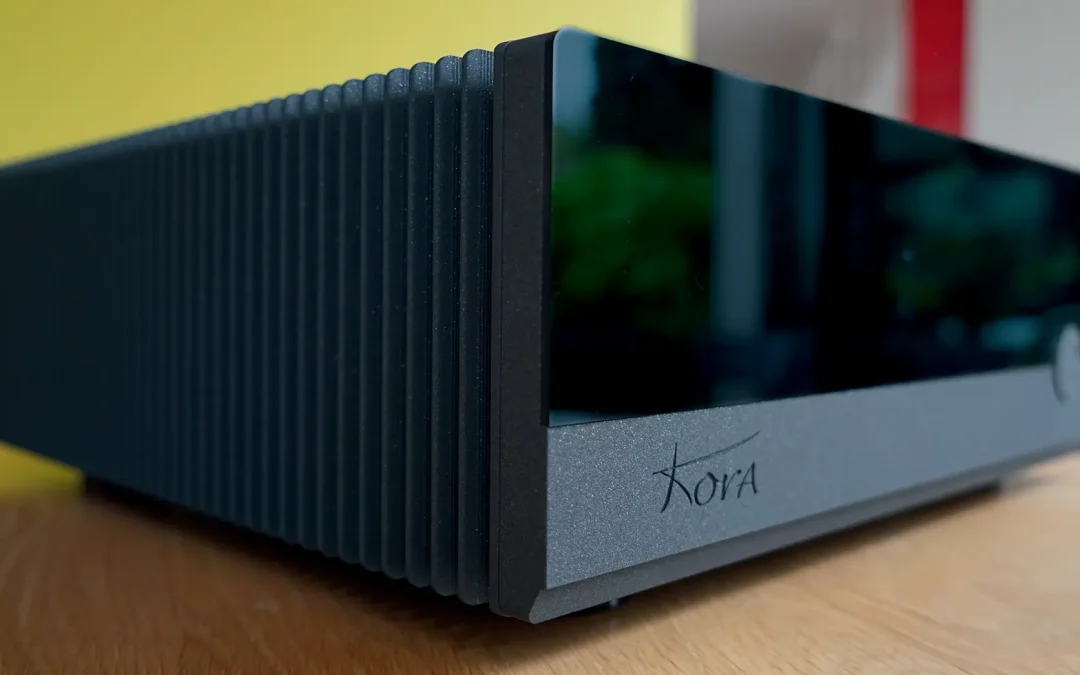
After testing the brand’s smallest integrated four years ago, we’re now discovering its biggest power amplifier. In any case, this big difference teaches us one thing: Kora maintains a constant level of quality and creativity throughout its range. The Kora TA480 is a valiant power block that has nothing to envy the finest machines in international production.
What all Kora electronics have in common is the Square Tube circuit, a proprietary technology developed by Bruno Vander Elst, head of the company. On paper, the principle seems quite simple (and extremely judicious), but putting it into practice is infinitely less so. The Square Tube is a tube operational amplifier circuit whose technical name is Vacuum Tube DC Operational Amplifier.
The four tubes in question are double triodes from the ECC family, specifically the ECC82 and ECC83, biased in pure class A with, as a result, an operating point placed right in the middle of the load line. This operating point is imposed by a current source on the two ECC83 differential stage input triodes and by a reference voltage for the two ECC82 output triodes, in order to guarantee maximum life. The heating of these tubes is regulated, in direct current and referenced to earth for the ECC83, but alternating and floating for the ECC82. They make up a voltage amplification stage with extremely high dynamic gain, the output of which drives a push-pull stage with complementary Motorola power transistors biased in class AB. This output stage works as a follower, with no gain and very low impedance, guaranteeing extremely stable operation, even with complex loads. In a way, it replaces the output transformer of an all-tube amplifier without the usual technical drawbacks such as phase shift in the low and high frequencies, poor coupling in the low frequencies and current limitations.
To sum up: the Square Tube amplifies and controls the audio signal, while the output transistors adapt the current demand on the loudspeakers, ‘transforming’ into current what the tubes amplify into voltage. In a way, they are similar to certain hybrid class A/D circuits. Follow our lead…
The Kora TA480 is the brand’s most ambitious stereo power amplifier. Derived from the TB400 integrated model, its power is increased to 240 W per channel under 8 ohms. With the TA series, Kora has pioneered a technology that represents a real breakthrough in the way amplifiers work. This revolutionary design combines the best of the tube with the qualities of the transistor, much better than a hybrid amplifier could do. This sophisticated scheme allows the tubes to be powered from +300 to -200 V, unlike other amplifiers on the market that only power their tubes at positive values. As a result, the loudspeakers are pushed but also pulled, unlike other amplifiers that only push the diaphragms. The result is an unprecedented level of control over the drivers, which translates into superior articulation and detail, exceptionally low distortion and a bass that is as clear as ever.
Inside, the structure is perfectly symmetrical around a large toroidal transformer in a central position. The heat sinks on the sides house the various push-pull power transistors. The two capacitor banks are adjacent to the heat sinks.
The two-material front panel features a smoked Plexiglas plate at the top, revealing the four tubes when they are switched on. The matrix display informs the user of the adjustable gain level and the type of input (RCA or XLR). The single multifunction button gives access to all the amplifier’s parameters and manages the inputs. However, some operations can be accessed via the remote control supplied with the device.
The Kora TA480 has two separate stereo inputs. Input 1 is unbalanced and has two RCA coaxial sockets. The input impedance is 10 kilo-ohms. Input 2 is balanced and has two XLR sockets.
The input impedance of each polarity is 20 kilo-ohms. The input is selected using the front-panel button. Press to select SETUP mode, from which the input can be selected. The loudspeaker outputs are made via two pairs of screw terminals.
The set up
Despite appearances, the Kora TA480 has no volume control. It requires the use of a preamplifier. It will deliver its full rated power when the preamplifier provides a signal of the order of 500 mV. This value is the minimum necessary to obtain the nominal power output from the loudspeakers. To avoid saturating the amplifier input, it has an attenuator. In other words, an input signal reducer. This attenuator is adjustable from 0 dB to -40 dB in 1 dB steps. This attenuation can be adjusted simply by turning the knob on the front panel. The Kora remote control has no effect on this setting. After a 30-second delay on switch-on to warm up the tubes, the Kora TA480 is ready. There were no limits to the choice of loudspeakers. We encourage you to carry out a small audible test of the correct mains phase.
The sound
Even before you see it, you can often tell a big amp by the sound it produces. Not by the way it produces sound, or its personality, but by the scale with which it propels it into your environment, imposing it in your home. A big amp is often a guarantee of extraordinary sonic presence. That’s why we love them, and that’s why we often buy them. Car enthusiasts know perfectly well that more than six cylinders is always better… No matter how you turn this equation around, nothing beats a big engine! The same goes for amps as for cars… And with the Kora TA480, there’s no ambiguity…
Paradoxically, it ‘sounds bigger’ than its perceived volume, because it’s not particularly imposing compared to the average power block. On the other hand, it quietly assumes its weight of almost 30 kg. And its motorisation is totally disruptive. Neither tube, transistor or hybrid, it’s all its own… The purpose of this preamble is to put you in the mood. The Kora TA480 is not a conventional amp. It has a personality all its own, and is committed to offering its own version of neutrality. A joyful, dense, highly structured neutrality. As we audiophiles are well aware, absolute neutrality is a pipe dream. We all have our own systems of representation, and we’re all looking for the equipment that will meet our expectations. The Kora TA480 is the amp of choice for the music lover who enjoys music. It offers a very exciting vision of sound reproduction. Firstly, because it’s very physical. This is a powerful amp, and you can hear it straight away.
It deploys considerable energy with a great deal of control. In the company of all the speakers we paired it with, the Kora TA480 did its job without ever encountering the slightest resistance. The 240 W announced are there, no doubt about it. Even when listening to ‘sport’ music over extended periods, it is at ease and supports all rhythms without flinching, even three hours of high-level symphony orchestra. A famous tyre dealer once said that without control, power is useless. That’s exactly right, and the Kora TA480 has lived up to that maxim. It delivers plenty of power with remarkable precision. Despite the muscular quality it can sometimes impart to the listening experience, there is a permanent clarity that allows all the melodic lines to be considered individually with great ease. The same goes for the soundstage, which can be enjoyed in its entirety, but is enriched by a multitude of components that combine to create a rich panorama.
The Kora TA480 is feisty, precise and ultra-dynamic, but completely refuses to adopt facile stylistic effects. Despite everything, it’s a sophisticated device that offers elegant listening. When we talk about the pleasure we can feel in the way it reproduces the sound message, it inevitably makes us think of a very fine bottle of wine that it would be impossible not to finish once it has been opened. This is what makes listening to the Kora TA480 so sensual. It quickly convinces us that the reproduction is meticulous and natural, but it also quickly makes us realise that beyond formal perfection, the listener is seeking pleasure above all else. And that’s what this is all about.
Our conclusion
About four years ago, we fell in love with the ‘little’ TB140 integrated, which we continue to enjoy every day without tiring of it. Considering the number of devices we test, that’s a quality worth highlighting. With this (very) big brother, the notion of pleasure is multiplied tenfold. The Kora TA480 is a delectable amplifier. Its totally original and relevant technology ensures above all very natural sound reproduction, providing maximum sensations while perfectly respecting the codes of top-of-the-range amplification. It’s with immense satisfaction that we test a big French electronic that has absolutely nothing to envy the behemoths from across the Atlantic. We warmly recommend this amplifier to all audiophiles on a budget.
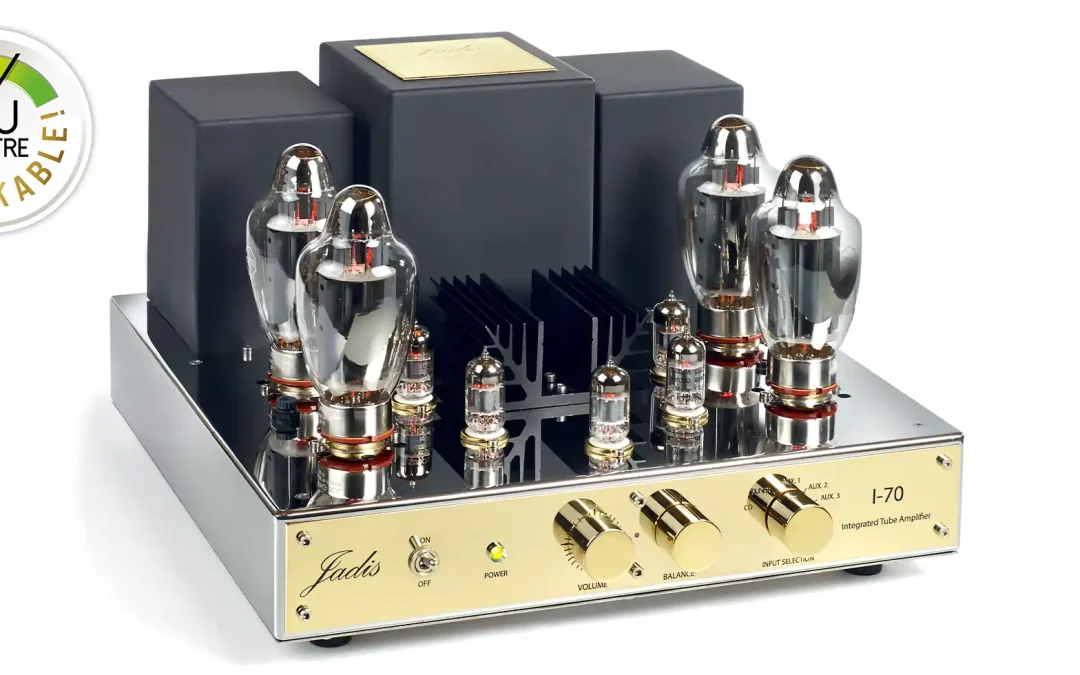
By the manufacturer’s own admission, whose catalogue is not short of models, the idea of developing a new built-in had been brewing for some time. A modern integrated with a new look and enhanced performance. The growing power of the new KT170 tetrode did the rest! So welcome to the new Jadis I70, a handsome, squared-off instrument that’s as faithful as ever to the philosophy of the proud Languedoc manufacturer.
When you first look at the Jadis I70, you get the feeling that the design has become more modern. However, the manufacturer has lost none of its visual signature, which makes a Jadis an electronic watch like no other. The I70 is no exception to the rule of the stainless steel case and 24-carat gold plating, the famous Jadis Touch that combines classicism and elegance. The chassis is low-slung, lightening the overall appearance. The mirror-symmetrical layout of the tubes and transformers and the square footprint contribute to the visual rejuvenation of the Jadis I70. The rear layout of the exclusively analogue and unbalanced connectors, in particular the left and right speaker outputs, was dictated by the internal layout of the circuits wired in the air, which the manufacturer has revised and improved.
The power supply and output transformers, all barrel-mounted and resin-damped, have been the subject of new research to meet the needs of the Jadis I70, which incorporates several technical features found on Jadis monoblocks. As usual, they are designed and built in situ at Villedubert. The output transformers have been adapted for use in a simple ultra-linear push-pull configuration with the new Tung-Sol KT 170 power tetrodes, with a huge operating margin to guarantee an extremely low distortion rate throughout the available power range, announced at 60 W in pure class A.
Incidentally, Jadis is one of the very few manufacturers in the world to offer push-pull assemblies operating in pure class A rather than class AB. This implies an operating point with a higher quiescent current than in class AB (current virtually zero or very low in class AB) and consequently push-pull output transformers capable of withstanding this quiescent current while retaining the primary inductance necessary to ensure a satisfactory response in the low frequencies. As for the power supply transformer, it has been designed with multiple secondary windings to match the new circuit structure, which separates the power supply for the power block from that of the input and driver stages in order to avoid any intermodulation, particularly during current-hungry transient modulation peaks.
The high voltage is regulated by a transistor circuit whose heatsink can be seen on the chassis. Filament heating is regulated and stabilised to eliminate any risk of induced noise.
The Jadis audio layout is based around nine tubes: two ECC83 high-gain double-triodes, three ECC82 medium-gain double-triodes and four KT170 beam tetrodes with a glass envelope in the shape of a Coca-Cola bottle. The internal void volume is higher than that of a KT150 to improve heat dissipation.
The gain and driver stages are in a classic configuration, similar to the manufacturer’s other push-pull schemes.
The set up
The Jadis I70 has a square footprint measuring 40 cm on each side. What’s more, at 30 kg, it’s a heavy product, with its centre of gravity pushed backwards. It is therefore essential to provide it with a particularly sturdy stand, and to be very careful in the case of a tripod with a single rear stand. On the other hand, when it comes to loudspeakers, this amp is relatively versatile. We’ve paired it with a number of quite different models, and each time, the marriage has been completely conclusive.
The sound
Rarely has a brand of amplifiers offered such a charismatic sonic personality as Jadis. And yet, the brand has demonstrated its ability to evolve over time to remain as relevant as ever. The proof is in this new integrated amplifier with majestic KT170 tubes, a rejuvenated look and reproduction that’s as addictive as ever. It doesn’t take long to be convinced that this is one of the Languedoc manufacturer’s marvellous products. That said, even if the essential virtues of Jadis are still there, you can quickly detect a real modernity in the way they are highlighted. The manufacturer’s strong point is its ability to magnify sound. Jadis always sounds majestic, rich and full: it’s a party every day. There’s never a dull moment, time flies, and recorded music is always wonderfully embodied. The term ‘sonic density’ seems to have been invented for the manufacturer. With the Jadis I70, this formidable presence is there. On the other hand, we quickly notice an unprecedented tension, a way of sharply emphasising rhythmic tracking, of demonstrating a more marked reactivity than usual. This I70 is very lively, lighter too, but no less robust. It retains everything that has forged the Jadis reputation, while adding a substantial dose of precision and ‘piquancy’. As a result, the soundstage is as majestic, wide and deep as ever, but it is now much more precise, with better-defined placement of instruments in space. The punctuality of the various sound sources seems to be better achieved. We felt this very clearly, whether on the Børresen Z-2s or on our T&T Nel Extrême. In both cases, but with nuances that the I70 highlighted perfectly, the sound environment is set up in an extremely exhaustive way and with a very nice gradation of the different planes according to the three axes (width, depth and height). This hyper-successful spatialisation combined with a spectral balance of great beauty delivers a level of sonic pleasure that is as vivid and persistent as ever. And the Jadis I70’s ability to handle the explosiveness of a big band or symphony orchestra is particularly exciting. The I70 is very much at home in exalting the articulation of the most diverse styles. On the contrary, it never imposes the slightest restrictive vision.
Our conclusion
As always, a Jadis amplifier is particularly hard to resist. It has a strong personality. That said, contrary to certain preconceived ideas, this in no way prevents you from enjoying your favourite music with a sense of discovery. Because the Jadis I70 is in no way a device that simplifies or modifies the message. On the contrary, it tends to sublimate it, giving it the opportunity to surprise you in an emotional and sensational way. What’s more, this new vintage, adorned with the KT170s, is capable of powering top-of-the-range loudspeakers with obvious ease, persuasively and with that unique verve. At the end of each listening session in its company, you can’t help but think that, in the end, nothing else matters… A great vintage from the South!
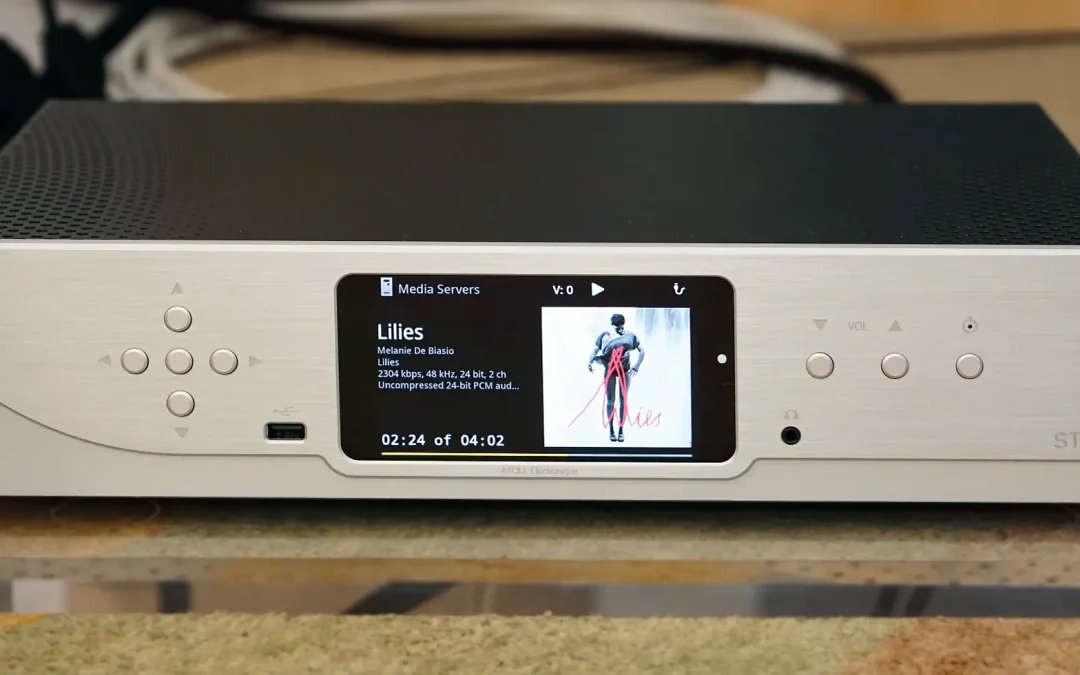
The Atoll ST300 Signature is the brand’s latest network player.We’ve known for some months that it was in the making, and we’ve obviously respected our confidentiality agreements with the Norman manufacturer.But the wait is always long for the enthusiast.Now it’s here, and we have no regrets about having been patient.Because the ST300 Signature is a marvellous digital source.Here’s an in-depth review.
The front panel of the Atoll ST300 Signature is identical to that of its little brother, the 200. Apart from the model name, it’s all the same. There’s the same attractive, delicately brushed metal front panel and the brand’s beautiful engraving under the screen. This player is equipped with a 5-inch TFT colour graphic display with a resolution of 800 x 480 pixels. Atoll is one of the few manufacturers to equip its network players with such a display, which is extremely practical for everyday use. It is also one of the few manufacturers to have developed a proprietary control application. These are commendable efforts that deserve a mention. Operation can therefore be carried out from the front, using the basic controls, or via the very comprehensive remote control supplied as standard.
On the other hand, the rear panel of the ST300 Signature is completely different. Not only is it more voluminous, but it also boasts better quality connectors, revealing much higher ambitions. These differences only materialise in the analogue section at output and input level. The six RCA sockets are massive models in gold-plated, Teflon-insulated pure copper. Finally, the unbalanced analogue outputs are doubled by a pair of balanced outputs.
Connections include two USB-A inputs (one front and one rear), four S/PDIF digital inputs (two coaxial and two optical), a Bluetooth receiver, two analogue inputs, an RJ45 network socket, a wi-fi antenna (802.11b/g/n), two S/PDIF digital outputs (one coaxial and one optical), a pair of RCA analogue outputs, a 12 V trigger and a mini-jack headphone output on the front panel.
The Atoll ST300 Signature can play DSF, PCM, FLAC, ALAC, AIFF, WMA, OGG, WAV, AAC and MP3 audio files in PCM at up to 24 bit/192 kHz, as well as DSD 64 & 128 formats. The Atoll streamer is connected using the UPnP/DLNA protocol and can access Internet radio via the Airable service. Streaming on platforms includes access to Qobuz, Deezer, Tidal, Tidal Connect, Spotify, Amazon Music… In short, you’re spoilt for choice.
On a purely technical level, the Atoll ST300 Signature has a rational internal organisation. It is made up of several sections. The pure Class A analogue volume control with no feedback operates via a switched resistor array and is configurable. If you decide to use it in conjunction with an integrated amplifier, the ST300 Signature can be set to fixed output. However, the unit also offers a variable configuration, allowing it to be coupled directly to a power amplifier.
The power supply section is divided into three linear power supplies of 10 V, 10 V and 30 V. The choice of voltage filtering is based on a capacitive assembly that reaches the coquettish value of 69,000 μF. This imposing multi-capacitor filtering provides much greater dynamic range.
Digital information is transferred via a Cirrus Logic CS8416, a digital audio receiver that supports sampling frequencies of up to 192 kHz. It features a very low jitter clock recovery mechanism that produces a very clean signal from the incoming audio stream.
Digital-to-analogue conversion is performed by a dual Texas Instruments/Burr Brown PCM1792 circuit, one per channel. By using a configuration that operates in parallel, twice as much current is obtained, which is ideal for a converter that works with current. The signal-to-noise ratio reaches a remarkable 132 dB.
As always, it’s the attention to detail that makes the difference, such as this ‘double’ conversion. But also the filtering of the DAC part by the large red Clarity Cap capacitors carefully selected by Atoll. In the end, the Atoll ST300 Signature is a high-level digital source that the development team feels is very close to the excellent CD400 player – that’s all there is to it!
The set up
Nothing too complicated. Especially if you use the Ethernet link. The Atoll ST300 Signature is then immediately recognised by the network. You can control it using the proprietary application, which is the simplest and most natural option, in every sense of the word. You can also use Audirvana Studio or Bubble UPNP, which is what we did. As far as the analogue output is concerned, if you have the option, we advise you to opt for balanced mode. Finally, pay attention to the correct mains phase. Naturally, we recommend that you choose a well-made cable to enhance the performance of this excellent network player.
The sound
Something special happens immediately with the Atoll ST300 Signature. We can’t tell you whether we have a particularly strong connection with Burr Brown converters, but the fact remains that this device imposes itself on our ears in an extremely natural and, above all, completely obvious way. In a way, you can’t help thinking ‘this is it’, ‘everything’s perfectly set up, there’s nothing more to touch’! This feeling of having achieved a more than satisfactory sound balance is a real joy. Clearly, the ST300 Signature isn’t the best network player in the world, but the great thing about it is that it lets us enjoy recorded music without question. In fact, with it, we’re at a stage where we’re not even looking for something extra. Not a little more bass, not a little more treble, not a little more dynamic range, nothing. Just enjoy the music, that’s all.
The sound reproduction of this device is particularly marked by density. The sound is full, thick, grainy and full of substance. You could almost make the analogy with a fine silver photograph. And yet, it is capable of demonstrating a magnificent level of precision and outstanding sharpness. It cleverly combines the best virtues of digital and analogue. This excellent material makes it possible to recreate a three-dimensional image with astonishing substance and materiality. The stage develops very naturally along the three axes (width, depth, height). It’s easy to follow the movements of the musicians on stage. The ST300 Signature produces warm, dense sounds that make listening to it surprisingly credible. We re-listened to the various Dire Straits albums on it, as part of our Zoom feature in this issue. And there is undeniably a wonderful complicity between the band’s records and the sound reproduction of this player: a presence that is simply exceptional.
Our conclusion
We’ve loved and respected Atoll Electronique from the outset, first and foremost because the company knows how to design and manufacture high-quality products at very competitive prices. For over twenty years, it has had ample opportunity to prove this through its many talented creations. But it’s also a company that knows how to take risks, and that’s much less common, especially in the world of audio SMEs. We well remember that Atoll was the first French manufacturer to launch an accessible and high-performance home cinema preamplifier/processor, the PR5.1. Now, with the ST300 Signature, Atoll is offering its third and best network player at a price that remains particularly affordable compared to the competition. Above all, for €2,800, the Atoll ST300 Signature is as complete as you could wish for. Because it also combines a whole host of other features! That’s why we recommend this device, which for us is a clear landmark in the hierarchy of network players available today. A product that’s essential for us!
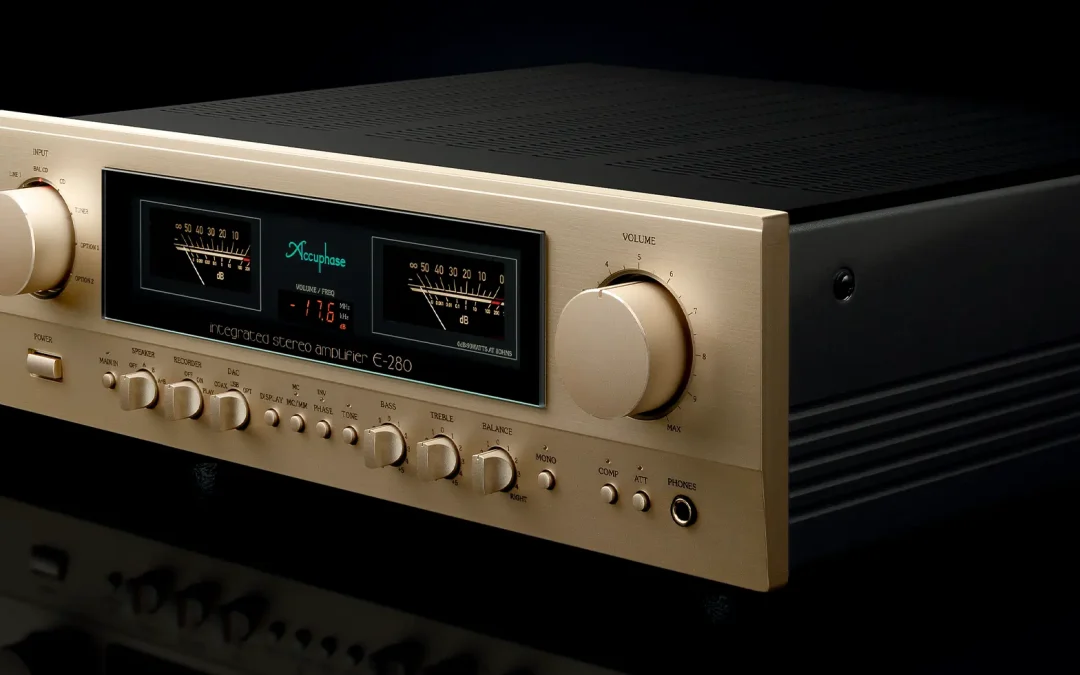
The latest integrated amplifier to be presented by the manufacturer, the Accuphase E280 benefits from all the advances of the other models, both in terms of the preamplifier and its AAVA volume management, and in terms of power amplification, with its dual-mono structure. More modest in size and power than the brand’s larger products, it surpasses the previous E270 and offers a fine entry into the world of Japanese high fidelity, capable of developing a remarkable sound with the vast majority of loudspeakers.
Thhe brand’s smallest amplifier, the Accuphase E280 retains the champagne-coloured front panel emblematic of the brand, around a glass pane housing the two needle-type meters visible on all class A/B units, now extended from -40 to -50 dB. Thinner than the other models, it still does not have a hatch and leaves all the adjustment buttons visible, from the selection of the two pairs of speakers available to bass and treble management, which are rare on such products apart from those from Japanese manufacturers. It also offers balance adjustment and a mono function. Recording can be managed via a REC input and a PLAY output, although most users will turn exclusively to the analogue inputs, five unbalanced (RCA) and one balanced (XLR). There is also an output so that only the preamplifier part can be used, and an input so that only the amplifier part can be used.
Two optional cards can be added to all these connections, simply to add an unbalanced input (LINE-10), an MM/MC phono input (AD-50), or above all to provide three digital inputs thanks to the new DAC-60 card, based on an ES9016K2M conversion chip. All these options can then be managed using the knobs already integrated into the front panel.
Inside, the improvements come from those made to the higher ranges, and while the Accuphase E280 retains two filter capacitors already increased to 30,000 μF on the previous generation, the dual-mono structure has been further improved, so that the units dedicated to the left and right channels are now perfectly symmetrical. In the centre, the high-efficiency transformer is combined with the power units on either side, whose output stages are made up of two bipolar transistors in a double parallel push-pull configuration. The 90 W power rating can then be increased to 105 W at 8 ohms and 150 W at 4 ohms. At the same time, noise is reduced by 12% at 36 μV compared with the E270, and the damping factor is increased by 25% to 500 thanks to the MOS-FET switches. Volume management is further enhanced by the patented AVAA (Accuphase Analog Vari-gain Amplifier) technology, now featuring a combination of sixteen V-I conversion circuits with differentiated gains, which are also perfectly parallel, allowing each channel to be processed independently without the use of variable resistors, thus achieving even greater precision. The new RC-250 remote control, massive and champagne-coloured like the Accuphase E280, is supplied as standard and can be used to control inputs, volume and any of the brand’s CD players – including the brand new DP-450, which we’ll be talking about shortly.
The set up
Without the addition of phono or digital cards, the Accuphase E280 is already a complete integrated amplifier in terms of analogue technology, and very ergonomic. Not as tall as its predecessors, it remains more discreet and only needs to be placed on a flat, low-vibration surface, and if possible, plugged into the mains with a cable longer than the one supplied. The difference remains obvious. The loudspeaker cables can be integrated with forks or banana plugs, while the plastic plugs on each input must be removed before adding the RCA or XLR source modulation cables.
With the front panel switched on, the device is extremely easy to use. The thumbwheel on the left lets you immediately select any input, even those on optional cards, while the thumbwheel on the right lets you adjust the sound. Both options are also available on the remote control, which is also highly ergonomic. Thanks to CTA Perception, we were able to listen to the Accuphase E280 in a variety of configurations, against competing amplifiers of lower quality or of the same range, and above all against the larger E380.
The sound
The identity of a brand like Accuphase leaves no room for confusion: the Accuphase E280 is the gateway to this world. Compared with smaller amplifiers, or even amplifiers in the same category, developed by many manufacturers who are often more comfortable in the lower range, the E-280 allows you to change the world of sound. It closes the gap with less expensive devices, both through the direct perception of a more lively sound and through a much airier, better-spaced soundstage. Voices gain in volume and substance, while the image becomes more structured and brings out a multitude of details that were often untouchable before. Blues singers become rounder, rockers’ lows move back and forth and then explode more. At the same time, background noise fades away and the sound becomes more natural, providing a real sense of realism. In direct comparison, the entry-level Luxman integrated can show more roundness and the E380, at €2,000 more than the Accuphase E280, takes these impressions even further, again improving timbre and asserting greater clarity in the background, for an even less muddled signal, particularly in large symphonic masses. Even so, the E280 can already take a large number of recordings far enough, without requiring the perfect engraving quality demanded by even more precise products.
Moving upmarket with sources (in our test to the sublime DP-570 CD player at €10,090), as well as with more power-hungry loudspeakers, demonstrates what a reserve of precision the E-280 can provide, as well as its instant power to energise the majority of bookshelf loudspeakers and a large proportion of floorstanding loudspeakers. The timbres are totally coherent at the top end of the spectrum, because the Accuphase E280 masters definition and therefore nuance over a very wide frequency range.
Our conclusion
With all the qualities of the Japanese manufacturer, in particular the speed of sound and a huge reduction in background noise, the Accuphase E280 remains, like its appearance, the gateway to the world of Accuphase. Without being as accomplished as the E380, it already offers all the soundstage, naturalness and space to take the listener into very high fidelity, when we are no longer just looking for music or sound, but also the true effects of reality. With its impeccable finish, it opens up a world of music that is impossible to imagine below this level. The icing on the cake is that, while at the end of its life the E-270 had dropped by €500 to just under the €5,000 ceiling, the E280 has kept the same price and still costs €4,990!
Author: Vincent Guillemin
Technical sheet: ACCUPHASE E280
Origin: Japan
Price: €4,990
Dimensions: 465 x 151 x 420 mm
Weight: 20.4 kg
Amplification type: Class A/B
Power rating:
2 x 90 W into 8 ohms
2 x 120 W into 4ohmsHarmonic distortion (THD): 0.05
Frequency response: 20 Hz to 20 kHz (+/-0.5 dB)
Signal-to-noise ratio: 96 dB (balanced); 107 dB (unbalanced)