

Recently reintroduced in France with its new Peak series, YG Acoustics dazzled the Munich High End 2024 with a demonstration of the XV 3 Signature from the Reference series, and the XX Live connected loudspeaker. Impressed by the quality of the phase and the purity of the sound, we wanted to put the brand back in the spotlight by testing a more affordable model from the Reference range. But rather than stop at a single model, we took advantage of the fact that the dealer Music Hall in Paris has several versions, to compare the two 2-way speakers in the catalogue: the Talus from the Peak series and the Carmel 3 from the Reference series.
YG Talus: back to the musical peaks
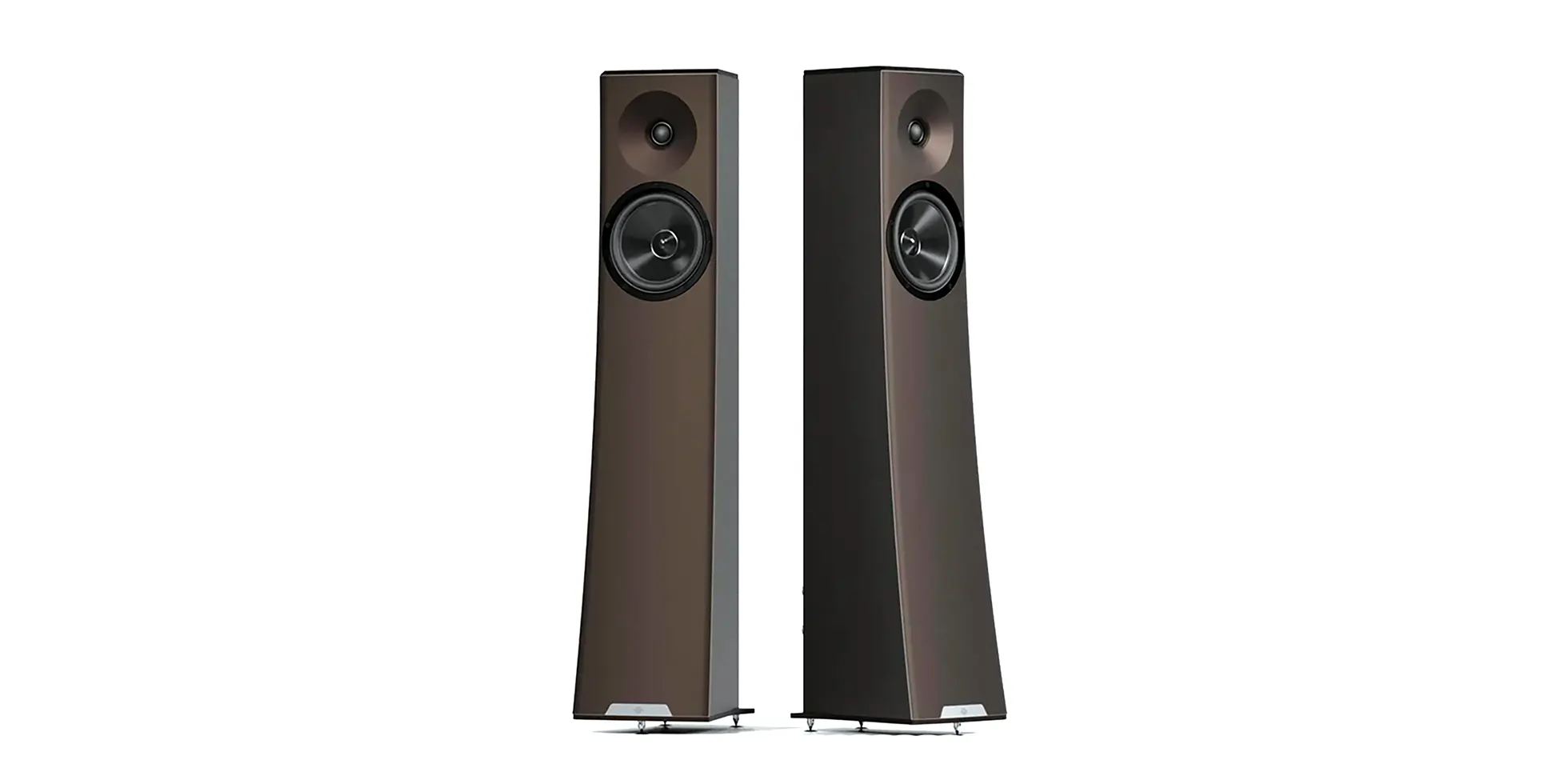
When we have tested the column Ascent (cf. VU#53; Remarkable) -the fourth model in a Peak series inspired by the mountains of Colorado -near the company’s headquarters- we had beside it the compact loudspeakers Cairn and Tor. The latter uses exactly the same drivers than the Talus, and an almost similar crossover structure integrated into the base of the cabinet. But as a floor-standing speaker, the Talus has a dense resin fiber enclosure with dimensions identical to those of the three-way Ascent: 101.5 cm high. A true two-way since it loses the woofer at the bottom, the Talus dips slightly lower but still reaching 32 Hz (compared with 26 Hz for the Ascent) and its aluminum front panel -still manufactured on the basis of 15 million points using computer modelling- is even more pleasing to the eye, as well as making the object more discreet.
The 18.5cm (7.25″) bass-midrange driver features the same BilletCore aluminum cone used on all the American brand’s models, while the tweeter is the same as that found on all the Peak series. Called ForgeCore, it is created from steel parts optimized by 3D geometry, and is therefore different from the Reference range tweeter. Like all Peak models, the Talus is handcrafted in the USA and benefits from special care and sumptuous assembly; it can be chosen in three wood colors: oak, ebony and rosewood. At 20 990 €, it costs 4 500 € more than the Tor (16 490 €) and 8 000 € less than the Ascent (28 990 €).
YG Carmel 3: the heart of the reference
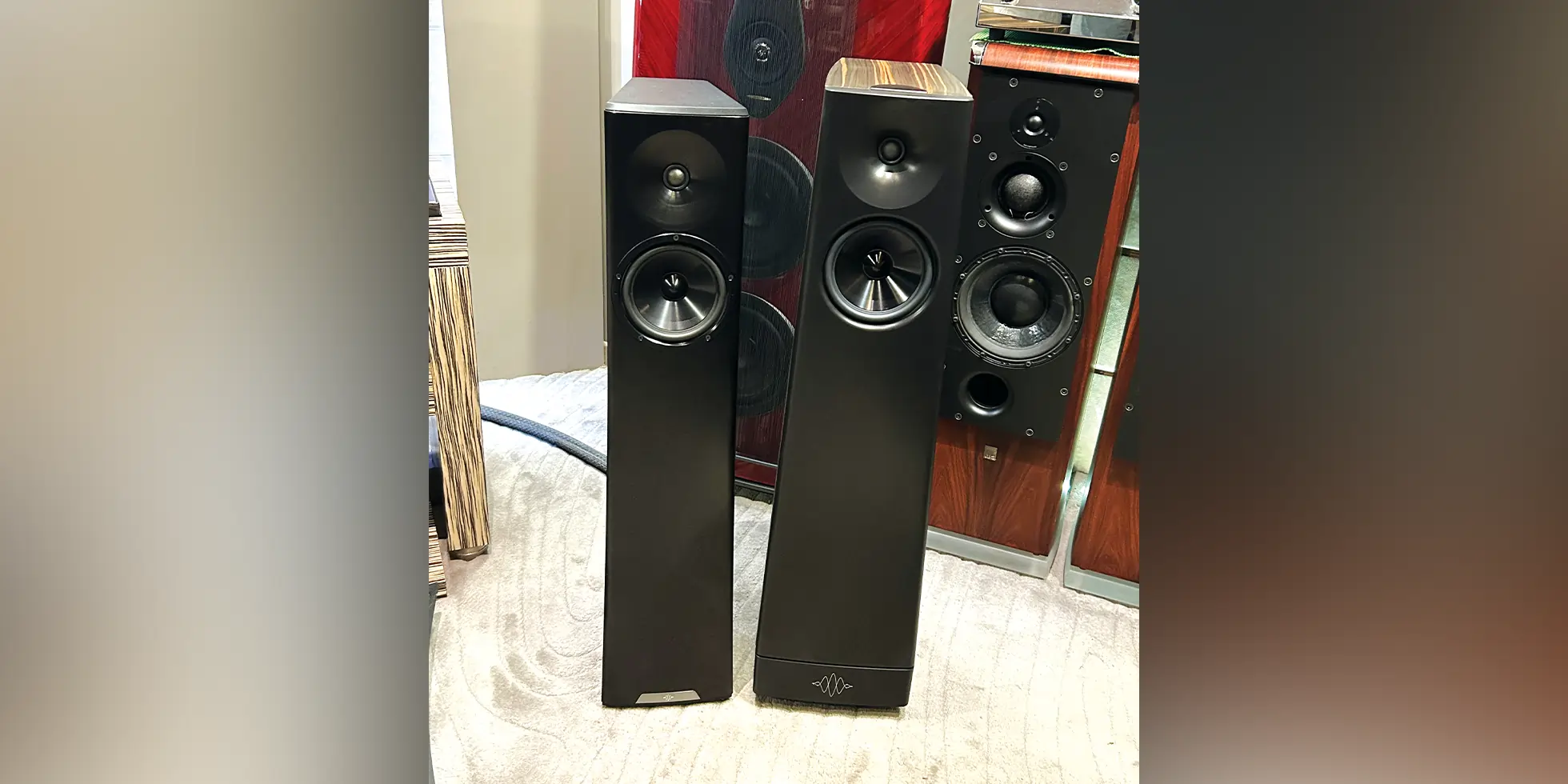
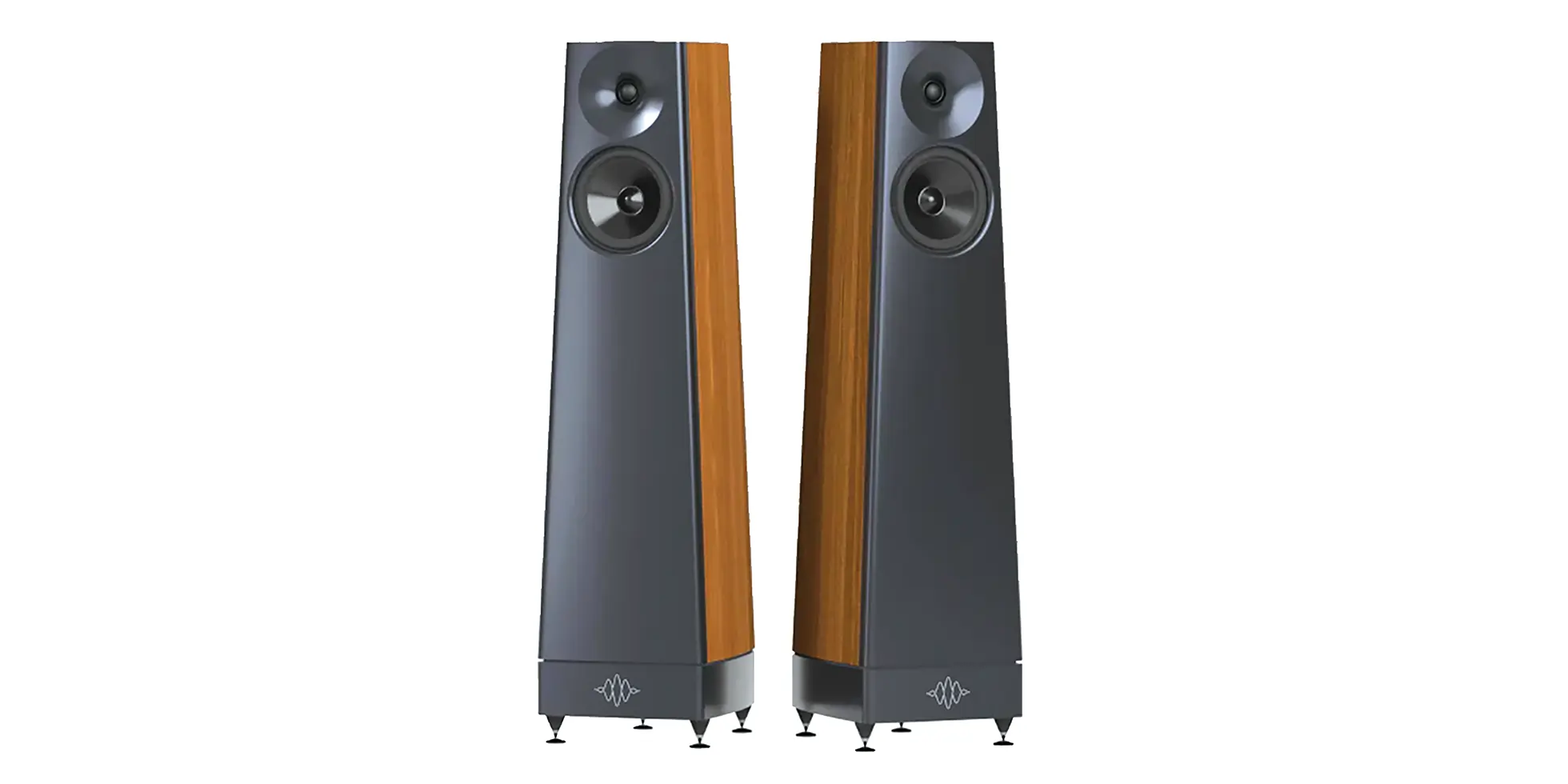
At 39 990 €, the Carmel 3 is almost twice as expensive, but it is only the entry-level model in YG’s Reference series! Including nine speaker models and three subwoofers (with the very impressive Invincible 21.2), this series contains just one two-way speaker before moving on to four three-way models (Vantage 3, Hailey 3, Sonja 3.2 & 3.3) and then four four-way models, three of which feature two two-way speakers per side (XV Studio 3, XV 3, XV 3 Signature), with basses placed in another cabinet of the same height as the midrange and treble one. Only the XX is handled by a single pair of speakers, its four channels being managed by bass units placed in the side of the main cabinet, weighing 170 kg per unit.
With a height of 103 cm, a width of just 23 cm and a depth of 28 cm at the base, reduced to just 20 cm at the top, the Carmel 3 still weighs 39 kg per unit. This is largely due to the solid, aerospace-grade aluminum walls, fitted to a precision of less than 0.1 mm, giving the speaker the effect of an exceptional object. Molded from an aluminum alloy, the BilletCore cones are machined into a thin 0.2 mm diaphragm weighing less than 30 g. But while the 7.25‘’ bass-midrange driver is the same as the Talus one, it is boosted on the Reference range by a more powerful and even more accurate neodymium motor. The tweeter features the same Lattice technology used throughout the Reference range, and is also made from aluminum alloy, with an 80 g ball machined using computer modelling and CNC machines to produce a final cell weighing just 0.03 g.
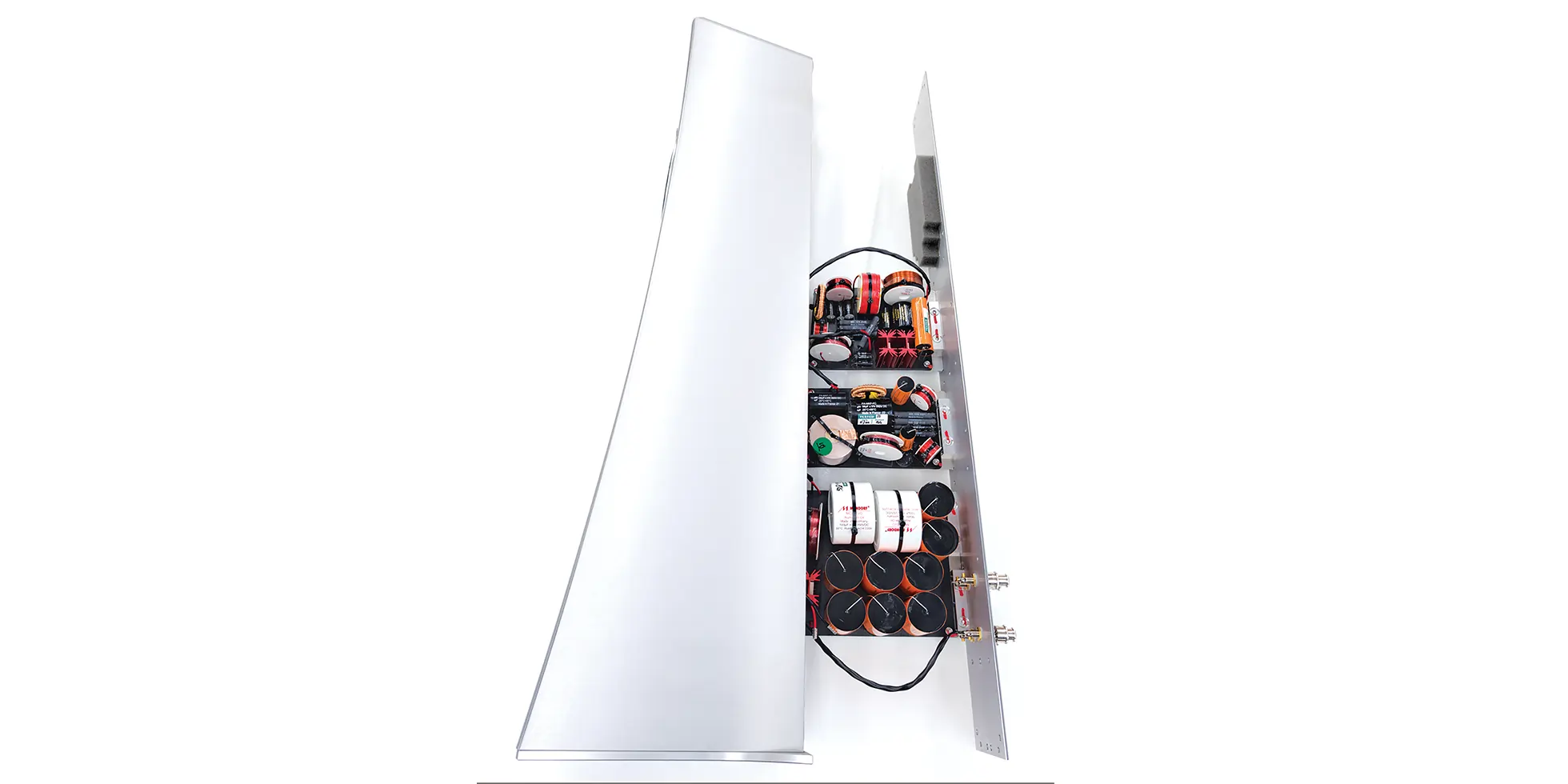
As for the crossovers, while those of the Talus are compacted in the base, those of the Carmel 3 occupy a large part of the enclosure, as you can see in the photo opposite. Chosen from among the best on the market, their often very heavy components leave no room for the slightest curve drift, with the aim of achieving the most perfect phase alignment and phase slope and transient response possible, for absolute synchronization between the two loudspeakers. Thanks to this structure, the closed Carmel 3 never lets anything protrude, releasing waves with a very high degree of linearity over a frequency range equivalent to that of the Talus (32 Hz-40 kHz), with a sensitivity of 87 dB (compared with 89 dB for the first). Supplied as standard in black or satin silver, this model, like all those in the Reference range, can be chosen from a wide selection of RAL colors, at extra cost.
The set up
We warned you when we listened to the Ascent at Concert Home (Paris, 16th) that we would be going to Music Hall (Paris, 8th) to test a Carmel 3, as it is one of the only dealers in France and even in Europe currently in possession of YG Acoustics speakers from the Reference range. Once there, we were able to take advantage of the fact that the Tor and Talus were also there – as well as the Sonja 3.2, which we will be coming back to in a major feature on bi-amplification – to compare all these models, and more particularly the two two-way floor-standing speakers described above.
To begin the tests, we started as we did for the Ascent test with an Accuphase E-5000, but this time we were able to extend our listening upwards thanks to a couple of Accuphase C2300 preamplifier & A80 power amplifier. The source of rare clarity being the Accuphase DC-1000 DAC and the Aurender N30 SA streamer with MC10 external clock, we never went back to it. But to develop our tests and move towards more American sounds, we incorporated the McIntosh MA8950 and MA12000 integrated amplifiers at the end.
The sound
With the Ascent, we heard and therefore described the majority of YG’s characteristics and more particularly those of the Peak range, which we found again with the Talus: less present in the bass range since it loses a driver dedicated to this register, but more open than the Tor bookshelf and therefore better suited to a room of more than 25 m², this column immediately shows itself to be very refined and very neutral. From the very first seconds, the sound is reminiscent of the speaker’s closed-load technology, which can be disturbing for some listeners, as it takes a while for the impression of wave control to make the brain realize that it can nevertheless enjoy what it hears. Once these sensations have been released, all the registers extend without the slightest conflict across a well-developed soundstage, equally suited to rock and classical music.
As far as tonal balance is concerned, the neutrality already seems perfect on the Talus, but the phase management and phase slope further improved on the Carmel 3 demonstrate that YG’s engineers are always capable of going further. And if we knew from listening to the XV 3 Signature in Munich that they can achieve a mind-blowing level of precision, it is a pretty similar sensation that we get from listening to the Carmel 3. Although it is the first model in the range, it does the Reference series proud with its impeccable purity and even more neutral tones, although the midrange and treble lighten up a little, as they become more flexible thanks to the aluminum diaphragms and some of the most perfect crossover currently designed in the world. This flexibility, which is even greater than that of the Talus, becomes even greater as you move up the amplification range, with the connection to McIntosh amplifiers creating more bulk and therefore a little less precision, for a more rounded listening experience, to be chosen according to your hearing preferences. Because of its shallower depth, the Carmel 3 is more directive than the Talus and seems better suited to rooms between 20 and 35m², with the three-way Vantage 3 then taking over.
The Carmel 3 comes with two terminals as standard, but you can ask for four to bi-amplify it, which is what we did, integrating the A80 for the highs and the A300 Accuphase blocks for the mid-bass. Even more refined, the music once again managed to gain in clarity and fluidity, with even freer filters once they were no longer called upon to separate frequencies, but only to send those expected autonomously to the BilletCore membrane and Lattice tweeter. This gain also favored aeration, and therefore better placement of the elements in the soundstage. The voices of the best recordings (Kaufmann in the Wesendonck Lieder, for example) appear with even more relief and realism, as well as being more fleshy.
Our conclusion
From the small compact Cairn in the Peak series onwards, YG Acoustics speakers can be considered true luxury products. They are clearly very high-fidelity models, whose build quality and modelling offer some of the purest sound on the market. At 20 990 €, the Talus is not for everyone, but it has all the features of a YG floor-standing speaker, built into a wooden cabinet that is easy to install in almost any room and any style of furniture.
Even more ultimate, the Carmel 3 offers an all-aluminum design, developed primarily for music and high-fidelity passionate listeners, with a purity that is as perfect in terms of phase management as it is in terms of the reproduction of all tones, thanks to the two aluminum drivers. Magnificent, this remarkable object is nevertheless reserved for a handful of enthusiasts, starting at 39 990 €.
Author: unknown
Technical sheet: YG TALUS
- Origin: United States
- Price: 20 990 €
- Dimensions: 1015 x 270 x 325 mm
- Weight: 43 kg (per unit)
- Frequency response: 32 Hz – 40 kHz
- Impedance: Medium at 7 ohms
- Sensitivity: 89 dB
Technical sheet: YG CARMEL 3
- Origin: United States
- Price: 39 990 €
- Dimensions: 1030 x 230 x 310 mm
- Weight: 39 kg (per unit)
- Frequency response: 32 Hz – 40 kHz
- Impedance: Medium at 6 ohms
- Sensitivity: 87 dB


