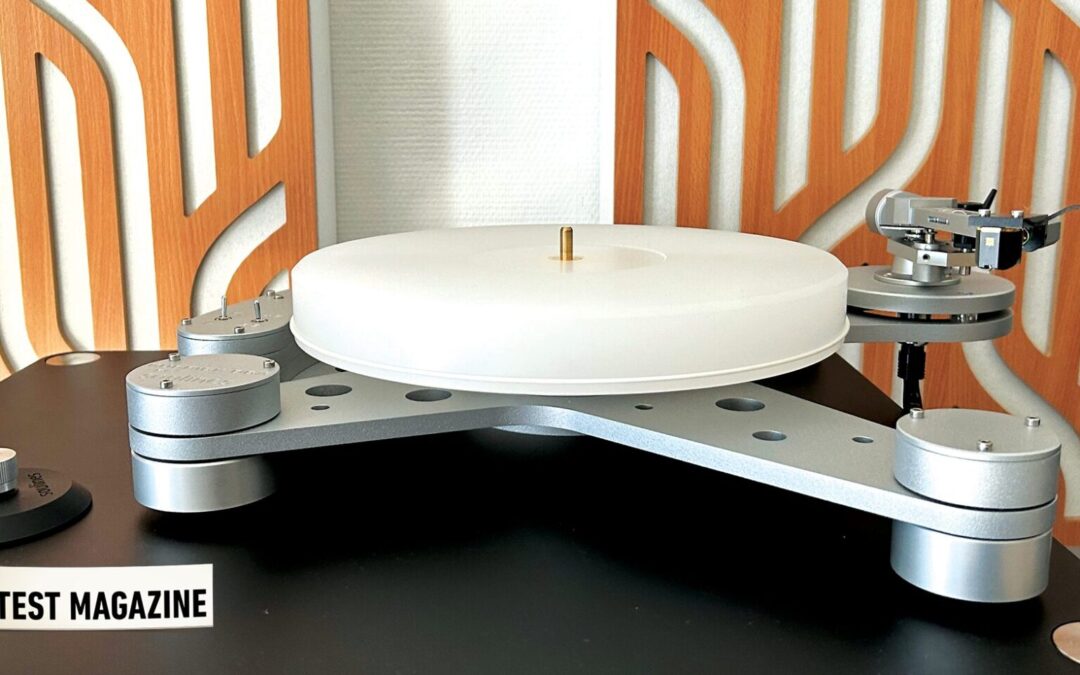
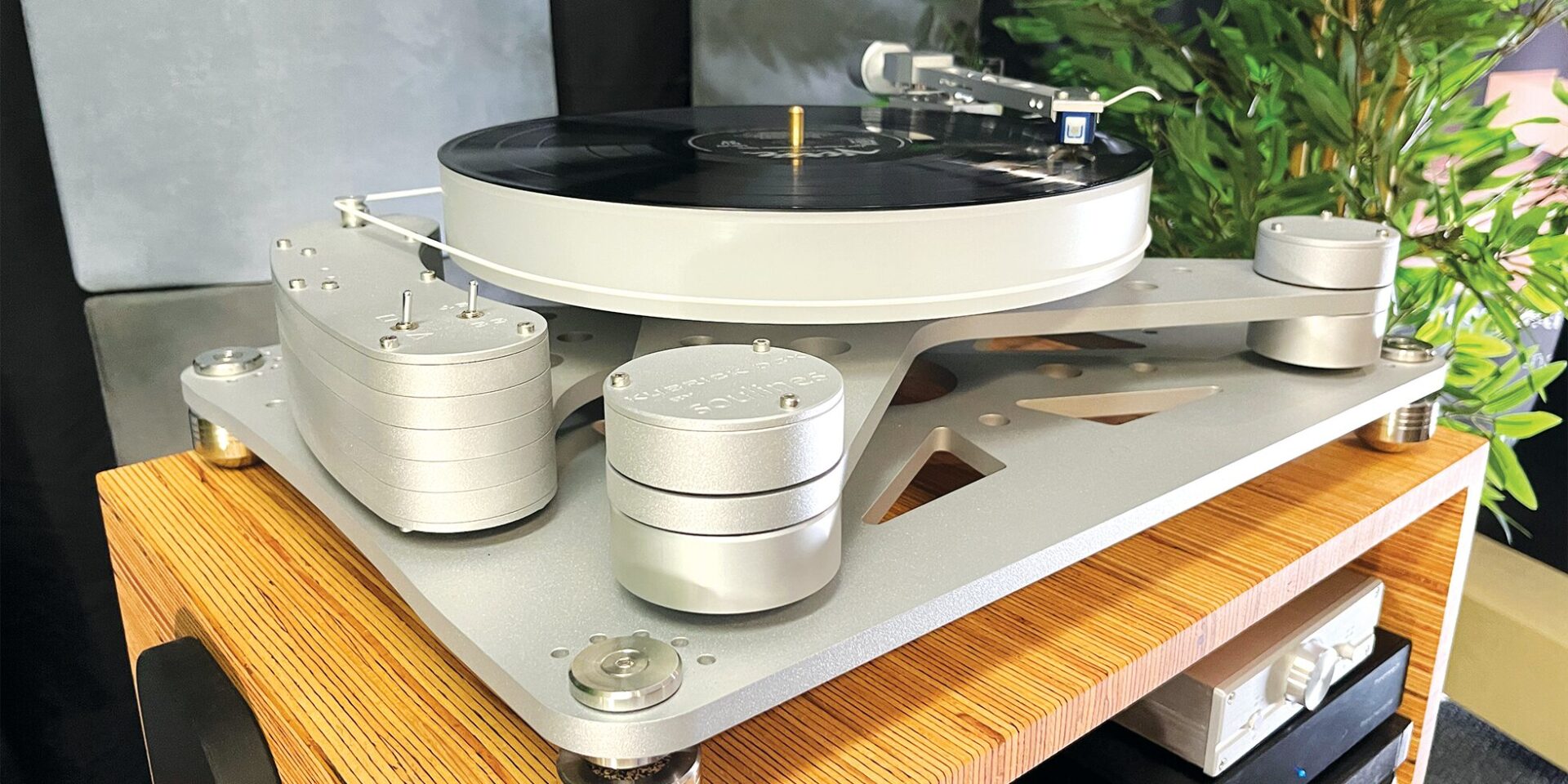
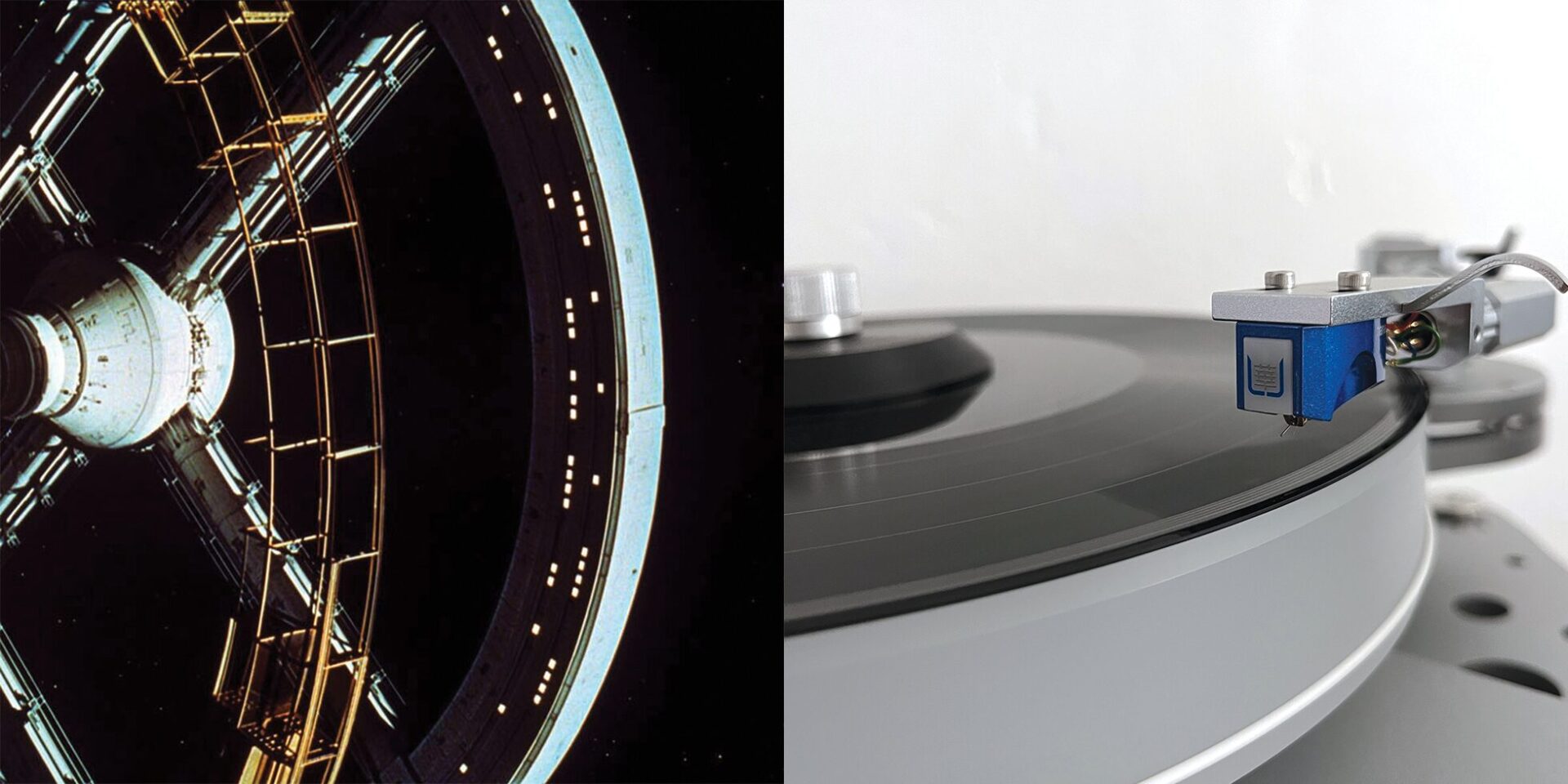
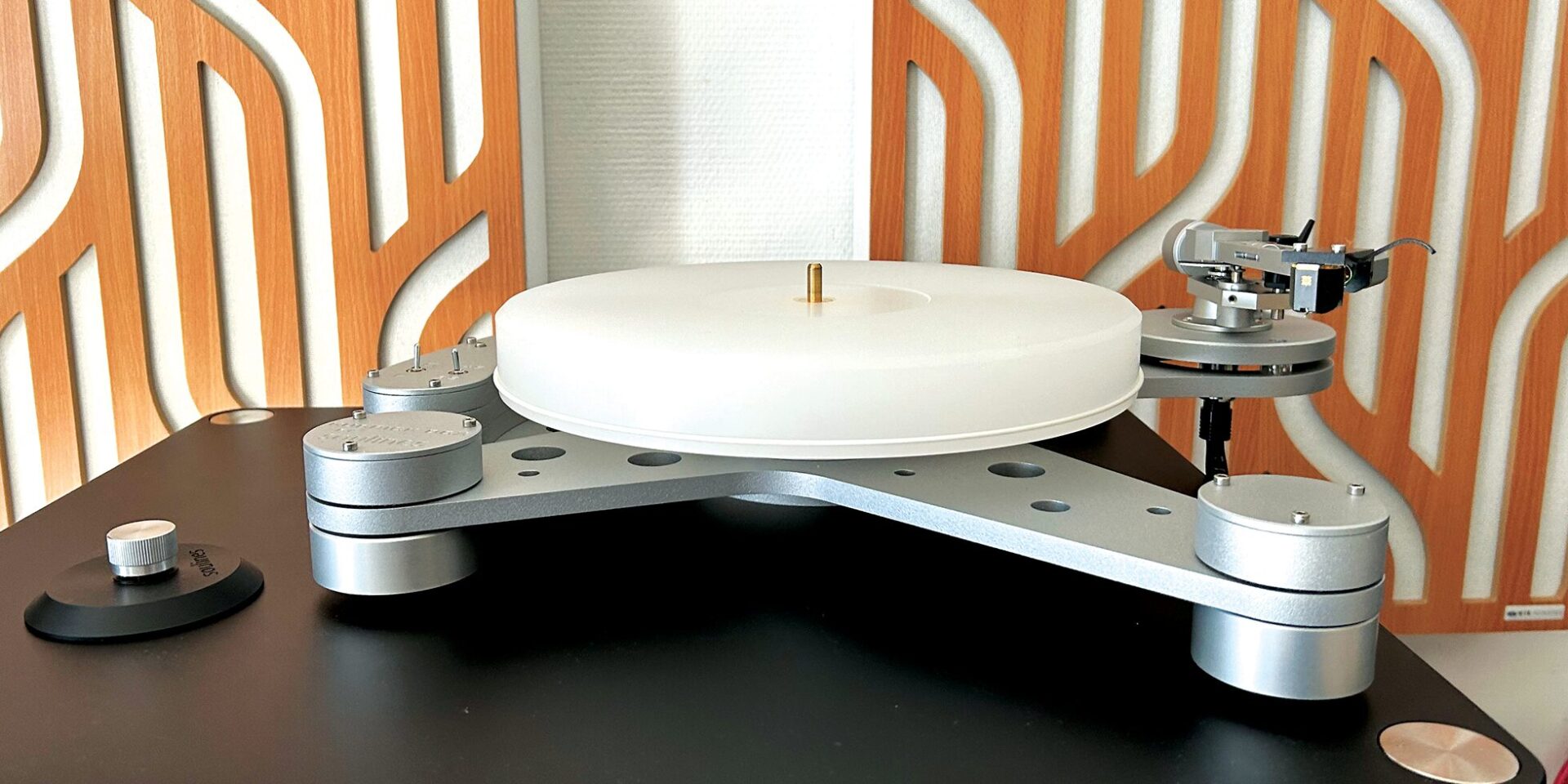
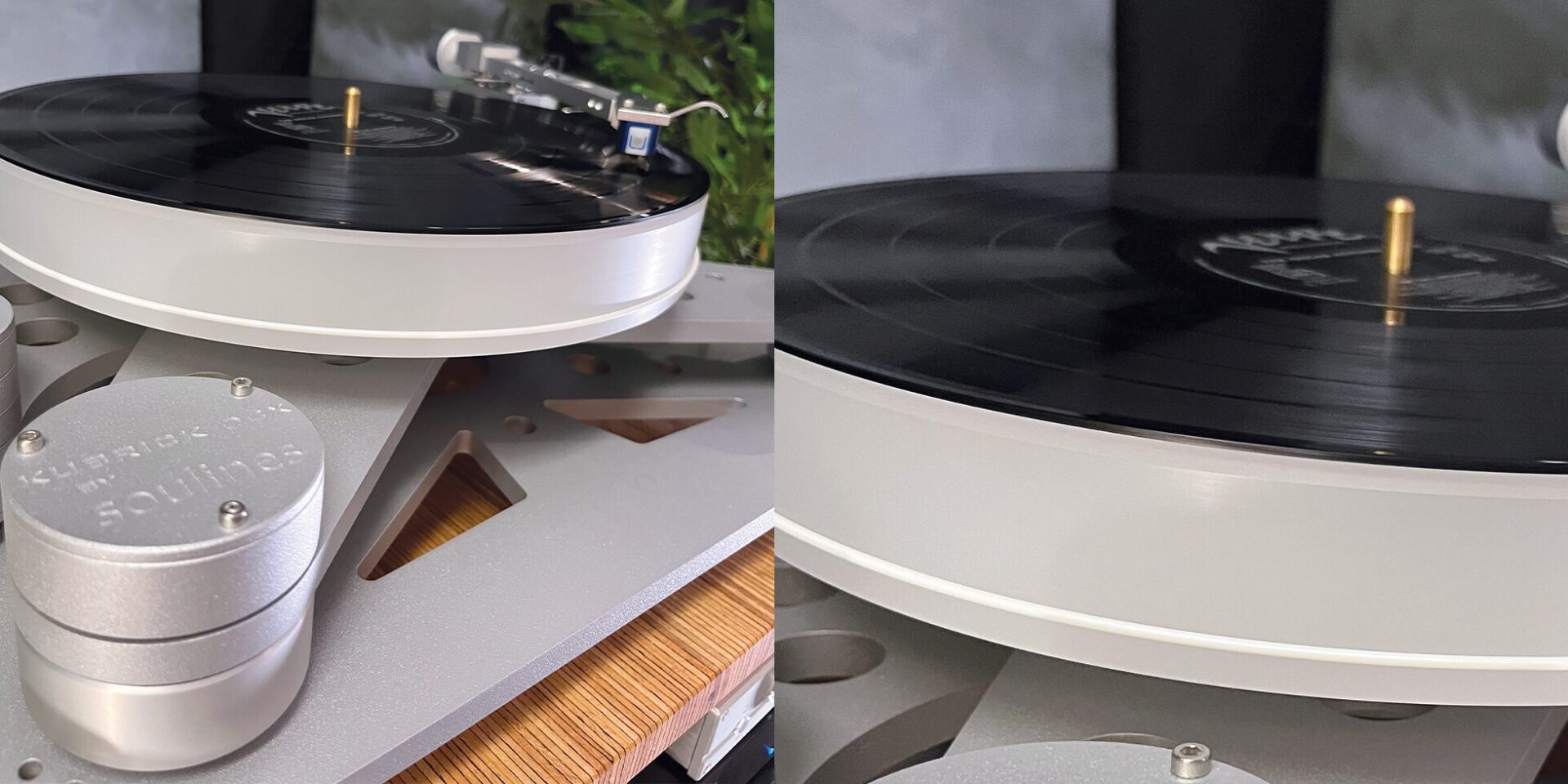
Inspired by the spacecraft in 2001: A Space Odyssey, the Soulines Kubrick DCX features an all-aluminum base designed around the golden ratio and the Fibonacci sequence. Adaptable to a wide range of tonearms thanks to three interchangeable bases, this Serbian-made turntable is available in France with a Japanese tonearm that is particularly well suited, both in terms of its modern design and innovative technology: the Sorane SA-1.2, also made entirely of aluminum, giving it a fast and tight sound that is as neutral as possible in its tones.
SOULINES KUBRICK DCX: INTERSTELLAR SPACESHIP
With a background in mechanical engineering and parallel training as a conservatory musician, Serbian Igor Gligorov began designing turntables from recycled materials in 2009. Two years later, his research led him to create the Soulines brand, whose first product was released in 2011. Named Hermes DCX, this turntable, messenger of the gods, already featured very modern curves and introduced the 40 mm thick, 3.2 kg acrylic platter, which is now found on all models, including the Kubrick DCX.
Subsequently, Igor Gligorov developed other, even more complex approaches with the compact tt42, before returning to greater simplicity with the Elgar DCX (which bears a resemblance to a bicycle pump, like the Kuzma Stabi S), and finally launching a conventional rectangular turntable, the Dostoyevsky DCX, and another with a smaller base, the Satie DCX.
The Kubrick DCX is particularly successful, incorporating not only curved lines, but above all a structure directly derived from the golden ratio φ and the Fibonacci sequence, which allows the proportions considered ideal in the development of the base to be maintained at all times.
Discovered by the Pisan mathematician in the 12th century, this sequence consists of always adding the sum of the two previous numbers, i.e., 0, 1, 1, 2, 3, 5… resulting in a structure with exceptional resistance to vibration, making it useful in the construction of certain designs (Greek temples are derived from the golden ratio), with applications that are also valid in the world of hi-fi.
Made of multi-layer aluminum, the main base of the Kubrick DCX is coupled at three points with the secondary base, also made of aluminum. The entire turntable is finished in silver anodized aluminum, giving it an extremely refined look. Three interchangeable bases are supplied as standard, allowing the integration of SME 9″, Jelco or Rega/Origin Live/Audio Note tonearms.
Three support cones, whose proportions are also related to the golden ratio, are coupled to the main base by means of rubber-cork washers. Their screw thread allows the turntable to be aligned as perfectly as possible on the horizontal axis.
Integrated into a block made of stacked aluminum layers, the DC motor is connected to a small external power supply; Soulines does not yet offer an optional hyper-regulated power supply to further improve the already very precise rotation. As for the platter mentioned above, it is made of laminated acrylic and mounted on an inverted bearing machined from solid brass and stainless steel, with a Derlin stop plate. Always useful for protecting against dust, a modern-looking platter cover is included with the turntable.
SORANE SA-1.2: THE SPATIAL TONARMS
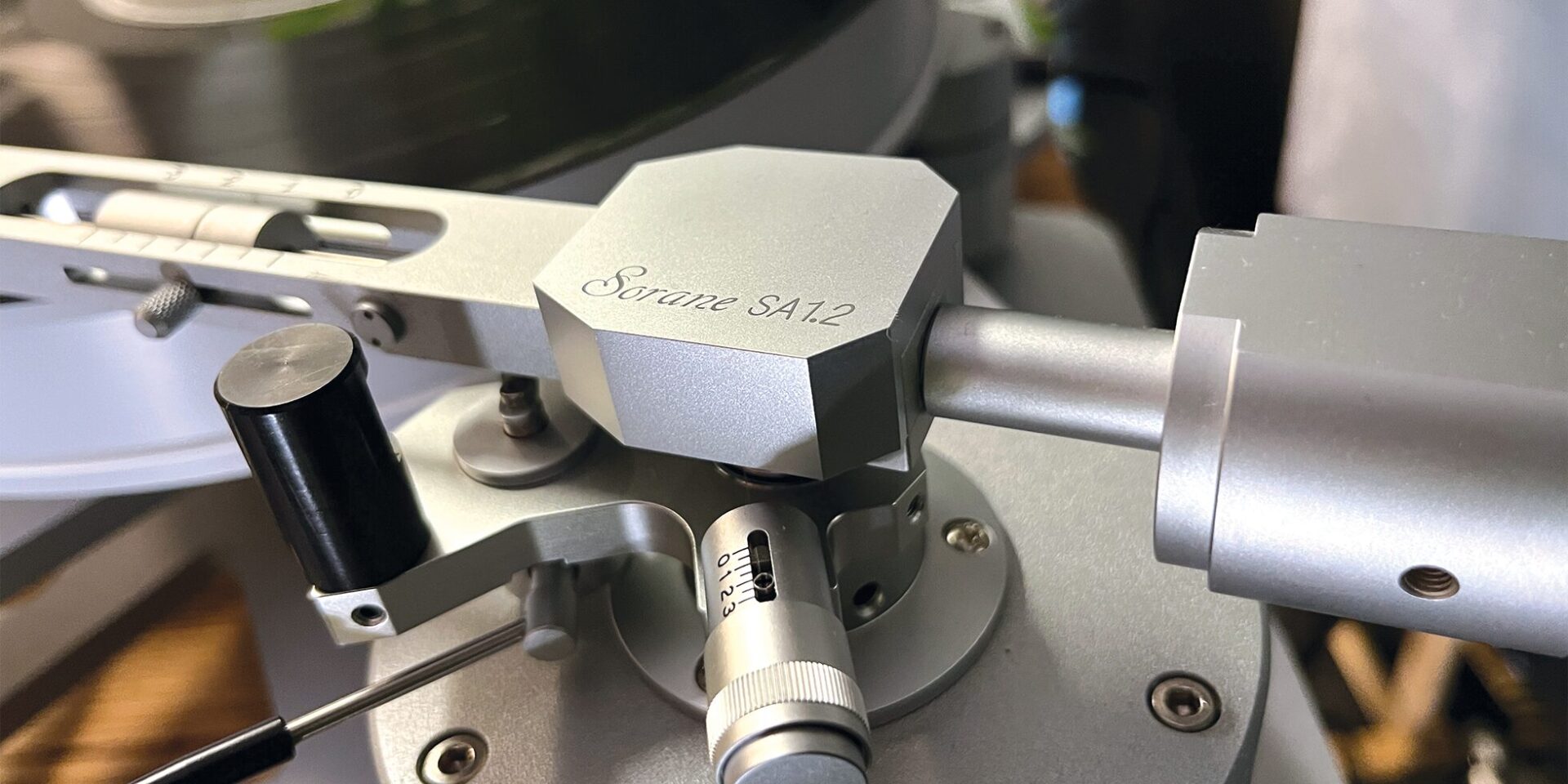
While many photos found on the internet show the Soulines with relatively conventional tonearms—those from Rega, for example—the kit offered in France by Delta Audio with the Sorane SA-1.2 tonearm seems to offer a particularly ideal combination, both to the eye and the ear. Meaning “spatial sound,” Sorane is a brand created by IT Industry, known in the industry for manufacturing Ikeda Sound Labs tonearms and recently developed with the help of Mr. Hiroshi San, whom we interviewed in 2023, notably to talk about Hana cartridges.
Presented with its TA-1 “S” tonearm coupled with the Transrotor ZET-1 turntable in our VUmètre n°49, this innovative brand sought other design solutions that led to the 12“ square tube tonearm, the ZA-12, and then to a ”J” tonearm, also carved from aluminum.
Particularly suited to cartridges with medium to low compliance, the SA-1.2 is available in an even more advanced version called BCS, which further improves the internal wiring and adds a negative counterweight to the positive counterweight. For our test, we used the classic version, sold in Europe for €2,150, which offers the advantage of a radial bearing, a weight placed on the front of the arm, making it very easy to control, and anti-skating that can be easily adjusted using the side knob.
At the other end, an SME shell also simplifies the mounting of one or more cartridges according to individual needs, while the base can be chosen at the time of ordering to fit directly with Rega, SME, Clearaudio, or Linn models.
THE SETUP OF THE SOULINES KUBRICK DCX & SORANE SA-1.2
Very easy to assemble, the Kubrick DCX turntable only requires screwing in its counterweights and the base chosen from the three available to integrate the arm. All that remains is to adjust the 3.2 kg platter on the spindle, then slide a thin silicone belt around it, which is also inserted into the motor block rotation. The turntable is connected to the mains via the external power supply provided.
The Sorane tonearm is also supplied pre-assembled, with only the rear counterweight to be screwed on, as well as the SME shell, on which we successively adjusted the Hana ML, Nagaoka MP-200 & MP-500 cartridges to check the response of the Soulines-Sorane combination with MM and MC cartridges.
The 5-PIN tonearm cable loaned to us for our test, which is integrated under the tonearm base, matched perfectly with the rest of our cabling, as we used an Esprit Aura G9 model, in line with our HP and modulation cables. For phono preamplification, we chose to go directly through the dedicated tubes of the Luxman CL-38uC when listening to the Hana ML, and through the Kora Phono with the MM cartridges.
Once calibrated with a small scale and adjusted with the Sorane’s protractor, adapted to its unconventional 9.4″ length and J-shape, we were able to listen to our black discs with and without the cork mat (which we quickly decided to keep), and we always used the tt-Clamp (available as an optional extra) to secure the disc to the platter.
THE SOUND OF THE SOULINES KUBRICK DCX & SORANE SA-1.2
Modern in appearance, the Soulines Kubrick DCX is also modern in sound. Manufactured like an aerospace vessel to absorb and dissipate vibrations caused by rotation as effectively as possible, this Serbian turntable provides rock-solid stability, concentrating the sound with tension, somewhat in line with the philosophy of certain Vertere models.
In perfect harmony, the Sorane arm also dissipates all vibrations to provide excellent bass response, almost bouncy on certain masterings, again with a speed and tension that almost make our Hana ML (MC) cartridge sound like a nimble MM.
Very well separated, the left and right channels bring out a wealth of information, with the best analog pressings standing out with details usually only perceptible in digital listening on DSD files. On the other hand, this raw rendering has a slight tendency to accentuate the high frequencies, slightly noticeable with the Hana ML and even more so with the very dynamic Nagaoka MP-500.
The midrange, which is also fast, is impressively neutral, and while some listeners may prefer more substance, upgrading the phono preamp compensates for this, restoring the silkiness often expected from analog listening.
Reflecting its build quality and design, the Soulines Kubrick DCX is a modern turntable that delivers impressive results with modern music. Even more so than Marvin Gaye’s soul, you can enjoy the full impact of the electronic bass in the R&B music of Tyler and Kendrick Lamar, or the dynamics of Adele’s vinyl records (very well pressed and mastered depending on the source).
Jazz and classical music (Holst’s The Planets by Mehta/Decca or Richard Strauss’s Also Sprach Zarathustra by Karajan/DG, in homage to Kubrick’s film) benefit from the neutrality of the timbres, with a rendering that always focuses on energy and contrasts rather than softness. Because even if some people tend to forget it, this is above all an analog listening experience: a tense sound with dynamic ranges far superior to those compressed by the size of digital files played from CDs, further diminished since then by MP3s.
OUR CONCLUSION
Modern in style and spirit, the Soulines Kubrick DCX is also modern in sound, demonstrating through the neutrality of its timbres and the roundness of its bass that the aluminum base is stable and not subject to vibration effects.
Ingeniously designed by engineer Igor Grigolov, this €5,000 turntable is ideally suited to the design and musical philosophy of the Sorane SA-1.2 tonearm, with which it forms a pair costing around €7,000, to which you still need to add a cartridge, recommended from the Hana ML or Nagaoka MP-500 range (around €1,000), or even higher-end models, which are perfectly suited to the low compliance of the Japanese tonearm. With such a spaceship, you’ll be ready for a musical leap into space.
Founded in the United States in 2002 with the aim of creating very high-fidelity speaker models, YG Acoustics had remained relatively unknown in France.
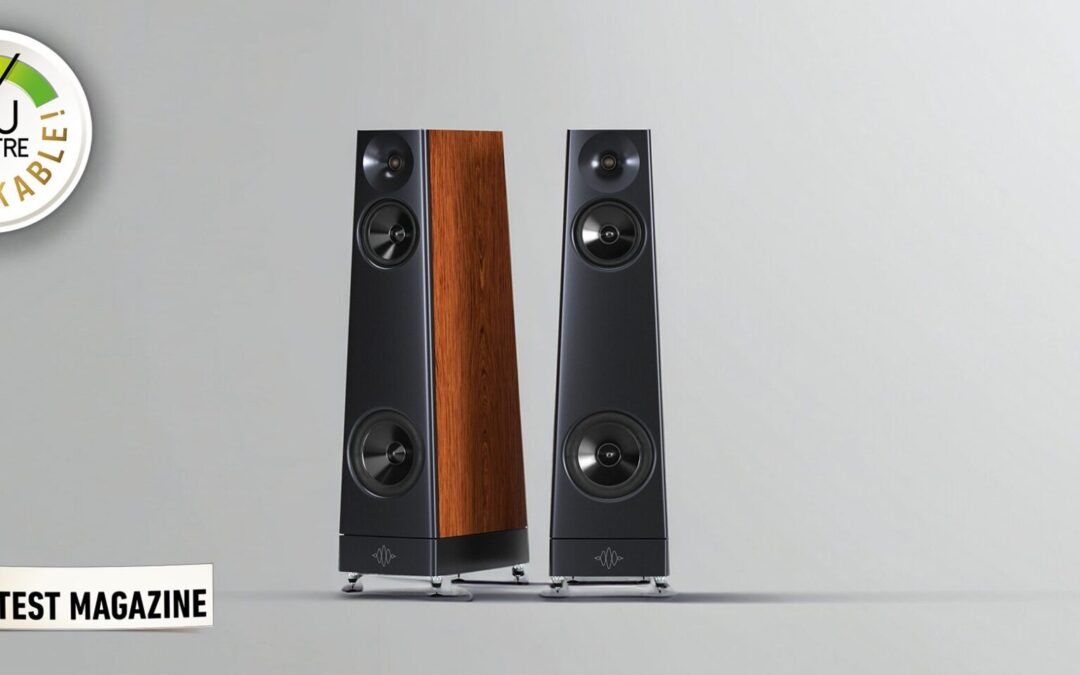
At the start of this year, it is taking advantage of a new distribution network to regain the upper hand, especially as it now offers a new range that is more affordable than the Reference. Named YG Acoustics Peak Ascent in homage to the Rocky Mountains of Colorado, this new series of six models starts with two compact speakers, a subwoofer, and three floorstanding speakers, of which we are testing the mid-range, a magnificent three-way model called Ascent.
Since its inception, YGAcoustics has been known as a benchmark brand, a name given to its first series of speakers made entirely from aerospace-grade aluminum for the cabinet and drivers. Amplification and network data management were then used to modify three models in this series to create the Live range, consisting of the Vantage 3, Sonja 3, and XX in active versions.
But while a few subwoofers had been added to the Colorado-based manufacturer’s product line, including the highly innovative Invincible 21.1 & 21.2, there were no bookshelf speakers in its catalog, and all models remained firmly positioned in the ultra-high-fidelity market due to their price points.
MOUNTAIN JOURNEY
It wasn’t until 2022 that the brand shook up its fundamentals by launching a new, more affordable series consisting of two compact speakers, in addition to three floorstanding speakers and a subwoofer. Named YG Acoustics Peak Ascent in homage to the Rocky Mountains in Colorado National Park, not far from the company’s headquarters, this series consists solely of names referring to mountains.
Smaller and designed with specially made stands, the two bookshelf speakers are named after rock formations: the smaller one after a pile of stacked stones (Cairn) and the second after a naturally formed rock (Tor). YG then takes us up with its three two-way (Talus) and three-way (Ascent) floorstanding speakers, to an even more ultimate final version (Summit), from which we can still descend if necessary thanks to a subwoofer (Descent).
ASCENT TO ELBERT
On this journey to Colorado’s highest mountain—Elbert, at 4,399 m, located just under 130 km from YG’s headquarters in the suburbs of Denver— we were able to choose several passages before settling on this ascent on the Ascent, with the firm intention of one day checking out the extra echo of the Summit, or comparing the two smaller models, equally curious to stray for a while onto the Reference series with its Carmel 3 if the opportunity arises.
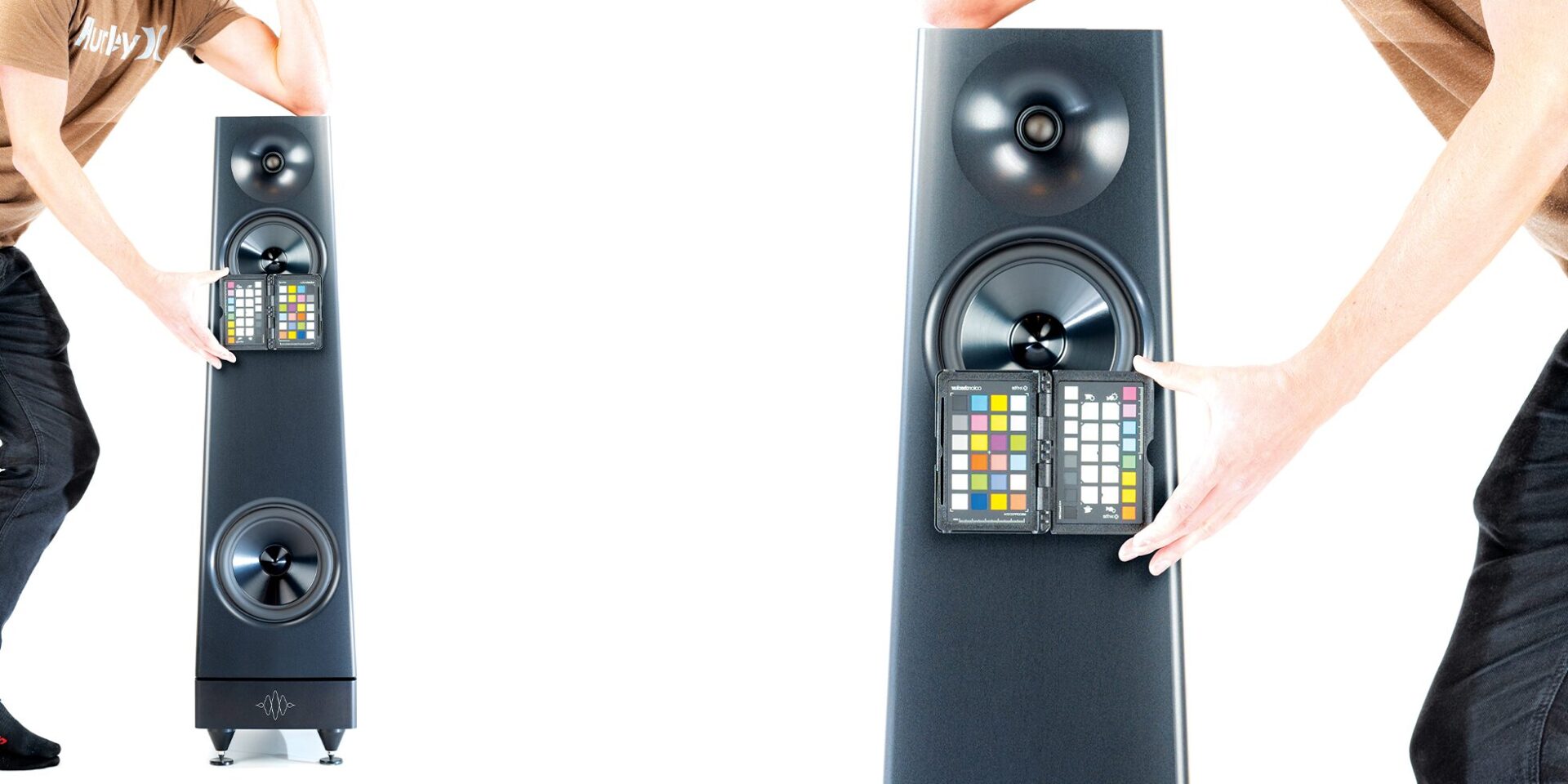
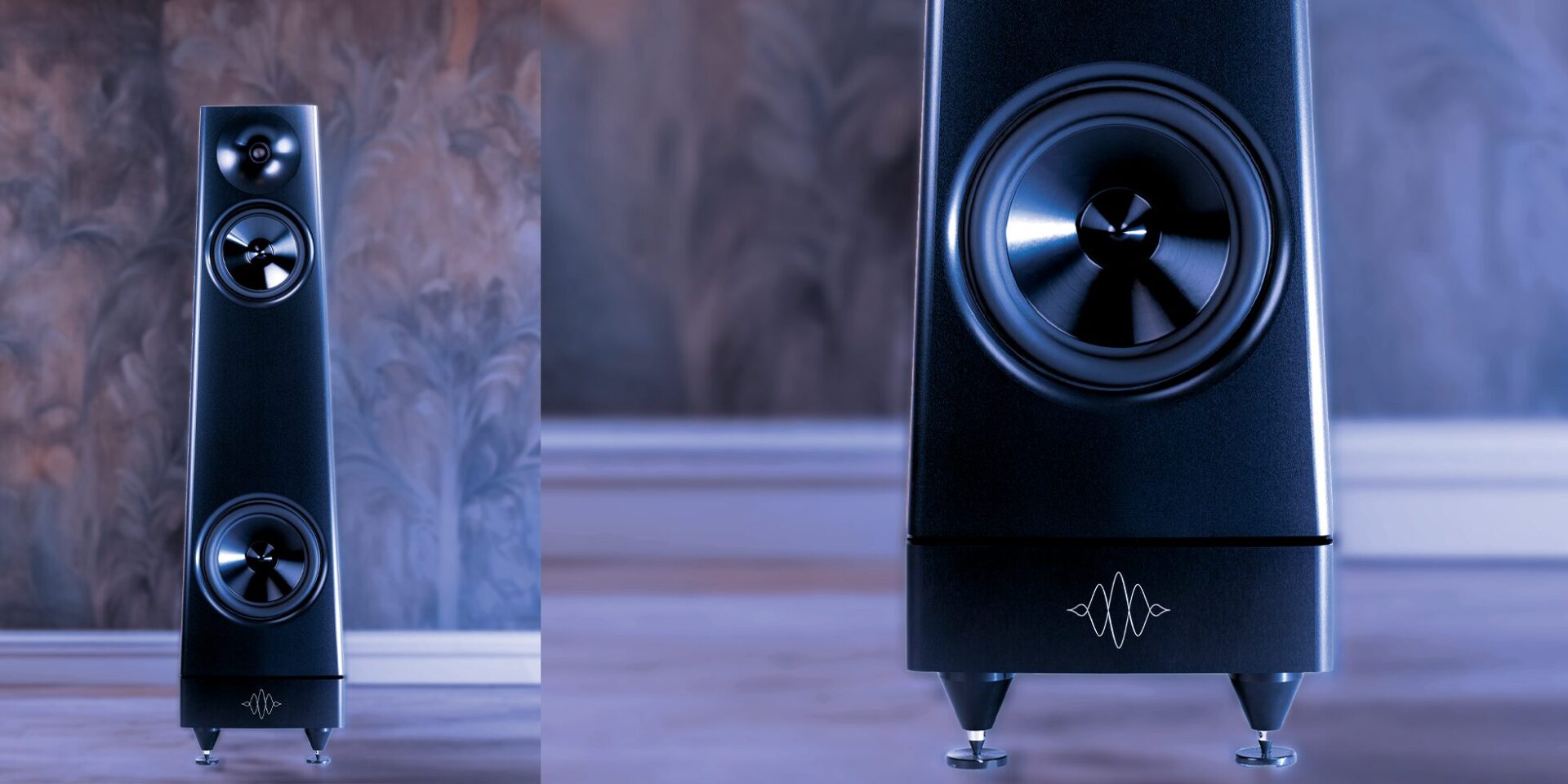
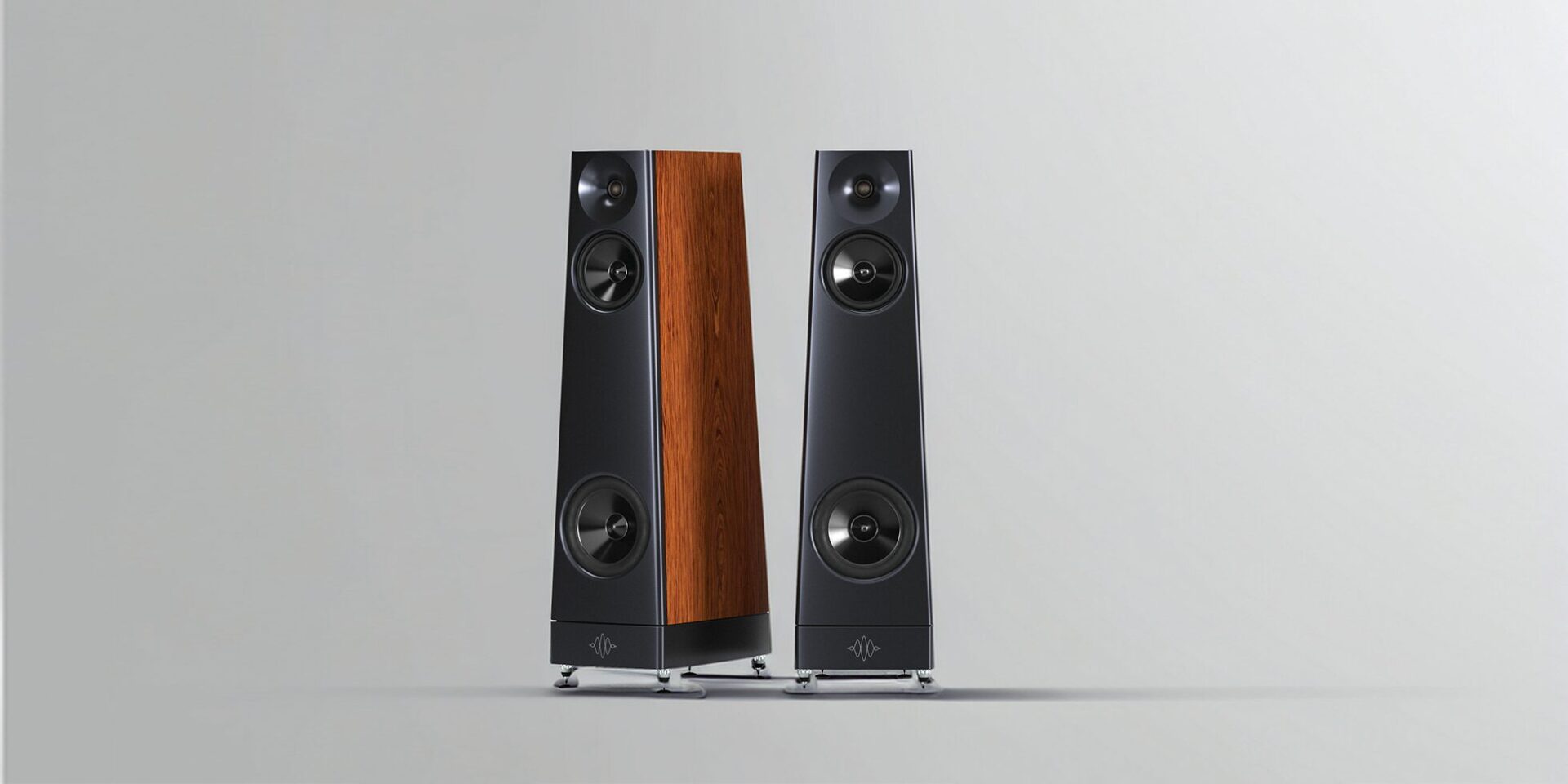
A center floorstanding speaker, the Ascent is a Talus with a bass driver added, so that only its midrange driver is dedicated to the midrange. Like all the other models in the range, this speaker is manufactured in a sealed cabinet made of dense, one-inch-thick resin fibers, dotted with reinforcements and acoustic absorbers to eliminate the vast majority of internal reflections and resonances.
The thick aluminum front panel is shaped by computer modeling into more than 15 million points and then cut by CNC machine.
Comprising three drivers, the Ascent features the same ForgeCore tweeter found in all Peaks series speakers. Based on steel forging technology optimized by 3D geometry with CNC cutting, these high-frequency management units with magnetic motor systems stand out from the Reference series Lattice speakers, which are made from aluminum billet.
However, all other diaphragms are the same as those in YG’s large series, patented BilletCore because they are cut from a solid billet of aerospace aluminum alloy to create a 0.2 mm thick cone weighing less than 30 g. To perfect the precision of the responses, these diaphragms are integrated into the front panel, again making extensive use of computer modeling, which analyzes not only the cone, but also the surround, the suspension, the interaction of the magnet and the voice coil, and even the different air waves depending on the lacquer used.
Leaving nothing to chance, the engineers, led by Matthew Webster, chose to place the filter in the soft aluminum base to remove all internal pressure from the cabinet and leave its components completely free.
Also the result of many hours of research, the circuits are designed to optimize amplitude, phase, and phase curve so that the drive units are consistent with each other over a very wide frequency range, with the result that all the speakers are synchronized in their movements, thus avoiding any auditory disturbance related to possible delays between membranes.
Like all Peaks starting with the Tor, and therefore like the Talus column with which it shares height (101.5 cm) and width (27 cm), the Ascent features an 18 cm (7.25″) membrane in the center, but this is only used to handle mid-range frequencies, as the bass is handled by a third speaker, located at the bottom of the cabinet at a critical distance of more than 10 cm from the base in which the filter is located.
Measuring 22 cm (8.75“), this latter driver is the main difference between the Ascent and the Summit, with its 26 cm (10.25”) bass driver, but above all with the Talus, which does not have this third driver at all. Available with ebony, oak, or rosewood veneer, the Ascent weighs 54 kg each, well supported by four superb spiked feet.
THE SETUP OF THE YG ACOUSTICS PEAK ASCENT
With a sensitivity of 90 dB and an average impedance of 4 ohms, the Ascents are relatively easy to amplify, but their design and pursuit of neutrality place them in a category that requires high-quality upstream components if you want to get the most out of them. Responsive to the slightest change, they can highlight the smallest detail, and for this reason, a source such as an Aurender N20 or N30SA or the Luxman NT-07 network player tested in this issue will allow the YG to reproduce every nuance of frequency and music.
Available from Concert Home in Paris—our partner Music Hall has chosen to include the Reference range—the Ascent speakers were tested alongside the first Cairn compact and other American speakers such as the EgglestonWorks Emma and Andra III SE. To amplify them, we preferred the results of the Accuphase E-5000 and Wavac MD-805m blocks, but separate Accuphase components could bring out even more detail, which we will attempt to confirm in a future test at Music Hall with the Carmel III.
THE SOUND OF THE YG ACOUSTICS PEAK ASCENT
When listening to a speaker from the Peaks series, two things immediately become apparent, making it clear that we are listening to YG Acoustics models: the first is that this small series makes no compromises in terms of quality; the second is that these are American speakers, with the musical philosophy that goes with them.
To elaborate on these points, let’s start with the first: even though the tweeter is no longer the Lattice from the Reference series, the ForgeCore design allows for a high-frequency response up to 40 kHz, which, while it can create a hint of acidity in the very high frequencies, otherwise covers this entire range with the slightest detail. For the rest of the sound spectrum, the BilletCore speakers, with their aluminum diaphragms, deliver perfectly neutral detail and nuance, which immediately places these models at the very top of the range.
Less directive than the Cairns—the only ones without a 7.25“ speaker, as theirs is actually 6”—the Ascents are also much more open, both in width and depth, but also impressively in height. This is undoubtedly due to their base, inspired by the Rocky Mountains, but listening to them gives you a real impression of altitude, capable of taking you very high. The summit targeted by the speaker of the same name is not far off with the Ascent,
which loses only 2 Hz in the lower range compared to the highest, covering a bass range from 26 Hz, while the Talus, still a two-way speaker, already descends to 32 Hz.
To return to our second point, the Ascent is very much like an American speaker in that it aims for versatility in musical styles and a neutrality of tone that is sometimes close to studio listening. Thus, on “City of Stars” from La La Land, we are less under the impression that Ryan Gosling is right in front of us, since it is clear that the actor’s voice has been retouched by a mixing console, but rather that he is just behind the glass, allowing us to enjoy the studio experience a few meters away, once all the parameters have been optimized.
Every instrument behind him is audible, down to the slightest sensitivity of the strings (guitar) or keyboard (piano), while every movement of his lips, tongue, or breath is audible.
With real singers like Abbey Lincoln, whose voice is wonderfully enhanced by the Luxman streamer upstream, the same sensations of participating live in the recording and hearing the slightest detail come through, while with rock music, we are simply lulled by the electric guitars, as if we were in the recording studio or right in front of the stage listening to the live performance.
As for trying out a large orchestra, we realized the superiority of the reproduction when we upgraded the amplification, as the Ascent can undoubtedly go even further and take us even higher with systems that are more advanced than those used for our test. Here again, with flawless precision, the detail of the great polyphonic works also benefited from a pure image thanks to research on phase curves, in addition to taking advantage of the Ascent’s three-way design and the center speaker used only for the midrange, to deliver every part of the spectrum with the same clarity.
OUR CONCLUSION
Created to offer reference sound, YG Acoustics has carved out a place for itself in the high-fidelity market over the last twenty years, without being affordable for a large number of music lovers. With the new Peaks series, the dream can now become a reality for a less restricted group of enthusiasts, for whom the €11,900 Cairn is a possibility.
At €27,990, the Ascent speakers are close to the price of the Carmel III speakers from the Reference series, but they have three channels and a large 26 cm (10.25″) woofer. These American speakers, which are finally available in France, are extremely neutral and allow you to travel for hours on end in the heights sought after by the Colorado engineers, taking you on a musical journey from your living room to the most sumptuous mountains.
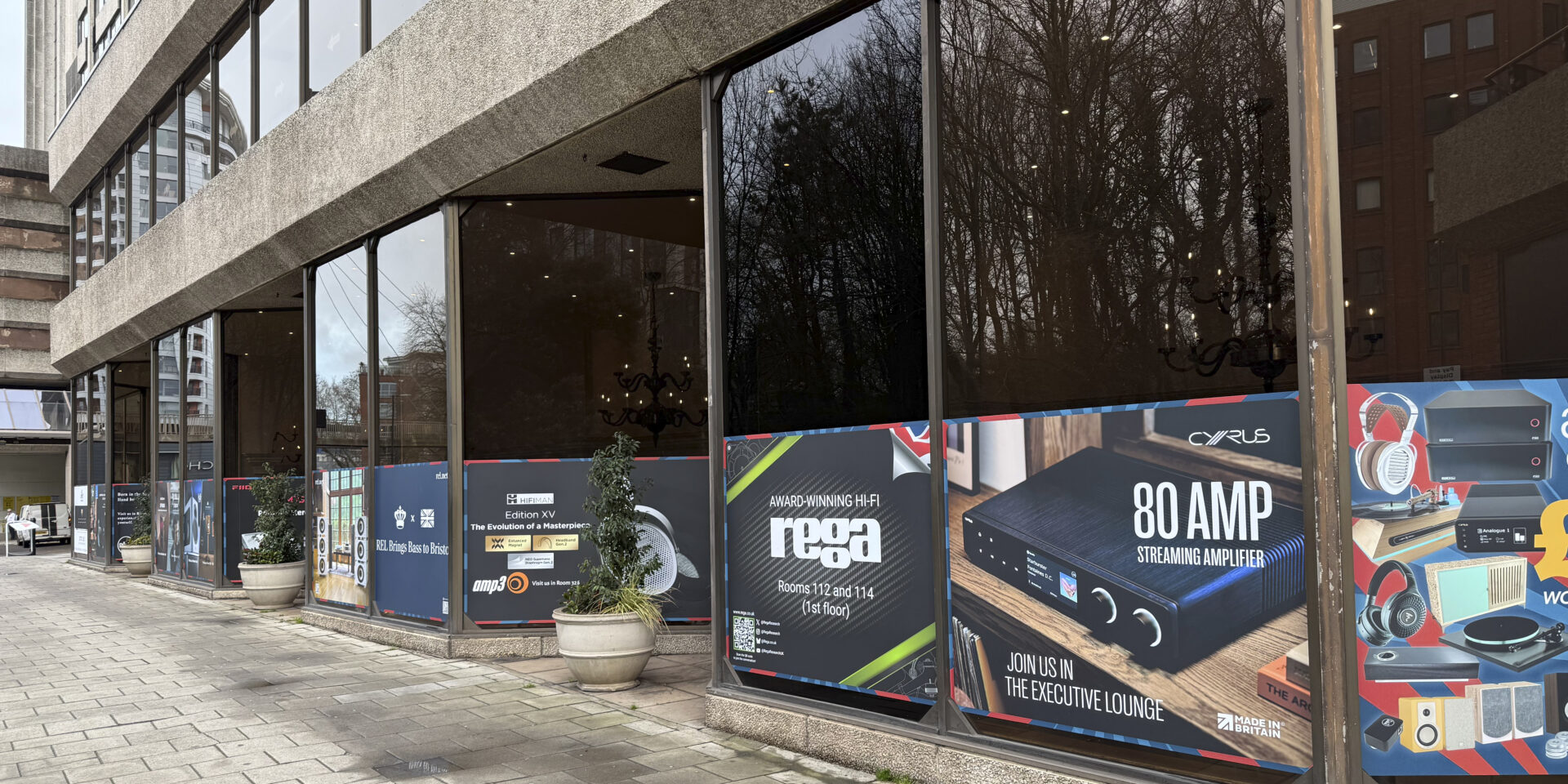
Among the world’s major hi-fi shows, the one in Bristol is the most famous in the United Kingdom. Held in a large downtown hotel, it occupies a long ground floor, a terrace, a basement, and four mezzanine levels, each with about fifteen rooms.
At the 2026 show, we were able to gauge the pulse of the British market and enjoy the presence of its many hi-fi manufacturers, as well as see and hear a wide selection of foreign brands presented either by the brands themselves or by their distributors in the country.
Set up in several rooms, some brands were able to showcase multiple ranges or series, while those with a single system seemed to focus on mid-range electronics, often available for purchase on-site via a catalog—which was also partially displayed as posters in the elevators for the most affordable products.
As for technological trends, this 2026 audio show seems to have largely stuck to the basics of current hi-fi. While connected or active speakers were certainly present in the entry-level segment, the majority of systems remained, overall, separate components, and the only truly major new high-end active system was the ATC EL50. As is the case worldwide, audiophile connected speakers still seem to remain a niche market, embraced by a very interesting company like Kii, whereas the Franco-British firm Focal-Naim chose this year to focus primarily on the new Mu-so Hekla soundbar and their headphones and headphone amplifiers.
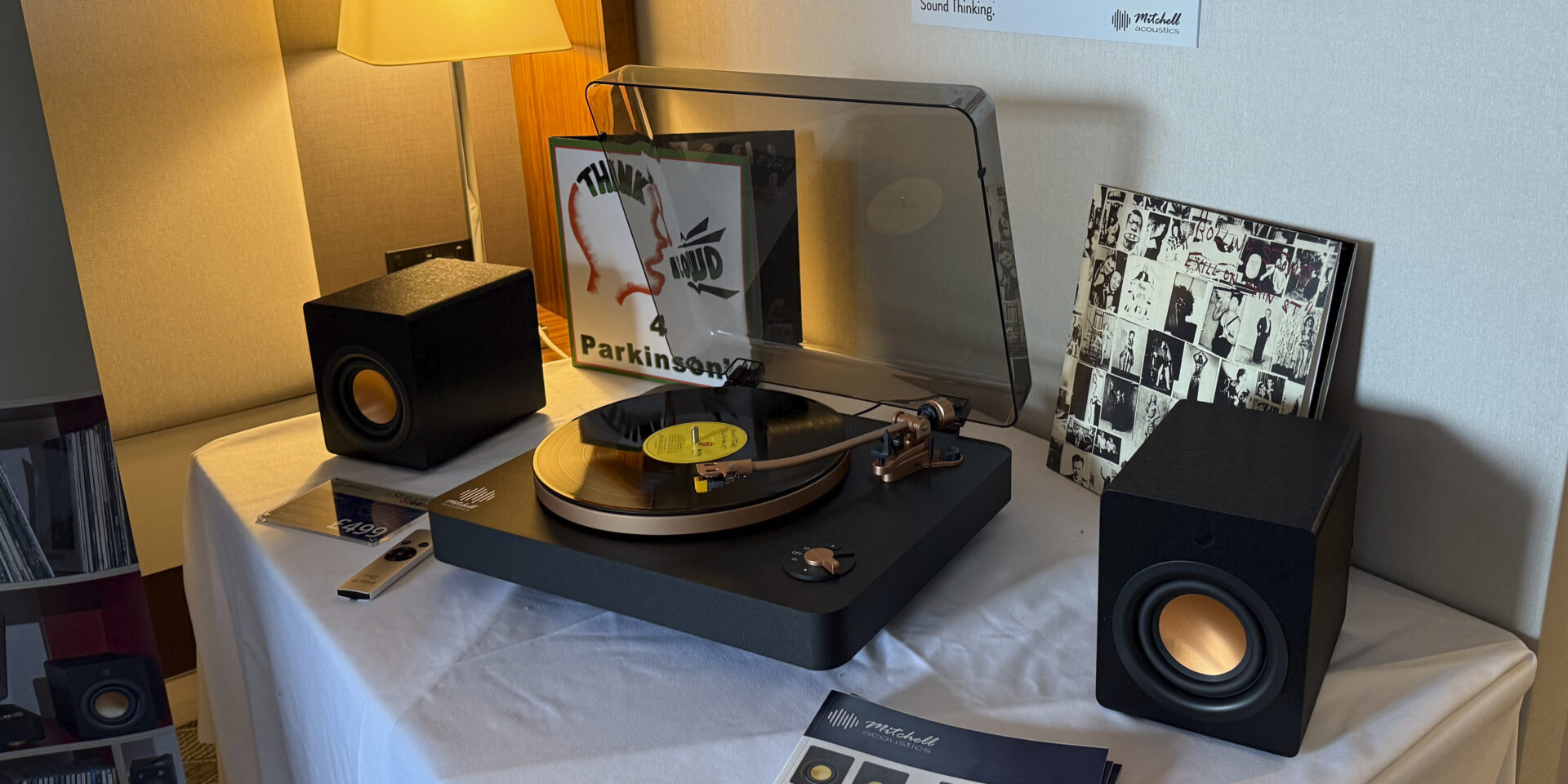
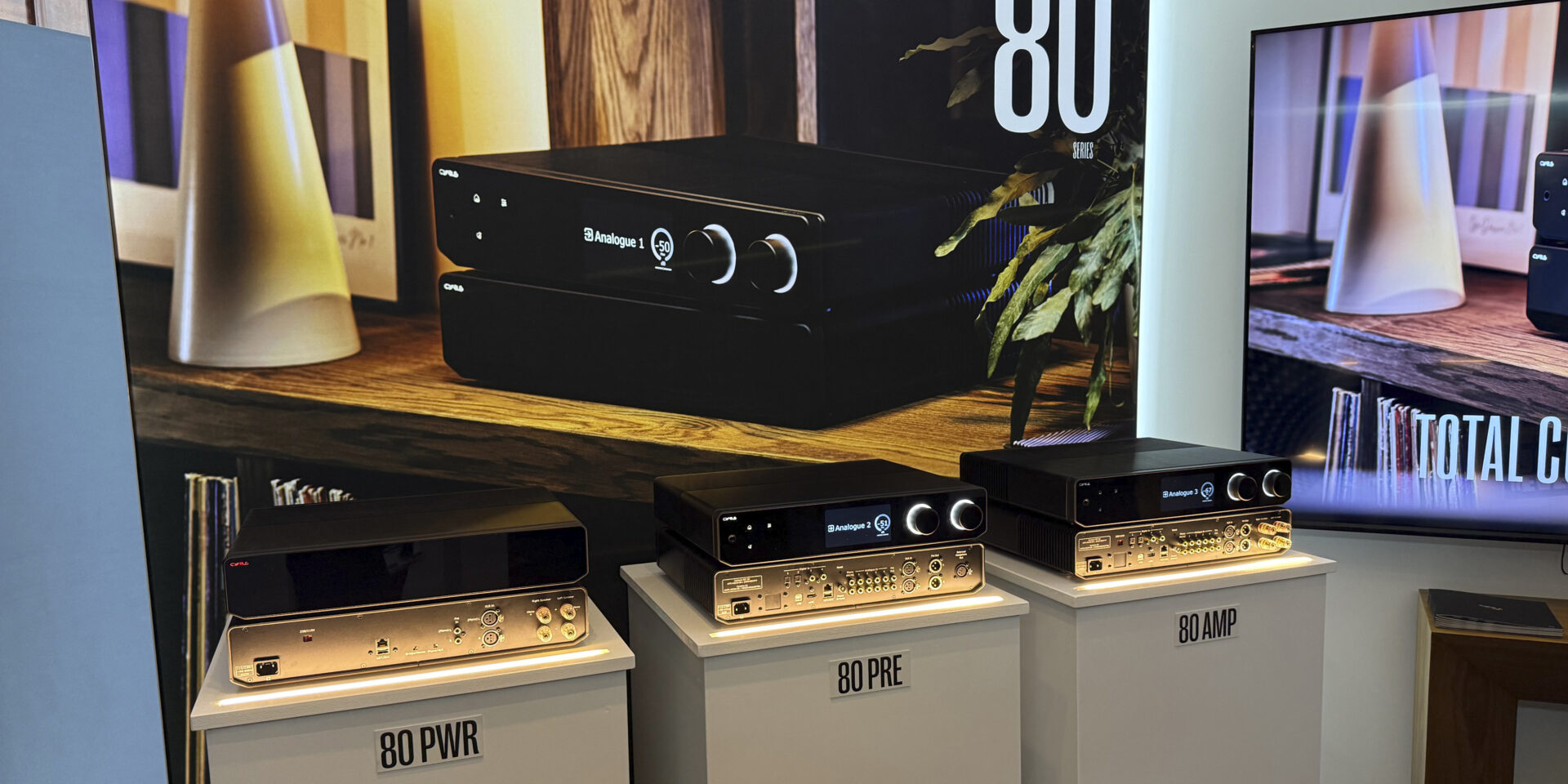
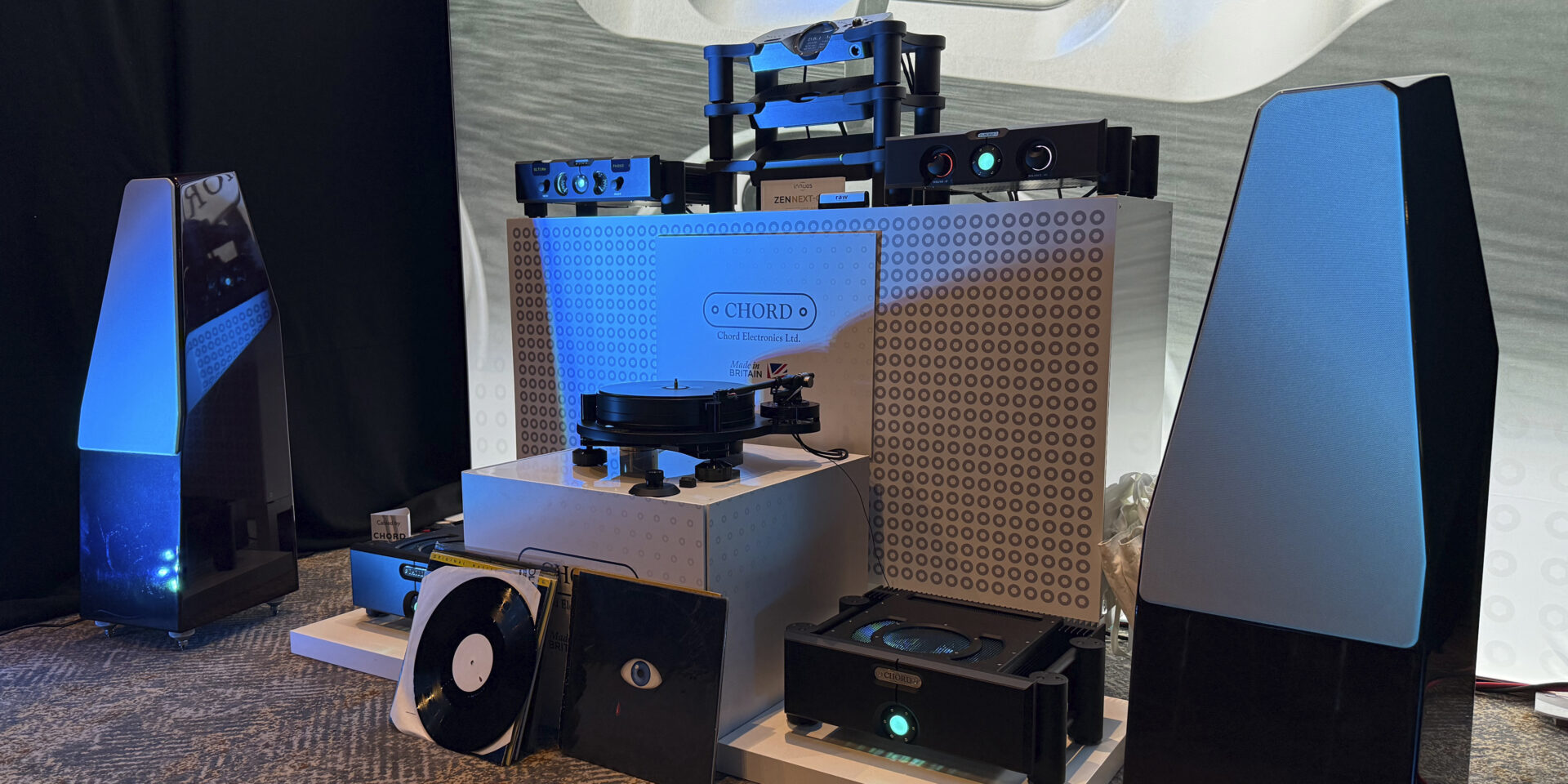
Among the new releases, we mainly identified new versions of existing models, plus a few promising developments, including the launch of the Cyrus 80 Series, Chord Company’s bi-terminated speaker cables, Rega’s new Planar 6 RS, the Upscaler for the Dave DAC from Chord Electronics, and the Revolv and Gyro turntables, whose numerous upgrades were passionately described by the director of Michell Audio. A few niche brands and local manufacturers were also present, such as March, Era Acoustics, and D’Von; they serve as a reminder of the artisanal and passionate nature of hi-fi. We wish them the best of luck!
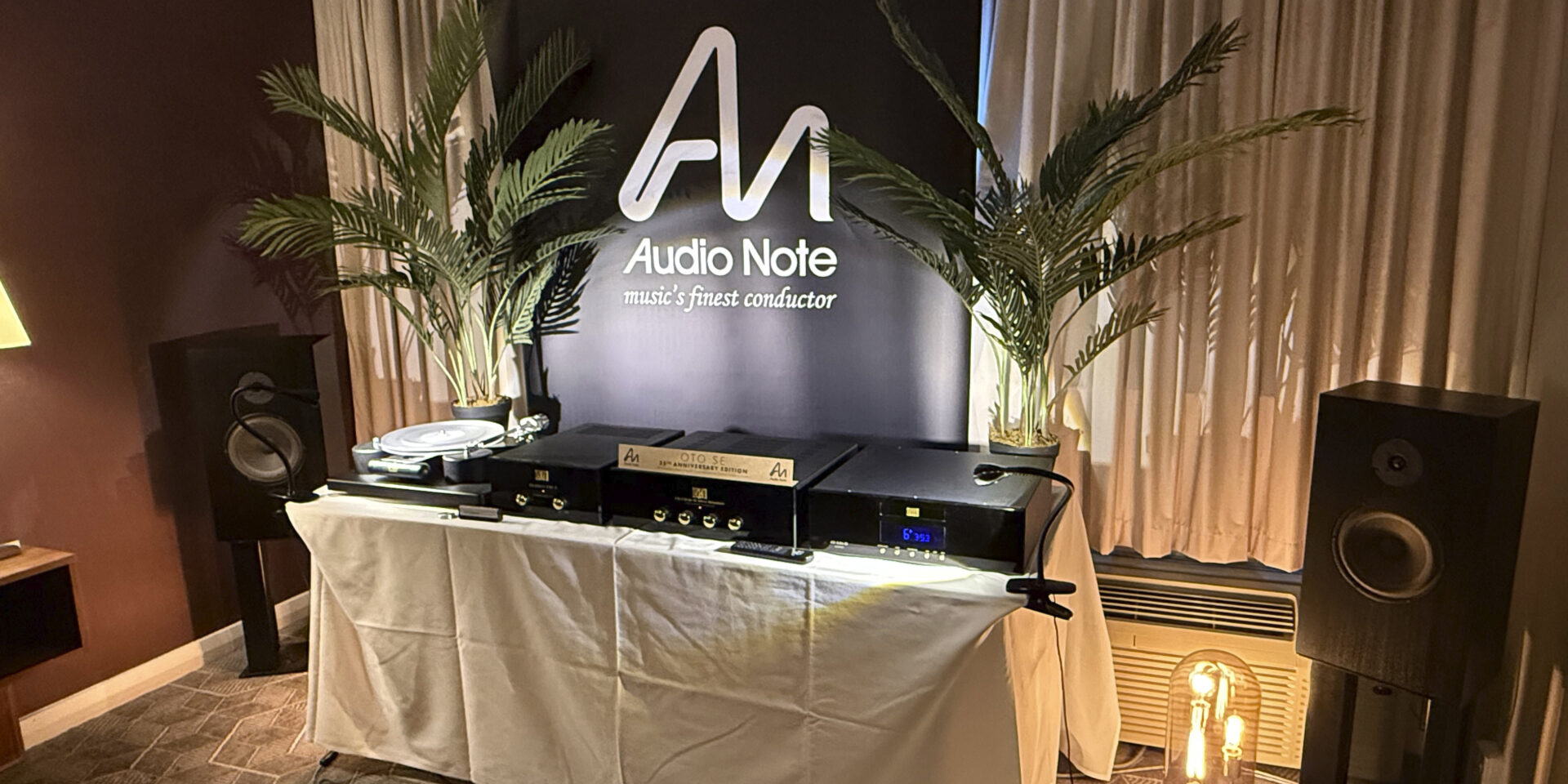
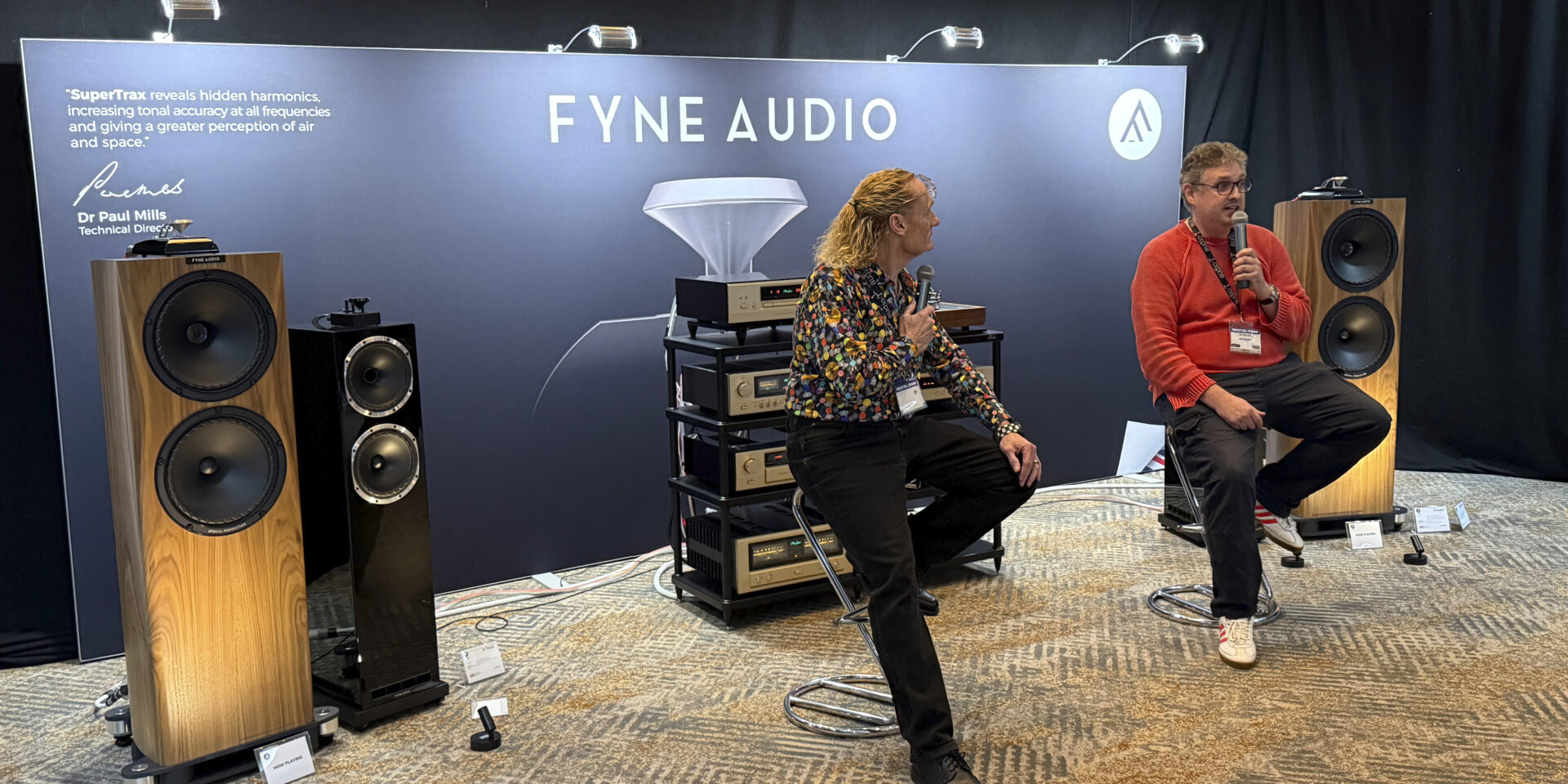
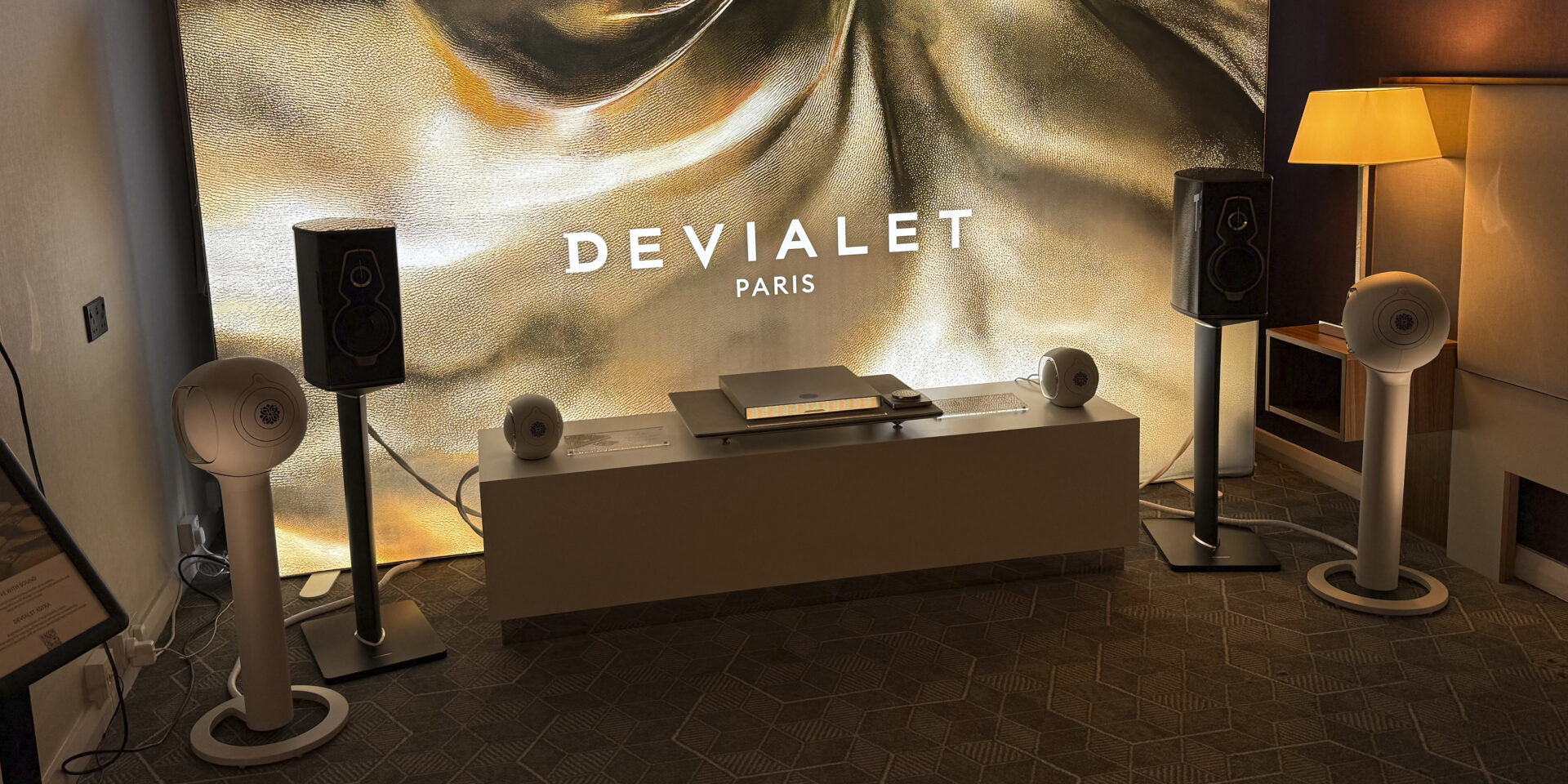
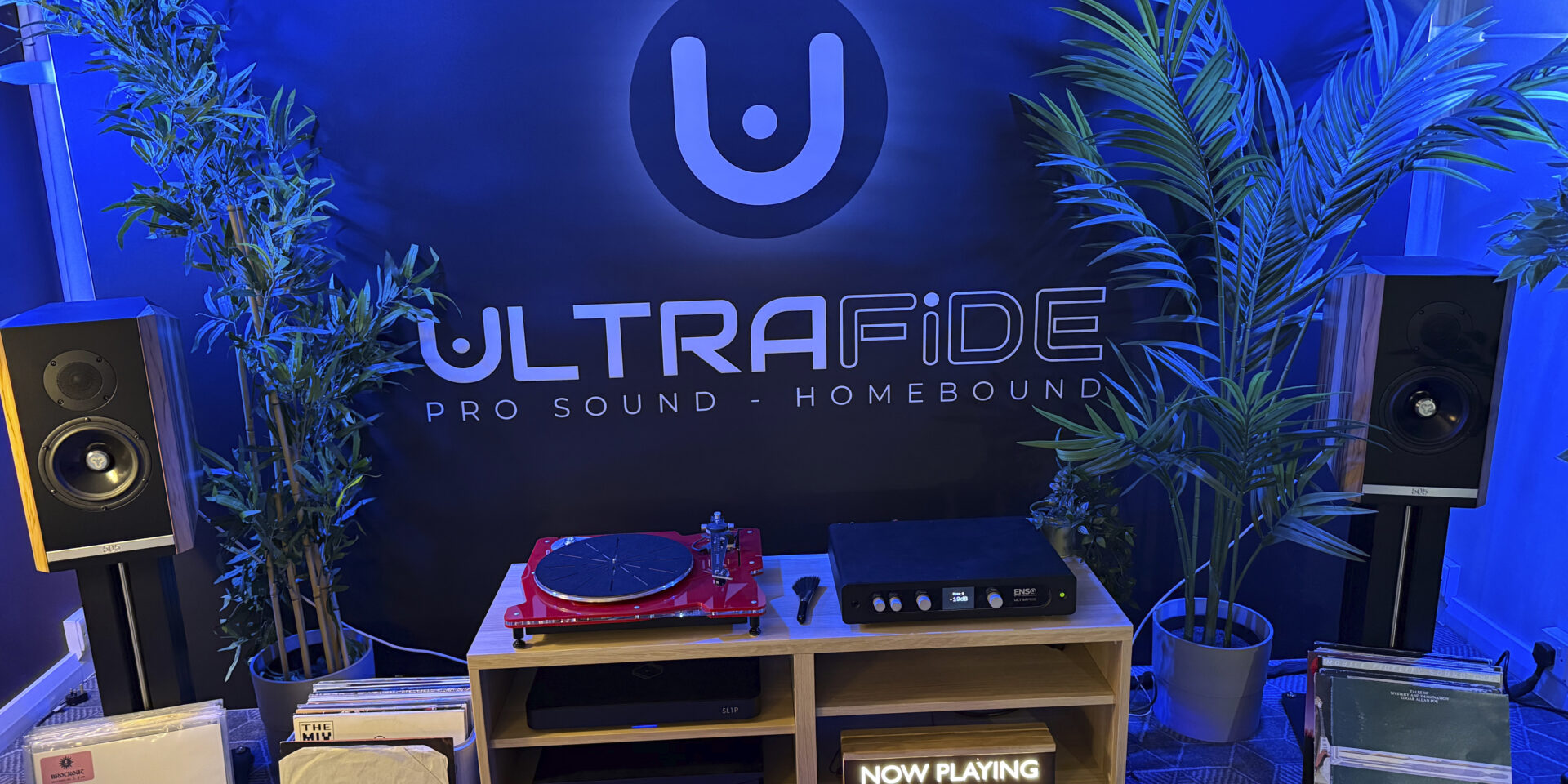
And here’s a photo tour to give you a quick overview.
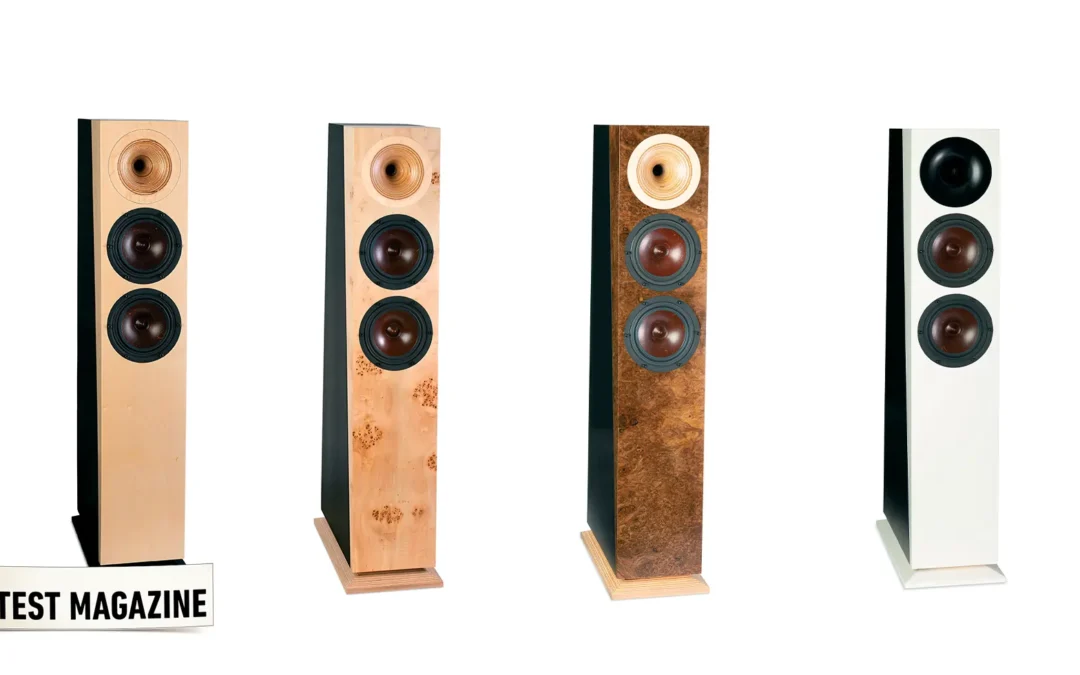
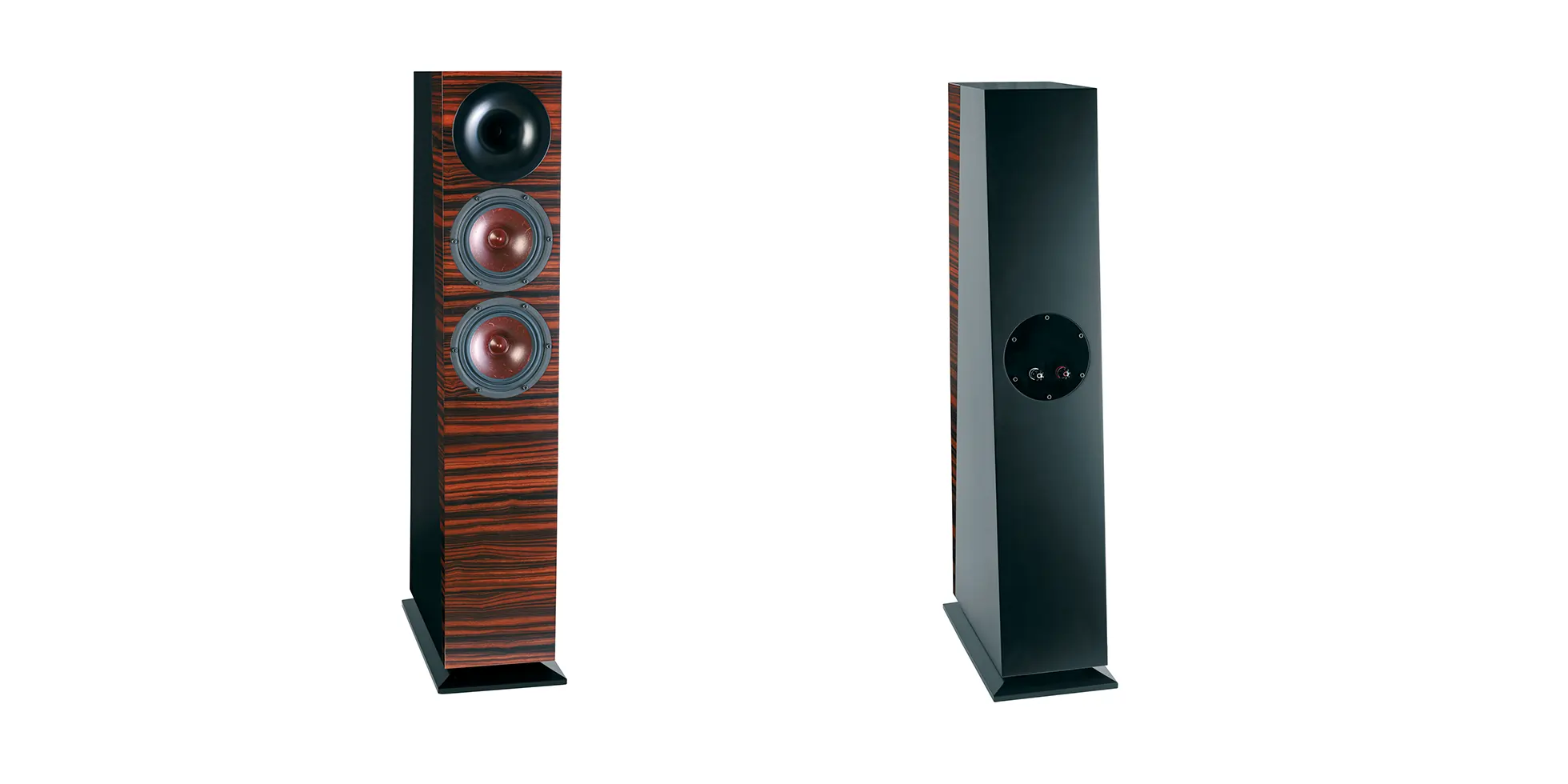
Featured in our issue no. 43 alongside its larger compact model, the Izumi, German brand Odeon Audio returns to VUmètre with a more substantial offering: the Odeon Audio Tosca 2020. This floorstanding speaker is the most advanced model in its catalog, ahead of the three external horn models. Priced at €8,290, it stands out for the quality of its hand-picked components—from Wima capacitors to Mundorf coils and Scan Speak drivers—in addition to its special compression tweeter from Italy, for a natural and versatile sound.
During our visit to the Esprit factory (see report in VUmètre No. 47), we had the opportunity to listen to the impressive Odeon Audio Semper (€33,900) and the ultimate Carnegie (€94,990).
Thinking we would test one of the models with external horns, we wanted to try the more reasonably priced Helix (€18,890), but ultimately realized that testing a more discreet speaker such as the Rigoletto 2020 or the Tosca 2020 would be more appropriate for the majority of our readers. So the Tosca 2020 stood out to us, both for the already very high quality of each component and for its musical realism.
Modified in 2020 to reach its third generation, the Tosca has improved both its mid-bass range and its tweeter, while remaining a two-way speaker, but with a wide frequency range capable of going down to 34 Hz and up to almost 25 kHz (manufacturer’s measurements). In order to achieve the finest response quality and the best bass performance, this speaker features a plywood cabinet with a 20 mm thick multiplex laminate structure designed to absorb vibrations as effectively as possible.
Added to this is a filter system that captures Helmholz resonances at the base of the mid-bass drivers, with the aim of providing the most natural air flow possible. The two speakers, manufactured by the Danish brand Scan Speak, feature a NAWI (non-unwindable) wood fiber cone and a very large magnet for greater rigidity and deeper bass reproduction.
Manufactured on the other side of Europe, the tweeter comes from Italy and uses high-compression technology based on a mylar diaphragm, a polyester film with the barbaric name of polyethylene terephthalate, also known by the acronym PET, which is highly resistant to traction, chemically stable, and highly reflective.
Driven by a neodymium magnet with a magnetic force of two Tesla to guide the moving coil, and reinforced by mechanical shielding to eliminate microphonic effects, it ensures faithful reproduction of high frequencies, supported in their diffusion by the 17 cm horn into which the tweeter is integrated. As for the low frequencies, a bass reflex system based on a downward-facing tunnel has been designed to improve the diffusion of some of the midrange frequencies, as well as to avoid being limited by placement too far or too close to a wall, as is the case with horizontal orientation.
The crossover filter is based on Wima film capacitors and Mundorf flat film coils, soldered point-to-point and mechanically secured, with the aim of minimizing deviations and achieving the most linear listening experience possible between each register. The cables used are German OFC copper and the terminals are among the best available: gold-plated copper WBT Nextgen, mounted on acrylic panels behind which the filters are placed.
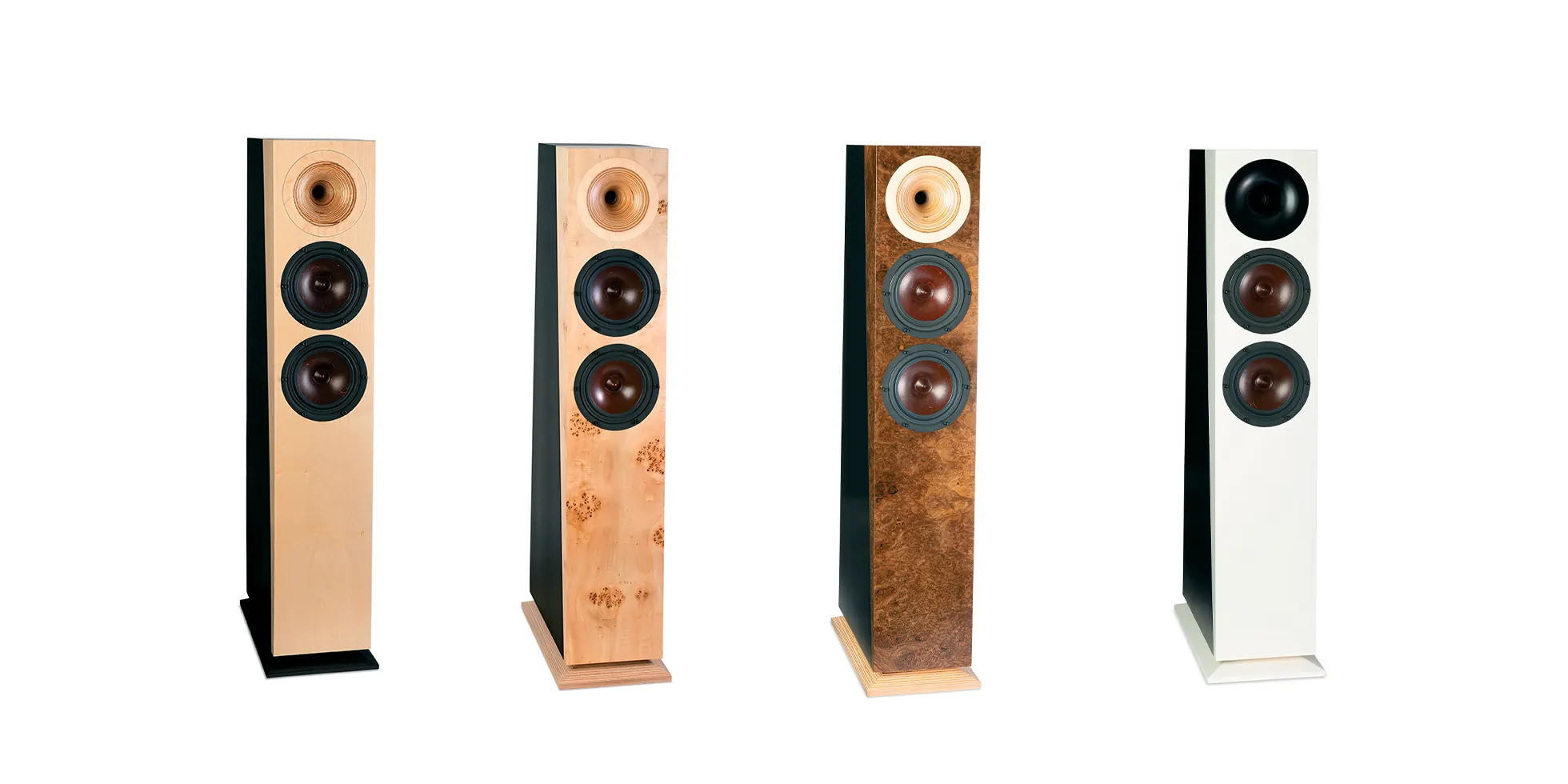
Measuring 111.5 cm in height, the Tosca 2020 speakers are placed on a wooden base and are available in a range of colors, either to enhance their woody character (poplar, macassar, walnut, maple) or to give them a more modern look with white or black lacquer finishes.
THE SETUP OF THE ODEON AUDIO TOSCA 2020
Available from only a few retailers, the Tosca 2020 speakers could be listened to at Hifi 35 in Rennes, where they were particularly well suited to being powered by a Unison Research S6 class A tube amplifier. The sources used also allowed us to develop the level of detail in depth, particularly with the new DCS Bartók Apex, whose range of nuances benefited from the Odeon Audio, brought back to a more conventional but already very musical level with the Moon 390 streamer.
Compared to more conventional competitors, such as the B&W 700 series and the KEF 800 series, the Tosca 2020s were also positioned in several locations in the auditorium, at different distances from the walls, as well as being oriented in various ways, in order to bring out their best potential, particularly when they were angled,
i.e., deliberately oriented towards the opposite corners of our sofa, with the aim of creating a perfect isosceles triangle and developing a more monitor-like listening experience.
THE SOUND OF THE ODEON AUDIO TOSCA 2020
As we were familiar with the Izumi and remembered their particular ease with natural music, we began testing the Tosca 2020 in the same way, which turned out to be a very good idea! While we were already very impressed with the sound quality of the smaller model, the large North Rhine-Westphalia column and its Italian-Danish speakers achieve an even higher level of realism.
With Savannah Conley’s new album or our usual jazz singers, the flavors of the midrange vocals come through directly, while the surrounding instruments benefit from the same purity of nuance. And more than just well-toned, the sound achieves a magnificent balance between all registers, with the notes superbly carried by the air.
Added to this is a wide soundstage, which gives our singers a beautiful volume, liberated and therefore with a special presence in the listening room, whose warmth is enhanced by the class A tubes of the Unison Research amplifier, as well as by the finesse of the details of the sources.
With very fine reproduction, particularly in the high frequencies thanks to the compression tweeter perfectly expelled by the horn, the Tosca 2020s, when angled towards the corners, further improve this precision, but at the expense of the soundstage, which then loses a little in width. This type of listening will then be a matter of taste!
Very comfortable with natural music, confirmed with classical chamber music ensembles, the Tosca 2020s were then pushed to their limits. And here again, compared to the Izumi, not only was the bass response much wider, but also much more natural.
While Hugh Masekela’s “Stimela” was initially used to check the tension of the real bass, superbly reproduced even in large dynamic ranges, it was with Tyler’s electronic sounds and the bass in Nirvana’s “Breed” that we were able to appreciate the excellent performance of the Scan Speak speakers at the lower end of the spectrum and the relevance of the downward-facing bass reflex system, without giving the impression of hitting the bottom of the cabinet.
To check the volume in terms of both width and depth and the handling of large masses, we first used Argerich’s Piano Concerto No. 1 (live Lugano, DG), as we had heard the pianist two days earlier in Evian. Here, the distinctly placed orchestral instruments combined with the clear distinction of the keyboard touch, with beautiful mechanical effects. On the other hand, when we played Tosca with Puccini’s eponymous opera, in the Karajan version from Decca, on “Tre Sbirri,” the initially magnificent organ gave way to limited depth when the orchestra and choir were fortissimo.
We checked again with “Vissi d’arte” from the same opera, where we had never before distinguished the crystalline harp so clearly, in addition to fully enjoying Leontyne Price’s tone, and we subsequently found that slight lack of breadth, not in width but in depth, which can be found in the brand’s superior, much more extreme models.
OUR CONCLUSION
Considered by some to be less versatile than certain competing speakers, Odeon Audio’s Tosca 2020s really won us over with their magnificent reproduction of timbres across a very wide range, without saturation even in the high frequencies or bass pushed to very high volumes. With impressive accuracy and naturalness, these German speakers offer superb fluidity and do not have the overly sharp character characteristic of many brands from this country.
Only limited in depth on very large masses, they are otherwise magnificent companions, especially if you are a fan of classical music and jazz. Although still discreet, this largest of the three speakers already benefits fully from the wooden horn effect, while retaining a classic design that the brand’s three largest models, which are much more voluminous and much more expensive, cannot offer.
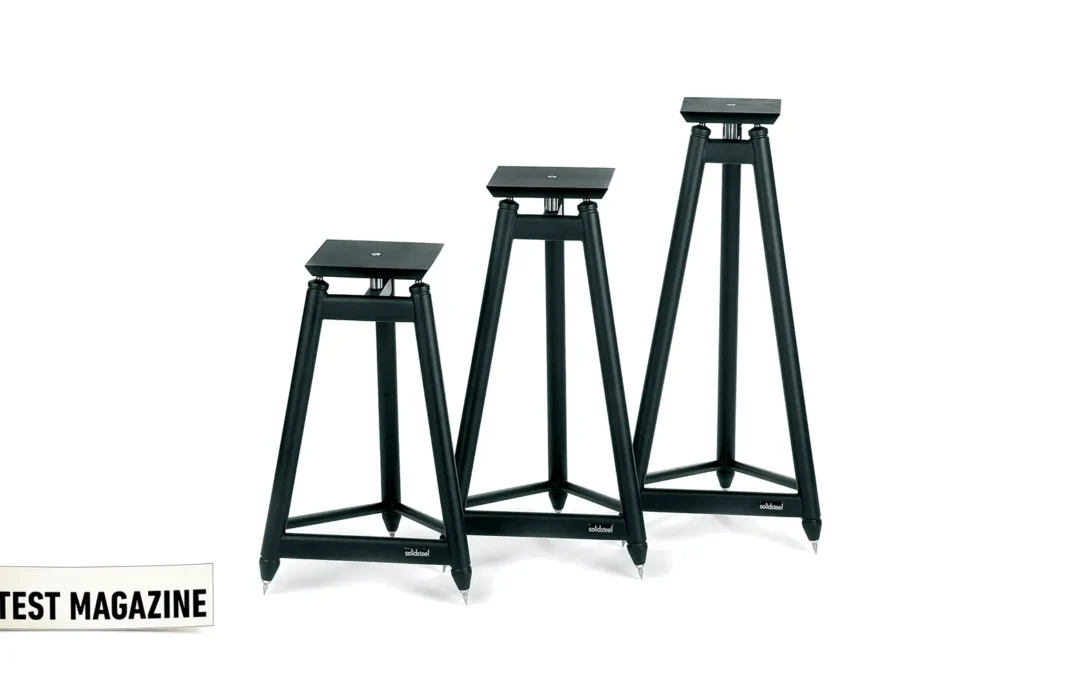
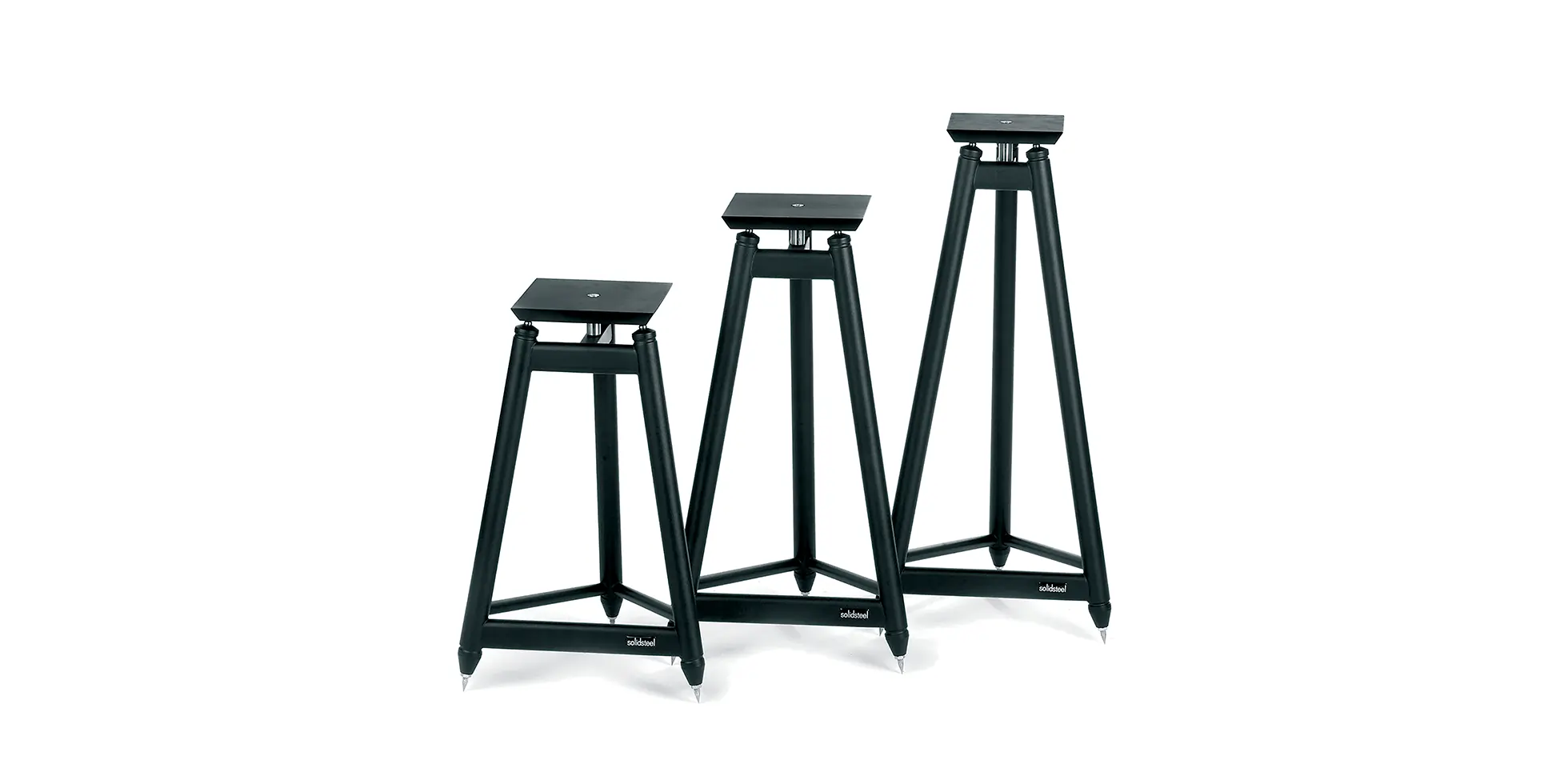
In addition to hi-fi furniture, Italian brand Solidsteel also has two ranges of speaker stands in its catalog, including the Solidsteel SS-7, available in three heights. Designed to support a large number of speakers with as little vibration as possible, they offer better bass concentration, refined detail, and improved sound spatialization.
All belonging to the S series—just below the top-of-the-line Hyperspike series—Solidsteel speaker stands fall into two categories, NS and SS, both of which are subdivided into three models of different heights. Named SS-5, SS-6, and SS-7, the models best designed to limit vibration are built on a tripod with a base measuring 13.4 inches wide by 12.2 inches long, with heights of 20.6 inches, 24.9 inches, and 28.6 inches respectively, offering the advantage of being compatible with all types of compact speakers.
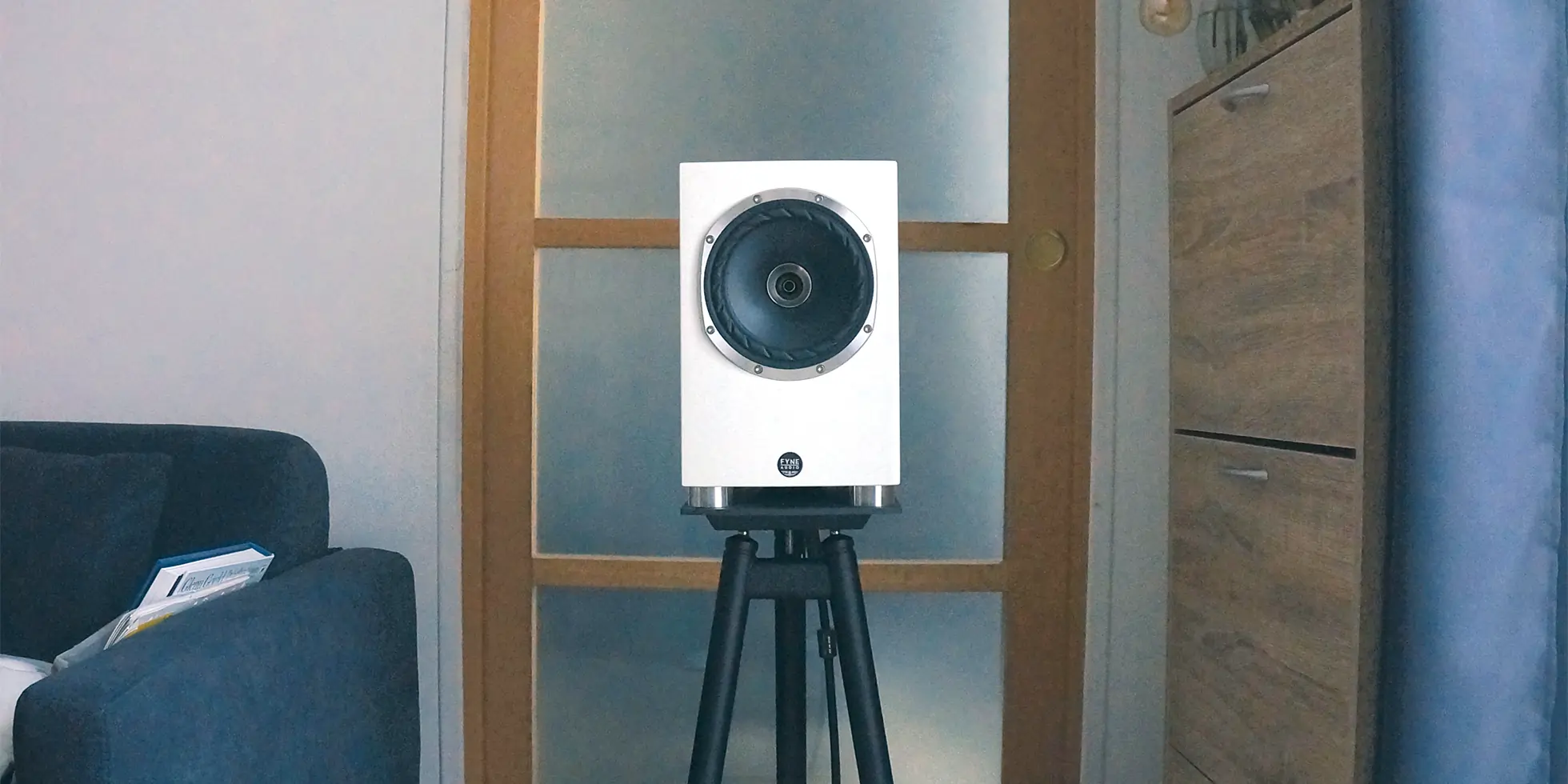
At the lower end of the range, the SS-5 is designed to fit large speakers such as the Fyne Audio F1-5, EgglestonWorks Nico Evo, or ATC SCM20, each of which is over 40 cm high. Higher up, the SS-7 is perfect for supporting small Jern speakers or conventional speakers that you want to raise in a large room, such as Kef LS50, B&W801, or Atohm GT1, the latter of which are otherwise perfectly suited to the medium size of the SS-6. If you want to go even higher, you’ll need to go back down to the NS range, which offers a less ordinary 1 m pair with its NS-10 stand.
Made of stainless steel with an anti-resonant finish, the Solidsteel SS can be further improved by filling it with a damping material, such as steel balls or sand. Also made of stainless steel, the removable spikes can be screwed in with a gap of about 1 cm, which is very practical in the case of a floor that is not perfectly flat.
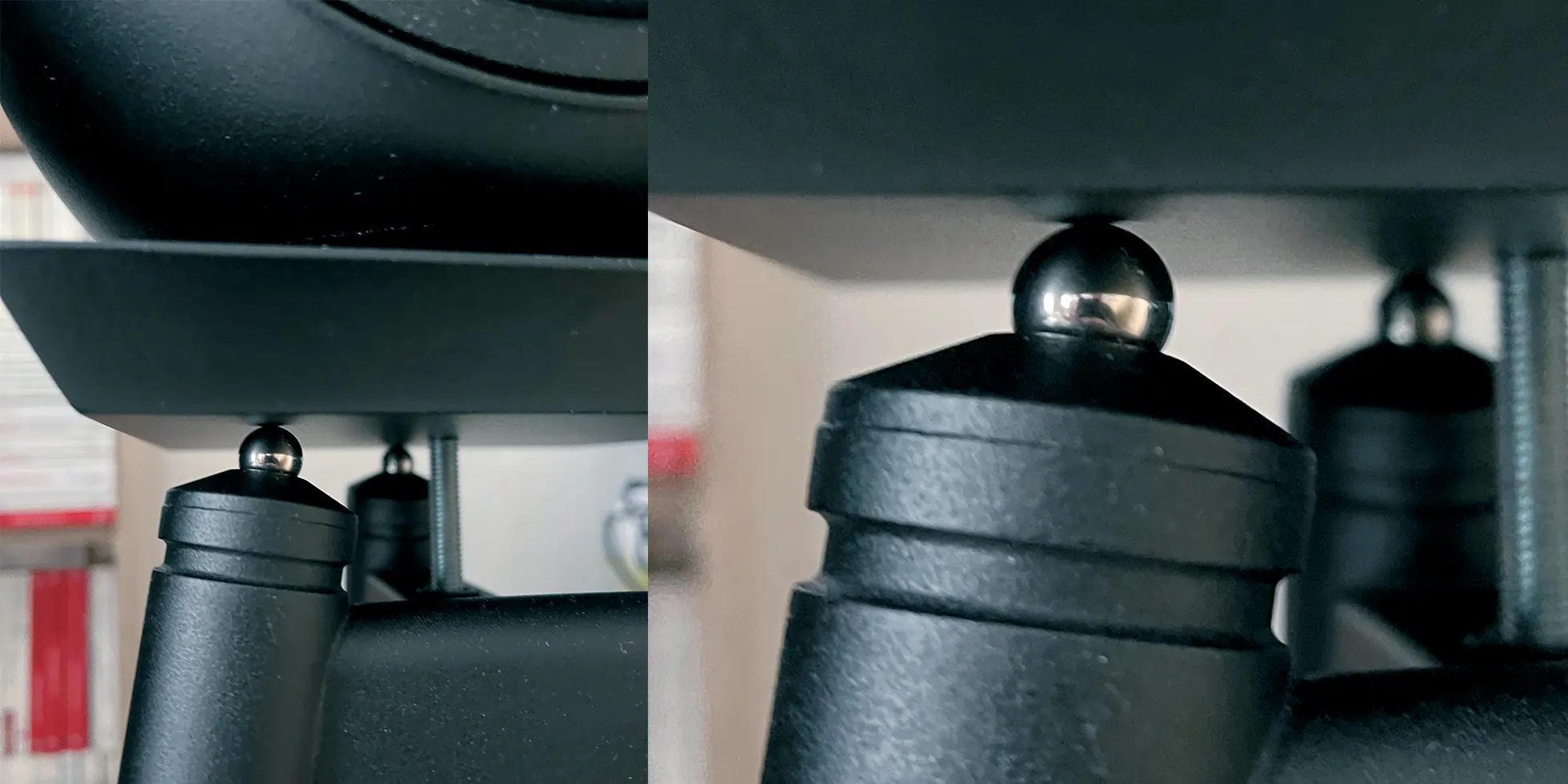
Alternatively, a standard 2 x 16 x 16 cm MDF plate can be custom-made to the diameter of the speakers, so that it fits perfectly with all models, in addition to allowing the three sizes of feet to be attached at the optimum height. In order to minimize vibrations, the base itself is decoupled from the chassis by steel balls, which are simply attached to the top of each foot, while it is held in place in the middle by a large screw, to which a small rubber circle is attached.
THE SETUP OF THE SOLIDSTEEL SS-7
Securely joined together using a traditional brass welding process, the three legs form a tripod onto which the spikes are screwed, to be placed on small counterpoints depending on the landing surface, while the small steel balls must be attached to the other ends, on which the base is then placed and securely screwed down using a large screw and an Allen key, supplied by the manufacturer. Next, simply add the speakers to the base, securing them with Blu-Tack, also supplied in the package.
During our tests, we alternated between the Atohm GT1, Jern 15H, Fyne Audio F500SP, and Closer Ogy speakers with entry-level Norstone stands, mid-range Linn stands, and Solidsteel stands, also taking into account a height difference of 18 cm and 12 cm between our two comparable models and the Solidsteel, tested at its highest level: the SS-7.
In addition to these multiple tests, we also applied different coverings between the parquet flooring and the stands, with and without spikes, from carpet to cork to solid beech panels, which were also very useful for bringing our Norstone stands to an almost identical height, as well as improving their bass response in an attempt to make them as good as the Italian model we tested… without ever quite succeeding!
THE SOUND OF THE SOLIDSTEEL SS-7
Any hi-fi enthusiast who owns a pair of compact speakers will have made this obvious discovery at some point: the stand is essential for getting the best out of all the registers of your products. Even when the speakers themselves have an independent base, such as the Fyne Audio F500SP or the Atohm GT1, combining them with decouplers or better stands allows them to perform even better.
We had already noticed this difference between Norstone and Linn stands, which were themselves greatly improved when placed on a surface such as cork for the Linns and beech for the Norstones.
However, the effect is even more striking when the aforementioned speakers are placed on Solidsteel SS-7s, simply left on their spikes and counter-spikes placed directly on the floor. Within moments, there is a feeling of “refocusing” of the sound, which particularly improves the bass response, resulting in a better image contour, refined in detail across the entire spectrum.
With female blues singers, the finesse of the voice is revealed even more, especially through the Atohm and Fyne speakers, while our Closer Acoustic Ogy speakers benefit above all from increased clarity in the sound reproduction of their single high-efficiency Fertin driver.
Less impressive with our Jern 15H speakers, because these closed-back speakers already weigh 16 kg and seem unalterable in advance, the sound still gains in definition, managing to bring out the bass and background even better, for example in electronic music, or in the timpani of an orchestra or the drums of a small jazz ensemble.
OUR CONCLUSION
With truly effective sound compared to lower-end stands, Solidsteel’s SS stands can be adapted to all needs thanks to their different heights and base dimensions. The results are striking in the bass range and benefit the entire sound image, seeming to refine most speakers, especially classic models in the $1,000 to $3,000 price range. Compared to the stands that manufacturers supply with their own speakers, these stands, which are entirely made in Italy and cost around $500, offer real added value at a price that is still reasonable compared to some of their competitors.