
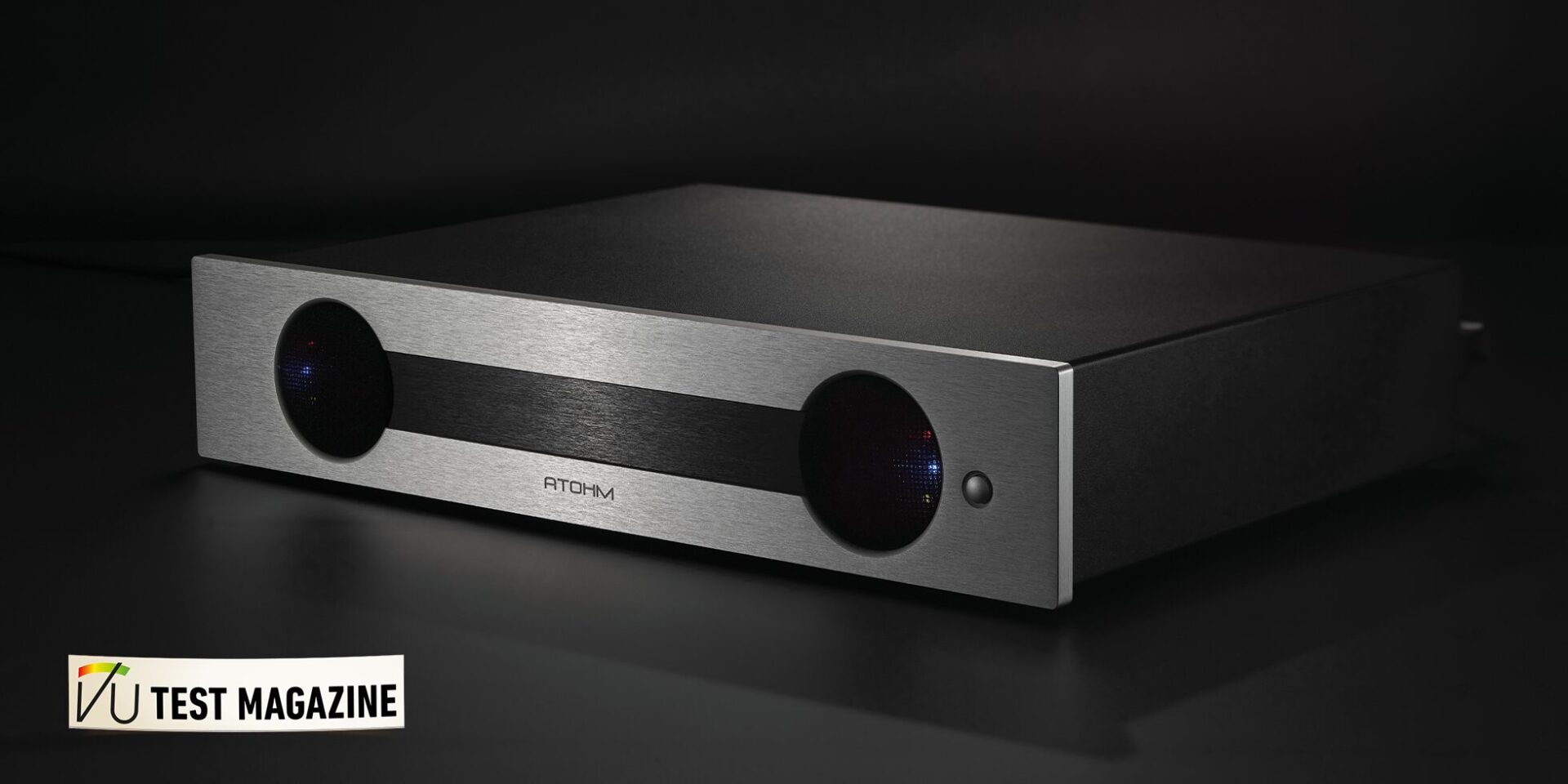
Thierry Comte, creator of the Atohm brand, recently set about developing a power amplifier, fine-tuning its settings to match his Atohm GT speakers as closely as possible. The result is the Atohm RS700 GT Edition, which delivers 350 W under 8 ohms in class D, with control via an analog-to-digital card incorporating a DSP.
Designed to work with all speakers on the market, it is even more suited to the brand’s models thanks to these exclusive settings, particularly in the lower end of the spectrum, which is extended at will thanks to X-Tend technology, under the protection of U-Guard and X-Guard, which limit bass peaks when their power could tear the speaker membranes.
It’s been a while since we last talked about Atohm, a French speaker manufacturer whose GT1 speakers we have at VUmètre, and which caused a sensation at the last Munich show with the presentation of new entry-level speakers, notably installed on the latest Sirocco speaker models to be launched very soon.
In the meantime, we return to the manufacturer’s catalog with its unique electronics, a dual-mono power amplifier with Class D stages capable of delivering up to 350 W into 8 Ω and 700 W into 4 Ω. Controlled by 96 kHz/24-bit DSP, the two amplifier boards are combined with a digital-to-analog preamplifier board that provides the finest possible control of the signal sent to the speakers. And since this is a Class D amplifier, its phenomenal damping factor exceeds 1,000 (measured by the manufacturer at 1,000 Hz/4 ohms).

The RS700 is very comprehensive and comes in several editions, including a Waterfall edition, adapted to the brand’s speakers and subwoofers, in exclusive partnership with Atohm for the speakers. For this test, however, we logically opted for the GT Edition, which is adaptable to the three speaker models in the GT range.
On the rear panel, we will quickly skip over two terminals that are unnecessary for this model (S/PDIF input and output) to focus on the speaker terminals and low-level RCA or XLR inputs, which are used to connect an analog preamplifier or simply a source with volume control.
There are also two low-level XLR outputs for those who would like to add one or two subwoofers, with a high-pass filter that can be set to 60-80 or 100 Hz with a 12 or 24 dB slope to avoid interfering with the bass frequency. Trigger jacks are also provided, which are always useful for powering up all the devices in a system at the same time.
To ensure the cards are properly cooled, all these inputs and outputs are located in the middle of the rear panel, between two very quiet 2,500 rpm fans, which are very useful when you want to listen to music at high volume for long periods of time.
On the front panel, there are circular vents on each side, and in the center of the panel, a set of knobs and switches (XLR/RCA; sub output, mute, etc.) placed in a row, the last of which allows you to bypass the X-Tend function. Once set to the correct parameters for conventional use, all these switches and vents can be covered by grilles and an aluminum strip, which are more pleasing to the eye.
DESIGNED FOR GT
So far, the Atohm RS700 GT Edition has been fairly conventional in its description of a high-quality dual-mono Class D amplifier with high-quality DSP, but it can drive any speaker model by providing real active filtering capabilities. It stands out even more when paired with Atohm GT speakers. To do this, you need to remove the cover and move the small switches inside to switch from classic mode to GT1, GT2, or GT3 mode, each of which has been finely tuned to the capabilities of the speakers.
Once GT mode is engaged, the RS700 truly shows its personality, as it adds two technologies focused on bass performance. Even in classic mode, the amplifier offers a U-Guard system that limits the amplitude and, more specifically, the clipping of signals, to ensure that they do not saturate the power stages and risk degrading the sound or damaging the speakers.

Already effective, this soft clipping is further enhanced when switching to GT mode, thanks to X-Guard technology, which constantly monitors the level of movement of the woofers to ensure that they never become too distorted. When activated, small green LEDs appear on both sides of the front panel. The third level of safety, T-Guard, constantly monitors the average energy sent to the speaker coils to prevent them from burning out. In the event of overpowering, the level is lowered by 15 dB for about 20 seconds (indicating that the sound level should be reduced for listening).
Thanks to all these precisely managed control systems, it has been possible to add a final bass extension parameter. Called X-Tend, this processing allows the frequency response of the speakers to be reduced or extended while improving group delay (it partially compensates for the bass reflex).
The GT3’s response can thus be selected from 70 Hz (-3 dB) to 30 Hz (linear) using the small knob on the front panel turned fully to the right. In this maximum position, the speaker’s range of motion is significantly greater and the X-Guard excursion control is used extensively to prevent any overflow. This function can always be canceled using the switch on the far right of the front panel, which allows you to return to the GT3’s natural response with a low cutoff at around 40Hz.

THE SETUP OF THE ATOHM RS700 GT EDITION
Adaptable to all speakers, the Atohm RS700 GT Edition was tested at the CTA store in Paris, where we had the opportunity to not only match it with the Atohm GT3 HD—even though we only have the GT1 in our auditoriums—but also to pair this power amplifier with several preamplifiers. The idea proved very convincing, because in addition to being able to check the combination with the Accuphase C-2300 preamplifier and the surprising combination with the Luxman CL-38uC tube amplifier, the most obvious match was clearly noticed in the combination with the Atoll PR400 Signature.
More consistent in response and range (to form an amplifier-preamplifier combination costing around €8,500), the Atohm amplifier was also directly connected to the Atoll ST300 Signature, used with its digital volume control, with a consistently high level of audible consistency, but with the advantage of bringing the amplifier-streamer combination down to around €6,500, with no need to add anything other than speakers. And indeed, although we initially tried several models, including the Sonus Faber Olympica Nova V, connecting the RS700 GT to the Atohm GT3-HD and setting the GT3 mode from within the device significantly improved performance.

THE SOUND OF THE ATOHM RS700 GT EDITION
Placed right next to the Accuphase C-2300 preamp in the CTA auditorium, we tried this first combination with the Atohm RS700 GT Edition, where despite a significant difference in price range (three times the price), it seemed interesting to discover how the French amplifier would perform compared to this very clear and pure Japanese product. With this pairing and the Sonus Faber speakers, we were able to appreciate the clarity of the whole and feel the great power of the amplification, which was comfortable in terms of dynamics as well as bass control.
Once we switched to the GT3 HD speakers, we noticed even greater sonic coherence, with better-defined contours, more natural timbres, and increased dynamics. And once GT3 mode was activated, we were able to adjust the dial to activate X-Tend and see how the membrane’s excursion developed, in a way that would have seemed worrying if we hadn’t known that U-Guard and X-Guard technologies were protecting us.
However, the soundstage was a little too sharp, so we decided to change the preamplification to the Atoll PR400 Signature, which gave us a more centered image in the midrange and a more consistent sound across all registers. With this new combination and a high-quality source, numerous tests allowed us to hear the gain of the X-Tend on a large symphonic ensemble, before testing several R&B tracks. With this very dynamic music, turning the volume up to very high levels initially pushed the membrane to limits that seemed difficult to reach, without ever saturating the sound.
Then we turned up the volume even further and green LEDs appeared, showing the action of the U-Guard and X-Guard to limit the movement of the speakers. At even higher volumes, red LEDs appeared, indicating soft-clipping processing, with the T-Guard kicking in to gently reduce the volume by 15 dB to prevent the speaker coils from burning out or damaging the amplifier, which was then at peak power (350 W!).
After such impressions, we were able to return to much calmer musical styles and chose jazz, without experiencing as much interest in the X-Tend here, since the bass speakers are much less stressed, but also switching – on the advice of Jean-Michel from CTA – to the Luxman
CL-38uC preamplifier. Surprisingly, given the combination of tubes with the Class D amplifier, the listening experience was once again very interesting, especially with quiet music, although less obvious than with the Atoll PR400 Signature for someone who listens to all styles of music.

OUR CONCLUSION
Very well positioned in relation to other products in its price range, the Atohm RS700 GT Edition becomes a real musical weapon when paired with speakers from the GT series, and even more so with the GT-3. Not only can it handle all types of music with powerful sound and a consistent soundstage, but it also brings out the maximum potential of the French manufacturer’s models.
Also available in a Waterfall version to best suit this brand’s models, the 350 W power amplifier under 8 ohms in class D impresses with its ability to extend the GT’s bass range, while offering all the safeguards to prevent damage. So, for all listeners interested in a versatile amplifier, and even more so for all Atohm speaker owners, the Atohm RS700 GT Edition is worth trying, especially for those who like to listen to music at high volumes!
Author(s): Vincent Guillemin
Technical Sheet: Atohm RS700 GT Edition
- Origin: France
- Price: €3,490
- Dimensions: 450 x 88 x 348 mm
- Weight: 8.7 kg
- Amplification type: Class D
- Nominal power
- 350 W into 8 ohms
- 700 W into 4 ohms
- Frequency response: 2 Hz – 45 kHz (-3 dB)
- Nominal load impedance: 4 – 16 ohms (3 ohms minimum)
- Signal-to-noise ratio (SNR): 110 dB
- Harmonic distortion (THD+N): <0.06%
- Damping factor: >1,000 (@1,000 Hz/4 ohms)
You might be interested: Atohm GT3 HD


