After developing isodynamic panel technologies inspired by Magnepan, first with the DP77 and DP107, then with another design for the DP140 and DP160, where the tweeter protruded from the central panel and was embedded in the wooden side structure, the two Montalbanais creators of Diptyque Audio, Gilles Douziech and Éric Poix, reinforced by two young collaborators, set about creating a very high-end product.
Named Référence (see VUmètre test no. 42, Remarkable), this pair of 1.80 m high panels, priced at over €40,000, has now given rise to two more affordable new products, based on exactly the same design, which is much classier than the previous one: the Diptyque Audio DP140 MkII and DP160 MkII. The smaller of the two is now being put to the test, revealing sounds that are as natural as ever and an unusual soundstage.
Diptyque Audio has given its famous DP140 isodynamic speakers a facelift. Presented under the name DP140 MkII, they use two isodynamic cells for bass and midrange reproduction. These operate according to the brand’s exclusive PPBM principle, the result of more than ten years of research, innovation, and optimization. Their mechanical structure is inherited from Diptyque Audio’s Reference model.
High frequencies are reproduced by a new ribbon tweeter. With a 55 mm long ribbon, it has a particularly wide frequency response, giving these new speakers unparalleled consistency and naturalness. However, isodynamic technology differs fundamentally from the electrodynamic technology used in conventional speakers. Mastering this technology is a real challenge that only a very small number of speaker manufacturers dare to take on.
In the case of Diptyque Audio, it was the meeting of two hi-fi enthusiasts that gave birth to the brand. Gilles Douziech and Éric Poix, both searching for a system capable of meeting their requirements for naturalness and purity, devoted their energy to rethinking every problem and seeking optimizations in order to be able to offer products with unparalleled performance.
At the time, Gilles Douziech, a 19-year-old electronics student, had the opportunity to do an internship with Marcel Rochet, designer of Mulidine speakers. This was an opportunity for him to live out his passion while learning complex concepts of acoustics. Added to this were the essential electronics studies required to develop filters capable of working in harmony with a wide variety of speakers.
Éric Poix, for his part, was a specialist in mechanics and metalwork. Also in search of absolute sound purity, he continued to develop his listening system. What’s more, his skills quickly led him to design speaker stands that are acoustically neutral thanks to their high rigidity. It was from this union of two experts with complementary skills that Diptyque Acoustique was born. But after exploring many avenues, no technology fully satisfied them.
That’s when isodynamic technology, also known as magnetostatic speakers, appeared to them as the most promising. This was especially true since Éric Poix’s expertise in ultra-resistant structures offered the possibility of new mechanical solutions for designing the essential components of such speakers. The design of ultra-rigid frames, among other things, allows for perfect membrane tension.
As prototypes were developed, Diptyque Audio also made numerous improvements to this technology. One of the most important concerns the use of powerful neodymium magnets placed on either side of the membrane so that the magnetic circuits it carries evolve within a constant field during their movement.
This architecture, known as Push Pull Bipolar Magnet, guarantees perfect control of the membrane’s movements. To maintain the acoustic neutrality of these speakers, their frame is based on an assembly of thin MDF notches, felt, and sheet metal plates. This complex combination of materials has proven its effectiveness and the quality of sound it offers.
Magnetostatic technology, although delicate to implement, has many advantages. First, the diffusion of a flat wave from a large surface guarantees a feeling of sound immersion without any sound projection effect. In addition, the dipole operation of such speakers recreates the spatialization of sound necessary to replicate the behavior of a concert hall. Furthermore, the use of ultra-thin 12-micron Mylar membranes guarantees a lively, lag-free response. In the same vein, the use of the same membrane across the entire audible spectrum preserves the consistency of the sound message. Finally, the absence of acoustic load eliminates the “box” effect that causes certain undesirable colorations.
Finally, the tweeter used in the DP140 MkII has been specifically designed for them. It is based on a ribbon made from the same Mylar film as the main cells. This ribbon is a substantial 55 mm long, which allows it to go relatively low. The tweeter’s extended frequency response gives the DP140 MkII a very smooth transition between the tweeter and the isodynamic drivers. It also allows the use of low-slope filters: 6 dB per octave. This smooth transition ensures impressive naturalness and realism in the midrange. Listening to grand piano, among other things, highlights this behavior.
THE SETUP OF THE DIPTYQUE AUDIO DP-140 MKII
Discovered at the 2023 Munich High-End Show in the same room as the B.Audio Alpha One tested in this issue, the Diptyque DP140 MkIIs were listened to again before the summer during our visit to the manufacturer in Montauban, with Jadis amplification and Esprit Lumina cables, then again with these cables at the Paris Audio Video Show in October, this time connected to an Atoll 400 series amplifier-preamplifier pair and the ST300 network source.
In order to further refine our tests, we were able to listen to the panels again conscientiously and in a calm environment in the large room at L’Auditorium Parisien, a dealer for the brand, with Cardas cables on Moon devices, then on the Mark Levinson 5805 amplifier connected to a dCS source.
Above all, these final tests allowed us to verify the best placement of the panels in a large room and their effective response. In the final analysis, we were able to consider the very noticeable differences depending on whether the tweeters were placed inward or outward, since unlike the vast majority of speakers or even electrodynamic panels, the DP-140 MkIIs are symmetrical, like the Reference models, with one tweeter on the left and the other on the right.
THE SOUND OF THE DIPTYQUE AUDIO DP-140 MKII
Now based on the design and technologies developed for the Reference series, the new Diptyque DP140 MkII—soon to be followed by the DP-160 Mk I—are smaller versions of their predecessors, both visually and in terms of sound. Mainly listened to with the tweeters facing outwards, these panels immediately offer a wide soundstage, which is particularly exciting for imaging the live scenes of certain recordings.
For example, we started with the Goldberg Variations in Christopher Tarnow’s very pure but highly technical studio recording for Víkingur Ólafsson, but this recording, in which we had already noticed an inversion of the low and high registers compared to the usual listening experience of a recorded piano, is even more disturbing with the DP140 MkII.
Conversely, Lang Lang’s live performance of the same work immediately transported us to the middle of Leipzig’s Thomaskirche, as if we were present in the church during the concert. Also from Bach’s masterpiece, Xu Xiao Mei’s live recording at the Abbey of Saint-Riquier gives the instant sensation of having changed location, and as with Lang Lang’s concert, it almost makes us believe that we are part of the audience, transported with a swipe of the finger on the iPad from one church to another, yet more than a thousand kilometers apart.
With such realism, we then wanted to visit Cologne thanks to Keith Jarrett’s Köln Konzert, where the only Hi-Res file found today on Qobuz places the pianist on the far right, this musical impression reinforced here by the image perfectly materialized thanks to the Montalbanais isodynamic panels.
The effect also works with live opera, where the singers’ positions and movements on a large stage can be perfectly reproduced visually. Large masses are never a problem either, with elements becoming more refined as the source is improved (from Moon to dCS in our case), while the change from a Moon 340i amplifier to a Mark Levinson 5805 surprised us.
Whereas we had already made this same change with speakers in the past and found the American amplifier, connected to the DP140 MkII via Cardas cables, to produce a sound that was immediately louder and faster, this time it just added a little extra speed and refinement. This allowed us to better understand the impressions we had during previous listening sessions, where, despite the variety of locations and very different upstream equipment, we recognized a very similar sound between the Munich and Paris shows, demonstrating that the panels are less sensitive to amplification than many conventional speakers, and that a good amplifier in the $3,000 to $4,000 price range can already make them sing.
Once the DP140 MkIIs were inverted to place the tweeters inside, the sound immediately tightened up. By bringing the panels closer together widthwise, the sound became more monitor-like, developing finesse and detail at the expense of the breadth of the soundstage. In terms of imagery, it previously felt like listening to Nick Cave or a pianist while sitting in a concert hall, whereas with the tweeters in the center, it felt more like we had brought these artists into our living room. This is mainly a matter of taste, but in a large room, we strongly recommend offsetting the tweeters to take full advantage of the amplitude offered by these new Diptyque speakers.
OUR CONCLUSION
With their expertise and maturity, the creators of Diptyque Audio have once again hit the mark with the DP140 MkII. Directly derived from the work and long development of the Reference models, these smaller panels far surpass the older models, DP140 and DP160, in addition to being much more stylish in their design and therefore much more flattering if they are to be integrated into a living room. Of course, this comes at a price, which is €2,000 higher than the previous generation DP160, but it is justified by the musical gain.
With their highly natural reproduction, the DP140 MIIs are not so much surprising for their impeccably accurate timbres, which we expected, but for the realism of the image and, if the tweeters are positioned correctly towards the outside, the breadth of the soundstage, which allows us to enjoy all the great concerts recorded live over the last century from the comfort of our own homes.
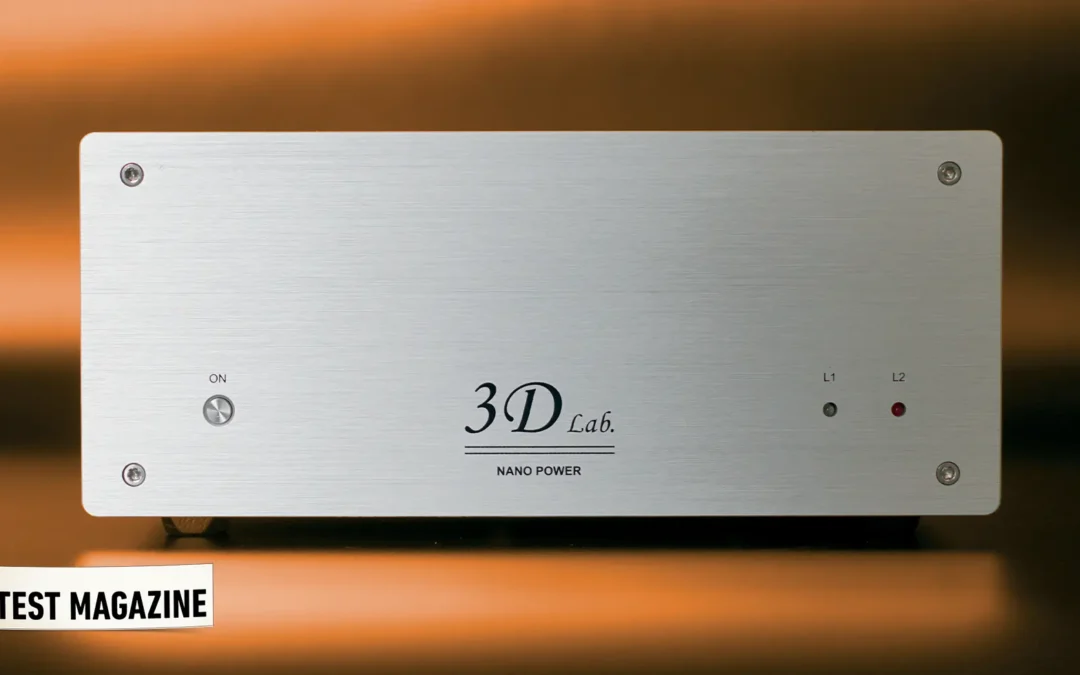
Long convinced that the purity of the electrical current in hi-fi equipment is essential for optimal performance, Charles-Henri Delaleu has developed a range of external power supplies, the first of which, called Nano Power 2, has just been launched on the market. Based on extremely low ripple and noise levels, this new addition to 3D-Lab’s Nano range is available in one or two rails, allowing different output voltages to be set for dual use with products requiring different voltages.
Integrated into the usual chassis of the Nano range, the Nano Power power supply was finally released at the end of 2022, after being presented for the first time at the Paris Video Audio Show in 2021. Soon to be followed by an even higher-end Signature version, the classic range already consists of two models, Nano Power 1 and Nano Power 2, the difference being that the number 2 can power two devices at the same time, with the important ability to offer different voltages for each of the two rails.
Still notable for its discreet aluminum front panel, the Nano Power stands out because the small On button, which is only decorative on the Nano Transport and Player, is now functional! Next to it are two LEDs, blue and red, the former indicating when the device is operational and the latter when it is in standby mode.
At the rear, a five-pin socket allows you to connect a cable with one or two outputs, both of which are supplied in the box by the manufacturer. To select single or dual use, there is a small switch that you flip to the right when you want to power two products at the same time. Placed on a single printed circuit board, the two rails each use two 3,300 µF and 25 V transformers associated on each side with numerous semiconductors in discrete components, leading to a BI Technologies potentiometer and then to the switch, whose purpose is to set the voltage in six steps, from 3.3 V to 15 V.
On request, this DC voltage can be adjusted from 1.8 V to 18 V, although most high-fidelity devices are concerned with the directly configurable variables of 5 V, 9 V, and 12 V. A large 52 VA Printtrafo transformer block molded in epoxy resin with double winding completes the Nano Power, which is still based on very low-interference components, in order to create a power supply with some of the lowest noise and ripple levels on the market.
The setup of the Nano Power 2
Very easy to install, the Nano Power 2 comes in a shoebox format that allows it to be integrated almost anywhere, with good damping provided by its rubber feet, although adding decouplers further improves performance by further limiting vibrations.
Once it is connected to the mains via an IEC cable, it is important to ensure that the correct voltage is set for the desired devices, as powering a 9V DAC with 12V, for example, could burn it out in a matter of seconds. Once connected to the other devices—which should always be left on since their switches are no longer the master—simply turn on the switch on the back of the Nano Power and the small button on the front, then wait for the blue LED to light up.
For our tests, we paired the 3D-Lab Nano Power 2 with a Nano Player Platinum network player, positioned in the middle of the 3D-Lab range between Sonata and Signature. We then added the second rail to our Internet box. The Kora TB140 amplifier and our Jern 15H speakers, connected by Esprit cables from the Celesta to Aura ranges, were faithful companions in analyzing the contribution of the separate power supply in detail. This is refined by its use on Silent Angel’s very high-end Internet switch, also tested in this issue.
The sound of the Nano Power 2
It’s no secret that improving the reliability of a device’s power supply allows it to deliver its best performance, and while most high-fidelity products already have a lot of work put into their power supply, adding a high-quality external one further improves the sound quality. Initially connected only to the 3D-Lab Nano Player Platinum, the Nano Power 2 provides extra volume while creating more roundness and allowing for better contouring of the notes, with the advantage of giving the impression that they last longer. The power supply also refines the tone of voice and enhances the timbres, particularly the bass, which is better sustained and slightly deeper.
With the Nano Player used for transport only, the same qualities are noticeable when the external power supply is added, increasing the clarity of the signal as well as giving it volume, obviously because the background noise has receded and the soundstage gains in definition. Integration into the Internet box allows us to use the device with two different voltages, and thus to verify the perfect coordination of the elements, to the advantage of the Nano Power 2 compared to our Ferrum Hypsos, whose splitter can only power two or three devices with identical voltages and currents in the same direction.
Our conclusion
Finally released, the 3D-Lab Nano Power clearly brings added quality to the Nano Player Platinum network player, while at the same time being designed to be adaptable to products from other brands and with different voltages. In its Nano Power 2 version, having two rails with two separate voltage selectors provides a significant advantage over competing power supplies, as it becomes possible to simultaneously ensure the reliability of the power supply to a streamer and that of a network switch or Internet box.
Developed over more than three years by Jacek Grodecki, the two Closer Acoustics Ogy speakers stand out from the Polish brand’s larger models, while retaining the distinctive characteristics of a full-range driver from Catherine Fertin’s French workshops. With their highly distinctive sound, the Ogy speakers are charming companions for natural music, especially intimate music.
The first in a range of five speakers, all of which are large and heavy columns, the latest additions to Closer Acoustics, charmingly named Ogy, stand out for their compactness. Their cabinet measures 30.6 cm in length, a comfortable 31.2 cm in height, and only 13.2 cm in width, making them extremely discreet. Made from birch plywood, treated internally both in terms of the material and with a carefully designed acoustic labyrinth, the Ogy benefits from external reinforcement in acrylic stone which, in order to make it very resistant to vibrations, gives it a substantial weight of 8.6 kg per unit.
Another distinctive feature is its use of a technique that we believe is unduly disparaged: the single full-range speaker, whose main advantage is that it avoids the need for multiple speakers and tweeters to handle different frequencies, thereby eliminating the need for crossover filters and other derivative circuits.
Even better, this speaker is one of those developed over many years by Michel Fertin and further improved today by his daughter, Catherine Fertin: the small 10 cm diameter LB5, sensitive from 50 Hz to 18 kHz and driven by the labyrinth to even lower responses.
At the rear, two high-quality terminals allow the speaker to be connected directly, either with spade connectors or banana plugs, while the speaker, which is currently only available to order on the manufacturer’s website (translated into French), comes in three finishes: natural (€1,490 excl. tax), white (€1,753 excl. tax) and black (€2,013 excl. VAT). For our test, we were loaned the black model, which proved to be particularly classy. According to the designer, the price difference is explained by the time spent obtaining such a brilliant lacquer finish thanks to the numerous layers applied, resulting in a sound quality that is considered better than that of the other two versions.
The Set Up of the Closer Acoustics Ogy
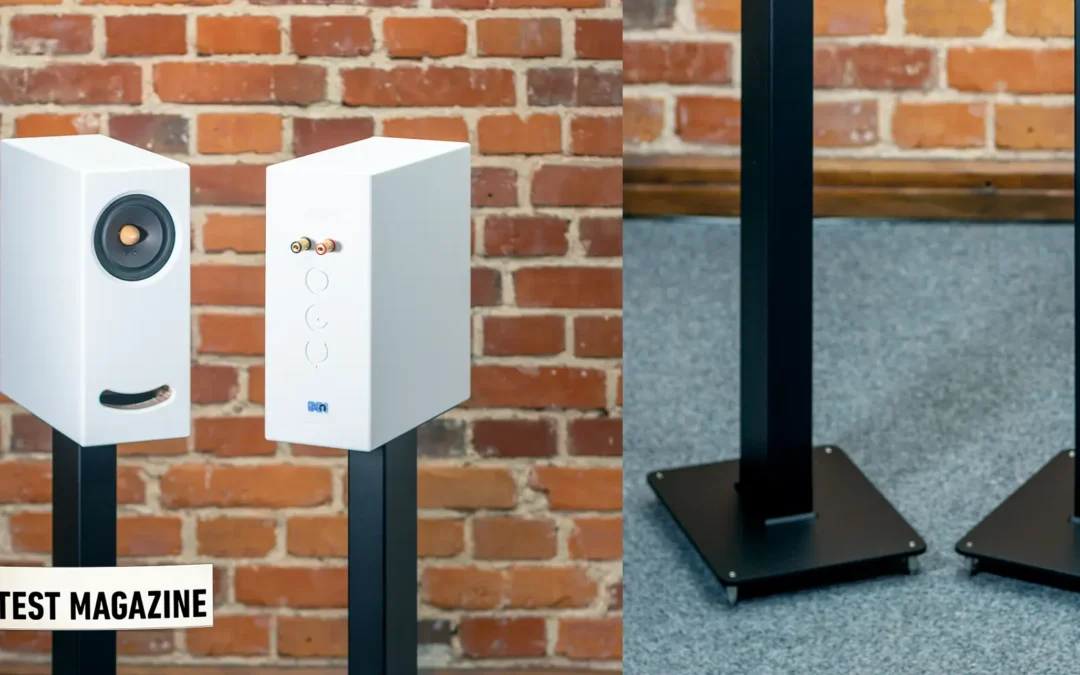
If you decide to purchase the Ogy speakers, it is best to pair them with one of their two dedicated stands, designed for their narrow width and available in a choice of heights: 65 cm (reference ER650; €249 excl. tax) with a round shape, or 70 cm (KT700; €279 excl. VAT) and square in shape. Otherwise, simply place the speakers in the middle of more conventional stands.
For our tests, we were able to favor the Solidsteel SS-7, also tested in this issue, while the small Polonaises proved particularly receptive to the best sources and cables, with our HP Esprit Eterna taking them further than the Beta from the same brand. In terms of amplification, class A works particularly well, although it should be noted that these speakers are specifically designed to work with tube amplifiers, which we were able to verify with the Kora TB140 and, for playing, with the large 300B from the Jadis I300, also reviewed in this issue.
Finally, we regularly removed the lacquered front panel cover, which is held firmly in place by four magnets, to reveal the natural wood behind it. This resulted in a slight loss of clarity, but opened up the sound even more and limited the cabinet effects.
The Sound of the Closer Acoustics Ogy
Listening to a full-range speaker may seem surprising at first, but it’s a sound we love at VUmètre, just like that of our Zu Soul speakers, which we selected to remain in our test studios after hearing them for the first time. Similarly, the small Ogy offers a specific sound, positioned towards the top of the spectrum, which may seem to detune part of the bass or even the midrange, with the bass being somewhat underemphasized due to the speaker being limited to a diameter of ten centimeters. Nevertheless, these speakers have a real charm, as well as offering a surprisingly wide soundstage considering the size of the cabinet.
The well-designed acoustic labyrinth is reminiscent of that found in Boenicke speakers, and it offers the same performance to the little Polonaise, whose sound certainly lacks body in the lower end of the spectrum, but without ever saturating or sounding muddy, thanks in large part to the magnificent French Fertin full-range driver. This very clear element benefits from the rigidity of the cabinet to produce a supple and superbly detailed sound, with a precision that is rare in this price range. These impressions are particularly evident in the trumpets and saxophones of jazz musicians, as well as in the natural voices of soul and lieder singers. It is with this type of natural music that the Ogy really stands out!
It offers its full potential, especially when paired with an analog source and a class A or tube amplifier and freed from its front panel, resulting in the development of a very special grain, with a subtle elegance in its simplicity, allowing you to hear the smallest details while opening up the space of a modest room. Listening can be done from fairly close up, but it is ideal when the speakers can breathe in terms of width, not only in relation to the side walls, but also between themselves. To achieve this, don’t hesitate to place them more than two meters apart, at a height of at least sixty-five centimeters, the first size of their dedicated feet.
Our Conclusion
Conceptualized over several years to offer a calibrated set for Catherine Fertin’s LB5 speaker, Closer Acoustics’ Ogy speakers have a special charm when it comes to natural instruments and voices. Although they struggle with large orchestral symphonies or music with strong digital bass, these speakers delight at moderate volumes on many albums, from Amy Winehouse’s Frank to Nina Simone’s Pastel Blues, as well as numerous small classical and jazz ensembles.
Discreet, they are perfect for listening in your bedroom or living room, enjoying winter moments by the fireside. Currently not distributed in France, the Ogy speakers can only be ordered from the manufacturer’s website, and while the pleasure they provide makes you want to own them, it’s important to remember that they are designed for a limited repertoire or simply as a second pair of speakers. This prevents us from awarding them the Essential label, even though they remain a real favorite of ours!
Author(s) : Vincent Guillemin
Technical Sheet: CLOSER ACOUSTICS OGY
Origin: Poland
Price: from €1,788 (wood) to €2,415 (black lacquer)
Released at the end of September, the Px8 S2 incorporates the structural and component improvements of the Px7 S3, including a refined design, better microphones, a carbon membrane that is better integrated into the ear cups, and Bluetooth aptX Lossless based on a latest-generation Qualcomm 5.3 chip. But as a higher-end model, it once again stands out from the Px7 and almost all of its competitors thanks to its excellent tone reproduction and high precision, with a sound that also gives pride of place to the bass.
Bowers & Wilkins’ best-selling wireless headphones (implying ‘connected’) are now an accessible gateway to high fidelity, especially for younger generations. These modern products do not compromise on musical quality, with a sound signature that reminds us that the brand also works with many studios around the world, starting with Abbey Road.
This new version of the Px8 features the same elements that brought improved ergonomics and significant enhancements to the Px7 S3 compared to the Px7 S2 a few months earlier. Released later, the Px8 is only now becoming the ‘S2’, at the risk of causing some confusion, even though it incorporates all the innovations of the latest generation Px7, i.e. the ‘S3’.
Firstly, at the request of the brand’s customers, the Px8 S2 has been slimmed down to the same dimensions as its little brother. This means that each ear cup is 3 mm thinner, giving it a more luxurious look and feel when worn. Its attractive die-cast aluminum structure is combined with classy cable inlays in the headband and fine perforations around the ear cups, just before the ear pads, which are made of genuine Nappa leather in this version.
In terms of new connectivity, the Px8 S2 has upgraded from the Px8’s Bluetooth 5.2 chip to a 5.3 chip, which, in addition to aptX Adaptive technology, now also features aptX Lossless. The more common codecs are still available, with the 24-bit DSP being even more comfortable handling high-resolution music files when connected via USC-C to a smartphone or a DAC, or directly from its USB-C port to a 3.5 mm jack, thanks to two 1.2 m cables integrated into the center of the protective pouch.
Thanks to its new active noise cancellation (ANC) system, it immerses you even more in the music in noisy environments, especially as the placement of the microphones (four per earpiece) has also been revised to improve phone calls and conversations.
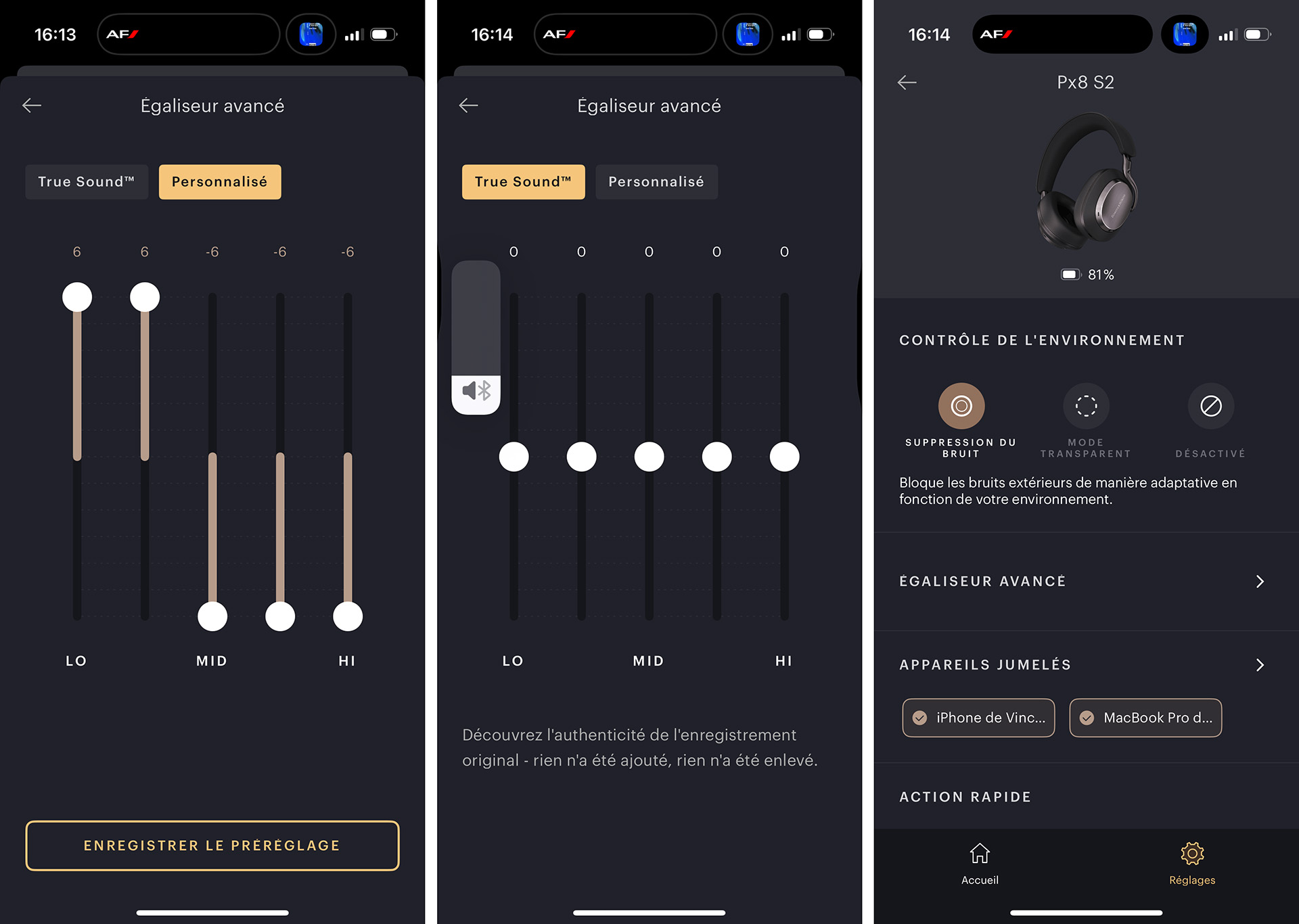
For music, the Px8 S2 still uses 40 mm diameter carbon full-range drivers, which are superior to those in the Px7 S3. But as with the latter, these are better integrated into the ear cup by being placed on a square structure, firmly locked at all four corners. Designed for direct Bluetooth use, these portable headphones benefit from the Music Bowers & Wilkins smartphone app, which allows you to use a 5-band equalizer to adjust the sound to your preferences, your mood or the style of music you are listening to.
THE USE
Faster charging via USB-C (just over an hour for a full charge) allows the Px8 S2 to be used for around 30 hours. Very convenient for wireless listening, these headphones are still better when plugged in rather than used via Bluetooth. Similarly, they are more open to music when left in classic mode (deactivated) than in ANC (noise cancellation) mode. As is often the case, transparent mode is of little interest, unless you want to be very attentive to surrounding noises, for example when cycling, but at the expense of listening to music.
Although our approach is primarily that of pure hi-fi enthusiasts and our initial tests were carried out in a very quiet environment, having the headphones in our possession for a month allowed us to listen to them for over 50 hours. Thanks to this listening time, we were not only able to hear the membrane of this almost new model soften over time, but also enjoy it in many mobile situations, including on planes, trains, bicycles and the underground in the city center.
Screenshot
THE SOUND
One of the first conventional hi-fi brands to enter the world of portable headphones, then connected headphones, Bowers & Wilkins still has a head start over most of its direct competitors today. However, there is no question of falling behind, as demonstrated by the new Px8 S2. Thanks to its carbon transducers, which are better secured within the structure of the ear cups, it offers greater fluidity compared to the first Px8, as well as improved bass control. The bass can now sometimes seem a little ‘boomy’ in the reproduction, but can be softened if necessary, using the equalizer on the smartphone app.
When listening to electronic or rap music, the sound is powerful and immersive, with impressive low-frequency control for a device of this type. At the same time, the manufacturer’s best portable headphones preserve a great deal of detail in the recordings. Compared to the Px7 S3, they are more precise, but above all even clearer in terms of timbre, with very well-nuanced colors. The treble is almost never harsh, except at very high volumes. And despite everything, this B&W product retains the brand’s sound characteristics in its reproduction. The midrange is less dominant than that of a Focal or Dali, for example, and the soundstage is slightly tighter, giving it a more monitor-like feel, which makes the Px8 S2 ideal for use as a work tool, especially when on the move.
With cables, the headphones can play higher-quality files, which again benefits the timbres, which are more nuanced because they have more information and stability to develop harmonics, as well as better sound openness. In terms of soundstage, the image becomes even more expansive when you switch off ANC mode, which is mainly designed for use in noisy environments, with more than satisfactory results, even if some competitors that are less focused on high fidelity currently perform better in terms of noise cancellation. In any case, the Px8 S2 is a true compromise between portable use and high-quality music listening, aimed at all audiences and demonstrating through its bass range that it also wants to win over younger generations.
OUR CONCLUSION
After the Px7, it is now the turn of the Px8 to be modernized and refined in a new version. With this S2 generation, one of the most high-end portable headphones on the market (729 € in Onyx Black or Warm Stone, 829 € in the McLaren edition) has listened to its customer base before letting itself be heard. Thanks to the feedback considered by the engineers at Bowers & Wilkins, it has gained in finesse and is now even more comfortable to wear and use during calls. But above all, while the Px8 was starting to be overtaken by the Px7 S3, at least in terms of bass, the Px8 S2 has regained a lead in terms of tone quality and musical precision. Thanks to this and a 5-band equalizer that can sometimes be useful for softening the sound, it easily ranks among the best portable headphones on the market today.
SPECS
ORIGIN: United Kingdom PRICE: 729 € DIMENSIONS: 177 mm (W) x 60 mm (D) x 234 mm (H) WEIGHT: 310 g SPEAKERS: 2 x 40 mm dynamic carbon drivers CONNECTIVITY: Bluetooth 5.3 (aptX™ Lossless; aptX™ Adaptive; – aptX™ HD; aptX™ Classic; AAC; SBC) – USB-C; 3.5 mm jack FINISHES: Onyx Black; Warm Stone
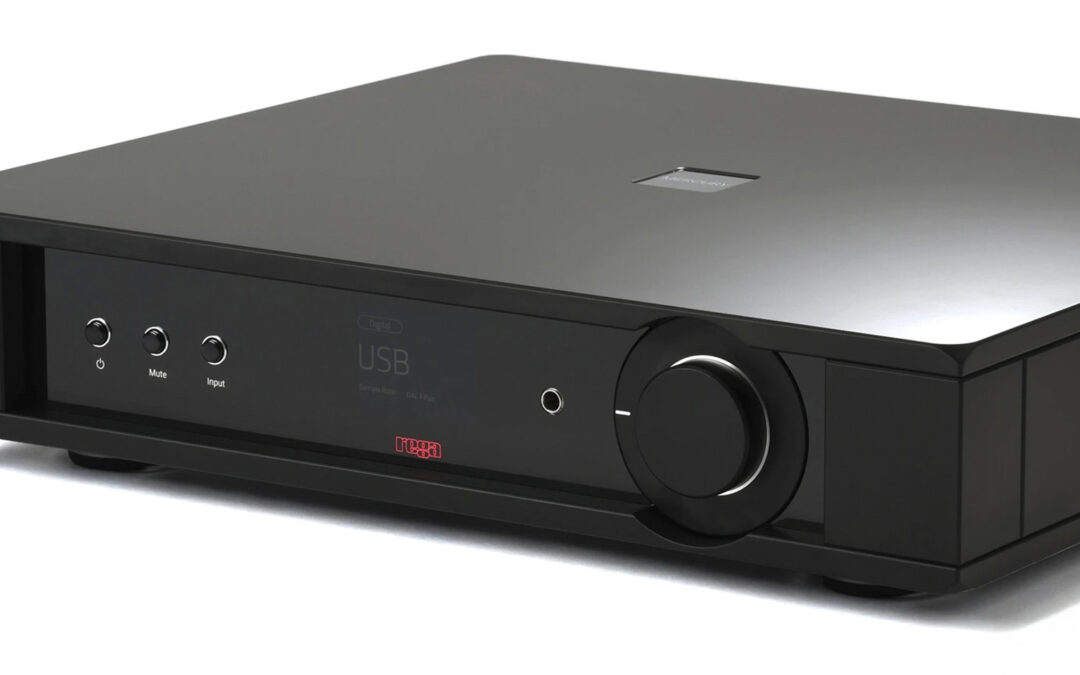
Going even further than the Osiris integrated amplifier, British manufacturer Rega has added the Solis power amplifier and Mercury preamplifier to its Reference series.
MERCURY
A modern preamplifier, the Mercury not only has a significant number of analogue inputs (1 x XLR; 4 x RCA; 1 x Rec In; 1 x Rec Out), but also almost as many digital inputs (2 x coax S/PDIF; 2 x optical; 1 x USB-B; 2 triggers). With a symmetrical structure after a large power transformer, this new preamplifier allows the signal to be output to an amplifier via a pair of RCA terminals and a pair of XLR terminals.
Its internal amplification circuit operates almost entirely in class A. For the critical parts, in addition to a current that is extensively filtered by multiple capacitors, very low-noise Linear Systems FET transistors are used in quadruple differential input stages; a topology that has already been proven with the Aura MC phono preamplifier.
As with the Osiris, volume control is provided by an APLS Blue Velvet RK27 module, based on a discrete, common-base symmetrical driver circuit. High-quality relays and polypropylene capacitors are used throughout the signal path. On the front panel, a 6.33 mm headphone jack completes this device, whose digital-to-analogue conversion is handled by two Wolfson DAC chips in parallel, capable of reading files up to 192 kHz/24-bit PCM and DSD64 (including DoP), which is more than enough to decode many current sampling rates.
SOLIS
Purely symmetrical, the Solis delivers a comfortable 168 W per channel into 8 Ω, doubling to 305 W into 4 Ω.
Power is supplied by two low-noise 330VA toroidal transformers, which use fully bonded core material to reduce mechanical noise when operating with high levels of mains distortion. These transformers are paired with 40,000µF Rega K-Power filter capacitors per channel. All power supplies use fast recovery rectifier diodes, and the input and low-level control stages are powered by a regulated symmetrical power supply, which provides a fully stabilized, low-noise voltage.
The common-base voltage amplification stage is differential-controlled, low distortion, high linearity and wide bandwidth. Twelve Sanken 130-watt 15-amp high-frequency multi-emitter output transistors (six per channel) are implemented in a high-current ‘triple’ output stage, allowing the Solis to potentially drive even very difficult speaker systems.
The cascaded differential input amplifier uses two low-noise current generators, referenced by LEDs. The open- and closed-loop feedback levels and gain bandwidth product components are carefully optimized. Nichicon audio capacitors are used in critical bypass and decoupling positions. To achieve this, electrolytic capacitors have been bypassed with polyester capacitors, and non-inductive HTR resistors have been added to the output stage.
The price of £13,900 for the pair, or £6,950 for each unit in the UK, translates to a European price of 18 990 €, or 9 495 € per unit.