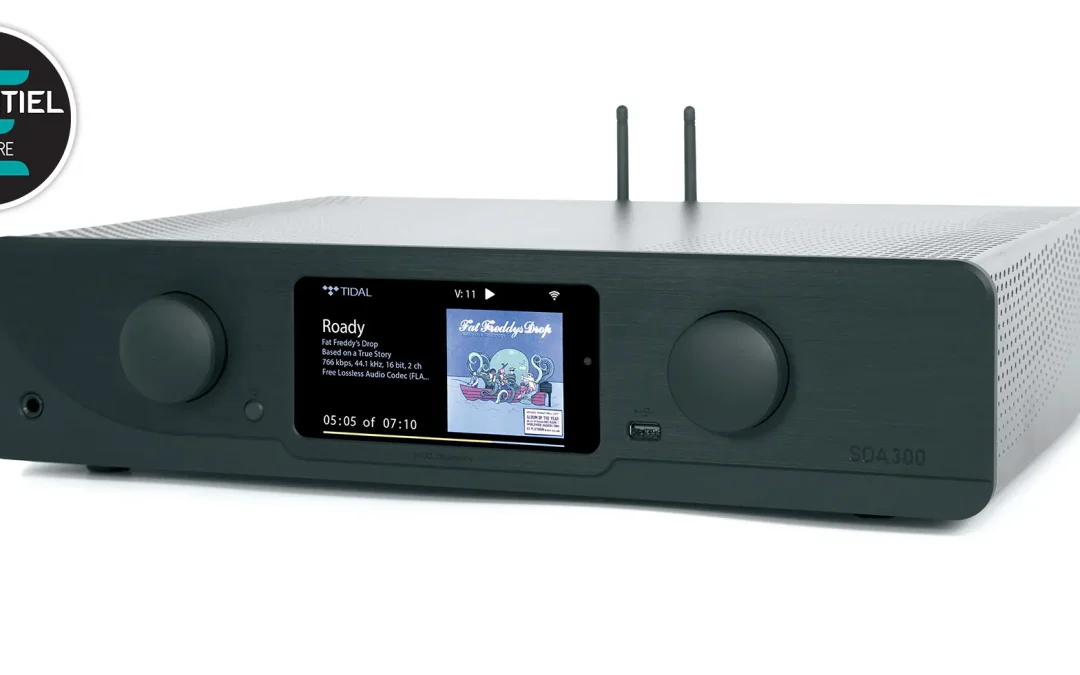
Previewed at High End 2022 in Munich, the brand’s all-in-one Atoll SDA300 Signature simply combines in a single device an integrated amplifier similar to the IN300 and a network player-converter based on the ST200 & ST300 Signature. Identical to the SDA200 Signature in terms of the front panel and rear panel connections, the newcomer really evolves on the inside, mainly in the amplifier section, with the aim of rediscovering the sound characteristics and vigour of the 300 series!
Buoyed by the success of its SDA200 Signature all-in-one and the appetite of audiophiles to downsize their audio boxes, Atoll Electronique is extending its range to include the SDA300 Signature, ideal like the first to save both space and budget. For example, an IN200 integrated amplifier costs €1,750 and an ST200 Signature network player/converter €2,100, while combining the two brings the SDA200 Signature down to €3,100, for a gross saving of €650, to which must be added the saving on a pair of modulation cables and a mains cable, both of which should cost at least €300 to supply serious equipment in this range, for a final net saving of over €1,200.
The calculation is the same for the SDA300 Signature, with a catalogue price of €4,000, while the separate components cost €2,100 (ST200 Signature) or €2,900 (ST300 Signature) and €2,650 (IN300, priced at €3,000 with DAC, but available without for €350 less at the request of Guillaume from CTA), i.e. a gross saving of €750 to €1,550. In exchange, you’ll just have to do without a few analogue inputs, particularly the balanced XLR one, to make everything else more user-friendly, even the preamplifier, which is easier to manage with a front-panel screen.
Once this financial overview has been swept under the carpet, the new device demonstrates all the know-how of a very dynamic French brand, always attentive to the needs of users, as well as the best technologies to develop the most beautiful musicality there is, while preserving price levels that are still reasonable despite the current price rises due to raw material inflation.
In the amplifier section, we find the double mono stages with two 440 VA toroidal transformers already familiar from the 300 range, for a total power supply announced at 892.2 VA, with not 12 ESR capacitors of 6,800uF as on the AM300 and IN300, but only eight, still made to Atoll’s specifications, and already quite sufficient to boost the unit, with a total capacitive rating of 65,800uF once the other capacitors dedicated to this section are added. Mosfet transistors on each channel combine with discrete component stages biased in pure class A, with the engineers’ work on the AM300 Signature power amplifier giving the SDA300 Signature 20W per channel at 4 ohms more than the IN300. At 2 x 280 W into 4 ohms, the amplification remains at a comfortable 150 W per channel into 8 ohms, while the output stages benefit from a remarkable treatment of feedback effects, going as far as very flattering custom-made terminal blocks, sufficient in themselves to demonstrate the quality of finish now achieved by the brand.
The preamplifier section of the Atoll SDA300 Signature is more limited than that of the IN300 Signature, but also less useful since its main use is obviously the playback of digital audio files. It still offers two analogue RCA inputs and a Pre-out output, while the digital inputs are positioned slightly higher than on the rear panel of the SDA200 Signature, due to the fact that the internal card takes up more space. There are two outputs – one optical and the other coaxial – if you wish to deploy the network part alone to another system, as well as two optical and two coaxial inputs for direct integration of the DAC, still subject as on the ST200 Signature to a Burr-Brown PCM1792 conversion chip, capable of handling formats up to 192 kHz/24-bit on the as yet unmentioned USB-A, RJ45 and Wi-Fi inputs, as well as DSD64 and DSD128. Once again, the engineers were able to take advantage of recent developments, this time on the ST300, to adopt the ClarityCap ESA47uH250Vdc link capacitors, which are superior to those used on the ST200, for the benefit of the sound.
A second USB-A input is located on the front panel, making it easier to integrate without having to go back to the back of the device, for example if you are temporarily integrating a USB key or hard drive. For the rest, the presentation remains strictly identical to that of the SDA200 Signature, apart from the height and the name of the device, which is discreetly engraved in the anodised aluminium in the bottom right-hand corner. In the centre is a handsome 5’ (8 x 4.8 cm) TFT LED colour screen, which is non-touchable by choice of the designers, who prefer, for reasons of cleanliness and interference from magnetic fields, to continue to leave its management to two imposing, easy-to-use thumbwheels, combined with a handy little back button, in addition to having further improved the interface of the Atoll Signature application available on iOS and Android, with recent major additions concerning web radios. A 6.5 mm headphone jack and Wi-Fi and Bluetooth antennae complete the picture of a true Swiss Army knife of French high-fidelity.
The set up
While the SDA200 Signature weighs just 12 kg, the SDA300 Signature is already showing its superiority through its mass, which is substantial at 18.9 kg, and impressive in a steel case with a conventional format of 440 x 320 x 96 mm (10.4 mm with rubber feet), 6 mm higher than its smaller brother. Used with its own network-player section as the main source, the SDA300 Signature was integrated into our two Solidsteel and Norstone hi-fi cabinets and connected to the mains, the Internet and the speakers, before being re-tested on its network, DAC and amplifier sections independently.
In possession of an ST300 Signature, we were able to make a detailed comparison of this source part, bearing in mind that the latter has the advantage of a completely dual-mono structure with one conversion chip per channel, whereas the SDA300, like the ST200 Signature, inherits a single chip.
To develop the tests of its amplifier part, we associated it with the compact Fyne Audio F500SP, Atohm GT1 and Jern 15H, while we then redeveloped the listening in our other studio, on Centaure furniture, then connected to the largest T&T Nel Extrême columns.
Once plugged in and switched on using the 0-1 switch on the back – it’s then possible to switch the unit off using a long press on the right-hand knob, with the advantage of leaving some circuits warming up – we used the Atoll application to find music from our library as well as numerous streaming platforms, bearing in mind that the SDA300 Signature is also Roon compatible. In the end, our use of a number of playback programs once again led us to choose Audirvana Studio, which is definitely superior for providing the greatest purity, and therefore musicality, of audio files transferred to the new Atoll.
The sound of the ATOLL SDA300 Signature
Like all current Atoll products, the SDA300 Signature maintains the brand’s sound identity, particularly musical on the 300 range, whose conversion chips are all different between the IN300’s internal DAC (Asahi Kasaï AK4490), the DAC300 (Sabre ESS9038 Pro) and the ST200/300 (TI Burr-Brown 1792), the latter found on the top-of-the-range all-in-one, powered by powerful amplification derived from the IN300.
Never in difficulty, the SDA300 Signature is particularly well matched to flexible loudspeakers such as Fyne Audio and Atohm, resulting in splendid balance and delicate respect for timbre across the entire spectrum. Slightly less ductile and dynamic than when connected to the ST300 Signature network player via one of its RCA inputs, the SDA300 Signature nonetheless offers a source that is already very realistic in terms of image and colours, resulting in warm instruments and vocals with a beautiful presence, whose immediately recognisable grain displays that softness particular to Burr-Brown chips, which are far from being as obsolete as some would like to believe.
In terms of definition and detail, the SDA300 Signature surpasses many of its rivals in its range, and takes a particular advantage over them as soon as we come back to its amplification, with results that are still surprising on the already energy-hungry Jern 15H, and especially when faced with larger floorstanding speakers such as the T&T Nel Extrême.
The ergonomic interface includes a plethora of Internet radio and streaming services, including Tidal, Deezer and Spotify, and also controls UPnP playback from other software, including Audirvana. Certain music parameters can also be modified if required, although we know that for the average person (including listeners), the interface and ease of use remain the priorities, which is why the Atoll application is one of the easiest to manage at the moment. Navigating through the tracks becomes child’s play, with the pleasure of moving seamlessly from a Beethoven symphony to Eve’s danceable R&B or Dr Dre’s edgy R&B, drifting into Manu Chao’s ‘Je ne t’aime plus’, and then reassuring yourself with ‘Plus Fort que nous’ under Melody Gardot’s marvellous delicacy. Delivered over a wide frequency range, all these styles will quickly add their share of detail and roundness to an endlessly musical listening experience.
Our conclusion
By combining an IN300 and an ST200 Signature, both of which have been improved, the new Atoll SDA300 Signature once again has all the qualities and sound characteristics that Atoll is renowned for, while setting itself apart from certain competitors who simply add a DAC and network card to their amplifier, without being able to achieve the same source quality or offer the same ease of use as with a colour screen on the front panel. Having already awarded an Essentiel VUmètre to the IN300, ST300 Signature and AM300 Signature, we wondered whether it might be redundant to award this prize again to this new high-fidelity all-in-one. But not for long! Since it’s a combination of the aforementioned elements, with the advantage of requiring less space and a smaller budget, it would make no sense not to judge this product as essential once again. Duly noted.
Author: Vincent Guillemin
Technical sheet: ATOLL SDA300 Signature
Origin: France
Price : €4,000
Dimensions : 440 x 96 x 320 mm
Weight : 18.9 kg
Power rating:
2 x 150 W at 8 ohms
2 x 280 W at 4 ohms
Harmonic distortion (THD+N) : 0.05%; 1 kHz
Frequency response: 5 Hz to 150 kHz
Signal-to-noise ratio (S/N ): 112 dB
Input impedance : 220 kilo-ohms
Digital inputs : Ethernet (RJ45); 2 x Toslink; 2 x coax SPDIF; 2 x RCA; 2 x USB type A; Wi-Fi antenna; Bluetooth antenna
Digital & analogue outputs : RCA pre-out; Toslink; Coax SPDIF; 6.5 mm jack
With 32 years’ experience behind it, Italian manufacturer Solidsteel continues to improve its ranges of furniture, always discreet and very classy visually, although their main characteristic remains that of supporting the best hi-fi components with the greatest possible stability. Divided into two series, S and Hyperspike, the hi-fi shelving range starts with the S2, followed by the superior Solidsteel S3, the latter favoured by music lovers and the focus of this issue.
Founded in 1990 by Moreno Conti, Solidsteel was Italy’s first hi-fi furniture brand. Sold in 2013 to its two sons, Gaetano and Manfredi Conti, it is now divided into two series. The first is more extensive and includes a wider range of products, from the NS and SS speaker stands to the VL vinyl cabinets, which allow a large number of discs to be placed on the lower level, while the upper level(s) are dedicated to hi-fi components, with the same quality of design as the Solidsteel S3 series.
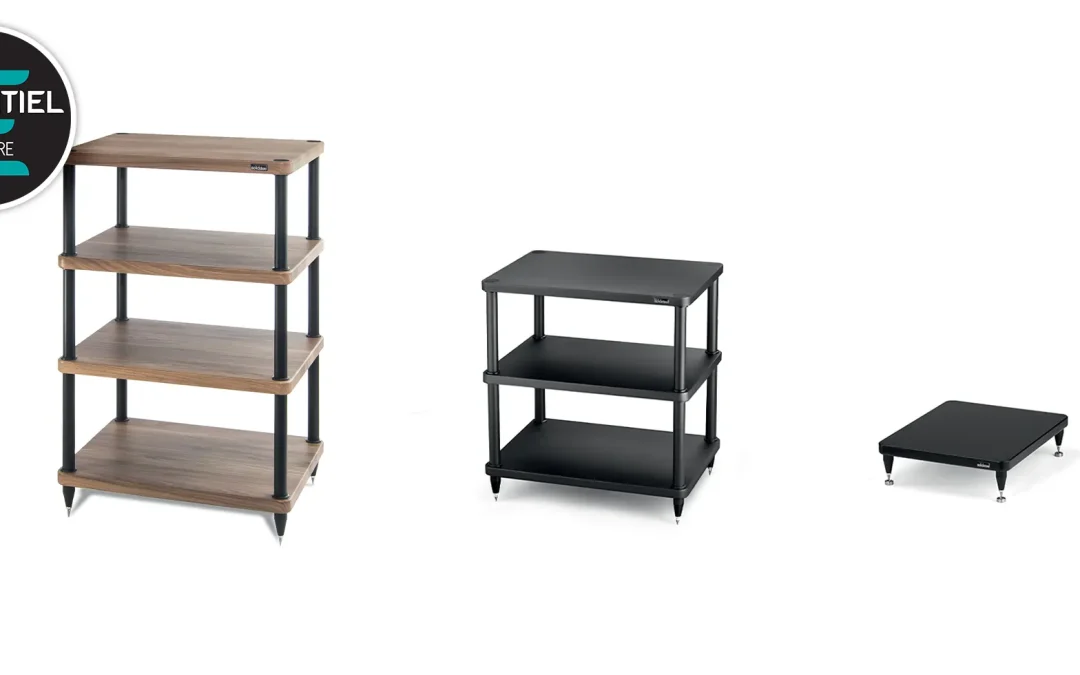
Following on from the S2 series, the entry-level models of which are necessarily black in colour, the S3 series already boasts superior perceived quality, not only in terms of its finishes and choice of colours (notably walnut, a slightly more expensive option than the black and white versions), but also in terms of its ability to better absorb vibrations. Made almost exclusively from Italian materials, the S3 range starts with a simple floor-standing amplifier stand, known as the S3-A or S3-B, which vary slightly in size from one to the next, developing from the S3-2 to the S3-5, the second number indicating the number of shelves available. From the S3-2 upwards, all the shelves are 30 mm thick, 430 mm wide and 584 mm long, enough to accommodate the vast majority of appliances, while maintaining a real compactness compared with many competing products.
The painted tubes are made of anodised aluminium, cushioned by absorbent materials and screwed at both ends to the trays, which are protected on each side by plastic circles. The other elements, including the spikes, are made of stainless steel or zinc-treated iron to eliminate any oxidation, while the floor plates are made of MDF, medium-density fibreboard covered with laminated polymer. Often used in high-fidelity applications, particularly for loudspeakers, MDF supports a high mass and reacts very well to vibrations. The S3 is therefore a highly effective piece of furniture for improving the quality of a hi-fi system, as well as remaining discreet and even classy, depending on how it fits in with both designer and antique furniture, whether you choose black, white or, above all, walnut.
The set up
Supplied in a relatively compact box, the Solidsteel S3’s design makes it very easy to assemble. All you have to do is remove the protective covers from each tube and plate and screw them together, for rock-solid stability that leaves no gaps, and therefore minimises any effect of vibration or non-horizontality. The size of all the tubes is the same for each model, but different for each version, and gets shorter as you choose more stages. For example, the S3-2, which has only two stages, has tubes 325 mm high, while those of the S3-3 are only 245 mm, those of the S3-4 225 mm and those of the S3-5 205 mm. In the case of a large amplifier, such as an Accuphase or Luxman, you’ll have to be very careful, because a huge E-800 measures 239 mm or a Luxman M-10x 224 mm, even if in both cases, with such top-of-the-range products, it would be advisable to upgrade to the brand’s Hyperspike range, whose stages are higher and, above all, even better for the sound.
Once the cabinet has been assembled, you still have to decide, depending on the surface on which it will be placed, whether to use spikes or counterspikes, although it is generally advisable to add them, once again to dissipate vibrations. For our test, we compared each element on the floor before placing it on an Ikea cabinet, then on a Norstone entry-level hi-fi cabinet, and finally on the S3-4.
The sound of the Solidsteel S3
As with accessories and cables, testing a piece of furniture is always a challenge, the results of which could prove more limited than in the case of testing amplifiers or sources, although a concise physical explanation can justify that every vibration lessened tends to reduce unwanted noise, and therefore improve the musical rendering. And indeed, it didn’t take more than a few minutes with the Solidsteel shelf to realise the difference compared to an inferior piece of furniture.
Let’s be totally transparent: we had already had an S3-4 for two years, and the impression of superior listening was so obvious to us that we never again tried to test a device other than on it, even during tests where it would have been much easier for us to place one of the elements on the floor, particularly in the case of large amplifiers.
However, by starting the analysis from scratch, we immediately realised just how much the Solidsteel had gained, not only over an Ikea cabinet, but also over an entry-level Norstone cabinet, which was already superior to a product not made for hi-fi. Placing the amplifier on the S3 opens up the sound and concentrates the sound, opening up the soundstage and refining the detail. For the best possible calibration, the amplifier should be placed on the bottom floor. For the sake of practicality, we initially placed the Luxman on the 3rd floor, but during our final tests of the device, it was moved back to the first floor, with the result that the sound was even more focused and the magnificent silkiness of the device developed a little further.
Already evident with the amplification, the gain in balance is even more marked with the addition of the sources, which further reduce noise and therefore clarify the image, while at the same time better nuancing the timbres. The gain in space and colour is obvious as soon as a DAC-streamer is added to one of the shelves, but the result is even more obvious with devices with rotating mechanics such as a CD/SACD player, and even more so with a vinyl turntable.
Our conclusion
With its elegant design, Solidsteel S3’s cabinet can be integrated discreetly into almost any type of furniture and will allow all the elements of a high-fidelity system to be finely positioned, with the result of a substantial musical gain. The S3 is very easy to assemble and modular, with the option of choosing a precise number of stages from the outset, then adding more as an option at a later date if required. What’s more, it’s still an affordable product, priced at around €500. For those more concerned about sound, this series was redesigned in 2020 to mark the brand’s 30th anniversary, giving rise to the S5, whose base is similar, but whose stages are immediately offered in different sizes, with a counter-platter at each stage, directly placed in the first main stage to create a significant decoupling, even better against vibrations. All the more to whet our curiosity!
With the latest energy standards, the legendary Japanese brand Luxman was in danger of no longer seeing its Class A amplifiers pass the test benches. So it went ahead and redesigned the architecture of its Class AB products, to get as close as possible to the sound usually produced by Class A amplifiers. The result is the Lifes 1.0 feedback circuit, new to the new Luxman L507Z amplifier, the false successor to the L507MkII and the brand’s new flagship integrated amplifier, alongside the L509X. On this occasion, we had the exclusive opportunity to test one of the first units to be delivered in Europe.
On the eve of its 100th anniversary, expected in 2025, Luxman is once again carrying out an in-depth review of its technologies to better adapt to the problems of today’s world. And while the brand has been able to create some of the finest amplifiers for almost a century (from the famous tube models to those based on class AB transistors), it is now having to rethink the design of its products, in order to remove from its catalogue class A transistor amplifiers, which are too energy-hungry and whose consumption is no longer acceptable by many standards (including European ones), which are becoming more and more drastic year after year, as the ecological crisis makes itself felt more and more.
We therefore regret the sumptuous L-590AXII, one of today’s best Class A amplifiers, with a warmth that is typical of this technology, for a power of 2 x 30 W under 8 ohms that is already very comfortable with many loudspeakers. We also regret the L507MkII integrated amplifier, a 2 x 110 W class AB amplifier priced at €6,590, from which the Luxman L507Z takes its base, but with almost all the improvements, resulting in a new price almost 3,000 higher, at €9,490.
Closer to the 2 x 120W class AB L-509X (launched at €9,690 and now at €10,690), the Luxman L507Z, like all Luxman amplifiers, uses a high-inertia power supply circuit, consisting of a large-capacity, highly regulated EI power transformer, combined with eight times 10,000μF filter capacitors, twice as many as the L507MkII and as many as the L509X. The high level of instantaneous current supplied provides great stability, which is reflected in the final sound. The preamplifier section, and in particular the volume control, incorporates the latest developments in patented LECUA1000 (Luxman Electronically Controlled Ultimate Attenuator) technology, derived directly from the C-900u stand-alone preamplifier and already installed on the L509X. This computerised attenuator, whose 3D-printed board is integrated into the amplification circuit, allows volume to be adjusted in 88 steps, This not only improves the finesse of signal processing as the volume is lowered, but is also more resistant to vibration, making it more robust than previous versions.
New LIFES 1.0 feedback circuit
In addition to this new design, which has been revised to direct the signal via the shortest possible route, with non-angular layout of the printed circuit boards to optimise current flow and limit loops and ground impedance effects, the L507Z’s special feature is above all its amplified feedback circuit. Once again completely redesigned, despite the latest generation ONDF 4.0 (Only Distortion Negative Feedback) further reworked in 2018 for the L509X, this circuit is now called LIFES 1.0 (Luxman Integrated Feedback Engine System). Recently launched on the M-10X power amplifier, its design is based on that tried and tested for more than twenty years up to the last generation, based on three stages, a parallel stage and a stage equipped with Darlington (a combination of two bipolar transistors which enables the gain to be increased tenfold), then a three-stage Darlington circuit combined with a four-parallel push-pull structure for the output stage. Based on this principle, the structure has been further revised to reduce the number of elements connected in parallel and halve the distortion of the amplification stage, while redesigning the output stage on a three-stage Darlington push-pull configuration with triple parallelism, the latter level ultimately closer to that of the L590AXII in pure class A than the more recent L509X in class AB. The loudspeaker relays have also been reworked, configured in parallel and with low resistance. They improve the damping factor, which is also helped by the OFC cabling, which has been shortened and is now even more direct to the speaker terminals.
Change with continuity
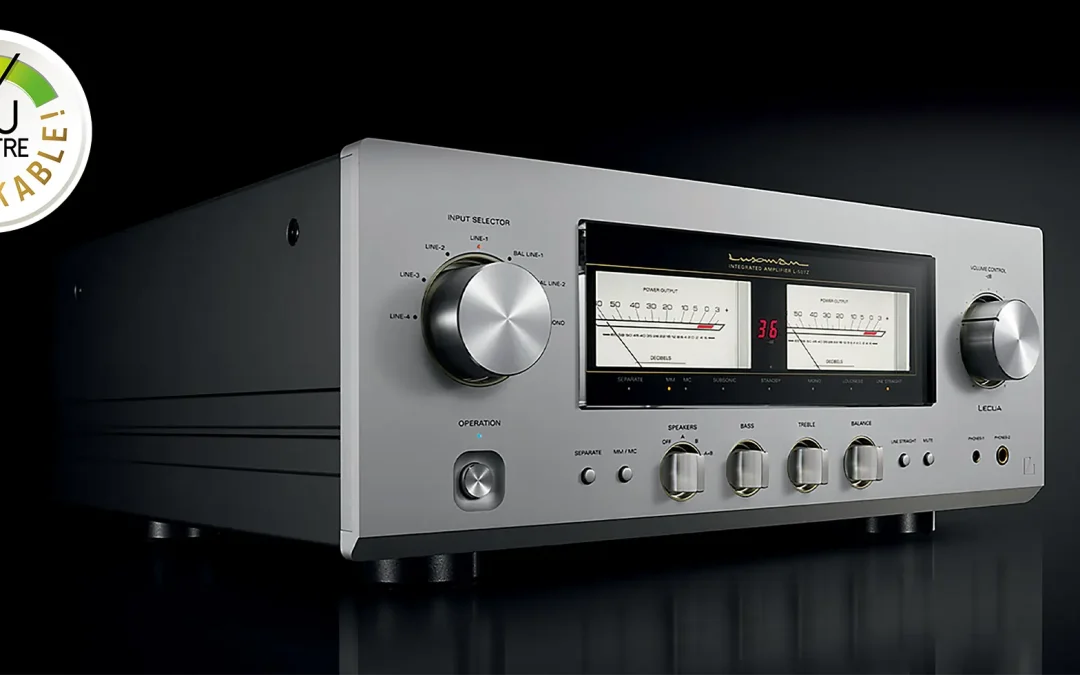
Compared with previous chassis, the L507Z chassis is even more robust thanks to its internal architecture, and allows you to play the game of seven errors with regard to its external design, but with one glaring difference: there are no longer six small front-panel selectors as on all other current models, but only four. Speaker management, which lets you choose an A, B, none or both pairs at the same time, is retained, as are bass, treble and balance management. On the other hand, Rec Out has disappeared, while MM or MC cells can now be selected with a single button, if you wish to use the amplifier’s standard phono preamp.
In addition to the two large left and right selectors, used respectively to manage source inputs and volume as always, the VU meters return to the white backlighting of the L509X, where previously the Class A models were yellow-lit and the Class AB models blue-lit. The light grey aluminium chassis, the only colour available and a Luxman reference, is grafted onto the bonnet with the two long plastic grilles familiar from the L590AXII, rather than the new cut-out metal model from the L509X, whose four cast-iron support feet the L507Z nevertheless uses.
There are also two headphone sockets on the front panel, a standard 6.3 mm one and a brand new 4.4 mm one with independent left and right cabling for improved separation of the two channels.
As for the rear panel, it still offers a plethora of connections, through which up to seven sources can be integrated in addition to two pairs of loudspeakers, including four RCA sources with wider (20 mm) copper-brass alloy terminals for input 1, classic (18 mm) and pure copper terminals for RCA Line-2, 3 & 4. Alongside these are a pair of grounded RCA phono terminals and two balanced XLR inputs. A Pre Out output allows you to take advantage of only the preamplifier part, while a Main In input allows you to integrate only the amplifier part of the device, complemented by 12 V/0.1A Trigger inputs and outputs, if you want to switch on several devices at the same time.
As standard (« De série »), the RA-17A remote control model allows you to select inputs and control volume remotely, in addition to a number of sound parameters and, if the amplifier is connected to a Luxman CD or SACD player, the latter’s basic functions.
The set up
The Luxman L507Z was tested on a system that usually houses a pure Class A Japanese integrated amplifier from a competing brand, and immediately found its place. It was connected to numerous pairs of speakers, compared on its phono preamp to a Vida Prima and a Gold Note PH-10, on the headphone inputs to a Sugden Masterclass HA-4 and, of course, allowed us to integrate sources via both its balanced and unbalanced inputs, with, as always for this type of product, greater musical gain when connected to XLRs. The loudspeaker terminal blocks prefer to use forks, although we also connected banana plugs on several occasions. Finally, moving the amplifier around on several shelves and using it during our Solidsteel cabinet test enabled us to check the resistance of its feet to various supports.
The sound of the Luxman L507Z
Luxman is one of the finest names in hi-fi, with an immediate sonic signature that is even more clearly defined in the L507Z than in previous Class AB models. Thanks to its new feedback circuit design, and the tried and tested LECUA amplification and volume management circuits, this new integrated amplifier boasts a level of sonic purity and finesse that has rarely been achieved. More ductile than an Accuphase integrated, even in class A, the Luxman L507Z manages to recapture the silkiness of the L590AXII, while benefiting from a directness of attack closer to the brand’s class ABs. The warmth of Class A may not be 100%, but it’s much more apparent than on the above models, and the roundness is always present, making for a very pleasant listening experience, free to carry the listener along for several hours without any feeling of fatigue.
On rock tracks, the L507Z develops both power and dynamics, while retaining a real flexibility that is even more audible when listening to natural music such as classical, jazz or blues. For the latter, the quality of the soundstage is always ample, as is the beauty of the timbre, benefiting not only the instruments, but even more so the voices, with that special grain and a very analogue feel, even when using a streamer as a source. The particularly classy white backlighting of the volume meters, between which the volume level is now displayed in red, allows them to evolve at will, to the delight of the eyes and above all the ears, from -80dB to a red zone of 0 to 3dB and more, which we didn’t venture into, out of respect for our neighbours as well as our loudspeakers.
Tested with a mid-range MC cell, the integrated phono preamp outperforms many entry-level and mid-range stand-alone preamps, without reaching the level of openness of our two models costing over a thousand euros, while the headphone outputs are everything but relegated to the background, and can compete with top-of-the-range stand-alone headphone amps, thanks to the fact that their amplification circuits are directly derived from those for loudspeakers.
Our conclusion
With the new Luxman L507Z, the brand shows that its engineers have lost none of their ability to challenge the most tried-and-tested technologies in order to improve their models time and time again. With its new Life 1.0 feedback circuit, the new class AB integrated amplifier achieves the feat of getting as close as possible to the usual class A sounds. In addition to the roundness of the sound, the precision of the details and the absence of noise take the listener into spheres of rare splendour, with the added advantage of relatively low energy consumption and a device that doesn’t heat up much. All this comes at a price, of course, but while the €9,490 you have to pay to enter this world is a hefty sum, it’s well worth it for the musical experience you’ll have afterwards!
Canadian loudspeaker manufacturer Totem also has a number of accessories in its catalogue, including the TOTEM Tress, priced at €29 per metre. Despite the low price, the simple design using quality materials produces a sound that is far better than expected across the entire frequency range of the sound spectrum.
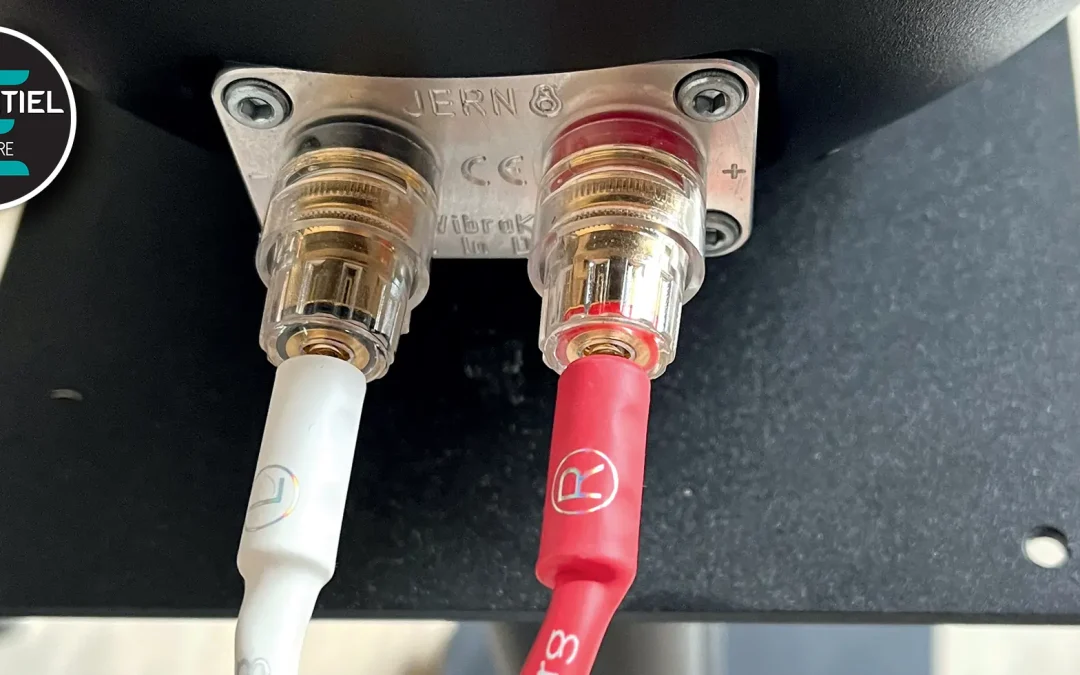
High fidelity doesn’t always have to cost an arm and a leg, as long as the technologies used by manufacturers are simple and the materials well chosen. This is how the cable from the famous Totem Acoustic loudspeaker brand is produced, consisting of a black and white twisted pair with silver-plated 1.8 mm² linearised OFC copper conductors. A Teflon dielectric shield makes the cable rustproof and limits interference. This composition, combined with the Totem Tress’ thinness and flexibility, makes it effective over long distances, adaptable as required, and can also be incorporated into a wall to make it even more discreet. Finished with bare wires, it can easily be integrated with forks or banana plugs, like the Viborg fitted to our test model, for a few more euros only.
The sound of the Totem tress
Compared to our benchmark models, some of which cost more than twenty times as much, the Totem Tress doesn’t show the same balance or, above all, the same suppression of background noise, but what it does over the entire audible frequency range is spectacular. The bass is round, the treble taut and very well timbred, while the midrange breathes with a range of nuances that are very well reproduced. Strings and vocals are revealed with realism, while the spatialization is beautifully full, with the cable’s ability to be forgotten so quickly as it doesn’t try to make its mark with extra luminosity or a particular emphasis on one part of the spectrum.
It makes all types of music simpler and better, from jazz and rock to electro and classical, with real definition of the various elements and layers. On a mid-range system, the Totem Tress already manages to render the elements as precisely as possible, whereas on a large system it only lets itself be surpassed in the extreme bass, which is less controlled. Despite this remark, this basic cable is enough to make a significant contribution to a well-composed high-fidelity system, where all the details provided by even very precise sources will come through with precision.
Our conclusion
It’s not every day that you find such an inexpensive product capable of challenging much more expensive cables. Connected to Viborg banana plugs, which are more practical than connecting bare wires to the terminal blocks of amplifiers and speakers, the Totem Tress succeeds in developing a very fine sound across the entire spectrum, maintaining nuanced timbres and an open, liberated soundstage. Like many of the speakers from this Quebec-based brand, this product is a great success!
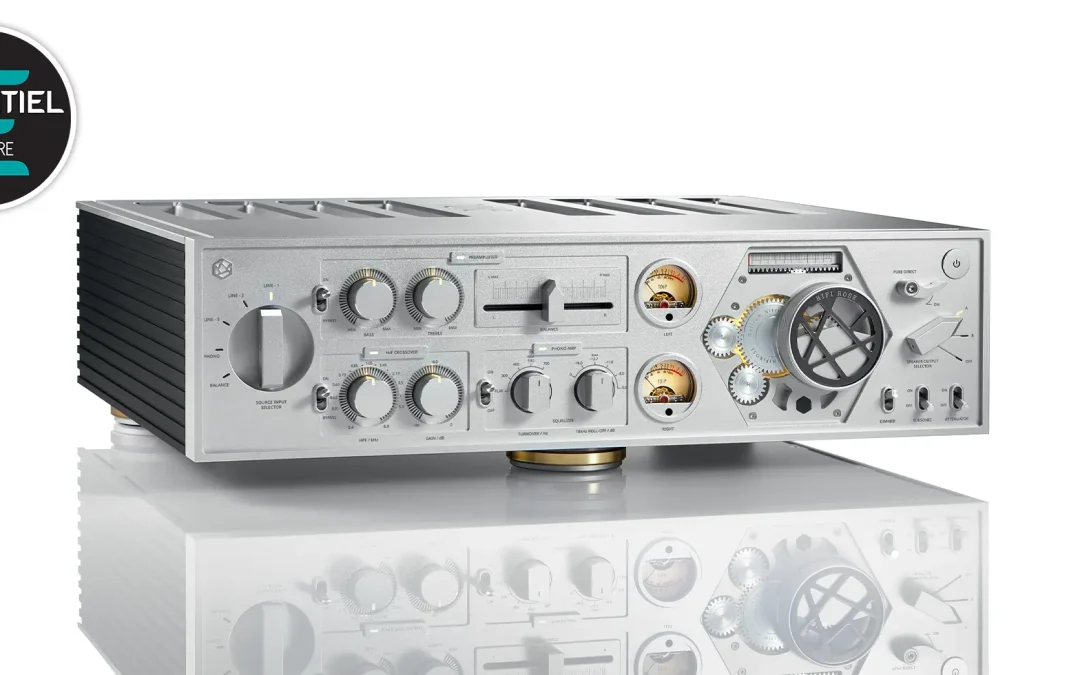
A young South Korean brand discovered through its network servers, HiFi ROSE is launching its HIFI ROSE RA180 integrated amplifier, whose two main features – using class AD and enabling bi-amplification – provide real added value, as well as delivering considerable power to speakers, while creating a smooth, airy sound.
Among the most innovative manufacturers of the moment, HiFi ROSE stands out thanks to its network players, whose main distinguishing feature from the competition is their complementary nature, in particular the addition of HDMI inputs and the integration of YouTube, enabling the audio player to be linked to a video system. The brand’s engineers are now taking the same approach to amplification, with the idea of drawing on the best of all existing technologies to create a highly versatile device. And so the HIFI ROSE RA180 was born.
Class AD and bi-amplification
Starting out as a simple integrated amplifier, without a DAC, where we might have expected a full digital function from a specialist in the field such as HiFi ROSE, the RA180 develops a digital approach to amplification via class D, while using a hybrid mode to create a class AD, whose warm sound brings us much closer to the sonic atmospheres of class A than of class D. To achieve this, the main innovation is the use of gallium nitride (GaN) FETs, which have a dead time ten times lower than that of conventional FET semiconductors and therefore offer a much faster switching speed, with the result of developing the linearity of Class D to higher levels than those usually found. You therefore benefit from the linear power, speed and extremely low distortion associated with this digital class, combined with many Class A components.
The power supply is provided by Silicon FETs (SiC) implemented on a proprietary PFC circuit whose processing offers a damping factor close to 200 and an available output power of over 1,000 W.
In addition to these technologies, the RA180 also stands out for its structure, made up of four independent amplifier modules, which not only allow bi-amplification on two pairs of speakers (since there are two stages of eight terminals at the rear of the unit), but also take advantage of a BTL (Bridge Tied Load) mode, which creates a bridge to link the loads and then multiplies the supply voltage power by four. With this technology, the power of 200 W under 4 and 8 ohms for four channels is increased to 400 W for two channels. With an unrestricted frequency range, much higher than that supposed to be audible to humans, particularly in the high frequencies where it peaks at 90 kHz (compared with 20 kHz audible), the HiFi ROSE is ideal for adding a pair of super-tweeter speakers to your loudspeakers, like the Townshends covered in the previous issue (see VUmètre No. 41).
Old-modern design
Even more so in real life than in photographs, the ROSE RA180 looks like a big toy straight out of the great hi-fi years of the last half-century. It’s impossible not to mention the Nagra reference, particularly in the vumeters, but beyond this influence, the amplifier displays its own personality as well as a genuine quest for ergonomics. From right to left, multiple buttons and selectors enable standby, the choice of speakers A or B to use the high or low line of terminals, a pure direct switch, and the possibility of using a subsonic filter or an attenuator. Then a large knob, made of aluminium like the rest of the front panel, is used to vary the volume using a set of interlocking notched circles, the level of which is reflected on a graduated bar just above.
Two illuminated meters on a yellow background mark the end of the right half of the unit, which is still very busy on the left to adapt the type of sound desired. In addition to different levels of gain and frequencies on the RIAA curve when using the internal phono preamp, an active filter limits low frequencies in order to improve high frequencies and therefore produce a finer sound. Then the preamplifier section offers something rarely found on European products and almost always on Asian amplifiers: balance, treble and bass management. A final selector on the far left allows you to choose the input, which is of course connected to the rear panel: three pairs of RCA sockets, a pair of XLR sockets and a pair of RCA phono sockets.
Supported by three large, vibration-resistant aluminium feet, the RA180’s interior is topped by an attractive nameplate that adds to the retro style, and bears the name of the device as well as its main feature: the use of gallium nitride. The rear uses a Furutech mains connection and offers two grounds for connecting both the amplifier to earth and to the ground of a turntable. In addition to the five pairs of analogue inputs mentioned above, the amplifier’s most impressive feature is the four blocks of four terminals which, when BTL mode is activated, deliver an extraordinary sound by combining four mono amplifiers linked in pairs.
The set up
Weighing in at a hefty 16.7 kg, the ROSE RA180 cannot be placed on just any stand, and we recommend that you use a quality hi-fi cabinet to support it. It is easily connected to the mains, to sources – including a vinyl turntable – and to speakers. This last part is where its real specificity lies, because while conventional connection of the left and right speakers is perfectly possible, it is ultimately rendered obsolete by the BTL bridged mode, which consists of connecting both sides of each speaker to the right terminal block of each of the eight pairs. So, the already comfortable power of 2 x 200 W in the case of classic stereo use, or 4 x 200 W in the case of a four-speaker system, peaks at 2 x 400 W in BTL mode and greatly modifies the sound, even with loudspeakers, without the need for a large power load.
As well as trying out this mode at our leisure with several models, our tests also focused on the bi-amplification of two- and three-way speakers. However, we had already returned the super-tweeters tested in the previous magazine and were unable to retrieve them to measure the amplifier’s capabilities in the extreme high register to the maximum, which would have been all the more exciting to check as they are particularly well suited to the Zu loudspeakers in our possession.
Mainly connected to digital sources, the ROSE was also compared on its phono input to stand-alone preamps, themselves connected to our Linn LP12 turntable and to the Vertere MG-1 MkII, also tested in this issue.
The sound of the HIFI ROSE RA180
The scent of ROSE is what immediately springs to mind when listening to this amplifier, whose sound seems to permeate the room like incense. With a conventional connection, what strikes you immediately is the smoothness and naturalness of the amplification. If you didn’t know better, the HIFI ROSE RA180 could be perceived as a pure Class A product rather than a Class AD hybrid. Vigorous, the energy provided is never violent, but just comfortable enough to energise a large number of loudspeakers, even very demanding ones. Warm, the timbres emerge with clarity across the entire spectrum through a very airy soundstage, wider than it is deep, but with a well-balanced overall breadth, with no disparity in treatment between the different elements.
In BTL mode, all the aforementioned components gain even more, and the warmth described above becomes thicker, while the soundstage seems to gain even more space, the power now at 400 W per channel allowing a real gain in attacks, initially round and now more clearly defined. The typicality of the sound doesn’t change, but everything opens up and improves to move this amplifier into another category, from which the competition initially found in stereo mode in this price range now seems to be moving away with the addition of the BTL. The same is true of the internal phono preamp, which is widely competitive with products priced at around €1,000, and against which we had to connect the Aurorasound Vida MkII preamp – priced almost the same as the amplifier – to truly surpass the phono quality of the RA180.
In the case of bi-amplification, the sound attracts in the same way as in BTL mode, and with a two-way loudspeaker, the difference between these two types of connection didn’t seem so glaring to us, since BTL already contributes so much compared to the classic stereo connection. On the other hand, on a very top-of-the-range three-way speaker, the high-frequency range was further extended and, at the same time, the whole quality of the image was refined, not only in the purity of the timbre, but also in the depth of its definition.
Our conclusion
The HiFi ROSE RA180 is attractive not only for its looks and modularity, but also for its class AD sound, which has nothing to envy to the warmth of many class AB or even class A amplifiers. Warm and powerful, with already very high levels of noise reduction and damping factor, it displays all its superb qualities when used in BTL mode, where a single pair of speakers is carried away with almost no limit to the width of its frequency band and the breadth of its dynamics.
Having succeeded in breaking into high-fidelity with innovative sources, HiFi ROSE is continuing its pioneering work with amplification, giving pride of place to digital technology. So far, so good!