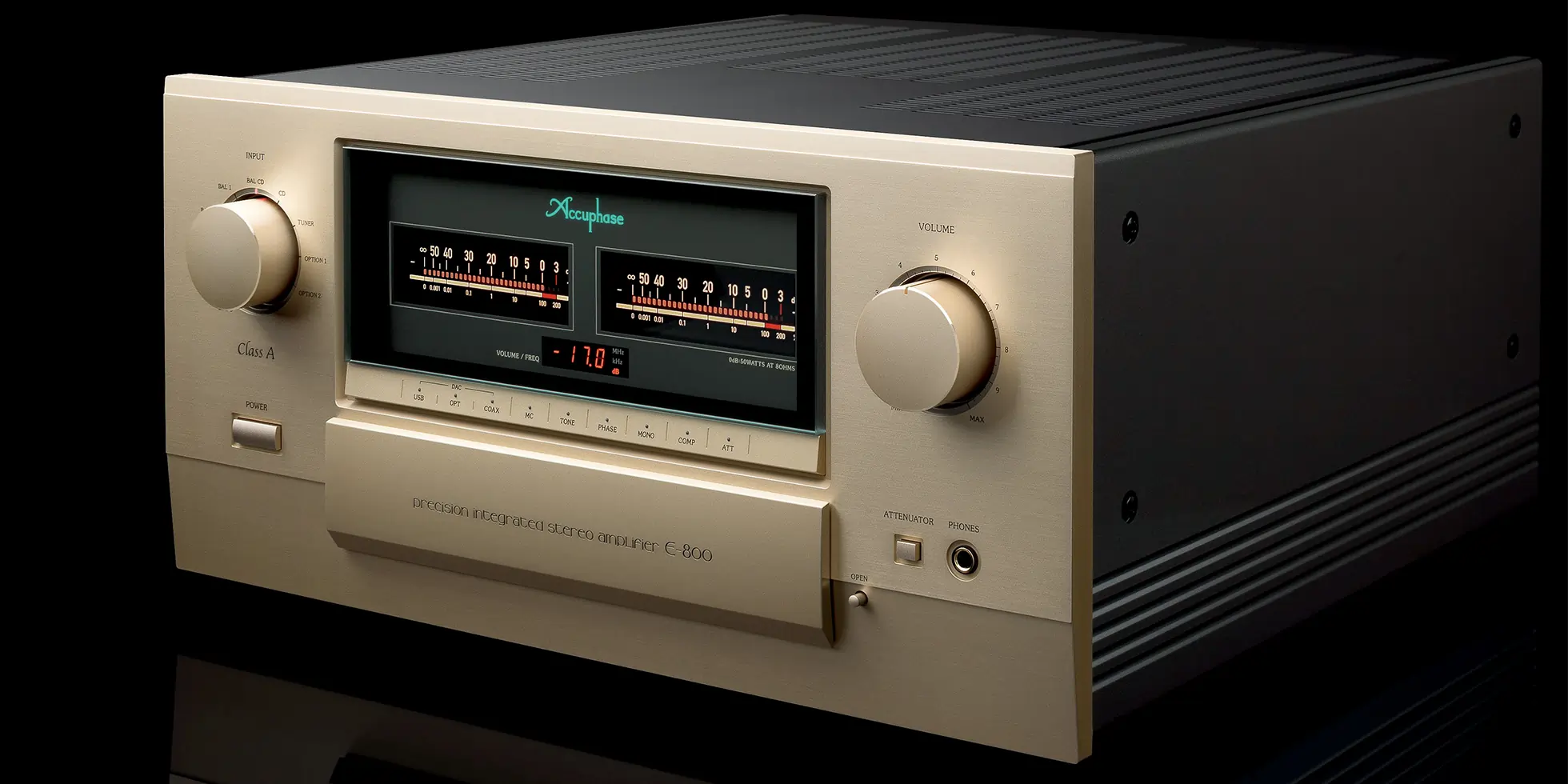

After attending the High End trade show in Munich, Accuphase’s management team headed for Paris, where they visited Music Hall, one of the most important resellers for the company in France. On this occasion, we had the privilege of meeting one of the brand’s founders, Jim S. Saito, surrounded by his team of engineers and sales staff.
Could you briefly introduce yourself to our readers?
Jim Saito: I’m one of the founders of Accuphase. I have been with the company since the very beginning. Several decades ago, there was a boom in hi-fi and many manufacturers appeared. Some of the big names remained, like Sony or Marantz, but these brands needed to sell a lot for a lot of people. For our part, we felt the need to manufacture very high-end products. So we created Kensonic and then Accuphase, and fifty years on, our philosophy is still the same.
Mark Suzuki: I’m the President of Accuphase, that I joined in 1981. As soon as I arrived, I started rethinking many products, and then designed our first CD player and converter, the DP-801 and DC-801.
Takaya Inokuma: Director of Engineering, I’m committed to the idea that we must continue to focus our production on quality and durability. We make sure that each of our products lasts as long as possible, and that if one of them breaks down, it’s as easy as possible to repair.
Tatsuki Tozuka: I’m in charge of international marketing, with a particular focus on the European market. I worked previously for Esoteric and joined Accuphase in 2009. I really like the way the company works, and I particularly appreciate the European market
Kohei Nishigawa: I’m also in charge of international marketing, but I’m more focused on the Asian and American markets. It’s very interesting for me to come to Europe to see the differences with other markets.
Let’s start with this point. How do you feel the European market differs from other markets?
T. T.: With its musical culture and hi-fi history, the European market is very stable. Europe is the cradle of classical music, and most people know very early what music is and how to listen to it. It is a very mature market, in every sense of the word.
K. N.: The Asian market is much younger, but it is growing very fast and it is much harder to keep up with. It is both very active, and at the same time sometimes based on fads that only last a few years or even a few months.

So, in Acccuphase’s wide range of amplifiers and sources, are you thinking of certain markets in particular to develop some of your products?
J. S.: We can define a global typicity in sound according to certain origins: there is an American sound, a French sound or a Japanese sound. But from that point on, we manufacture all products for all markets, the differences being then sometimes visible in the attractiveness of one reference rather than another in a given market. For example, France and Europe in general are very fond of integrated amplifiers, while other parts of the world, when they think of Accuphase, think of separate components.
Of course, you come to mind whenever the big high-fidelity brands are mentioned. How do you think about always maintaining this level for over 50 years?
T. S.: Our philosophy is always to challenge and develop our technologies to stay at the top of our game, and always improve our products. The main focus is on quality, then we think about developments, new product types or introducing certain innovations, but above all, we want to maintain quality. If a technology is very good for sound, but too unreliable to be sure that our products can cope with it for decades, we won’t integrate it.
M. S.: Not only are we careful to maintain the quality of our products at a very high level, but also that of the company and its employees.
You mentioned markets that are growing very fast, even though Accuphase has maintained almost constant production for many years. Do you intend to maintain this strategy in the future?
J. S.: We’re still manufacturing around 5,000 products a year, and the idea is to remain stable, with the main objective already given earlier: to maintain our level of quality. There would be a major risk in recruiting on a massive scale, training a lot of people and using more lines to ramp up production. Our primary objective is customer satisfaction. That’s why we are not thinking of expanding production, to ensure that our products remain reliable.
When you introduced yourself, you mentioned the ease with which you can modify parts if there is a problem. Is this also part of an ecological approach?
T. I.: The first approach was only to the quality of the products, simply to ensure that they never break down. But if they never break down, it avoids having to change and transport parts, so it becomes kind of ecological.
Today, there is a more in-depth reflection on ecology, particularly in Europe, which is becoming increasingly strict and should make us rethink the consumption of our class A amplifiers. We are thinking about new solutions, but also about maintaining class A until we find other techniques to achieve the same sound quality. Admittedly, these devices consume more power than class AB or class D amplifiers, but an amplifier remains a pleasure product that is only switched on at certain times to enjoy the music.
Analyzing your catalog, you have just released a new preamplifier called C-2300, which replaces not only the C-2150, but also the C-2450. You’ve also discontinued the DC-37 stand-alone DAC, without replacing it with an expected DC-47. Can you describe your product strategy in more detail?
M. S.: We have six models of integrated amplifiers, including two in class A. With the recent move upmarket to the E-800 and E-5000, these integrated amplifiers are partly replacing the separate entry-level units, so we are reducing the number of models while also moving upmarket. Today, an E-800 goes further than a C-2150 preamplifier and is more powerful than an A-48 power amplifier, in addition to being in a single box, which avoids cables between devices and also limits production costs, thus improving the quality-musicality-price ratio.
As for the DAC, we had fewer and fewer requests, so after some thought, we decided not to renew the DC-37. Our DACs can now be found on DC-60 cards and in our CD and SACD players. This is what customers turn to when they want an Accuphase digital source.
This must be a recurring question, but it is becoming all the more burning because at Munich, we saw Luxman present a N-07T network transport. Do you think you will soon be entering this market, where you have been awaited for years?
T. I.: For the moment, we are not doing streamers, because things have evolved enormously in this field over the last few years, and still depend too much on chips and software that change too quickly. In our opinion, there is a latent instability in producing a streamer, as much for the product as for the control app.
Accuphase certainly has to keep an eye on this world, but if you bought our first CD player, you can still use it today and play your CDs on it, so we wouldn’t want to go back on our philosophy by offering a network player that would be obsolete in a few years’ time, or could no longer be controlled by new computers and smartphones. Nobody knows today what will still be available in five years’ time, so for the time being, we prefer that our customers acquire a network transport elsewhere if they wish, and integrate it directly on our DAC cards or on the digital inputs of our CD-SACD players.
In addition to sources and amplifiers, Accuphase manufactures sector conditioners and voice equalizers. How important is it for you to purify the entire musical environment?
T. I.: Over 20 years ago, we created our first stand-alone power supply. We are specialized in hi-fi, but we remain an electronics company. Normally, conditioners are made by cable companies, but we were not always convinced by the products, so we decided to launch our own, in order to control the whole environment around our products. Audiophiles know that the overall environment of a system is very important, so we have to offer them in-house possibilities to make music quality as reliable as possible.
How do you see the future of the hi-fi market worldwide, and in particular its analog side, where you have phono preamplifiers and a cartridge, but no vinyl turntable?
M. S.: Today, streaming is growing very fast, but if you want to enjoy your music to the full and be sure of continuing to do so in a few years’ time, we think you need to use more solid media, such as CDs and vinyl. That’s why we are continuing to make devices to meet these needs, in the belief that they won’t disappear anytime soon.
You might also like: ACCUPHASE E800