When you visit the website www.dual.de, you can see that the German brand clearly offers a choice between automatic and manual models for its turntables. In reality, even the manufacturer’s “manual” models are semi-automatic—that is, if you leave this function enabled, the tonearm lifts automatically at the end of playback and the platter stops, which is not the case with a purely manual turntable.
Because in the audiophile world, high-end turntables are inevitably manual. So, while Dual’s automatic lineup starts with the “3” series—beginning with the CS 329 (399 €) and extending through the CS 429 (699 €) and the CS 529 Bluetooth (999 €) to the CS 629 Q—the manual lineup begins directly with the number “4” and the CS 418 (549 €). It then expands to the CS 518 (699 €), followed by the CS 618 Q with its Direct Drive control (1 199 €). And since the last Vienna show, a new CS 718 Q has been added to the lineup.
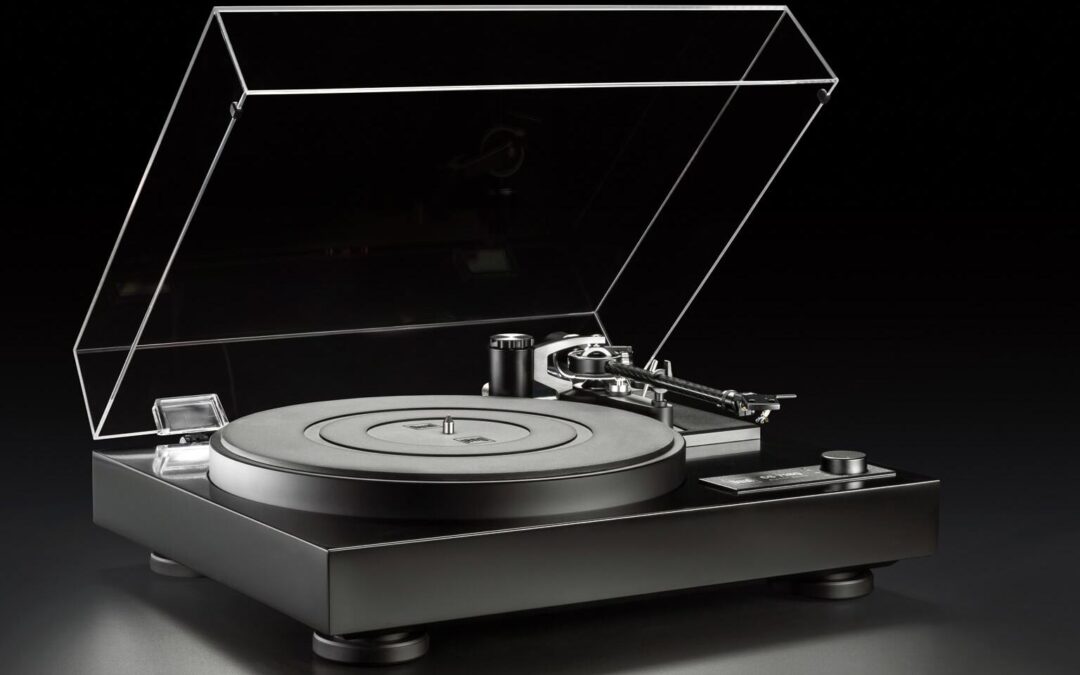
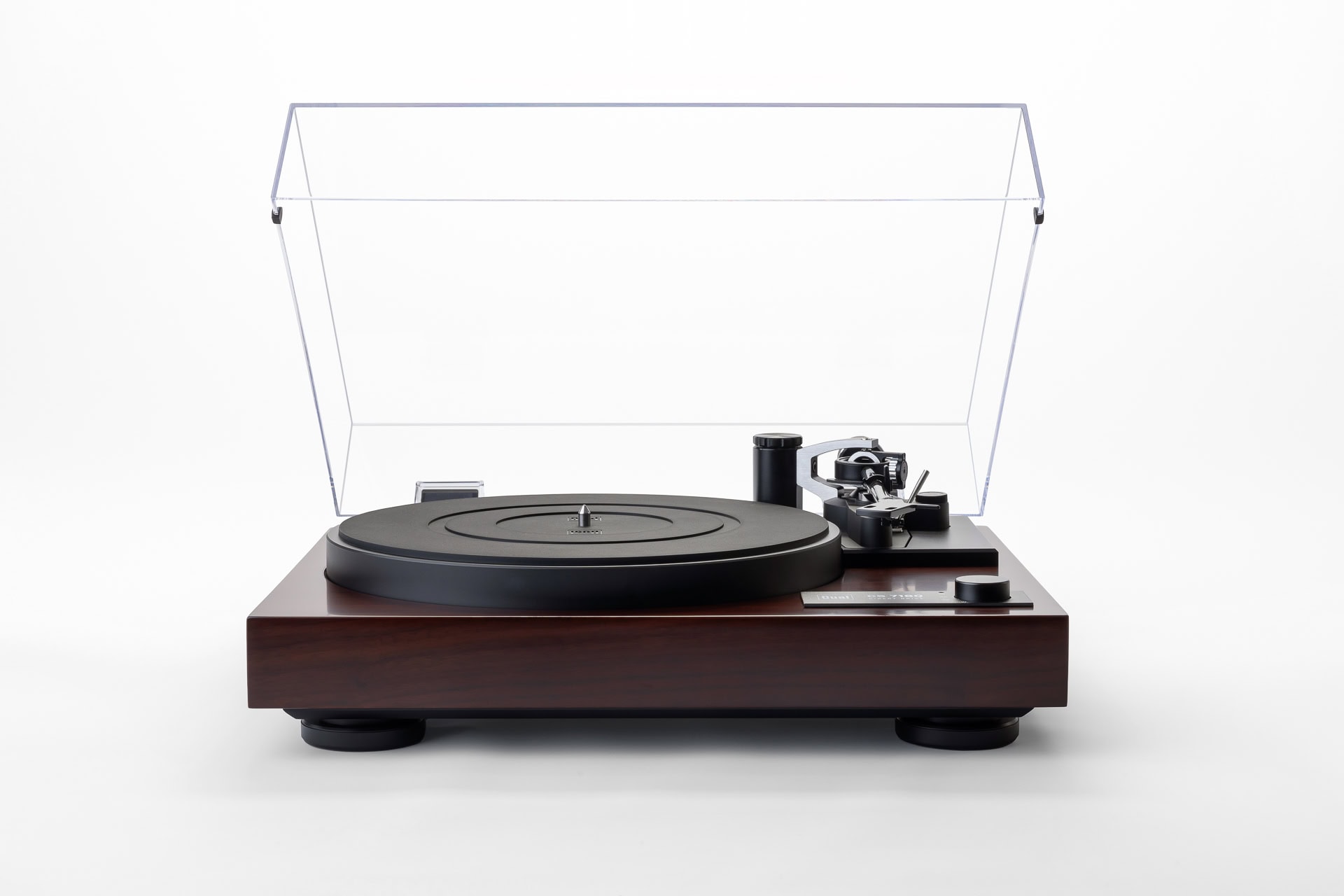
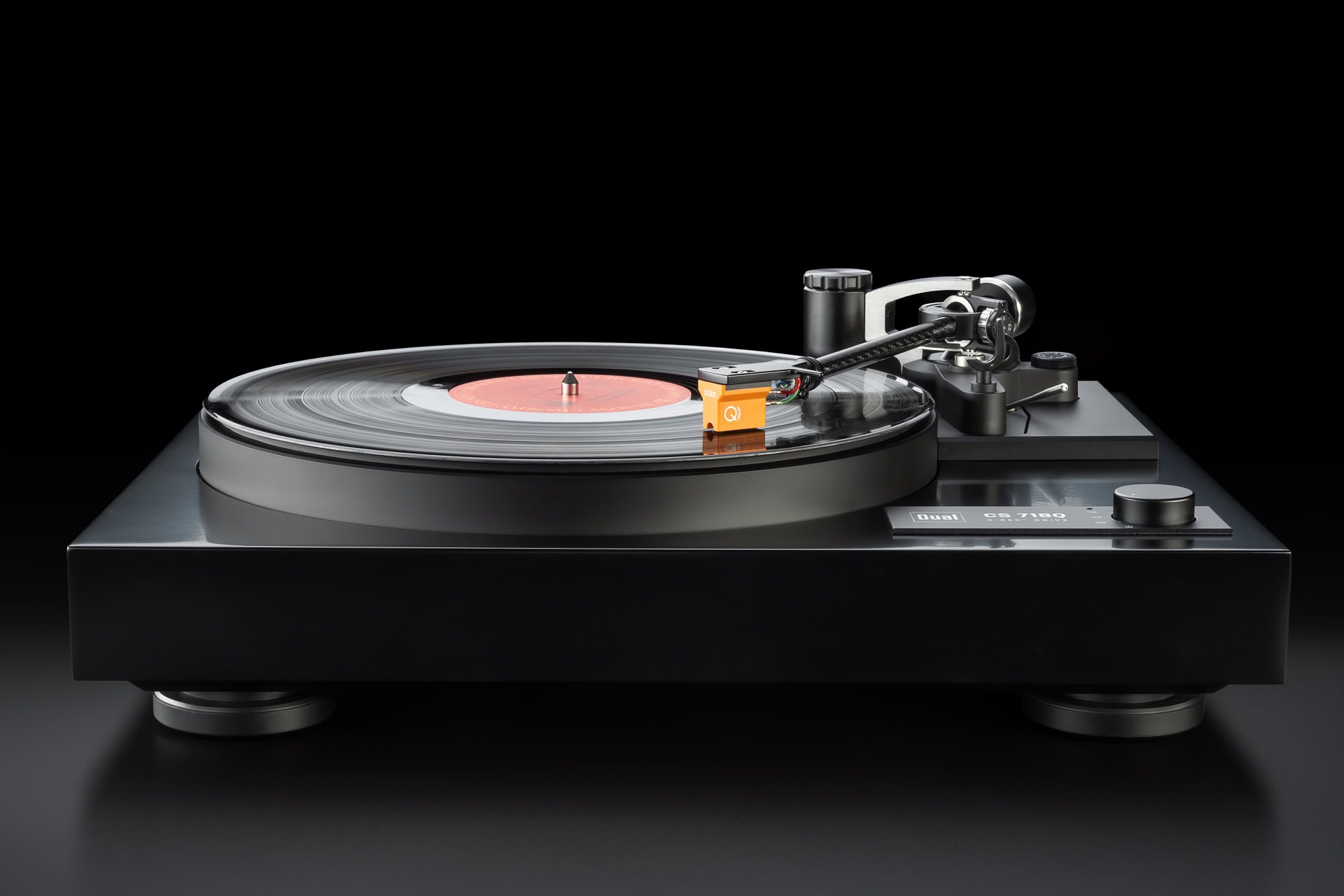
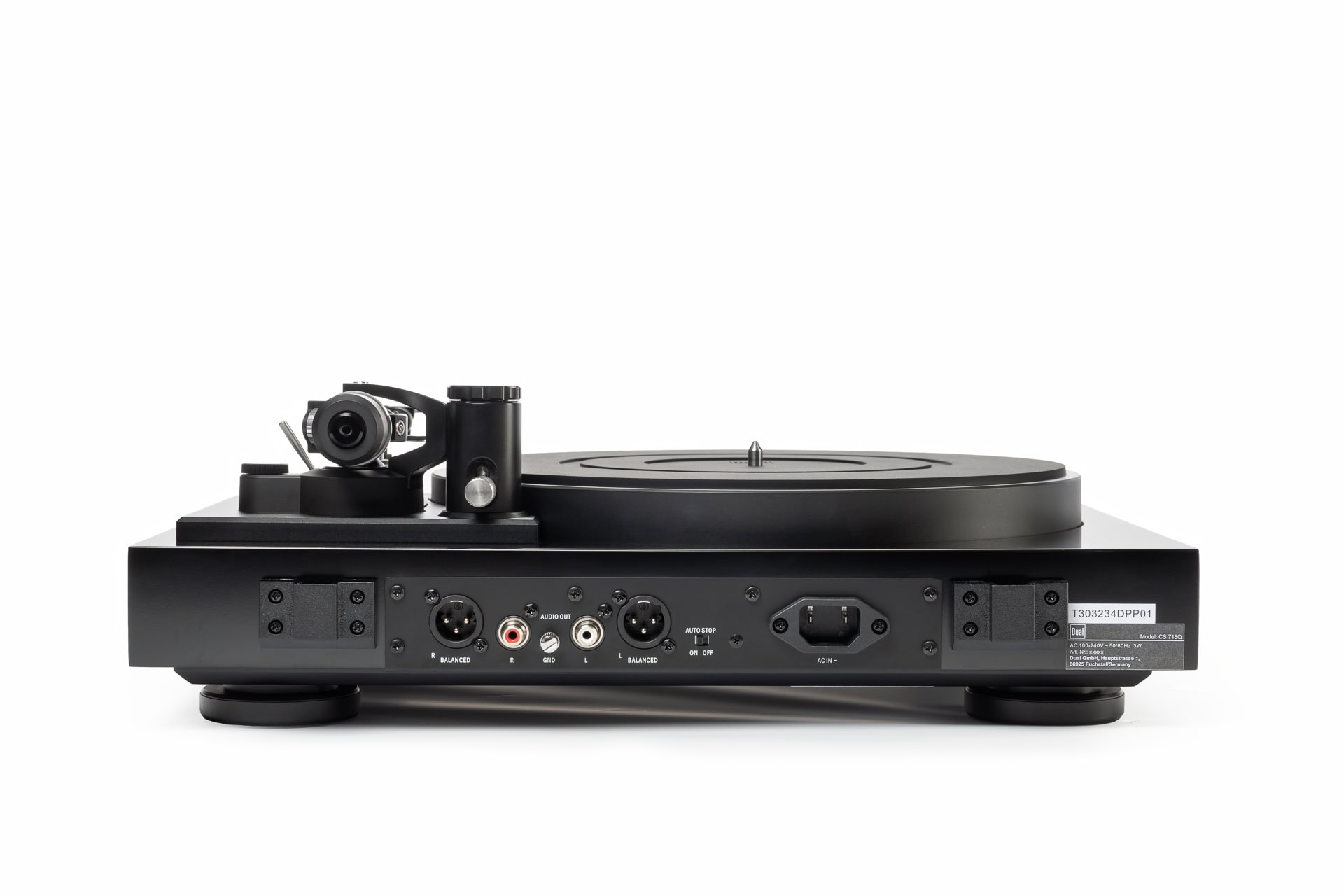
A worthy successor to the 1973 CS 701—the first direct-drive turntable manufactured in Europe—the CS 718 Q is now one of three models in the lineup, alongside the CS 618 Q (see our review in VU#52) and the CS 629 Q, to feature Direct Drive technology. And like the models in the 6 Series, Dual’s new flagship turntable adds a “Q” to its model number to indicate that it incorporates a highly precise quartz speed control, ensuring a speed variation (more technically measured as wobble and flicker) of less than 0.05% (DIN), whether playing at 33, 45, or 78 rpm.
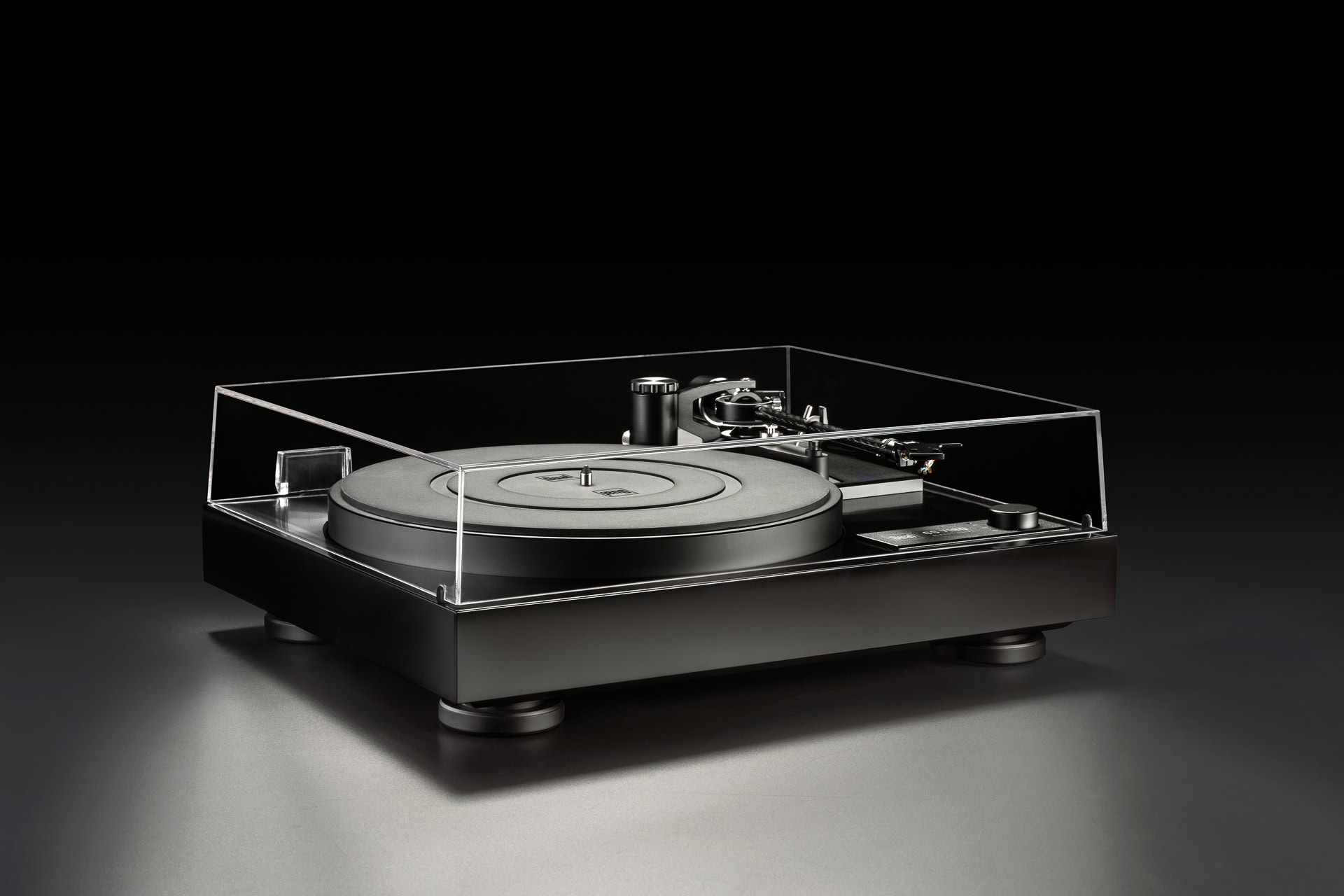
Its 1.9 kg aluminum platter, with a diameter of 305 mm, is topped with a 4 mm-thick rubber mat. It is mounted on a hardened steel spindle with a brass bushing, which is in turn inserted into an MDF chassis that brings the turntable’s total weight to 10 kg. To support this weight and minimize vibrations, four 68-mm-diameter feet with elastomer are positioned underneath and are height-adjustable to ensure perfect levelness.
Designed exclusively for the CS 718 Q, the tonearm’s tube consists of a carbon-aluminum sandwich that is both highly rigid and very lightweight, finished with a machined shell equipped with an azimuth locking mechanism. Its ball bearing, connected to the end of the machined rotation shaft, is paired with a high-precision double-gimbal spindle mount.
Available in walnut or satin black finishes, with a transparent cover included but without a cartridge, this top-tier turntable from Dual also stands out for its connectivity options—it can be connected to the phono preamp via either a pair of RCA or XLR terminals—and for its more exclusive price tag of 2 490 €.
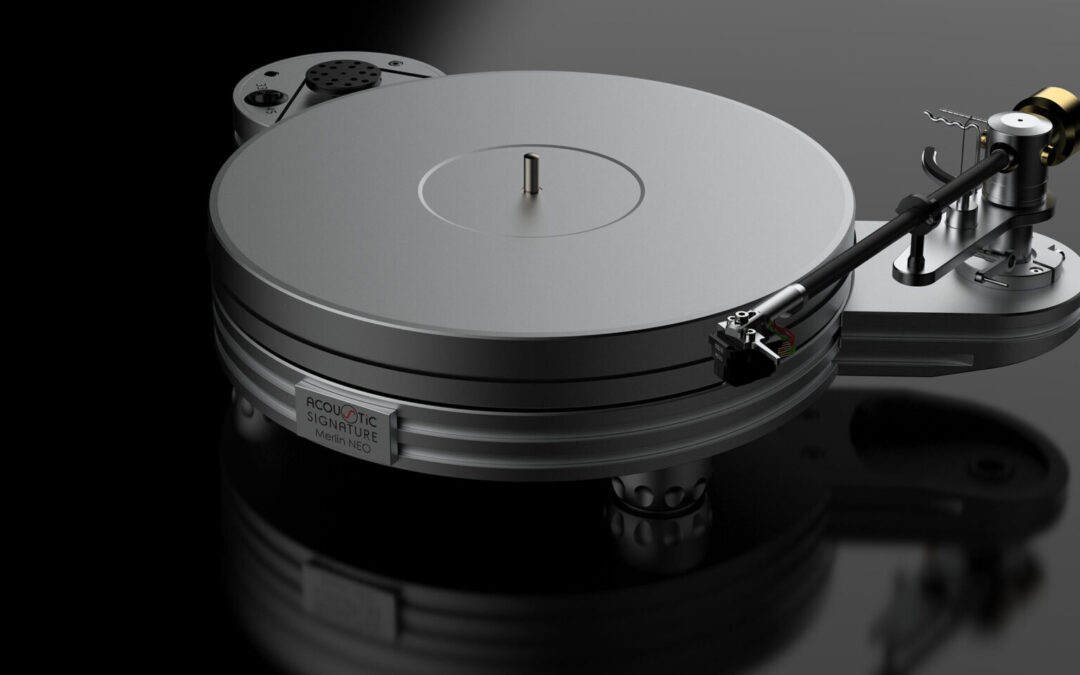
The Vienna show was an opportunity for Acoustic Signature to celebrate its 30th anniversary with two new models. The first of these is a new entry-level turntable, the Merlin NEO, the only one in the lineup to be sold exclusively as a bundle with the TA-500 NEO tonearm.
While we go into detail about the Double X in VUmètre No. 66 FR, this article is an opportunity to discuss the brand’s new entry-level model. As soon as it arrives in France, we’ll give it a listen to determine whether we’ll approve it for a second review on Acoustic Signature, or if we’d rather start by telling you about a more established turntable like the Hurricane or the Typhoon -from which the Merlin borrows some of its technologies.
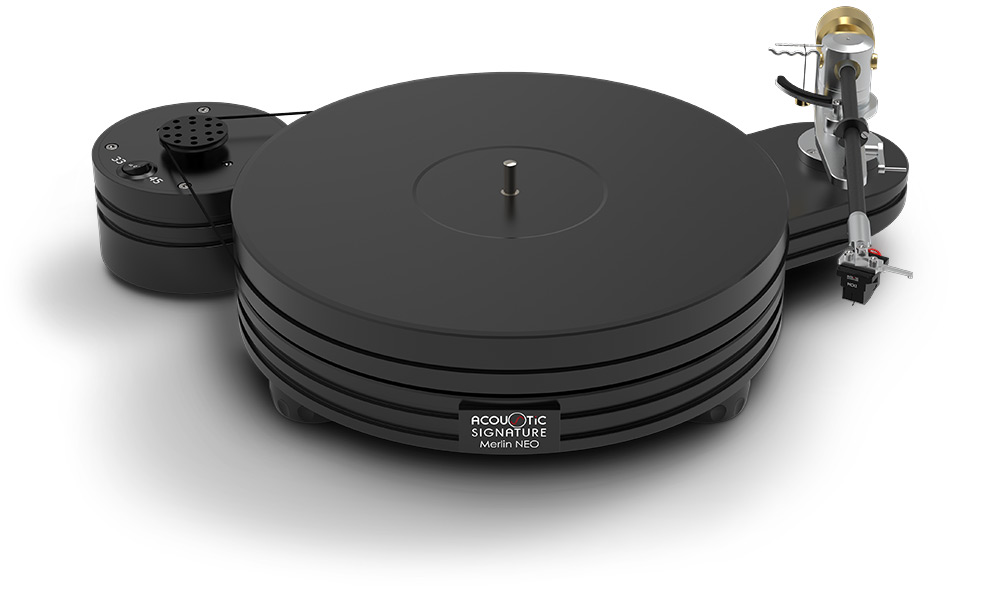
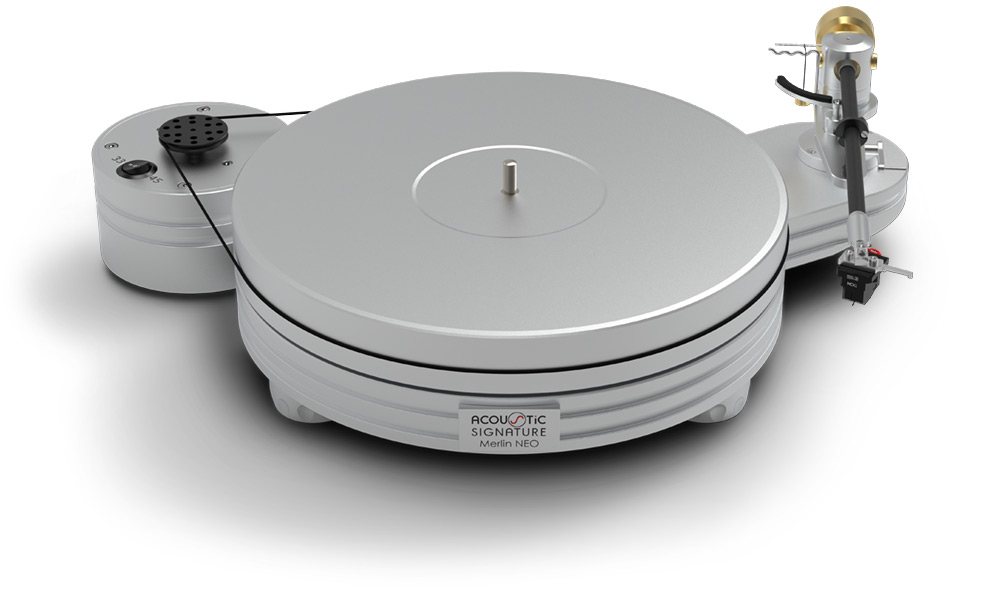
While the Merlin NEO is designed to make the German brand more affordable, it incorporates the key technologies found on all the brand’s other turntables, including the DTD (Duraturn Diamond Bearing) bearing and the CLD (Constrained Layer Damping) aluminum anti-resonance damping system, complemented by AVC vibration control.
The externally mounted, digitally controlled motor operates at 33.33 and 45 rpm; its decoupling prevents any transmission of mechanical vibration from the motor to the main chassis -except, of course, to the platter via the thin belt connecting it to the platter. And while the platter doesn’t weigh the 10 kg (20 Ils) of a Double X, it does weigh 5.8 kg (12.8 Ibs) -the same as the Maximus’s- and is also made of anodized aluminum with a layer of bitumen on the underside.
For this first Acoustic Signature model sold exclusively as a package, the Merlin NEO is paired with the excellent TA-500 NEO tonearm -the top model in the line- which is already perfectly suited to minimizing vibrations thanks to the ultra-rigid structure of its tube. The cable connected to it is an Audioquest Golden Gate, featuring RCA connectors so it can be plugged into any phono preamp.
Available for order now, the Merlin NEO is sold with the tonearm but without a cartridge, in a silver or black finish, for 3 998 €.
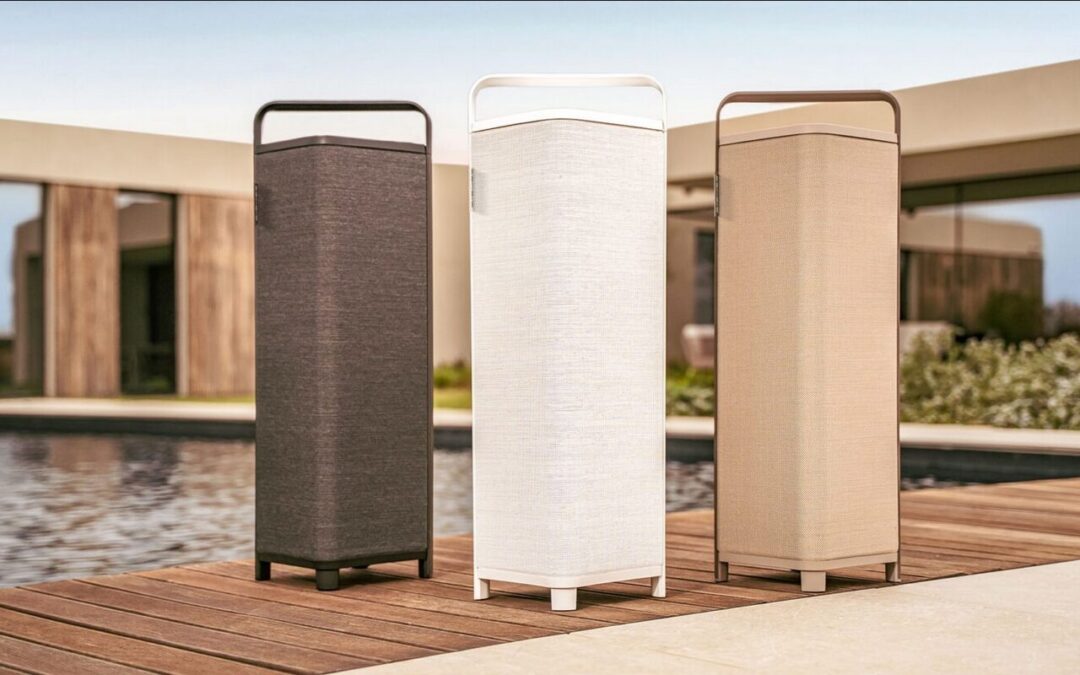
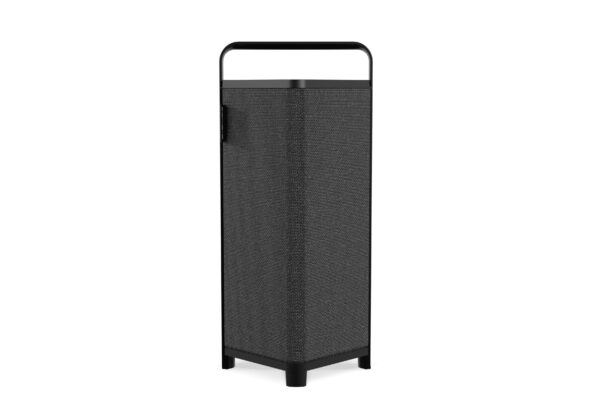
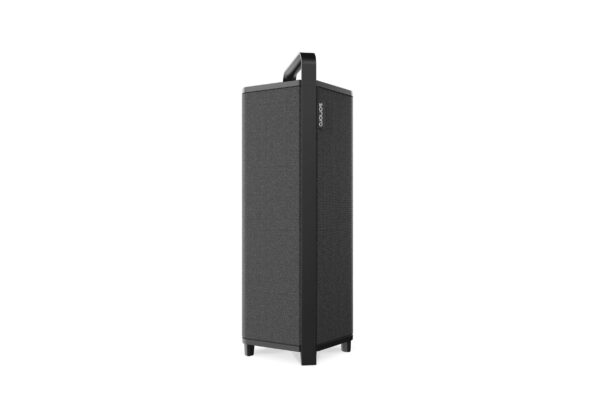
Following its all-in-one living room systems, the German company Sonoro is entering the connected speaker market with the VIBES.
Designed exclusively for Bluetooth to simplify use, the VIBES features the latest-generation Qualcomm aptX™ HD 5.4 chip, as well as the Auracast protocol, allowing it to be paired with a large number of devices from a single terminal.
Controlled via the VIBES Remote app (iOS or Android) or directly through a music app to stream audio via Bluetooth, this new speaker is designed to be moved quickly thanks to its handle on top—though its weight (7.5 kilos for the L version and 12.3 kilos for the XL) means it’s best suited for use within the same general area, such as between a sunroom and a garden, for example.
Its IPX 4 rating ensures splash resistance, so it can also be placed around a pool (you can even set up about ten of them all around it) or safely withstand brief exposure to the elements. However, it is not “weatherproof,” and as you can see from its finish, the idea is to bring it indoors after use.
Its battery offers a claimed runtime of approximately 16 hours, but it can also be plugged in, and a switch is provided to bypass the battery in this case. The VIBES XL delivers 360° sound thanks to four 3“ full-range speakers and an 8” subwoofer. The VIBES L features two 3-inch full-range speakers and a 6.5-inch subwoofer. Both models utilize the EQ Boost spatial sound reproduction feature.
Priced at 699 € and 999 €, respectively, the Sonoro VIBES are available now in black, white, or beige to keep you company during the summer heat.
With audiophile subwoofers gaining popularity in both home cinema and hi-fi, they have been developing in recent years and are now featured in the catalogues of speaker brands such as the Swiss benchmark Stenheim.
Whilst North American manufacturers have never been shy about subwoofers – which have been available for decades from virtually every speaker brand in the US and Canada – their European counterparts, particularly those specializing in high-fidelity, have often been slower to embrace them.
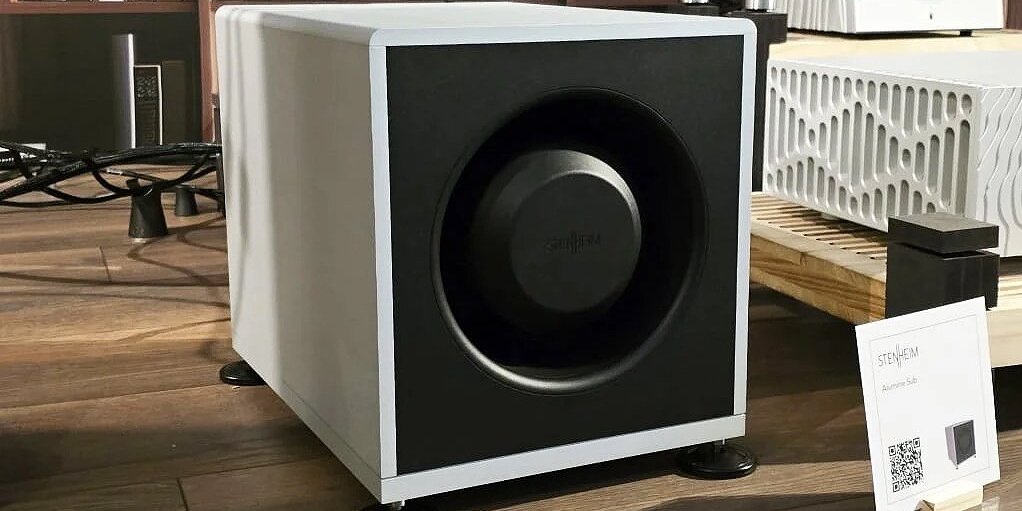
It was therefore with some surprise, but also an understanding of the value in offering such a product, that we discovered Stenheim’s Alumine S10 in Vienna. Designed primarily to complement the speakers in the range – notably as an ideal addition to the compact Alumine Two and Two SE models (review VU#57 FR) – or to enhance the bass response of the Alumine Three and Five floorstanding speakers, this new subwoofer has also been developed to work with other brands.
The S10 fits perfectly within the Alumine series, being made entirely of aluminium and having undergone extensive testing of its internal structure, which comprises three independent chambers. Featuring an isobaric design, it incorporates not one, but two 10-inch (26 cm) cones aligned with the acoustic suspension system. Its frequency response is limited to the sub-bass range, from 20 to 100 Hz, driven by a 1,200 W internal amplifier.
When installing it, its weight of 44.5 kg (98.1 Ib) must be considered, but its dimensions – 32 cm wide, 34.2 cm high and 43 cm deep – make it a relatively unobtrusive piece of kit, fairly easy to position even in stylish living rooms. With connectivity options including XLR, RCA, Toslink optical, SPDIF coaxial, AES and RJ45, the Alumine S10 also offers direct XLR, RCA and Toslink outputs.
It is initially being launched in two colors – light grey or dark grey – with a black front panel, but will soon be available in optional all-black, ivory or mocha finishes, with prices starting from 18 500 €.
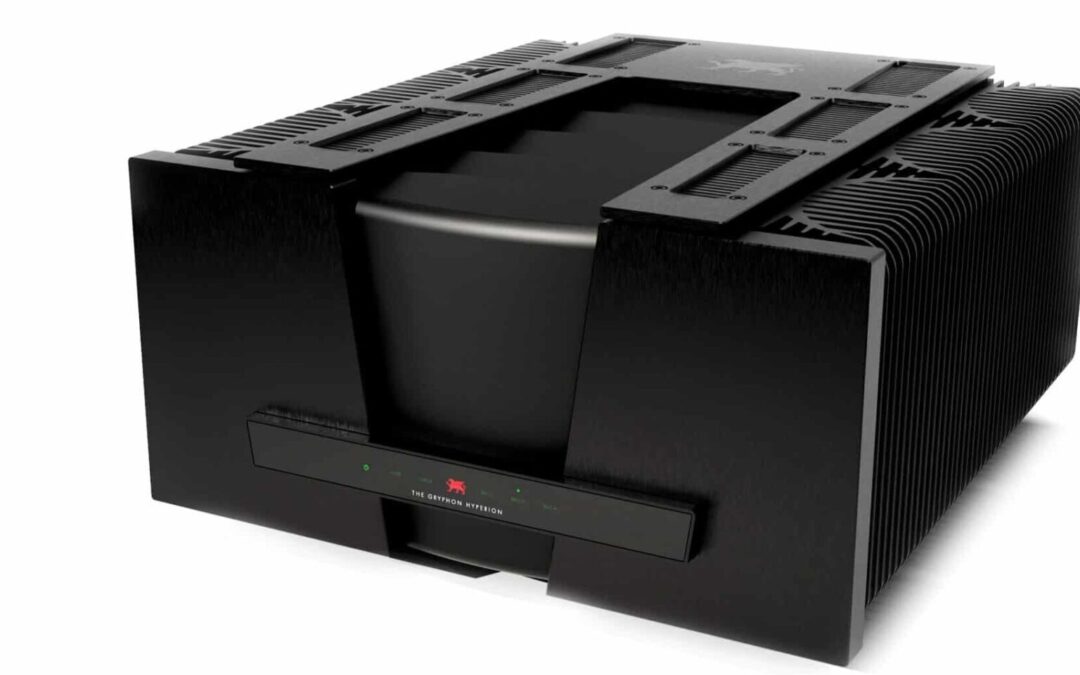
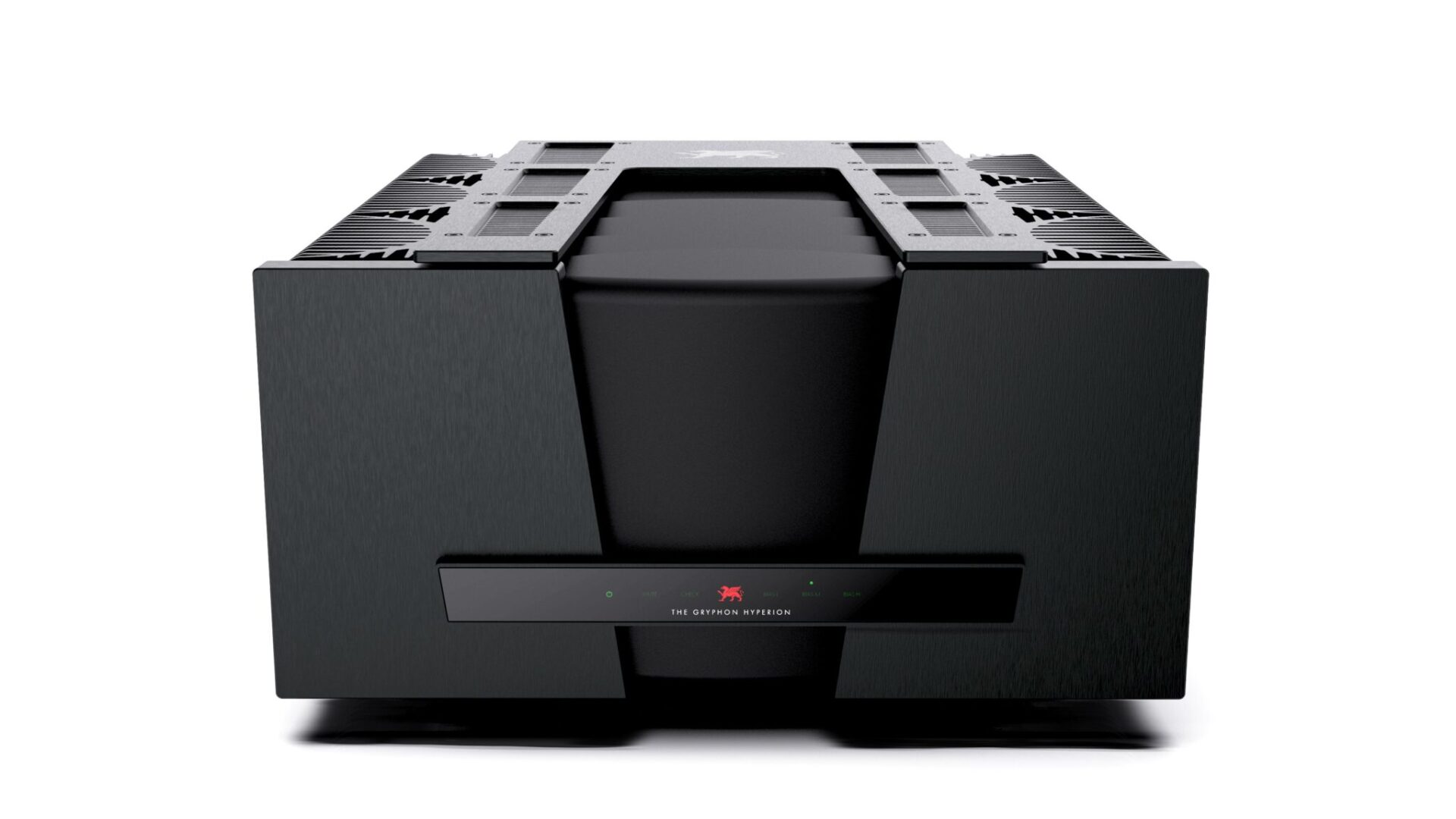
It didn’t take long for Gryphon to complement its new Helios with a heroic power amplifier called the Hyperion.
Between the Apex and its 1,040,000 μF of capacitive load from its capacitor bank (including the zinc-foil capacitors used for decoupling the local power supply) and the Antileon with 335,000 μF, there was room for a companion ideally suited to the preamplifier unveiled in early April. With 500,000 μF and 40 bipolar output transistors (compared to 64 on the Apex), the Hyperion is available like the other models as a stereo unit, or as two mono units (which also doubles all components, and thus the filtering capacity per channel).
In a configuration that is obviously dual-mono from the stereo version onwards, this new large Gryphon designed by Tom Møller still uses zero global feedback technology and delivers a gigantic 180 W into 8 Ω per channel, 360 W into 4 Ω and 720 W into 2 Ω in Classe A; these power figures rise to 200 W, 400 W and 800 W respectively in mono mode, with the power doubling each time the impedance is halved, a linear response made possible by a very substantial power supply; in this case, that provided by two toroidal transformers of 1,500 VA each.
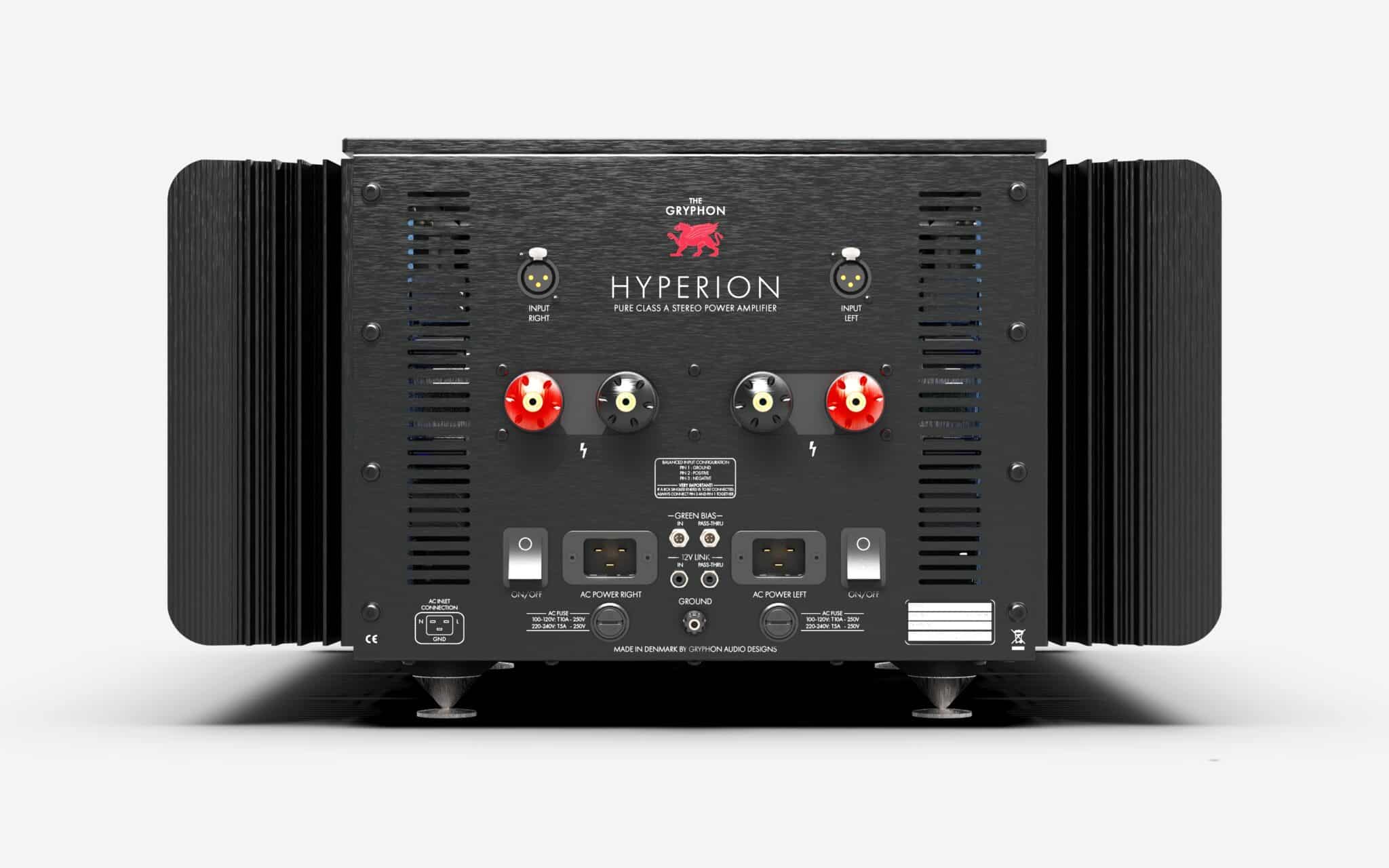
With a very understated front panel, the new Gryphon features on the rear panel a complete internal left-right separation, with a mains socket per channel for power supply, each fitted with its own switch. A pair of speaker terminals is then provided on each side, along with an XLR input terminal on each side.
With a depth of 65.4 cm and a net weight of 126 kg, the Hyperion seems almost reasonable compared to the Apex, which measures 88.6 cm and weighs 202 kg net per unit.