Distributor Audio Focus has announced that it will become the distributor for the Berkeley Audio Design brand starting in 2026.
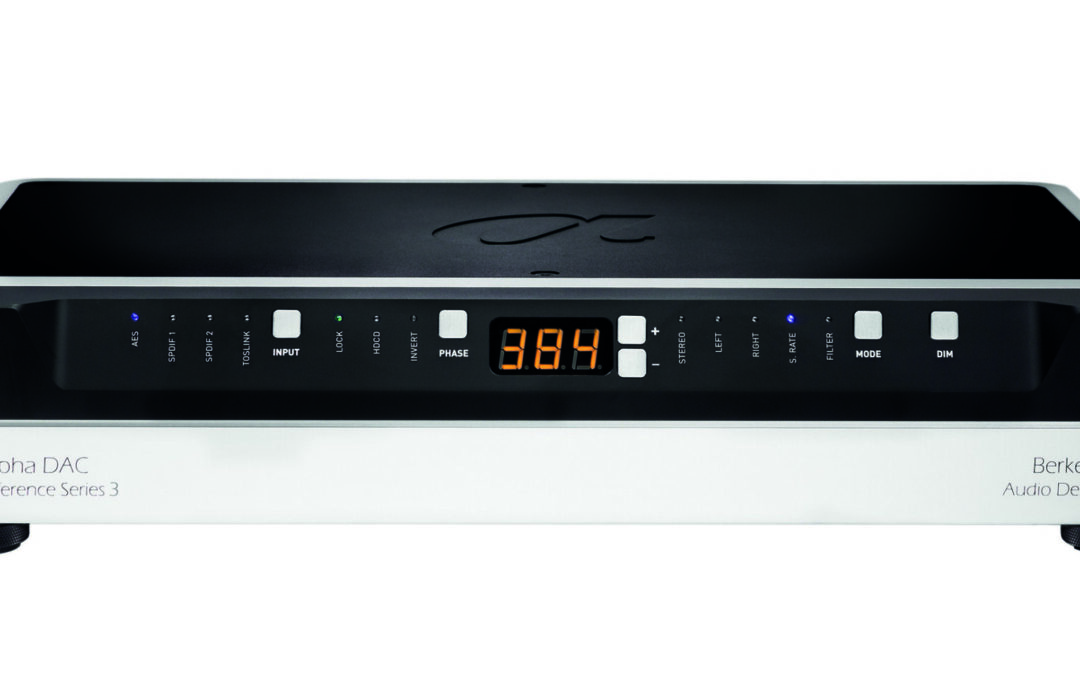
To start with, the Alpha DAC Reference Series 3P model will be promoted. Considered by some to be the gold standard in converters, particularly in the United States, this model does not use oversampling or offer the very high frequencies of current conventional DAC chips. Instead, it focuses on the essentials, namely playing PCM or MQA files at sampling rates of 32 to 192 kHz up to 24 bits, as well as DSD up to DSD128. As a reminder, this covers the vast majority of current audio files and, in higher sample rates, most of them are larger and more often oversampled or upsampled, and therefore non-native.
To achieve extremely high precision sound levels, the Alpha DAC Reference 3P implements exceptional electrical and mechanical isolation against noise, combined with extreme stability in the time domain. Aerospace-grade ceramic materials are used in all critical areas, and the housing is designed to minimize electrical noise and maximize mechanical and thermal stability. As proof, the device weighs 13.6 kg, and the entire housing is precision-machined from solid 6061-T6 aluminum alloy.
Of course, this comes at a price, and it matches the exceptional nature of the product: 39 990 €.
To avoid the pollution created by a USB port, even one that is shielded and electrically and mechanically isolated, this input is only available on the DAC by adding a second case, the Alpha USB Reference Series. Completely galvanically isolated in this smaller 1.27 kg box, the USB Audio 2.0 port is fully re-clocked by an exclusive ultra-low phase noise clock technology, identical to that of the DAC, and then sent back to the AES or coaxial port (BNC or S/PDIF, as desired). You can then connect to the DAC via these links. But here again, this box comes at a price, costing a whopping 7 000 € in Europe.
In a second phase, the importer will also bring the Alpha series to France, which is about three times less expensive, again with the DAC separate from the USB box.
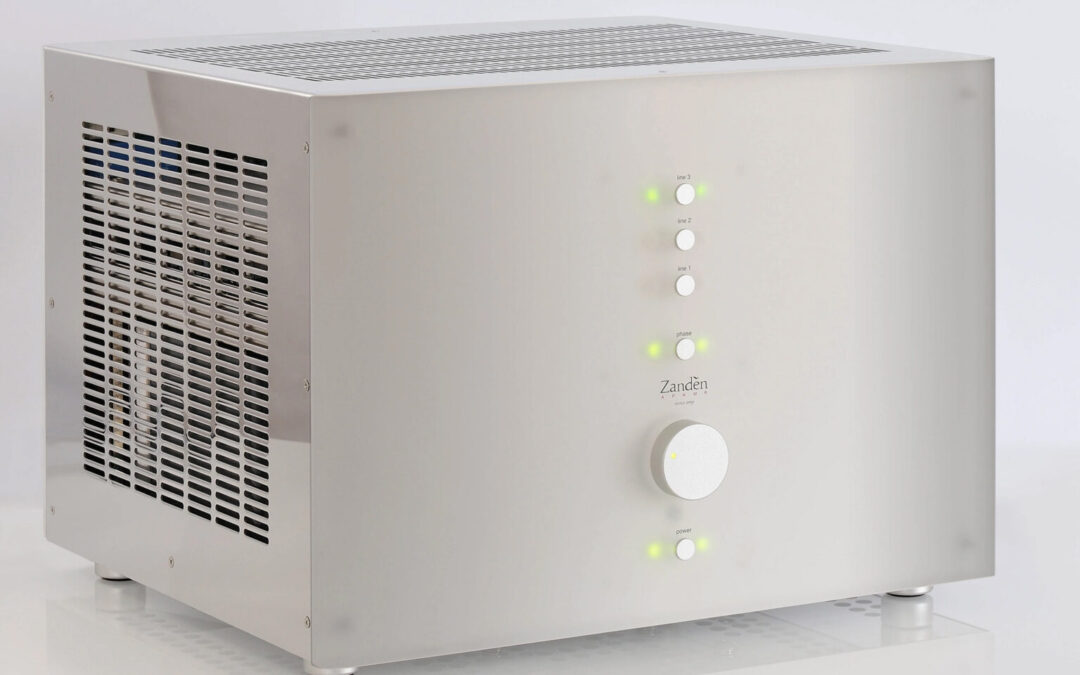
Fully symmetrical, the new Zanden 6000F integrated amplifier allows you to choose between KT-120 or KT-150 power tubes.
The latest model in the Modern range, it features the same sleek white design in a solid chassis with dimensions similar to those of the 8120 power amplifier. Like this one, the 6000F uses two tubes per channel and delivers a comfortable rated power output of 90 W into 8 Ω (with KT-120).
Also featuring four 12AU7 preamp tubes, this new integrated amplifier follows the principles of the 6000 model, but in a superior chassis with reinforced feet. The circuit diagrams have also been revised, as have the components, the RFI/EMI shielding (see our review of the Model 120, VU#58), the filter capacitors, and the internal wiring.
With extremely low feedback, the 6000F can amplify most speakers on the market and has four pairs of analog inputs, either RCA or Neutrik XLR, including one unity gain input for use in a home theater environment. With ergonomics worthy of the most modern devices, this integrated amplifier comes standard with a remote control and features such as polarity reversal.
Soon to be tested by VUmètre to verify the transparency and expressiveness that are hallmarks of this Japanese family brand, which we featured in our issue 62 Special Japan (in French), the 6000F model is being launched at a price of 32 900 € until the end of January, then 34 900 € for 2026.
During a visit to Hifi113 in the 15th arrondissement of Paris, we had the opportunity to rediscover the Serbian Dayens amplifiers, which we hadn’t heard in several years.
Founded in 1991, the company still manufactures all its products by hand in Serbia. Its catalog now includes a dozen models of wooden speakers and around ten electronic devices. Focusing on amplification, as it does not produce any sources, the manufacturer offers interesting and very affordable integrated amplifier models.
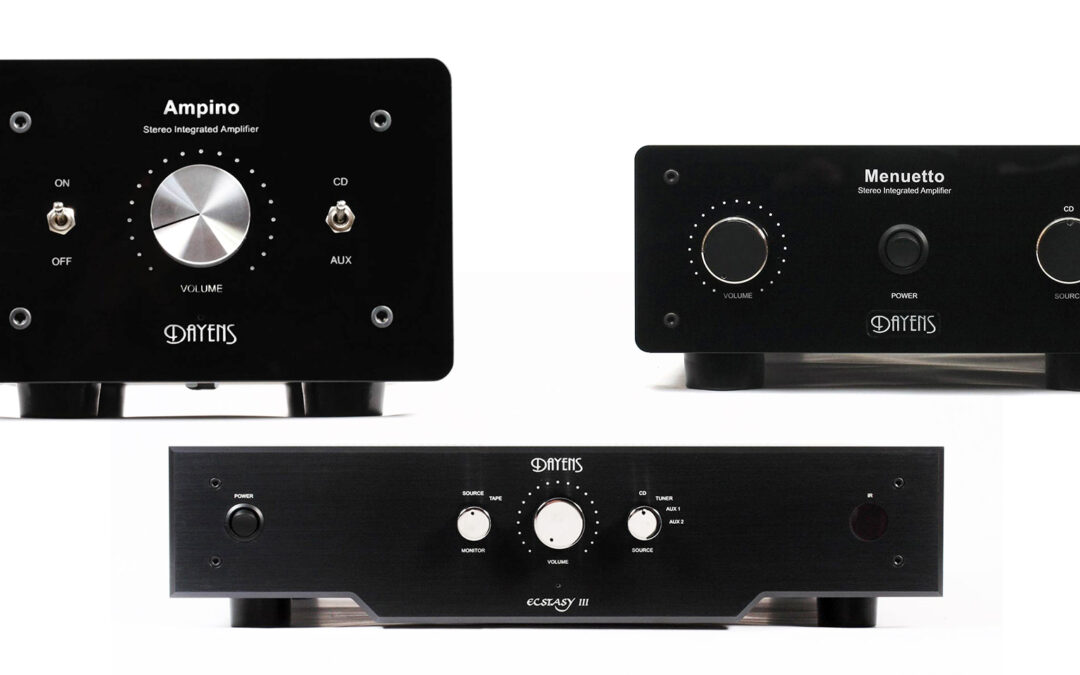
Ampino Very compact, with a chassis measuring only 15 cm wide, 9 cm high, and 28.5 cm deep, the Ampino uses an ALPS RK27 Blue Velvet volume potentiometer. On the amplification stage, a pair of Japanese bipolar transistors powered by a 100 VA toroidal transformer, filtered by Mundorf MCap® ZN Classic capacitors, develops 25 W per channel under 8 Ω or 40 W under 4 Ω in class AB. This model is available for resale at a price of 800 €.
Menuetto Still compact but this time in a “shoebox” format, the Menuetto uses the same volume potentiometer, this time motorized. More ergonomic, it offers a remote control and four pairs of RCA inputs, selectable via a dial that activates the various internal relays. Its class AB power is almost double that of the Ampino, as the Menuetto’s 200 VA transformer allows the output transistors to deliver 50 W per channel into 8 Ω and up to 70 W into 4 Ω. This model costs 1 290 € in Europe.
Ecstasy III With a more conventional format (46 cm wide), the Ecstasy III can incorporate a 400 VA toroidal transformer, with the current this time filtered by Mundorf MCap® Supreme EVO capacitors. The volume knob remains unchanged, as do the relays for the four inputs, but a “tape” output is also available this time.As with the power supply, the available power is doubled, this time thanks to two pairs of transistors per channel with a total value of 100 W under 8 Ω and 150 W under 4 Ω. Weighing in at a substantial 14 kg, its circuits and components are selected from among the best to deliver the highest possible sound quality. Its European price is 2 150 €.
In addition to these devices, there are four power amplifiers and two preamplifiers, under the names Ampino or Ecstasy IV (Power or Preamplifier). Don’t hesitate to give them a listen when you get the chance!
Through distributor Ana Mighty Sound, high-end Aidas cartridges are now available in France, Switzerland, Belgium, and Luxembourg.
Starting out as a cartridge repairer in the late 1990s, Aidas Svazas quickly became a refinisher, then a designer. At first, this resulted in models that were even better than those on the market once they had passed through the Lithuanian’s hands. Then, in 2010, the inevitable happened: the first AS-1 cartridge from a new brand, simply named after its creator: Aidas.
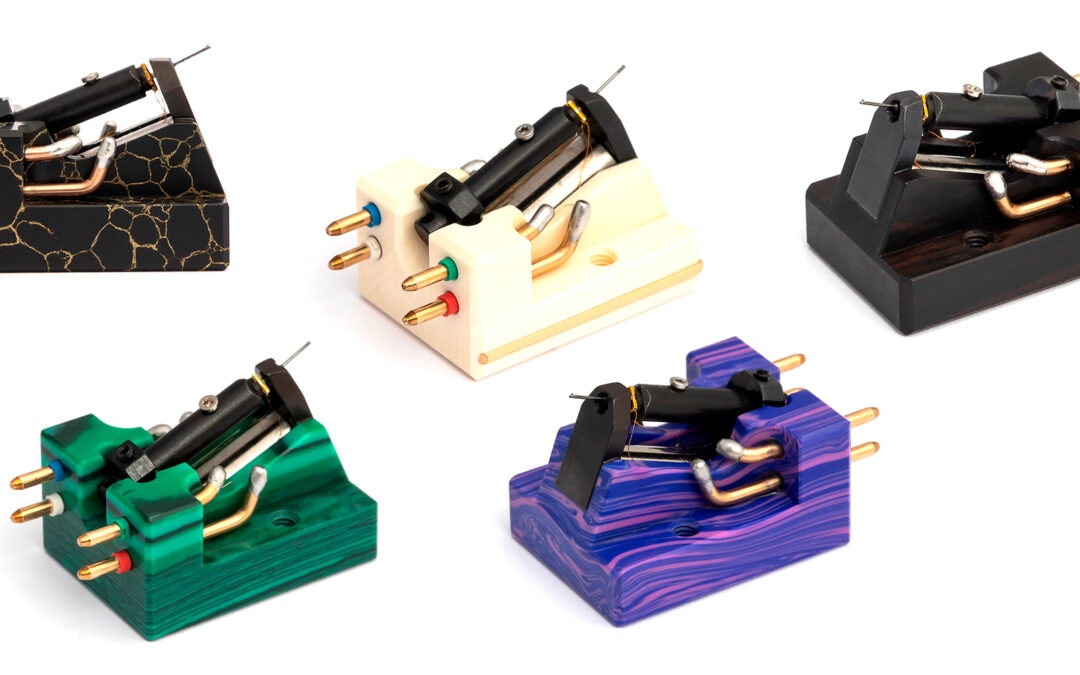
All moving coil (MC) cartridges, they are now available in four series. The first, labeled CU, uses copper coils and wood for its chassis. This series includes the Panzerholz, Durawood, Durawook BE, and Composite (all priced at 4 500 €). With an AlNiCo5 magnet system and a Japanese Namiki boron cantilever, these cartridges, like all the others, use a MicroRidge stylus.
The AG series features a 6N silver-plated copper coil (0.03 mm) in the unique Malachite Green model, made of green hard stone (5 500 €). Then the AU-CU series makes way for a gold-plated copper coil, with the Tru-Stone Gold Web, African Blackwood, and Brazilian Purpleheart Wood models, the latter two in a rare wood chassis from Gabon and Brazil. In this range, while the stone version may be risky on certain tonearms due to its 12.6 g weight, the wooden versions weigh just 8 g, and the first black wooden version even offers a “Baby” version, weighing 6.8 g (still 5 500 €).
And to top off the range, an AU series now incorporates pure gold for its coils. But while the Tru-Stone Violet Gold stone version (6 700 €) is already impressive, the cartridge that everyone remembers at each of the brand’s presentations is the latest: the Mammoth Gold. Available in a classic version (11.2 g; 9 000 €) and a Baby version (6.8 g; 7 900 €), this cartridge is simply made from one of the lightest and most resistant materials: ivory. But to protect living animals, the use of elephant ivory is prohibited, which we fully support. Aidas Svazas simply recovered a piece of mammoth tusk that could not be used by museums. This provided him with material for a limited and exclusive number of cells, which can be heard very soon in Paris in the new Ana Mighty Sound showroom, right next to the Eiffel Tower.
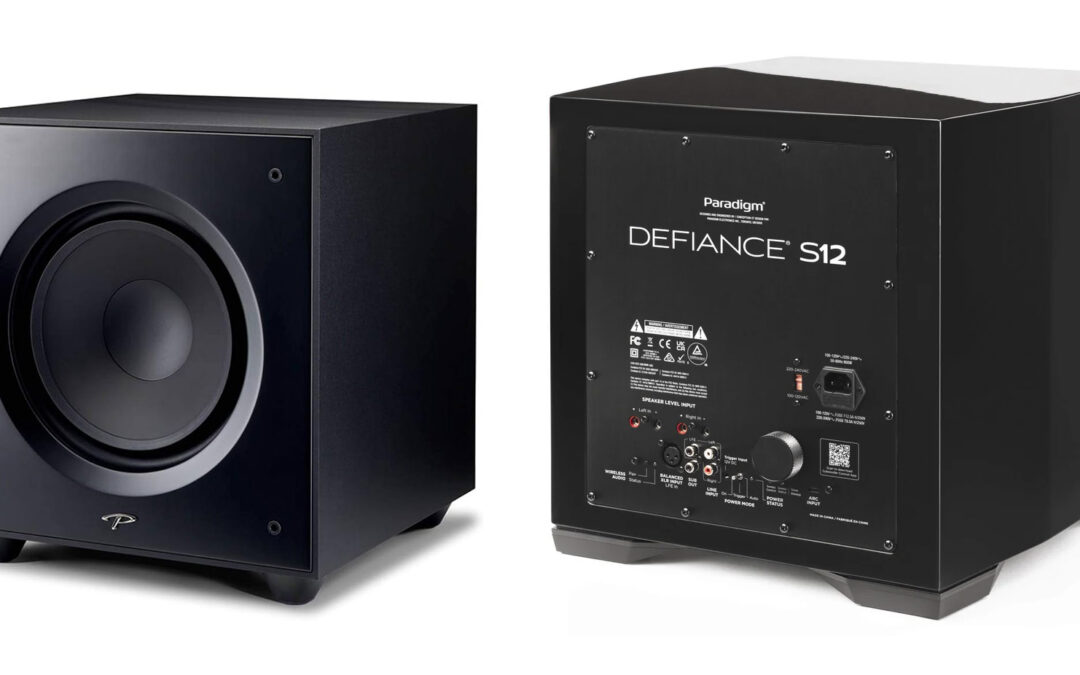
As if it didn’t already have enough in its catalog, or as if the number 13 was unlucky for the Canadian manufacturer, Paradigm has added two more pairs of subwoofers this year.
The 10-inch and 12-inch Essentials Sub and Defiance S have been added to the Defiance V and XR series, as well as the impressive Signature Sub2 (14 990 €) and Persona SUB (10 790 €). At much more affordable prices, the Essentials Sub is priced at 529 € (Sub 10) and 719 € (Sub 12), while the more refined S10 and S12 cost 1 390 € and 1 790 € respectively.
Housed in MDF cabinets, the Essentials combine a 200W Class D amplifier with 350W continuous power, capable of doubling the peak power. The Defiance S series is designed to be livelier, with the same size satin anodized aluminum cones rather than carbon-polypropylene cones, powered by more powerful magnets and 500 W and 800 W Class D amplifiers, capable of delivering up to 1 000 W and 1 200 W.
A wireless kit can be added to the first series, which uses a high-resolution 56-bit DSP, whereas the Defiance S series integrates Wi-Fi and a 64-bit DSP directly. And above all, in addition to their denser chassis and improved vibration control, thanks not only to 1-inch (25 mm) thick MDF panels, but also to well-designed anti-vibration feet, the Defiance speakers also feature ARC (Anthem Room Correction) room correction. When used with a microphone and ARC Genesis software, these models become very user-friendly, especially when configured using the Paradigm SubControl smartphone app.
These subwoofers can be integrated via Sub, LFE, or even HP inputs, and can be used for both hi-fi and home theater setups.