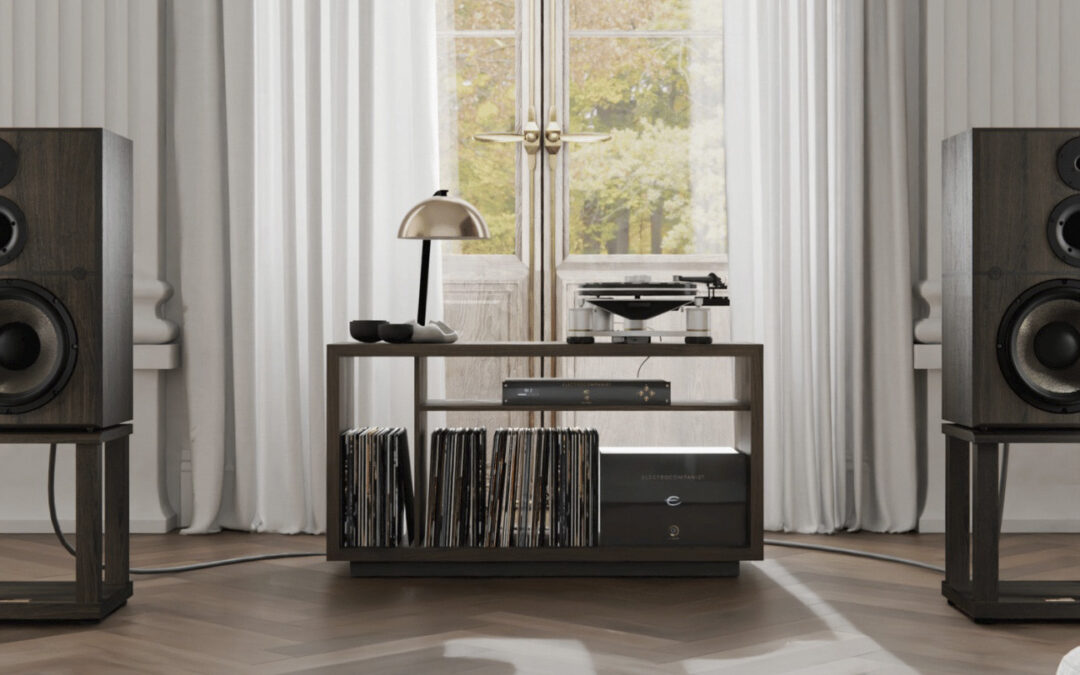
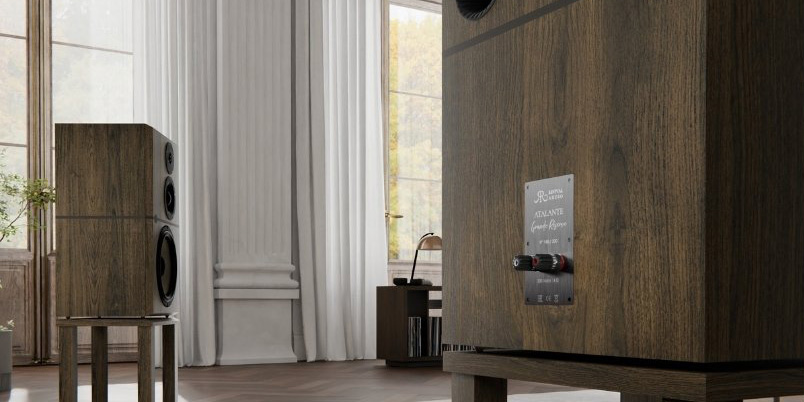
In a limited edition of 300 pairs, the ATALANTE Grande Réserve has the same dimensions as the ATALANTE 5, but seeks to surpass the 7.
With its smoked oak finish found in the feet dedicated to this model, the Grande Réserve evokes the world of French fine wines. Numbered and engraved on a gold-plated aluminum plate on the back, this speaker uses two WBT speaker terminals and updates all the components of the ATALANTE 5.
The 28 mm (1.1“) tweeter and 75 mm (3”) midrange driver use RASC™ membranes in the Evo version, combined with the 30 cm (12″) BSC™ woofer, redesigned for this model. They are integrated into a patented StrataBaffle™ multi-layer front baffle that combines solid oak on the front, a UDF core, and MDF reinforcements, with chamfered edges to optimize rigidity. The cabinet has been redesigned internally and houses a completely revised crossover, with Mundorf components and van den Hul Skyline cables, to cross over the drivers at 400 Hz (bass->midrange) and 2,000 Hz (midrange->treble).
With a nominal impedance of 4 ohms and a sensitivity of 89 dB, this new Revival Audio model boasts a frequency response of 26 Hz to 24 kHz. It retails for 9 890 €, including wooden feet. Perfect for enjoying fine wines or cognacs while listening to wonderful music!
At the end of the year, Blue Note unveiled the upcoming titles in its flagship Classic Vinyl Series and Tone Poet series for 2026.
CLASSIC VINYL SERIES 2026 Supervised by Cem Kurosman and still mastered from the original analog tapes by the prolific Kevin Gray, the Classic Vinyl Series continues its exploration of the vast Blue Note catalog with titles spanning many eras and styles across the legendary label’s eight decades of history. The newly announced titles begin on January 23 with two swing classics from the 1960s: Art Blakey & The Jazz Messengers’ Free For All and Joe Henderson’s Our Thing. Other highlights include two remarkable albums from the 1990s that are being reissued on vinyl for the very first time: John Scofield’s Meant To Be(pressed directly from the original analog tapes) and Medeski Martin & Wood’s Tonic, as well as bebop classics from the 1500 series by Thelonious Monk (Genius Of Modern Music) and J.J. Johnson (The Eminent Jay Jay Johnson); albums by the organ-guitar-drums trio of Jimmy Smith (Softly As A Summer Breeze) and Grant Green (Street Of Dreams); the contrasting 1969 albums by Eddie Gale (Black Rhythm Happening) and The Three Sounds (Soul Symphony); and hard bop classics by Blue Note legends including Donald Byrd, Freddie Hubbard, Lee Morgan, Freddie Hubbard, Horace Silver, Hank Mobley, Lou Donaldson, and many others.
TONE POET 2026 As with the Classic series, the tracks for the Tone Poet series have once again been selected by Joe Harley and mastered from the original tapes by Kevin Gray, but manufactured by RTI on 180-gram vinyl and presented in deluxe sleeves with session photos by Francis Wolff. Once again, the lineup will revisit rare gems, bold and underrated recordings, and, of course, beloved titles from the Blue Note catalog that some have been eagerly awaiting, such as Jimmy Smith’s The Sermon and Sonny Rollins’ Vol. 2. Also included are albums from other labels under the Blue Note umbrella, including Pacific Jazz and Jazz West. The new titles announced will be released starting January 9 with the release of Hank Mobley’s album Hank, recorded in 1957 with his sextet, Tyrone Washington’s little-known gem Natural Essence, recorded in 1967, and the quarterly Tone Poet Society Exclusive Blue Mitchell album Boss Horn (1966). This last is limited to 1,000 numbered copies, adorned with a gold Tone Poet Society Exclusive stamp and accompanied by a lithograph of a photo by Francis Wolff. Joe Harley has even announced a few carefully prepared surprises that are sure to delight the label’s most demanding fans.
These are wonderful promises that are sure to satisfy the musical thirst of jazz enthusiasts, music lovers, and audiophiles.29/01/2026
The Romanian manufacturer Meze has just updated its range of closed-back headphones with the 2nd generation 99 Classics, closely followed today by the new Strada, which inherits the chassis of the larger Liric model.
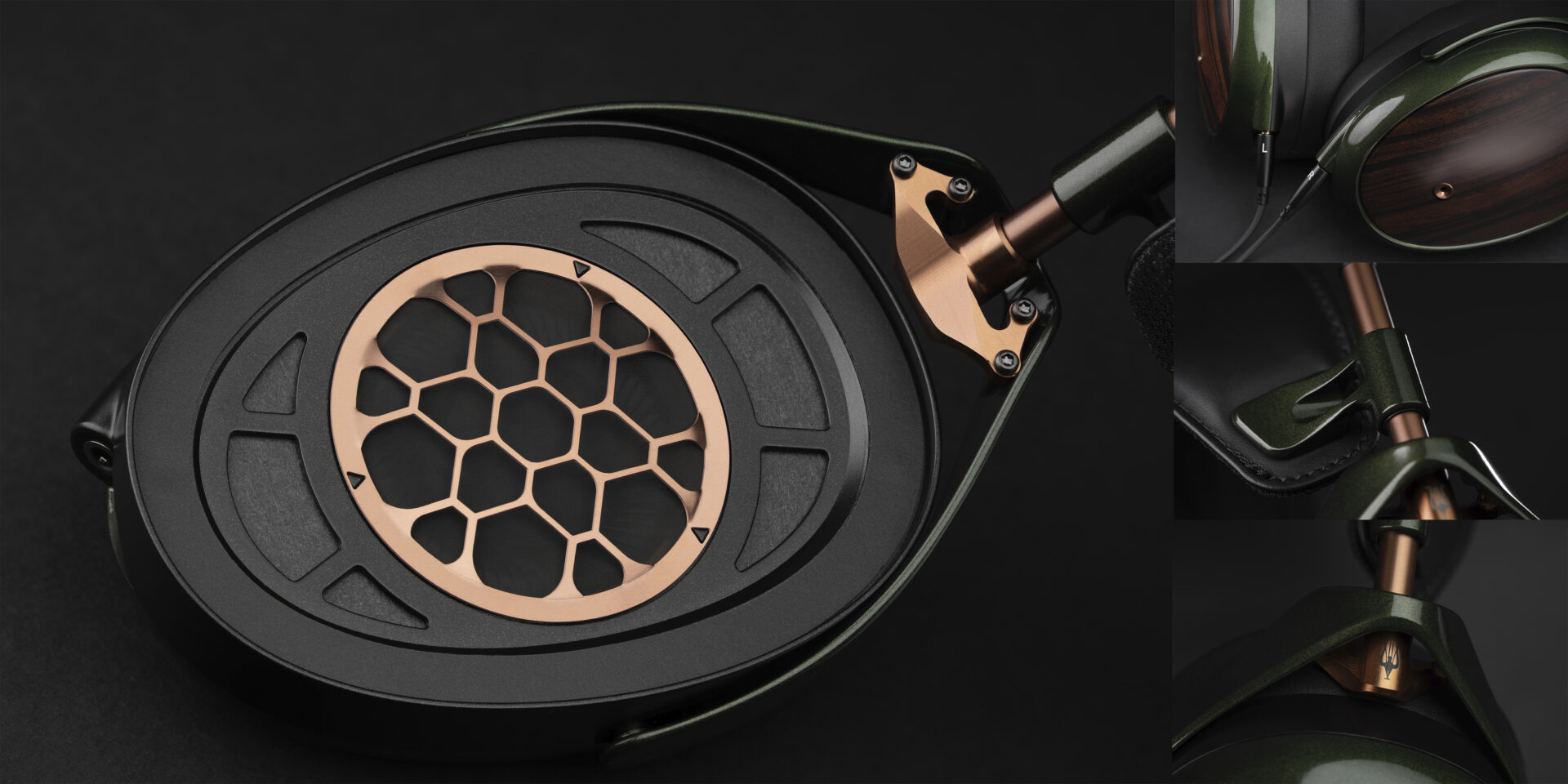
Distinguished by the green color of its ear cups, covered with natural Macassar ebony wood on the sides, the Strada maintains the brand’s commitment to comfort. To achieve this, it offers ear cups made of fine leather on the outside and Alcantara on the inside, which are detachable and therefore very easy to replace thanks to a magnetic connection to the ear cup.
A small metal rod connects the ear cups on each side to the headband, which has a fabric lower section and a symmetrical design with four shock absorbers, designed to limit pressure on the top of the head. The magnesium frame reduces the weight, bringing the total weight of the headphones to 332 g, excluding the cable.
The 50 mm diameter dynamic transducer is derived directly from the recent 109 PRO open model, slightly revised to suit a closed design. The central dome, made of cellulose composite, is reinforced with carbon fiber.
The dome contour is made of a semi-crystalline polymer coated with beryllium, applied by physical vapor deposition (PVD).
The structure of the membrane is reinforced by grooves around the entire circumference, positioned at a 45.5° angle to the central part, in order to provide the fastest and purest sound response possible. A copper-zinc alloy contour allows for precise maintenance of the diaphragm with the chassis.
With an impedance of 50 Ω, the Meze Strada offers a very wide frequency response from 5 Hz to 30 kHz and a sensitivity of 111 dB. The two 1.8 m OFC copper cables covered with Kevlar are also easily detachable. They connect to the headphones via two 3.5 mm jacks, the first with a 4.4 mm balanced jack and the other with a 3.5 mm unbalanced jack, combined with a 6.3 mm adapter. Available now, we will be testing these headphones soon. They retail for 799 €.
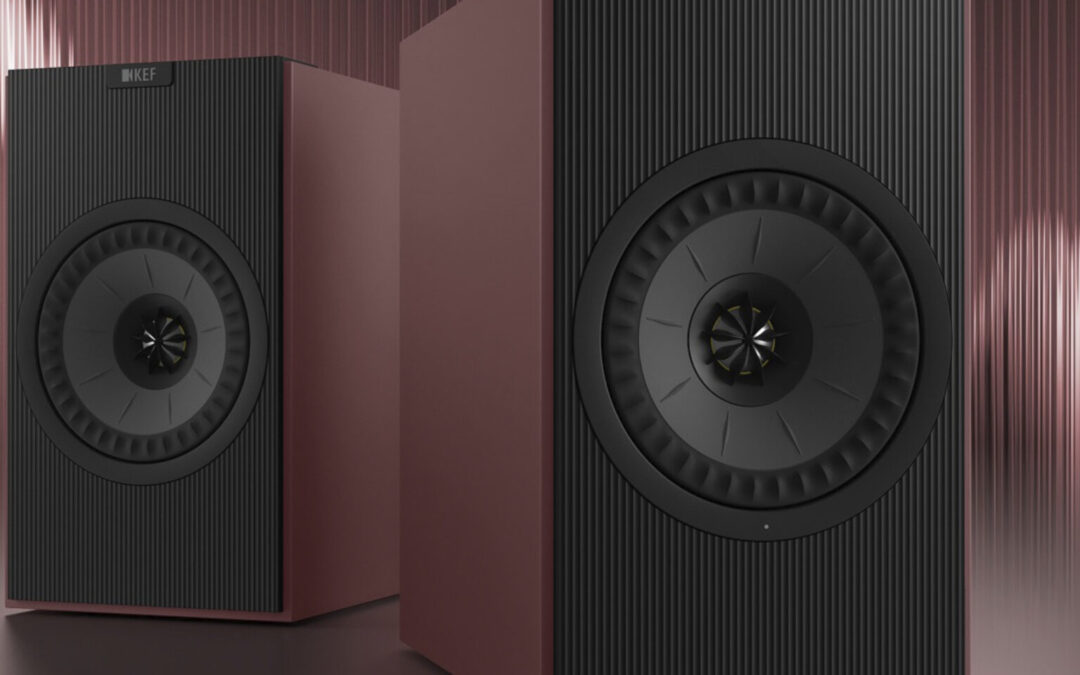
With the Coda W, KEF honors its 1970s model, which has been refined over more than thirty years, while making its connected technology even more accessible.
A pioneer in the connected hi-fi speaker market since the launch of the LS50 Wireless (test VU#10 FR), which later became the LS50 Wireless II (2 499 €) with the addition of the Meta chassis, KEF has since expanded its range. First upwards with the LS60 Wireless floorstanding speaker (5 499 €), then downwards with the more compact LSX, which also became the LSX II (1 249 €). More recently, this model was simplified to bring the LSX II LT version below the one thousand mark (999 €).
Since the end of the last year, a new pair of mid-sized speakers, the LS50 Wireless II and LSX II, are entering the fray, but at an even more affordable price of 899 €. Available in five colors—red, gray, green, blue, or black—the Coda W retains the principles of the other connected models, but without Wi-Fi and based solely on the latest generation Bluetooth 5.4 aptX Adaptive and Lossless module.
However, the wired connections available on the primary speaker remain extensive. Not only are there digital connections with HDMI eArc for connecting to a home theater system, an optical jack, and a USB-C port, but there are also analog connections with an RCA input and an RCA phono input for connecting a turntable (with unspecified input impedance, which should only affect MM cartridges).
As you might expect, the speaker technology remains the patented Uni-Q coaxial design. In this case, it is the 12th generation with a 25 mm (1’’) aluminum dome for the central tweeter and a 130 mm (5.25″) magnesium-aluminum alloy cone for the mid-bass. This speaker offers a response range of 41 Hz to 20 kHz and can be supplemented by a subwoofer thanks to its RCA Sub output.
Screenshot
A DSP based on the proprietary Music Integrity Engine patent allows for optimal frequency tuning, combined with dual 100 W amplification per speaker, divided between 30 W for the tweeter and 70 W for the midrange and bass frequencies. As with the other models, touch controls are available on the top of the master speaker, although the simplest option is to use a smartphone or tablet. A remote control is also included with the package.
Although described as “wireless” as is always the case with connected models, these speakers still need to be plugged into the mains via the primary speaker, then connected to the secondary speaker using a C-Link cable. A 3 m version is included with the pack, while the 8 m version is sold as an optional extra for 59 €. And if you don’t want to place the Coda W on a shelf or piece of furniture, dedicated SQ1 stands are also available, priced at 299 € per pair.
We’ll tell you more as soon as we’ve had a chance to listen to the products in one of our listening rooms!
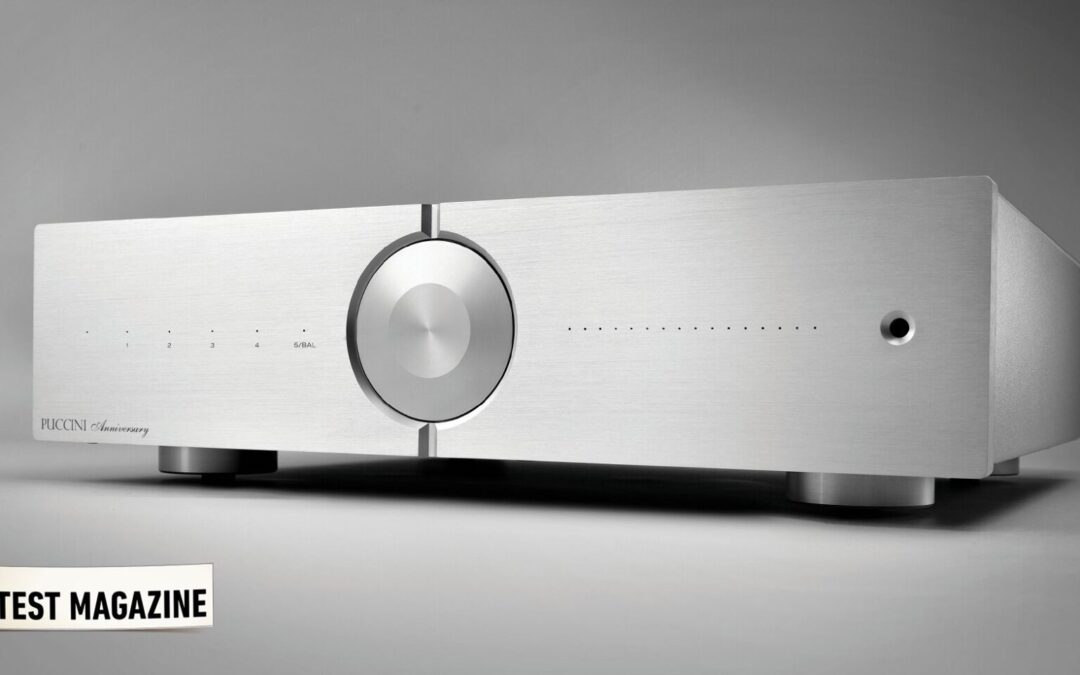
It has already been 20 years since the Italian designer of audiophile-quality electronics introduced the Audio Analogue Puccini Anniversary. The first piece of equipment produced by Audio Analogue, the Puccini also made its mark on the world of high fidelity by quickly joining the very exclusive club of equipment considered to be the benchmark in power amplification. Still in the catalog and regularly revised, the Puccini Anniversary is more than ever an amplifier to be reckoned with.
The Puccini has a little secret that enables it to deliver such high performance. It lies in the very structure of its power stages and their operating principle. The Audio Analogue Puccini is part of the extremely small family of power amplifiers without negative feedback. This idea emerged in the Airtech laboratories.
While some may consider this a minor design detail, the impact of this choice on sound reproduction is far from insignificant. This absence of negative feedback, also known as “zero feedback” architecture, significantly reduces the amplifier’s sensitivity to the type of load, or its behavior, that it is designed to drive.
This eliminates the risk of oscillation, as well as the appearance of resonance peaks in the highest frequencies or saturation of the input stages. All of these factors guarantee sound reproduction that is free from coloration or distortion.
However, this choice of a structure without counter-reaction is not enough to give the Puccini its exceptional performance. Audio Analogue has also worked hard to lower its output impedance so that it can handle even the most delicate speakers and those with the highest current requirements. To achieve this, its output stages feature a triple push-pull on each channel. The same applies to distortion reduction. On the Puccini, it reaches the limits of what is measurable. Finally, the power supply uses devices that guarantee the Puccini’s excellent immunity to external electrical interference.
It should be noted that Audio Analogue has been particularly generous in the design of this power supply. A 700 VA toroidal transformer forms its heart. This allows the push-pull power stages to express themselves fully, even when the most extreme dynamics occur.
However, in order to convey energy between the power supply and the output stages while taking full advantage of the most intense current management capabilities, it is still necessary to avoid losses in the amplifier’s internal wiring.
To meet this requirement, the Puccini features internal wiring designed around 7N purity OCC solid copper conductors.
Similarly, all printed circuit boards feature gold-plated copper tracks that are twice as thick as those found in standard circuits, in order to improve electrical conductivity. Finally, as is traditional in high-quality equipment, the Puccini adopts a dual-mono internal architecture. Each channel has its own circuitry, which significantly limits their interaction.
The Puccini has high-quality connectors for connecting to other components in the system. On the input side, it is directly compatible with the highest quality sources as it is equipped with an XLR input. For more conventional components, there are four dedicated line-level analog inputs on RCA connectors.
These connectors are directly connected to the electronic boards and the desired source is selected via relays. It is worth noting that the Puccini’s volume control uses very high-quality Analog Devices potentiometers. For speaker connections, Audio Analogue has opted for pairs of high-quality, generously sized screw terminals that can accommodate both thick cables and banana plugs or spade connectors.
Finally, the Puccini comes in an elegant, minimalist case. Its front panel is made from a 14 mm thick solid aluminum plate. Although the only visible control appears to be the volume control, the Puccini is designed to work in perfect harmony with the components it is connected to.
For example, its volume control has four selectable scales. This makes it possible to adjust its progressivity according to the efficiency of the speakers or your listening habits. Similarly, the brightness of the LEDs indicating the input in use is adjustable. They can even be completely hidden.
The set-up of the Audio Analogue Puccini Anniversary
The Puccini Anniversary’s overhead line should not obscure its weight of almost 16 kg. Therefore, a rigid support is essential. Its particularly comfortable available power will allow it to easily power a wide range of speakers in comfortable or even spacious environments.
The sound of the Audio Analogue Puccini Anniversary
There is no doubt that the designers of this Italian brand have a particular sound in mind, and it is in the realm of elegance and refinement that we find it. With many complex musical messages, the Puccini Anniversary unfolds its modulation with an innate sense of fluidity.
It seems to play with all the sonic pitfalls thanks to a clear and defined vision of the different melodic lines that make up the varied excerpts we were able to submit to it. This beautiful acuity ensures its readability at all times. Precise without being inquisitive, exhaustive without being robust, it excels in the difficult exercise of balancing lightness and density.
However, it delivers on low notes with a firmness reminiscent of its predecessor, the Maestro, albeit slightly less so. The three-dimensional space recreated by the Puccini Anniversary allows you to appreciate a deep horizon where the sections are well defined. Some listeners may prefer a more full-bodied sound, but the Italian amplifier has chosen a more refined approach to support its message.
This allows it to always be relevant, never excessive, and always in control. And to corroborate this philosophy, it strives to offer a smiling face to the musical phrase it reproduces, bathing it in light.
Our conclusion
Despite its age and long history in the catalog, the Puccini Anniversary is an amplifier that is still very much relevant today. There is no reason why the great qualities it displayed several years ago should have faded with time, proving that a well-designed and well-made product can stand the test of time.
This is fortunate and reassuring for consumers like us. And while we may regret that its price has risen, the same can be said of many other devices, especially at a time when price increases have unfortunately become commonplace. For all these reasons, we consider this amplifier to be still relevant today and believe that consumers are right to include it in their selection of integrated amplifiers in this price range.