Impulse recently announced the next two titles in its Verve Vault series, to be released in March. After eight previously released titles, including Antonio Carlos Jobim’s sublime The Composer Of Desafinado, Plays, the label will release Elevation (1974) by legendary saxophonist Pharoah Sanders, in which he expands his vision of spiritual jazz in an album recorded during two concerts and a studio session that strikes a balance between ecstatic expression and concentrated interaction between the musicians.
The other release is Gábor Szabó’s Spellbinder (1966), which introduced the Hungarian guitarist to a wider American audience with a hypnotic blend of powerful grooves and modal jazz, Eastern European folk influences, and pop textures typical of the 1960s. Both vinyl records are already available for pre-order.
New releases from Craft
Craft Recordings continues to add to its famous Jazz Dispensary series with the release of a post-bop classic, Joe Henderson’s cult album Tetragon. Mastered from analog tapes, this is the album on which Henderson continued to develop his sound in the field of post-bop before venturing into spiritual jazz. He is accompanied by a world-class ensemble including Ron Carter, Jack DeJohnette, Kenny Barron, Louis Hayes, and Don Friedman. Needless to say, we can’t wait to hear these gems on our turntables.
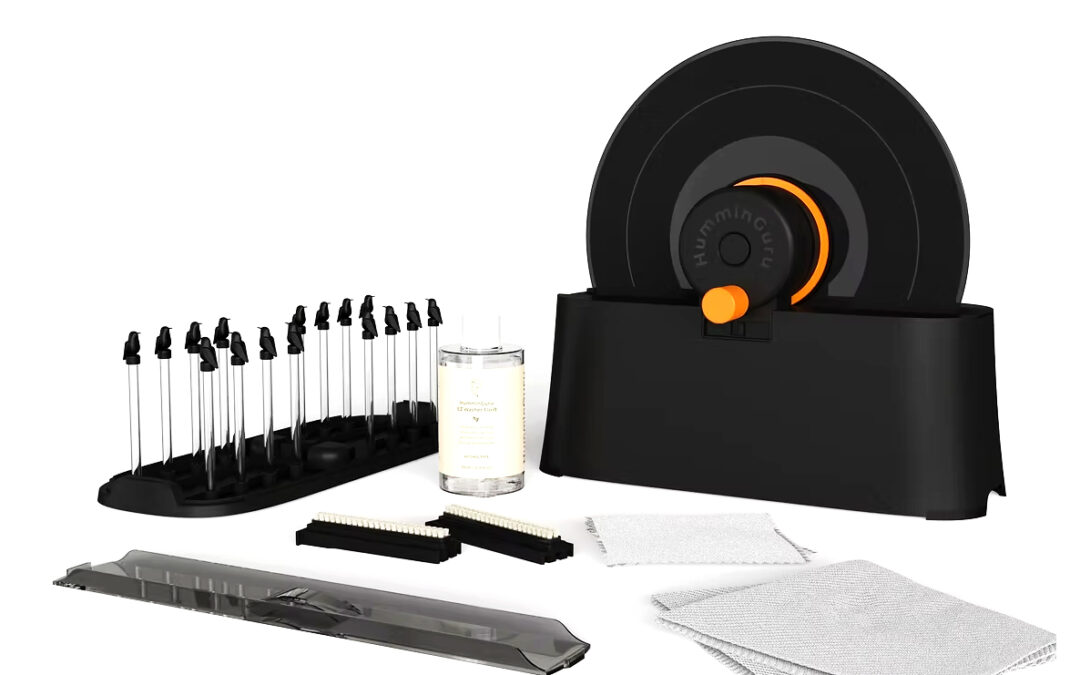
Humminguru, which has been making a name for itself in recent years with its affordable ultrasonic vinyl cleaning machines, is now making cleaning even more affordable, provided you do everything yourself.
The EZ Washer consists of a tray that you fill with demineralized water and, ideally, a vinyl cleaning solution such as the brand’s EZ bottle. Then, simply clamp the vinyl between the two plastic parts of the clamp supplied with the machine, onto which a small orange handle fits.
Goat hair brushes are integrated into the machine. Once the clamp is around the vinyl, simply insert it into the top of the machine and turn it about ten times in each direction by hand. You can then remove the clamp and place your vinyl record on a drying rack with small rods, topped with little rubber penguins that came with the Humminguru Nova (VU#56 FR; We Keep).
It should also be noted that the clamp protects the entire inside of the records, including their labels, with rubber, and can handle all vinyl records with a thickness of 1 to 3 mm, which is most of them.
More tedious than an automatic machine, especially if you’ve added the fountain that came out at the end of last year (The Toy; VU#63 FR; We Keep), the EZ Washer has the big advantage of offering you an ergonomic and economical solution for washing your black discs, as it retails for 129 €.
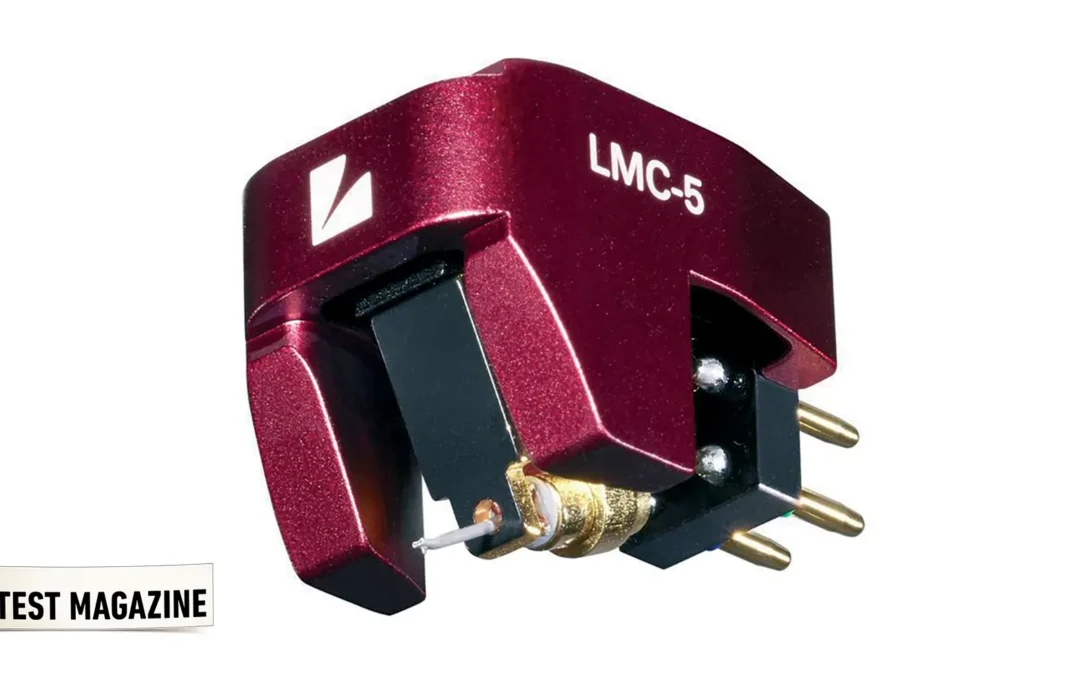
After introducing audiophile-quality cartridges with globally recognized performance more than forty years ago, Luxman has finally announced a new addition to its lineup. Named the Luxman LMC5, this cartridge is the result of two years of research. True to the Luxman spirit, it aims to be one of the most exceptional products on the market and to take over from the famous LMC1 and LMC2 cartridges, which appeared on the market in 1981 and 1982 respectively.
Jeff Sigmund, president of Luxman America, does not hesitate to declare:
“Our LMC5 cartridge is designed to satisfy the most demanding music listeners by offering them unparalleled purity of reproduction. It is the careful and uncompromising choice of materials, the creation of multiple prototypes, and the use of extensive listening tests that have enabled us to achieve this result. We are therefore committed to excellence. The resulting listening quality must be tested to be fully appreciated.”
Like the vast majority of high-quality cartridges, the LM5 is based on a moving coil (MC) architecture. The coils are made of 30-micrometer diameter enameled urethane wire. This is the thinnest wire of this type currently available on the market. They are wound symmetrically for optimal channel separation and bathed in an intense magnetic field generated by a cross-mounted iron core combined with a powerful BH20 samarium-cobalt magnet.
Finally, the stylus is based on a Shibata diamond stylus. It should be noted that this moving assembly, which forms the heart of the LMC5 and gives it its character, has a very low mass. This unique feature allows it to deliver a particularly wide frequency response in the extreme high frequencies, with tests carried out by Luxman confirming a frequency response of up to 3 kHz, which is remarkable for a phono cartridge.
THE SOUND OF THE LUXMAN LMC5
At Luxman, the concept of listening comfort is paramount, and to be perfectly honest, this is a reassurance and excellent news for us. We have never been disappointed by the tonal balance of this manufacturer’s products. Its beautiful phono cartridge offers a listening experience that is entirely in line with the company’s philosophy. Here, finesse, subtlety, and tranquility take precedence.
To paraphrase Baudelaire, the LMC5 brings you luxury, calm, and pleasure… Luxury, first and foremost, because this cartridge’s harmonic palette is extremely rich, with dense bass, beautifully structured midrange, and very fine, pure, unadorned treble. Calm, because the LMC5 admirably masters dynamics and knows how to alternate between strong and soft moments without any lag or inertia.
Pleasure, finally, because its melodic tracking is so elegant that it allows you to follow the most complex pieces with a wonderful feeling of simplicity. Add to this the fact that the LMC5 is just as comfortable with acoustic music as it is with a 1960s jazz trio or an opera, and you’ll understand that it is not in the least restrictive.
OUR CONCLUSION
Until now, we had only limited experience with Luxman’s purely analog components. It was therefore with immense satisfaction that we were able to thoroughly test this cartridge, which we warmly recommend. At its price point, it is a truly interesting alternative to the big brands already well established in this highly competitive market. Above all, try it out at your favorite dealer; you are likely to make a discovery that is as obvious in terms of sound intensity as it is in musical authenticity.
Author(s): Pierre Fontaine
Technical Sheet: Luxman LMC5
Origin: Japan
Price: €2,190
Dimensions: 17 x 18.3 x 21.3 mm (without terminals)
Weight: 8.5 g
Internal impedance: 4.7 Ω (1 kHz)
Recommended stylus pressure: 2.1 to 2.3 g (2.2 g standard)
Output voltage: 0.4 mV (1 kHz and 3.54 cm/sec.)
Frequency response: 10 Hz to 3 kHz
Channel separation/balance: 28 dB (1 kHz)
Recommended load resistance: 40 Ω or more
Recommended load resistance with step-up transformer: 2.5 to 10 Ω
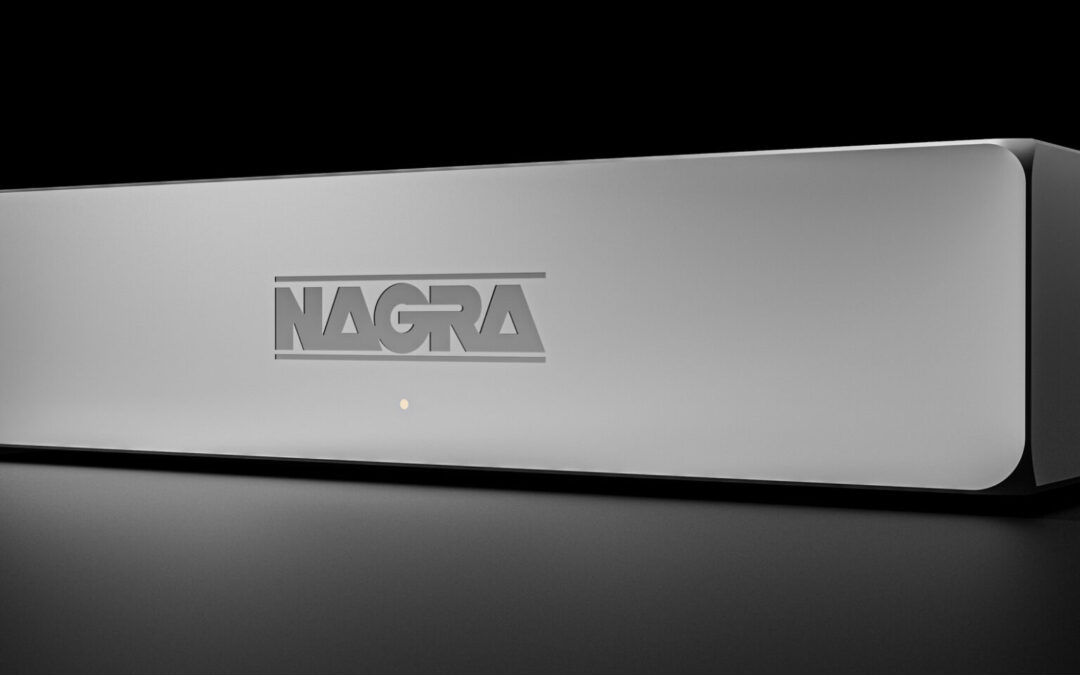
After focusing on high-end products over the last decade, with the launch of its HD line followed by its Reference line, the renowned Swiss manufacturer seems to have turned its attention more recently to a more affordable series.
Although the Preamp II-S has demonstrated in recent months, with the simultaneous launch of a new Series II, that the brand has no intention of abandoning the very high end, the Compact series now places it in a more accessible category, albeit still an elite one.
Introduced by the Streamer, the Compact series has expanded with a Phono and then a PSU. And as it is a true Nagra series, it also offers a VFS damping platter. Today, the Player is added to the range.
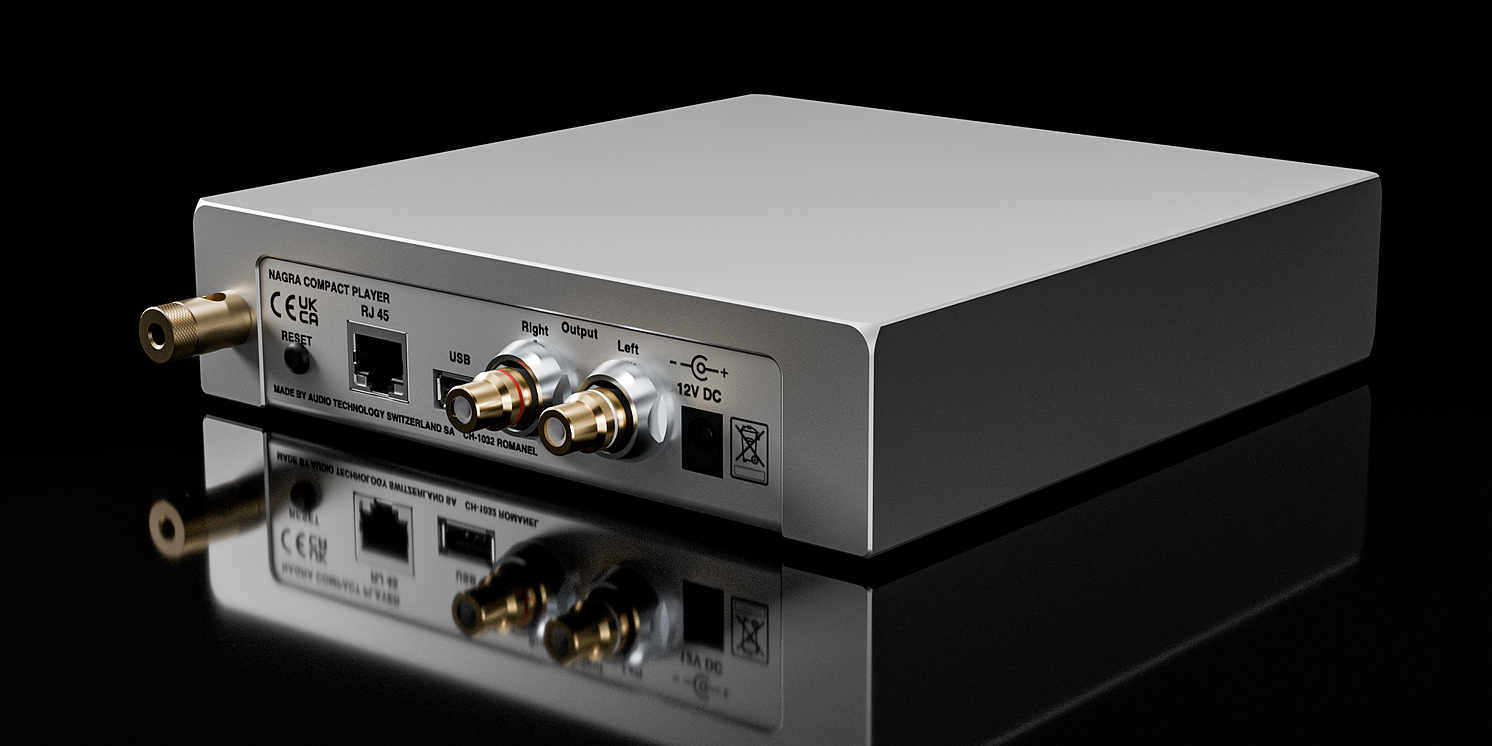
Still in the same very discreet, elegant aluminum chassis, reduced to its simplest form on the front panel and measuring 18.5 cm by 16.6 cm with a height of only 4.1 cm, the Compact Player adds, as predictable, a DAC to the Streamer’s network card. Based on a proprietary NADM (Nagra Audio Digital Module) digital module, this small device reproduces the analog signal using a dual-mono circuit topology.
Exclusively equipped with RCA output terminals, it adds USB-data and RJ45 inputs so that it can be used solely as a streamer, without the possibility of integrating its DAC with another digital source. However, a ground terminal shows the level of the product, to be connected to the mains via a small 12V plug, which can accommodate the external power supply of the series, the Compact PSU, if necessary. It supports files up to DSD256 and PCM 384 kHz/32-bit, compatible with all current UPnP streaming platforms, as well as Roon, Audirvāna, JPlay, and Qobuz Connect.
Available now, the Nagra Compact Player retails for CHF 5 500 or 6 500 €, depending on which side of the Alps you’re on, and $7 500 if you are on the other side of the Atlantic. This makes it 1 500 € more expensive than the Compact Streamer, but with the advantage of directly converting the signal to analog for connection to an amplifier, making it the main source for your system.
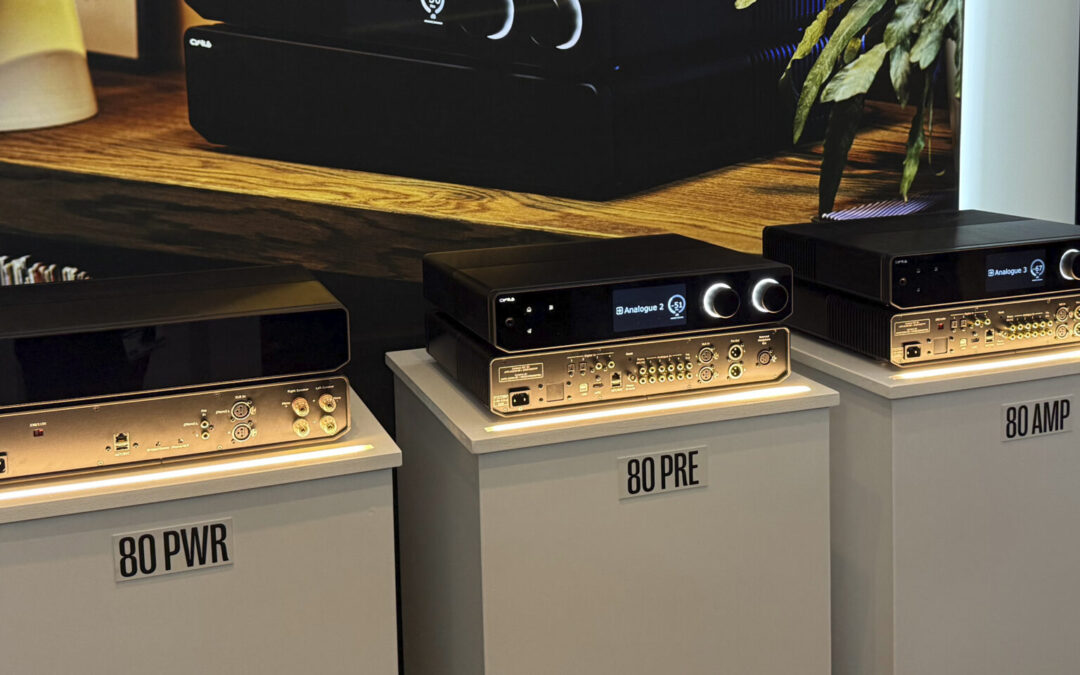
Secretly unveiled to the press a few months ago, British manufacturer Cyrus Audio’s 80 Series is now being revealed to the public at the Bristol Hi-Fi Show. Retaining the new design of its 40 series but switching to full-size chassis, Cyrus is releasing a new series designed to sit at the top of its catalog. With three models for its launch, this series will begin with the official release of the amplifier-streamer in March or April, before expanding with a preamplifier-streamer and a power amplifier.
Cyrus 80 Streamer Amplifier While the Cyrus 40 AMP directly integrates a DAC and an MM phono module, the 80 series amplifier is much more of a high-end all-in-one, gaining a streamer function and an MM/MC phono module. More powerful, it goes from 100 W to 150 W per channel under 8 Ω in class A/B and takes advantage of its larger chassis to directly integrate a power supply, similar to the one available separately in the 40 series with the PSU model. Its 5″ TFT screen and front panel with angled corners are similar in design to those of the 40 series, but wider and with two large knobs instead of one. The DAC remains the same as that already found in the 40 series electronics, powered by the Sabre ES9039Q2M chip, with support for files up to 192 kHz/24-bit. However, the streaming module eliminates the need for a separate network player, and the phono module is said to be as good as that of the Cyrus 40 Phono, which was released shortly after the other four models in the series.
Cyrus 80 Streamer Preamplifier Identical to the integrated amplifier but without the amplification section, the streamer-preamplifier has the same components for volume control, digital and analog inputs, BluOS streaming function, and DAC. It has XLR and RCA outputs for connection to a power amplifier and is said to be slightly better than the 80 integrated amplifier in terms of signal management, as its power supply is almost the same, but concentrated solely on the preamplification and digital sections.
Cyrus 80 Amplifier To complement either of the two devices mentioned above, the 80 series amplifier will be added to the catalog at the same time as the preamplifier. More powerful than the integrated amplifier, delivering 200 W per channel into 8 Ω, it can also be bridged for use on a single channel, delivering 300 W of mono power. Before attempting to use it in a dual configuration, we will be interested in testing it and adding it to the amplifier as part of a horizontal bi-amplification setup.
CYRUS_Jet serie 80
European and UK prices are not yet final, but we will tell you more as soon as we have the products in our hands!