Derived from the HD 500, the HD 505 Copper is the latest audiophile headphones from Sennheiser, the first to be launched in the German brand’s 80th anniversary year.
The HD 505 Copper shares a large part of the response curve with the HD 600 and HD 599 SE, and surpasses them at the extremes. Available only in black, these dynamic wired open-air headphones add a fine copper-colored edging around the detachable ear pads, a finition also found on the bottom of the synthetic leather headband.
Weighing 237 grams, this new model retains the option of easily removing the 3.5 mm jack cable connected to the left ear only. With a length of 1.80 m, this cable can then be easily modified or replaced by an identical model or one with a 6.33 mm jack. The 120-ohm impedance transducers, manufactured in Ireland, are claimed to respond over a frequency range of 12 Hz to 38.5 kHz, i.e. above the range measured by the human ear (approx. 20 Hz to 20 kHz). They are protected by external metal mesh earpieces.
Slightly more expensive than the HD 599 SE (219.99 €), the HD 505 Copper remain within reasonable bounds compared with the more audiophile HD 800 S (1 799 €), and more affordable than the HD 660S2 (599.99 €), since it is launched at 279.99 €.
Well-known for its WiiM Amp, priced at just 369 €, a streamer- amplifier with 2 x 60 watts of Class D power at 8 ohms, doubled at 4 ohms, the electronics manufacturer Wiim has now added the Vibelink Amp to its catalog.
Launched at the same price as the Amp version, the Vibelink Amp does away with all streaming (and therefore Bluetooth) in favor of increased power and a better DAC chipset. While the Wiim Amp features a Sabre ES9018 K2M chip, upgraded on the Amp Pro version (459 €) by the ESS ES9038 Q2M, the Vibelink goes even further with the brand-new ES9039 Q2M. Still only integrable in optical and coaxial, the converter can only be used for files to formats up to PCM 192kHz/24bits, and no longer supports USB data or HDMI, which were available on the WiiM Amp.
Still structured in Class D around a TI TPA3255 chip, the Vibelink Amp sees its chassis reinforced by two aluminum plates, while its amplification is developed by seven TI OPA 1612 OP amp chips, for power increased to 100 watts per channel at 8 ohms and 200 watts at 4 ohms. With a single pair of RCA terminals, it can integrate an analog source, but is primarily designed for connection to a streamer via its digital inputs. Sober in presentation, like all the brand’s products, the Vibelink is better finished than the Amp, but can only be connected to speakers via banana cables, as the speaker terminals no longer protrude as on the classic version, but are integrated directly into the chassis.
As already mentioned, the price of the Vibelink Amp is the same than the one of the WiiM Amp, at 369 €, leaving the buyer with the choice of opting for an integrated streamer, or a better DAC and more power.
Now a well-known audiophile sharing software, Audirvāna adds the British Presto Music platform to its catalog of streaming applications (Qobuz, Spotify, Tidal, etc.).
Specializing in classical music and jazz, Presto Music stands out for a catalog based exclusively on these two categories, and obviously a high level of quality for streamed files (up to 192 kHz/24bits in Hi-Res). At 10.99 € per month in its first version, Presto Music is still rarely integrated natively by streamer brands and on their parent apps. Going through Audirvāna means that all compatible network players and transports (either through direct Audirvāna integration, or simply UPnP) can now receive files from the British platform.
With more than 200 000 albums, Presto Music also allows you to buy and download albums, in addition to taking particular care to integrate their librettos, often absent from other platforms, which are less rigorous in offering these documents of interest above all to classical music lovers. We wish these partners every success in their new collaboration!
Rega’s best-seller for over three decades, the Brio integrated amplifier has been modified many times, sometimes without changing its name, before becoming the Brio R in 2011.
Now, at the start of 2025, it’s embracing all these changes by becoming Brio Mk7, making it clear that it’s already in its 7th generation! Still in shoebox format – dimensions that we recently mentioned as being particularly popular in France, although still maintained by a few British manufacturers such as Cyrus – the Rega Brio Mk7 manages to keep a large power supply in its small black aluminium chassis, filtered by two imposing capacitors. Its amplification circuit enables it to develop 50 watts at 8 Ω (the Brio 1 was only 30W) and 73 watts at 6 Ω, without indication of power at 4 Ω (probably around 90W).
In terms of preamplification, it offers three RCA inputs and one phono input (MM only), so you can connect a turntable directly to it without needing to invest in a phono preamp. In a sign of modernity, these four analogue inputs are complemented by two digital ones, thanks to a digital-to-analogue converter (DAC) capable of reading files in formats up to 192kHz/24bits, which can be integrated into S/PDIF coaxial and Toslink optical cables. The sober front panel has not changed much from the previous version, but it does allow you to select and indicate inputs and sound volume (functions found on the remote control), and offers a practical 3.5mm headphone socket.
Proof that great hi-fi products can still be made at moderate prices: the Rega Brio Mk7 will be launched in 2025 at 1 050 € (£799) !
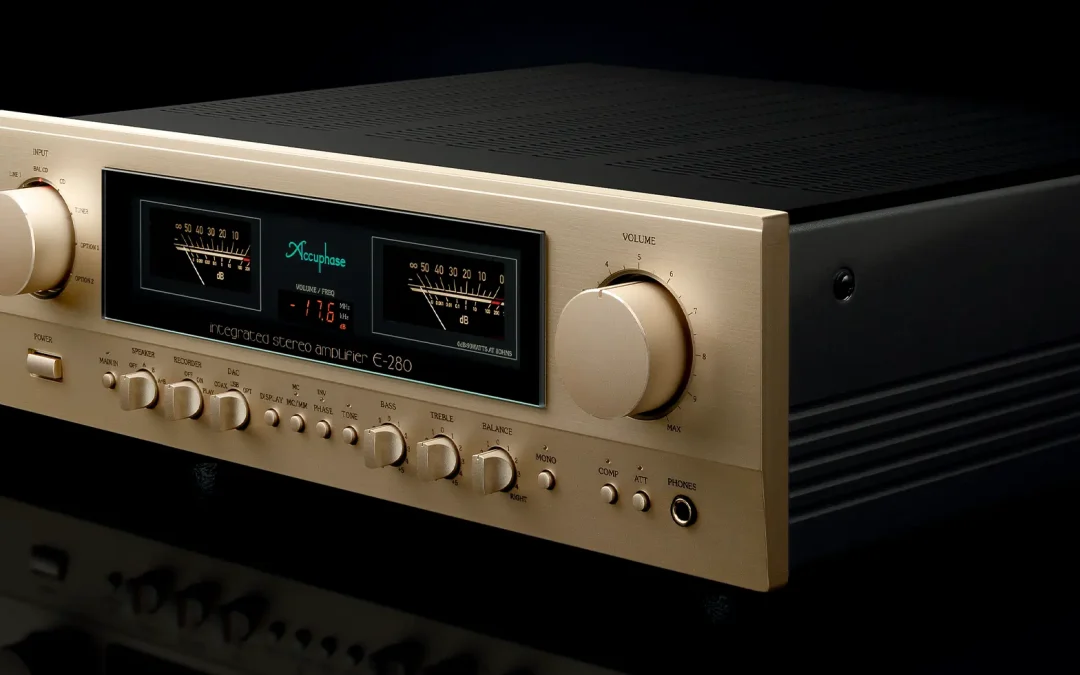
Accuphase recently warned that the two entry-level integrators in its catalogue would be replaced by a single one. This is now the case with the E-3000, but although we were rather expecting the E-280 chassis to be removed, leaving only integrated amplifiers with a trapdoor on the front-panel, as it is for the E-380 and all the other models from the Japanese manufacturer, it’s the opposite that seems to have been chosen by the engineers.
With 100 watts per channel at 8 ohms (and 150W at 4Ω), the E-3000 gains 10W over the E-280 and loses 20W over the E-380. The design of the front panel has been revised very slightly (some round buttons have become square) and the rear panel still offers the same number of RCA inputs (five in all) plus an XLR. Two pairs of speaker terminals are still available, very useful for bi-wiring or for wiring two different pairs of speakers. The internal circuit has also been reworked, using Mosfet again and improving the purely parallel structure (once you get past the power supply transformer, which is the same for both circuits).
Still very versatile, with its remote control (new RC-260 version) as standard, its pre out output or main in input for direct integration into the amplifier part, the E-3000 maintains the same signal-to-noise ratio levels as the E-280 (VU#38). At 5 990 €, it is 1 000 € more expensive than the previous entry-level amp and 1 000 € less expensive than the E-380. No doubt relevant to the Japanese market, it now requires European listeners, more keen on models with a trapdoor, to invest a minima in an E-4000 (VU#46), at 9 290 €.