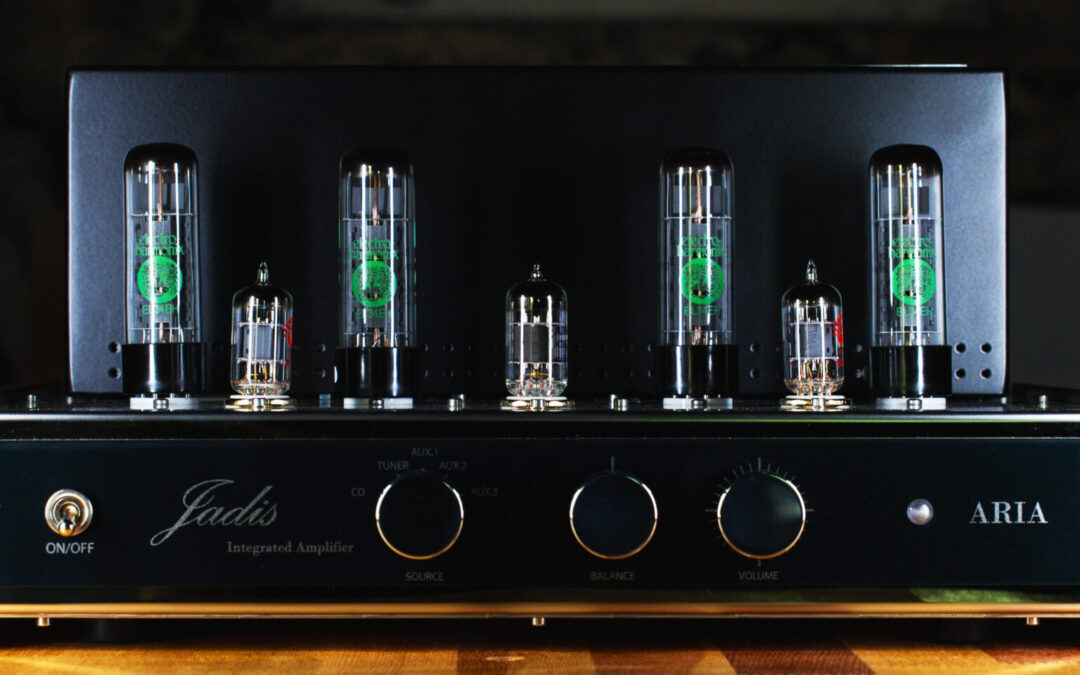
Discovered at the last Munich show, the new Jadis Aria integrated amplifier has a new design with a chrome front panel and lacquered wood sides.
Despite this new format, it remains faithful to the core values of the Languedoc-based company, with point-to-point wiring and proprietary transformers manufactured in-house. This amplifier operates with a single push-pull tube stage per channel and a tube preamplification stage. For the power section, you can choose between four EL34, KT88, or KT120 tubes, with the only power rating currently specified by the Carcassonne-based manufacturer being 30 watts into 8 ohms.
The preamplifier stage combines an ECC82 double triode with two ECC83 double triodes. Five inputs are available to connect a comfortable number of sources, selectable on the front panel using a knob identical to the volume knob on the right, and balance between the two. Entirely assembled at Jadis, the new Aria is available for pre-order now.
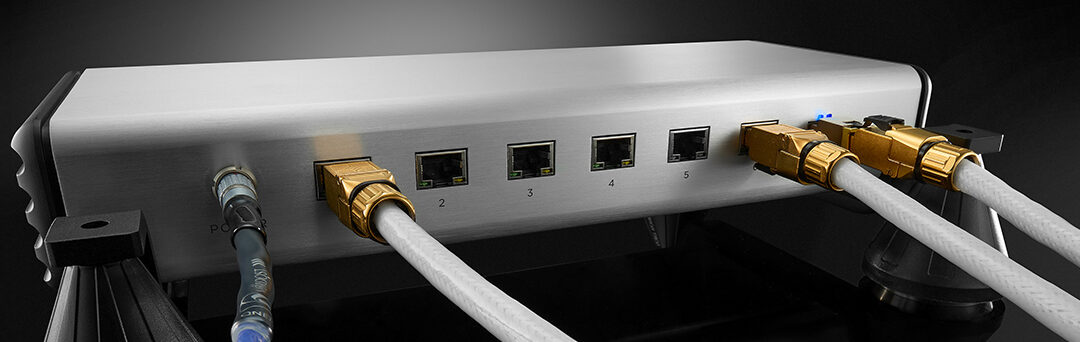
Among Nordost’s system enhancement products, the QNET switch appeared a few years ago, and could be upgraded by adding a QSource power supply. Today, the renowned American cable manufacturer’s catalog is expanding with the QNET7 version, which, as its name suggests, has seven Internet connection ports.
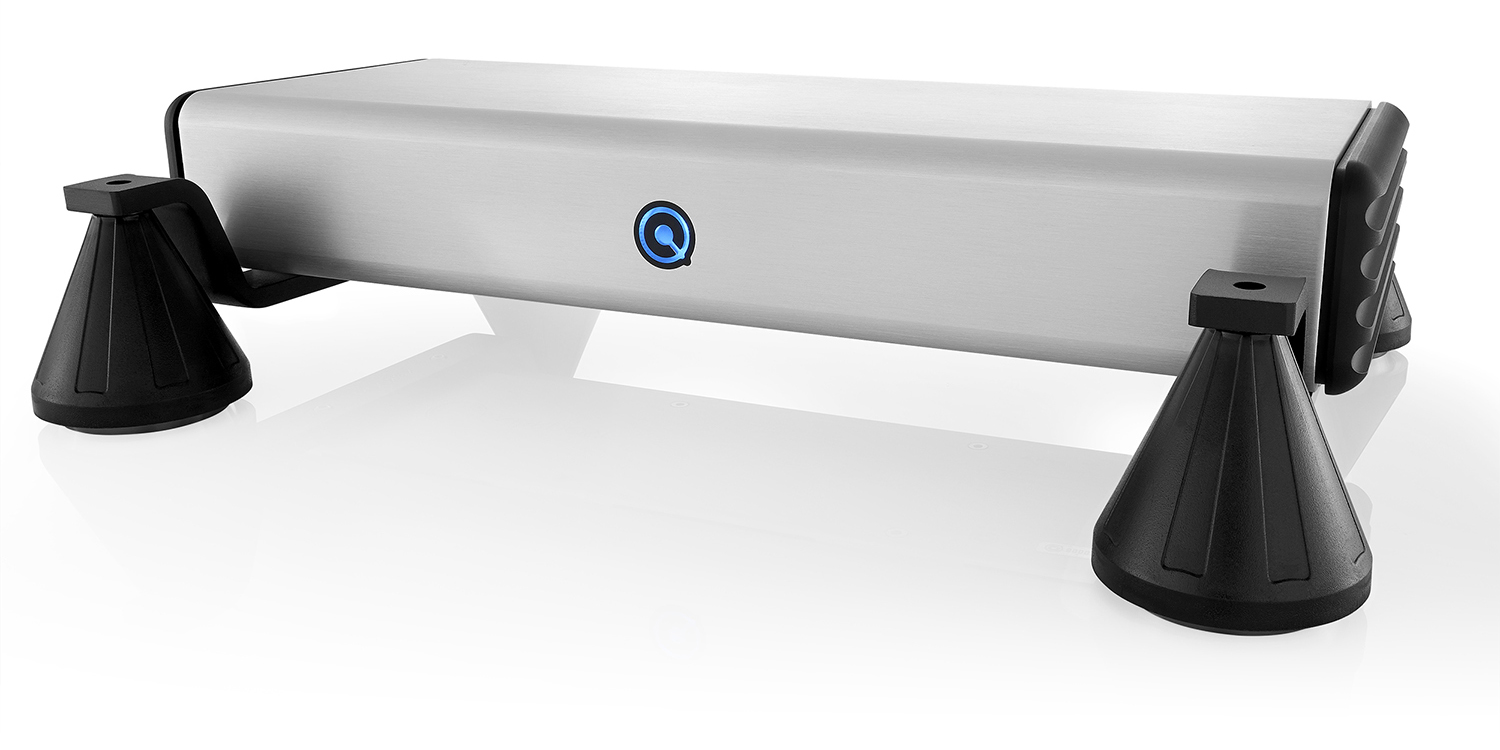
Moving away from the round shape of the QNET, the QNET7 features a rectangular chassis similar to the QSource, to which it can also be connected. Its RJ45 8P8C Ethernet ports 1 to 5 now offer the standard speed of 1000BASE-T (1 Gbps), while the sixth port remains at a more modest 100 Mbps. But to enter the modern era of new fiber streamers, the QNET7 adds a 7th SFP port. This makes it possible to exit the box via RJ45, enter the switch via this connection, and then exit via fiber, in which case there is no electricity in the optical signal, resulting in a drastic reduction in noise. Jitter is also minimized thanks to the device’s new circuitry.
Like other products in rectangular chassis, the QSource and especially the QB8 MkIII power strip, the QNET7 can also further reduce vibration with the addition of Stand Mount feet. By screwing them onto the underside in place of the rubber feet, four decouplers with ceramic balls and aluminum (AC), bronze (BC), or titanium (TC) bases can then be added.
We currently have a QNET, and we will also request a QNET7 to compare the sound quality of the two versions, in addition to testing the latter on its SFP fiber port. As the quality of the product suggests, the price obviously exceeds that of the smaller model, with the QNET selling for 3 700 € (3 799 $) and the QNET7 for 5 400 € (5 499 $).
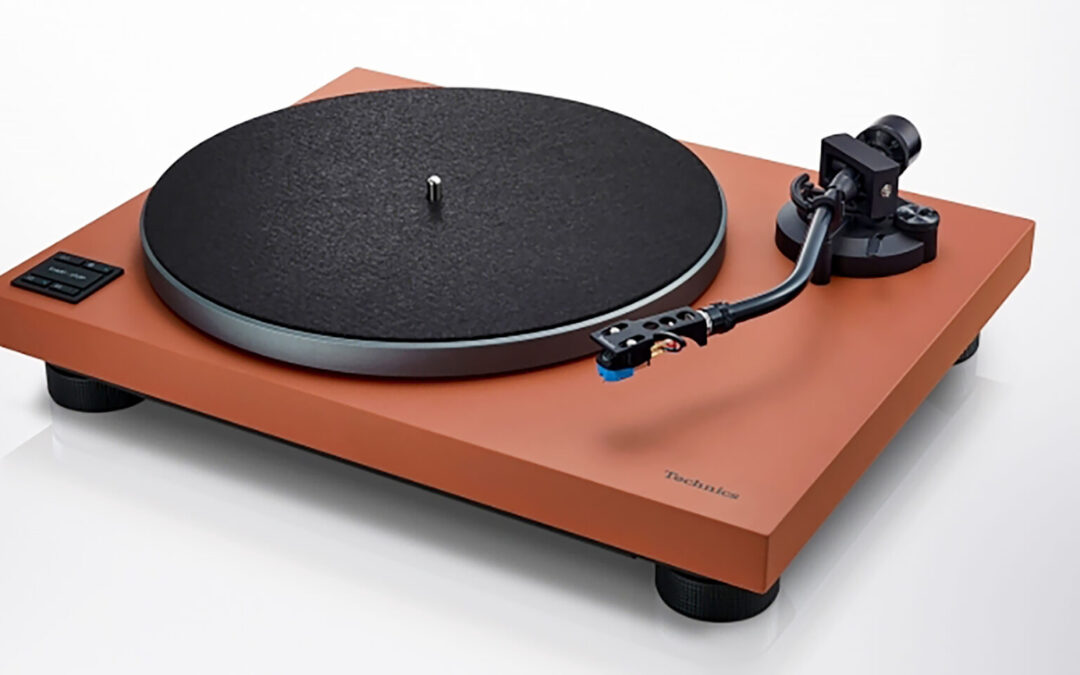
same MDF chassis, available in Terracotta, Light Grey), and Charcoal Black, as the SC-CX700 Bluetooth speakers.
The cast aluminum platter with mounted magnet rotates thanks to a direct drive motor with no ferrite in the core, while new feet help reduce vibration. The new tonearm has an S-shaped design and allows for the integration of a cartridge holder.
SL-40CBT In line with the trend for wireless turntables, the SL-40CBT is Bluetooth-enabled and can therefore communicate directly with the aforementioned speakers, or with any other Bluetooth amplifier or source, including headphones. It therefore has a built-in phono circuit, exclusively for playing moving magnet (MM) cartridges. Based on a rotation speed of 33 or 45 rpm for playing vinyl records, this turntable comes with a new Audio-Technica AT-VM95C cartridge from the series presented at the High-End show in Munich last May.
SL-50C With RCA cables and connectors for connecting to an external phono preamp, the second model features the same chassis, platter, motor, and tonearm, but adds 78 rpm speed and takes advantage of the extra budget saved by not including a phono card to upgrade to a higher-end cartridge, in this case an Ortofon 2M Red.
For the moment, these two turntables have been announced in the United States at $899 and they will be arriving in Europe very soon at a similar price in euros.
A few days ago, Verve Label Group and UMe announced the creation of “Verve Vault”, a new series of affordable (just under €30) fully analogue vinyl reissues featuring iconic jazz albums and little-known gems from Verve’s legendary catalogue.
The series will feature 180-gram vinyl records remastered from the original analogue tapes by the prolific Ryan K. Smith at Sterling Sound and pressed at Optimal. Starting on 10 October, “Verve Vault” will release two titles per month from various labels in the Verve family, such as Verve, Impulse!, Mercury, and many others. The series kicks off with two of the most sought-after albums in the catalogue: Dizzy Gillespie’s 1959 classic Sonny Side Up (featuring Sonny Stitt and Sonny Rollins) and Antonio Carlos Jobim’s 1963 debut album, The Composer of Desafinado Plays, which marked a turning point in the history of instrumental bossa nova. Both titles are available for pre-order now.
In November, Stan Getz’s “Focus” and Jimmy Smith & Wes Montgomery’s “The Dynamic Duo” will be released, followed in December by Max Roach’s “Percussion Bitter Sweet” and Archie Shepp’s “Four For Trane”. The year 2026 will open with the releases of two great singers: Dinah Washington and Blossom Dearie. Other titles will be announced shortly, but this new series from Verve already looks set for a bright future.
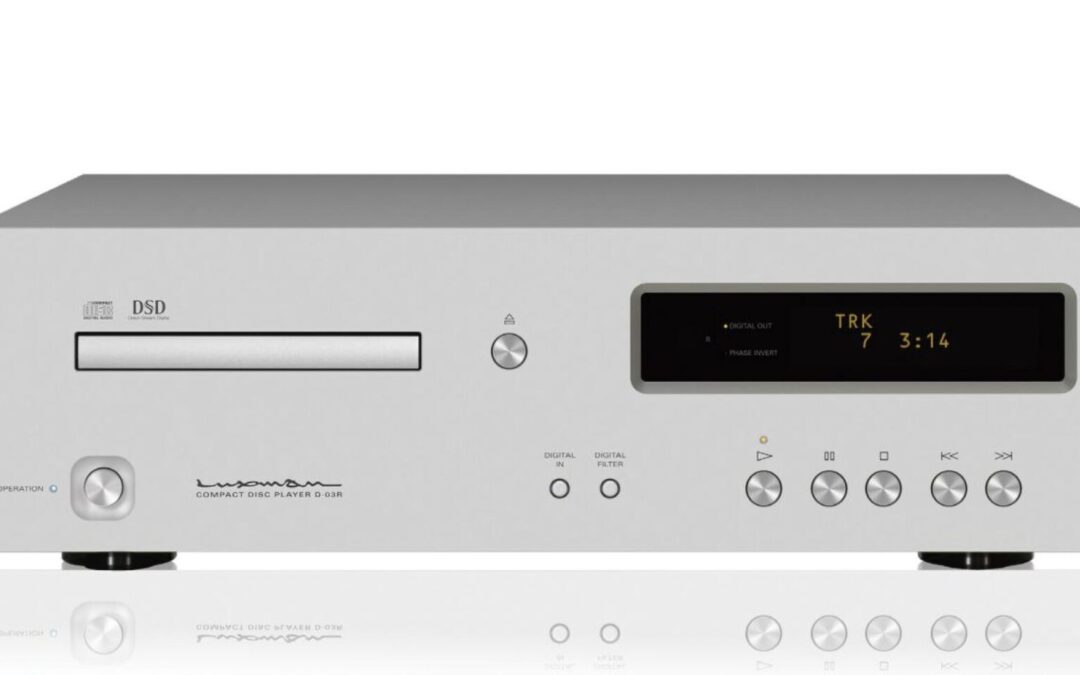
Unveiled in Japan at the beginning of the year, the Luxman D-03R arrived in Europe in early September, equipped with a power supply adapted to 220 V.
While the D-03x still used Texas Instrument DAC chips, the D-03R uses ROHM chips developed for Luxman, giving it a sound closer to that of the larger D-07X and D-10X models. In fact, it even incorporates a newer version of the BD34352EKV chip, used in mono for each channel, which guarantees support for PCM files up to 384 kHz/32-bit, DoP, and DSD512 (when using the USB input). The ultra-low phase noise clock has been redesigned, with jitter also controlled by a dedicated asynchronous transmission for the USB port and a high-precision integrated clock for the coaxial and optical ports.
The analog circuit features a symmetrical buffer circuit with four amplification units, as well as a more powerful power supply, with the DAC filtered by capacitors with double the power, from 3 300 µF to 6 600 µF. Gold-plated RCA terminals with an 18 mm pitch and Neutrik XLR terminals allow the CD player (you need to upgrade to the D-07X to play SACDs) to be connected to a preamplifier. Designed on a new chassis, with a revised mechanism on a 3.2 mm steel plate to better block vibrations, the D-03R comes with a new RD-28 remote control, which retains the numeric keypad for easier selection of CD tracks.
Weighing 13.2 kg, this new player is priced at 5 690 € in Europe.