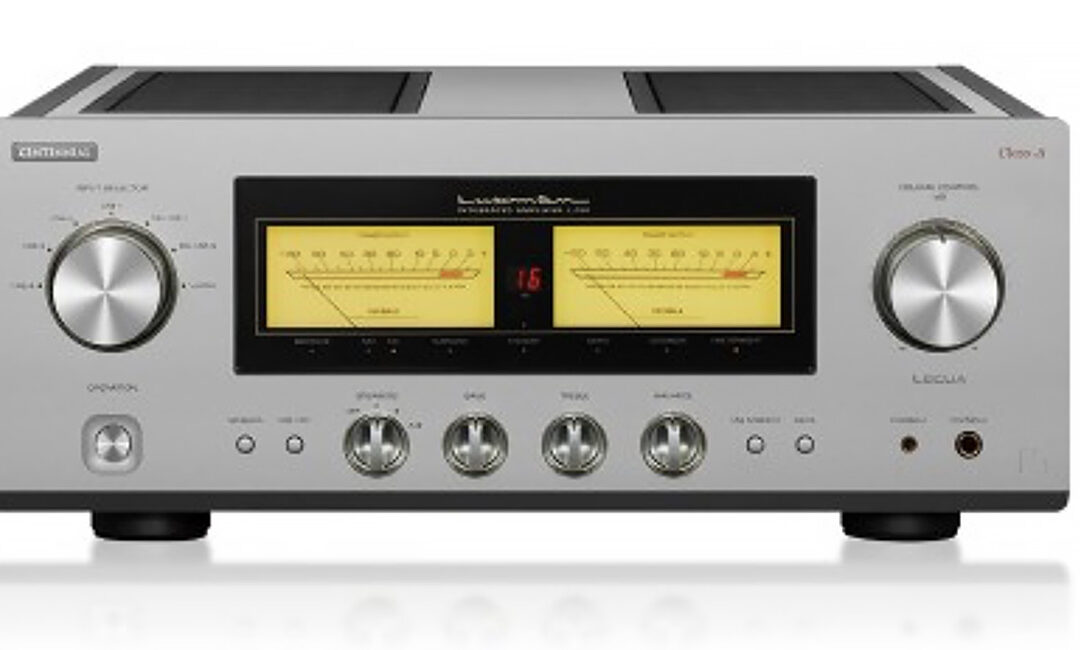
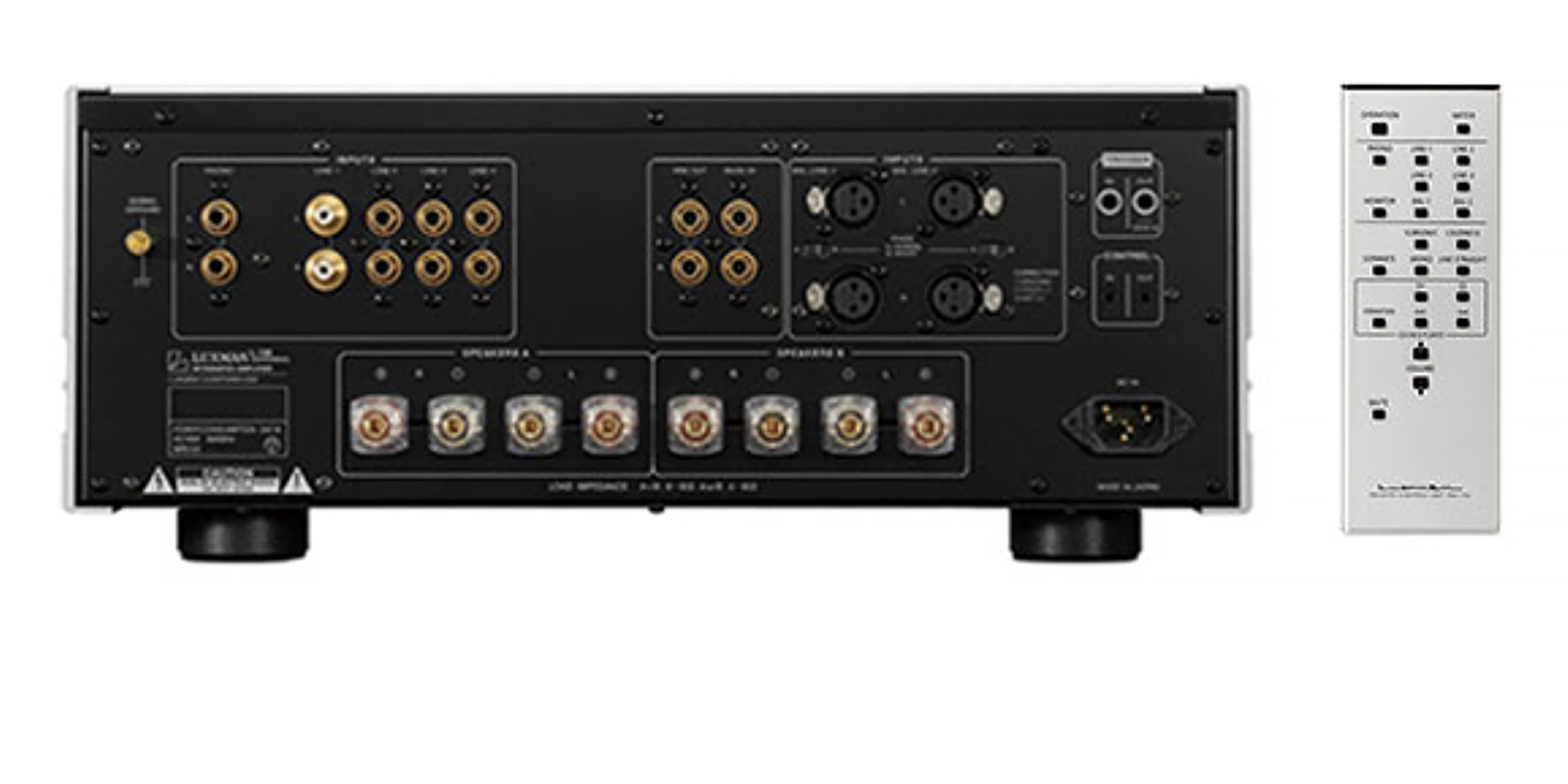
Unveiled in Japan at the beginning of the year, the Luxman D-03R arrived in Europe in early September, equipped with a power supply adapted to 220 V.
While the D-03x still used Texas Instrument DAC chips, the D-03R uses ROHM chips developed for Luxman, giving it a sound closer to that of the larger D-07X and D-10X models. In fact, it even incorporates a newer version of the BD34352EKV chip, used in mono for each channel, which guarantees support for PCM files up to 384 kHz/32-bit, DoP, and DSD512 (when using the USB input). The ultra-low phase noise clock has been redesigned, with jitter also controlled by a dedicated asynchronous transmission for the USB port and a high-precision integrated clock for the coaxial and optical ports.
The analog circuit features a symmetrical buffer circuit with four amplification units, as well as a more powerful power supply, with the DAC filtered by capacitors with double the power, from 3 300 µF to 6 600 µF. Gold-plated RCA terminals with an 18 mm pitch and Neutrik XLR terminals allow the CD player (you need to upgrade to the D-07X to play SACDs) to be connected to a preamplifier. Designed on a new chassis, with a revised mechanism on a 3.2 mm steel plate to better block vibrations, the D-03R comes with a new RD-28 remote control, which retains the numeric keypad for easier selection of CD tracks.
Weighing 13.2 kg, this new player is priced at 5 690 € in Europe.
Behind its understated lines of a conventional CD player, the Technics SL G700 M2 hides its true capabilities. In addition to playing compact discs, of course, it is a true universal access system for high-resolution audio sources, whether from physical media or digital files.
When it comes to physical media, Technics has equipped its latest model with a particularly open turntable. In addition to conventional CDs, it is compatible with MQA-encoded CDs. Similarly, when it comes to optical media, the SL G700 M2’s turntable is compatible with SACDs, whether they are single-channel or hybrid, meaning they contain both an SACD layer and a CD layer on the same disc.
Halfway between physical and digital storage are, of course, the indispensable USB sticks and other portable hard drives. The SL G700 M2 has USB ports for accessing their content. A conventional USB-A port is therefore dedicated to these storage devices. However, Technics wanted to further extend the scope of its latest addition by also equipping it with a USB-B port. This is dedicated to connecting a computer, among other things, so that the SL G700 M2 can use the music files stored on its hard drive, for example.
The SL G700 M2 is also very well equipped when it comes to digital sources. In order to access the home network and, through it, the Internet, this player has a high-speed Wi-Fi connection. It should be noted that an Ethernet port on an RJ-45 socket provides a backup for a wired connection. For our part, we always favour a wired connection whenever possible.
In addition to eliminating the inevitable selection of access points and exchange of passwords required to initialise a Wi-Fi connection, it often guarantees a more consistent bit rate.
Once connected, the SL G700 M2 offers all the traditional functions of a network player. In addition to traditional internet radio stations, it provides direct access to streaming music services such as Spotify Connect, Amazon Music, Deezer, Tidal, Qobuz, etc. Finally, the SL G700 M2 integrates Chromecast and works with Google Assistant.
To offer such versatility, the heart of the SL G700 M2 is based on ESS ES9026PRO converters in a dual monaural configuration. Each channel has its own converter, which significantly limits the risk of interaction between the two channels.
It should be noted that PCM streams, up to 192 kHz, undergo pre-processing to match the phase alignment and ideal impulse response upstream of their digital-to-analogue conversion. This processing enhances the purity of the sound and produces a clearer sound image. DSD streams, on the other hand, are applied directly to the DAC. This player, which supports MQA and most hi-res audio formats such as WAV/AIFF up to 32-bit/384 kHz, FLAC/ALAC up to 24-bit/384 kHz and DSD streams up to 11.2 MHz, can even play MQA-encoded CDs.
However, once the digital-to-analogue conversion has been completed, the purity of the analogue signal must still be preserved until its final playback in order to fully benefit from the quality of the converters. To achieve this, Technics has paid particular attention to the quality of the SL G700 M2’s amplification stages. Instead of using conventional operational amplifiers, they are based on an architecture designed around discrete components, selected and wired with the utmost care. This choice guarantees high responsiveness in these analogue stages as well as an excellent signal-to-noise ratio.
However, the quality of the player’s power supply also has a major impact on this parameter. A power supply that plunges the electronic circuits into an ‘electromagnetic fog’ causes a significant deterioration in listening purity. To preserve the finesse of the sound reproduction, the SL G700 M2 is equipped with a silent multi-level power supply that uses innovative technologies. The SL G700 M2’s power supply unit ensures complete suppression of power supply noise in three stages.
Firstly, this power supply operates at a high frequency of 300 kHz, which places any residual noise well beyond the audible frequencies. To ensure perfect stability, very low-noise regulators specifically designed for the SL G700 M2 are used. Finally, Technics employs active noise suppression through ‘current injection’. This new technology eliminates unwanted noise components by applying a current in the opposite direction to the detected noise.
USING THE TECHNICS SL G700 M2
This beautiful object is not very tall, but it has a wide and deep footprint. And it is quite heavy. The SL G700 M2 will therefore benefit from a good, stable and rigid support. It will also perform much better if you take care of the power cord. Finally, don’t hesitate to plug the USB-A ports at the front and rear using two Audioquest Jitterbugs or iFi iSilencers+. For a modest budget, this makes a big difference.
THE SOUND OF THE TECHNICS SL G700 M2
We were big fans of the first generation of the SL G700. Finally, a complete digital player that handles the network and all optical audio discs. The new version has the same impeccable pedigree. CD and SACD playback is particularly successful. We tend to forget it, but our precious collections of physical digital audio media contain musical treasures.
On some of our old SACD titles in particular, we were amazed by the quality of the reproduction, which was both refined and subtle, with beautiful dynamics and a wide bandwidth. What a pleasure it is to feel such a strong bass foundation. It really pushes forward. It’s very enjoyable. We then moved on to network playback, with the same pleasure.
Overall, the SL G700 M2 is a successful digital source, but one that places more emphasis on the chiselled and precise side of sound reproduction compared to the first generation, which favoured a more embodied and mellow tonal balance. We would therefore be tempted to say that the transition from one generation to the next is more evident in the evolution of the device’s sound personality than in its intrinsic performance.
Of course, the balance of the SL G700 M2 favours the perception of detail, transparency is superior, and the speed on small signals is a step up. This is a machine that provides a feeling of accuracy and finesse in all areas of play. Not only is the resolution excellent, but the precision of the soundstage is remarkable.
OUR CONCLUSION
We reiterate our confidence in and interest in this device, which, in its second iteration, still offers an unbeatable package of features, build quality, and sound and musical satisfaction. This device is remarkably designed and built. It is worthy of more expensive devices, and the attention to detail has been taken to the extreme. For the eclectic music lover who does not want to limit their scope and who wants to enjoy all digital files, whether on physical media or dematerialised, this is the ideal machine, offered at a price that remains extremely reasonable given its qualities.
Author: Estève Fabry
TECHNICAL SHEET: TECHNICS SL G700 M2
Origin: Japan
Price: €2,999
Dimensions: 430 x 88 x 407 mm
Weight: 12.3 kg
Optical media played: 2-channel single/hybrid SACD, CD, MQA CD
Frequency response: 2 Hz to 50 kHz (SACD), 2 Hz to 20 kHz (CD)
Harmonic distortion: 0.0006% (SACD), 0.0015% (CD)
Headphone output: 110 mV/32 ohms
Analogue outputs: 1 x unbalanced RCA, 1 x balanced XLR
Based on a new 50 mm diameter BioDyna diaphragm, powered by a neodymium magnet, the new Fostex closed-back TH910 and open-back TH919 models improve sound amplitude and reduce feedback. The frequency response is advertised as covering a wide range from 12.5 Hz to 40 000 Hz.
Thanks to their new structures, these new flagship models are also 20% lighter, with some aluminium parts replaced by magnesium. Carefully painted with traditional Japanese Urushi lacquer by Sa-kamoto Otozo Shoten Co., Ltd, these headphones set new standards in terms of components (7N OFC copper internal cables) and comfort (new high-resilience urethane foam to adapt to the shape of the head, new synthetic leather made from silk protein).
Weighing approximately 385 g (excluding cable) and with an impedance of 25 ohms and a sensitivity of 100 dB/mW, these new headphones come with a leather pouch and a detachable 2 m asymmetrical cable, with two 3.5 mm jacks to connect to the headphones on one side, and a gold-plated 6.35 mm plug to connect to the amplifier on the other. A 4.4 mm symmetrical cable is currently in development.
The TH910 and TH919 are the brand’s new flagship headphones and are priced at 3 290 € and 3 490 € including VAT in Europe.
In its quest to produce the world’s best phono cartridges, Hana adds a new benchmark to its Umami series with the Black.
A creator of moving coil (MC) cartridges only, the Japanese brand Hana added an Umami range in 2020 with the Red model (test VU#36). Since then, the range has been expanded with the Blue (test VU#50), positioned below the Red as a synthesis between the Red and the ML, and is now topped by the Black.
With much higher aspirations than the Red, particularly given its price tag, which is three times higher, the Black is intended to be the most innovative cartridge from Excel Sound and its director, Masao Okada-San. To achieve this, it incorporates a Nude MicroLine stylus directly onto a diamond cantilever, making it even more rigid and sensitive than boron. Its integrated pole and rear yoke moving coil generator uses an inverted U-shaped yoke to optimize signal transfer from the cantilever. A neodymium-boron-iron (NdFeB) magnet improves energy transfer to further increase dynamics.
The hybrid armature, composed of 78% carbon-impregnated nickel-iron (permalloy), incorporates a hand-wound moving coil around ultra-lightweight 4N OFC pure copper wire. Its output level is only 0.3 mV under 5 ohms. The finish is a vapor-deposited coating of traditional Japanese urushi lacquer, in this case black, on the aluminum body.
Designed for use at very low levels with the best phono preamps on the market, the Hana Umami Black recommends a conventional tracking force of approximately 2.0 g, for a load impedance of only 50 ohms. As announced, its price is in line with the product’s claims, at €10,000 in Europe and $11,500 in the United States, with these cartridges still not available for sale in Japan.
We’ll tell you more in a month’s time, when it’s officially unveiled!
The first model in Totem Acoustic’s new Bison range, this small two-way speaker offers remarkable tonal accuracy. What’s more, it delivers a rich, natural sound image with a depth that belies its compact size. Let’s discover the Totem Bison Monitor.
The new family of speakers, named Bison in reference to the power and endurance of North America’s largest mammals, includes three models. The small Monitor is the entry-level model in this new series. It is based on a fairly conventional two-way architecture. Nevertheless, it benefits from all the expertise of the Canadian manufacturer. It should be noted that since its creation in 1987, Totem Acoustic has always focused its research on small-volume speakers.
Despite the constraints associated with small dimensions, the company has managed to offer expressive, natural and balanced sound reproduction in its products. To achieve this, Totem has always prioritised listening, subjectivity and feel over measurements when finalising the development of all its products. As a result, it is often estimates made “by ear”, based on long hours of listening, that determine the final adjustments to achieve a sound that prioritises appeal.
As for the Bison Monitor, while its architecture may seem fairly conventional, each of its components has been optimised to ensure that it too benefits from Totem Acoustic’s DNA. Its tweeter, for example, is based on a large 33 mm diameter dome cut and shaped by laser from a flexible fabric. This choice guarantees both excellent harmonic performance in the high frequencies and a very smooth sound reproduction.
In addition, its large diameter for a speaker of this type makes it possible to set a relatively low crossover frequency between the two sections. Totem Acoustic has chosen a value of 2.5 kHz.
Similarly, to ensure a smooth transition between the two channels, the filtering remains at order 1, or 6 dB per octave. This simple filtering also has the effect of limiting phase rotations near the crossover frequency. This contributes to the precision and depth of the sound image that these speakers are capable of delivering.
The bass section of the Bison Monitor is built around a 133 mm diameter woofer. It has a rather impressive motor, equipped with a 76 mm diameter moving coil. Again, this is a rather imposing size for a small bookshelf speaker. In addition, the entire moving assembly of this woofer has a very high elongation. The combination of these features allows the Bison Monitor to handle the deepest bass reproduction with ease while maintaining a lively and dynamic temperament.
Finally, the Bison Monitor’s handcrafted cabinet uses variable-density fibreboard. These combine very high rigidity on the outer surfaces of the cabinet with greater softness on the inner surfaces. This feature contributes to good damping of internal sound waves and counteracts the appearance of standing waves within the bass reflex load, which can cause unwanted colouration of the reproduction at certain frequencies.
It should be noted that internal reinforcements are used to further increase the rigidity of this cabinet and give it great acoustic neutrality. It is clear that every detail has been carefully considered to give these small speakers exceptional performance.
INSTALLING THE TOTEM BISON MONITOR
Given the rear position of the decompression vent on this small speaker, care should be taken not only to move it away from the rear wall, but also to place it at the correct height, with the tweeter at ear level for the listener in their listening position, which is usually seated. To do this, it is essential to choose a pair of high-quality stands.
For our part, we conducted our tests with older models from the Partington brand. In fact, the Canadian manufacturer continues to promote these models. If necessary, you can find excellent options at Music Tools and Solidsteel. When it comes to the amplifier, choose one with a good power supply, as the small Totems have excellent power handling and will tend to let you know it. There is no shortage of good options… Finally, here’s a piece of advice that we urge you to follow carefully: bi-wire these speakers.
THE SOUND OF THE TOTEM BISON MONITOR
With this Canadian manufacturer, there is always a moment when you feel a sense of paradox.
This paradox exists between the life-size sound delivered by its products and the absolutely ridiculous size of the speakers themselves. What has been true of most Totem monitors for 25 years is now true of the Bison Monitor. They are tiny, but they deliver a big sound. A big sound is already excellent, you might say. But what stands out here is the ability of the sound to completely emancipate itself from the speaker as a sound diffuser. It’s as if the sound were colonising the entire listening room freely and independently.
It’s a bit like the speakers have disappeared from view. This creates a particularly well-developed three-dimensional image.
Not only is it wide, deep and high, it is also precise and well structured. It’s a rather exhilarating sensation that is hard to shake once you’ve acquired a taste for it. At the same time, the little Bisons give the listener a wonderful physical sensation, with rhythmic tracking that highlights the nervousness of the chords and the urgency of rock or symphonic music.
It moves, it swings, in short, you never get bored for a minute. Especially since the spectral balance is completely realistic. Ultimately, this is a particularly lively and spontaneous little pair of speakers that seems to want to push the walls aside to impose its style. How can you resist such an outpouring of good humour that plays with genres and fashions to always give you the most enjoyable sound from your recordings, whether old or new?
OUR CONCLUSION
The Bison Monitor replaces the Sky. On paper, this was no easy task. The small Sky was a real success in its genre. But with the Bison, Totem pushes the envelope of musicality a little further, offering a richer tonal balance and what we felt was slightly higher power handling. What we take away from this adventure is that the Canadian manufacturer has truly mastered the art of making small, hyper-musical, and completely compact two-way bookshelf speakers, which can be easily accommodated in your home and, above all, provide life-size sound reproduction. We love it!