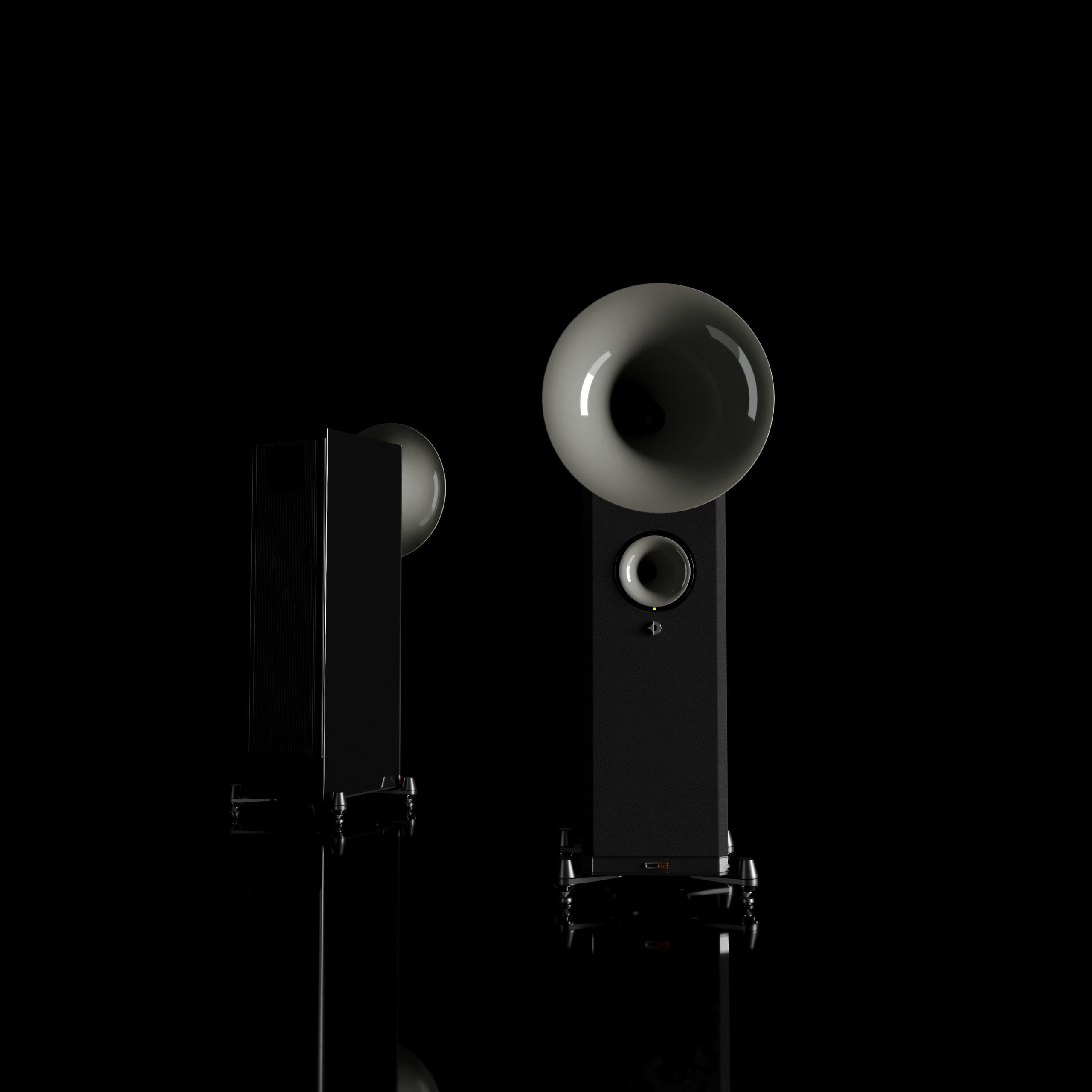
We had the chance and happiness to attend the entire 2022 edition of the audio video show in Warsaw. Below you will find our small selection of outstanding products and demonstrations.
Interesting trilogy composed of Hungarian Qualiton electronics, hORNS speakers and David Laboga cables.
The David Laboga cables are patiently handmade, leather covered and wood cased.
A classic yet very effective combination of the new Bowers and Wilkins 700 Series 3 speakers powered by Rotel electronics and a Rose network player.
Very elegant Gato audio PPA-1 universal phono preamplifier fully customizable.
A complete system composed of electronics and loudspeakers of the Scandinavian brand Gato audio in a very nice orange color.
The German manufacturer Sennheiser presented its entire range, including the exceptional IE900 in-ear headphones, in the purest audiophile tradition, with a full range speaker.
A very elegant set combining Naim audio electronics and Focal speakers in a graphite finish of the most beautiful effect.
A marvelous conception of high-end: Wilson audio speakers powered by d’Agostino power amplifiers, all driven by a dCS digital source: a certain idea of happiness.
This crazy system was composed of the Cary DMS-800 network-audio-player, Ypsilon preamplifier, Ypsilon Aelius power amplifiers and the Gran Gioia 2×16 loudspeakers from Blumenhofer Acoustics. A huuuuuge sound !
One more crazy system: monumental Marten columns powered by Tenor mono blocks, a superlative Wadax digital source and a Brinkmann turntable.
The McIntosh cavalry is as imposing as ever, consisting here of a pair of overpowering mono blocks driven by a tube preamplifier associated with its separate power supply.
The whole collection of Transrotor turntables with the different variations of tonearms, phono cartridges and power supplies.
The excellent Technics headphones here in wireless configuration.
An all-Scandinavian combination of Børresen speakers, Aavik electronics and Ansuz cables.
The complete range of Nu Vista electronics from British manufacturer Musical Fidelity powering here the Fyne audio speakers of the vintage series. Big sound, especially in analog…
The Monitor audio loudspeaker collection.
Simaudio presented its Moon electronics including the biggest mono blocks. Full cabling by Nordost.
Old acquaintances that we tested recently, the Chord electronics from Great Britain, with the preamplifier, the converter and two power amplifiers.
A complete line of the Norwegian manufacturer Electrocompaniet installed on magnificent HRS rack. Note the presence of the monstrous brand new AW 800 mono blocks.
The magnificent Rockport Technologies Avior II speakers associated with VTL electronics.
The Sikora Reference turntable was carrying the brand new Sikora KV MAX Zirconium Series tonearm. To match this extraordinary analog front end, there were the impressive Soundspace Systems PIROL speakers and Linnenberg electronics.
The excellent CH Precision C1.2 converter accompanied by the Swiss brand’s preamp and stereo power block: a guarantee of musicality!
ATC and Vivid: two totally different philosophies, but two specialists in musicality.
On the Ferrum stand, a multitude of small and very elegant boxes capable of great performance: DAC, intelligent power supply, preamp, power blocks… Products already available and prototypes of upcoming references.
A nice line-up of Triangle columns!
The almost complete range of Canor electronics: CD player, integrated amplifier, preamp and amplifiers.
The Canadian loudspeaker brand Perlisten is very much in the news at the moment.
The impressive Tentogra turntables and excellent T + A electronics : SDV 3100 HD DAC, PDT 3100 HD REF CD, and the M40 HV amps.
Magnificent Allnic valve amplifiers.
Audel Audio Magica speakers and their little sisters the Nika MK3.
Complete Adam Custom Audio system with a venerable Sony SACD player!
Very nice restoration of the Goldring Lenco 75.
A complete overview of the Manron range, atypical loudspeakers and tube amplifiers.
The very amazing Hong Kong Westminster Lab electronics, Quest preamplifier and Rei mono blocks with a Lumin server.
A plethoric stand at Pro-Ject came as a neighbor: an impressive collection of turntables, modular electronics as well as loudspeakers, all very compact and available in a multitude of elegant colors.
A remarkable signage to consider. For those who don’t know, Melodika is a cabling specialist…
The excellent French Audionec loudspeakers powered by Boulder electronics and a 432 Evo server.
A real CamJan particularly well organized and supplied with a multitude of references.
Very nice horizontal Accuphase electronics to serve the verticality of the Estelon loudspeakers sculptures.
RCM audio loudspeakers powered by a Vitus power pack connected to the crazy Furutech high-end power strip.
The latest Japanese turntable Tech DAS Air Force III.
Nice overview of Furutech connectivity in NCF finish.
The Cube Audio loudspeakers for full range and high performance.
The small Ogi speakers from Closer. Equipped with a horn folded in a glued laminated body, the small Ogi use a French 10cm wide band.
Beautiful French integrated amplifier Jadis with two 300 B electroharmonix tubes per channel.
We had the opportunity to have a long conversation with Juergen Reis during our visit in Berlin in the offices of MBL. The technical director of the German manufacturer devoted a lot of time and availability to explain us in detail the genesis and the functioning of his favorite loudspeaker. Here is the exhaustive report of our exchanges.
When was the first version of the MBL 101 born? The first version of the MBL 101 loudspeaker was introduced in 1986. MBL was founded in 1979 with the idea of having an omnidirectional loudspeaker system as “the” perfect loudspeaker. It was a sort of 3 way-system driven by 2 voice coils. It was a challenge those days, to bring this idea into a product. But at the end, the MBL 100 was at least the “proof” that this idea can be working. Even it was working in principal, this early version of the speaker needed to be sold together with a parametric equalizer to compensate the sound into a more homogeneous and balanced character. After the MBL 100, it was still a long way to go before the MBL 101 was born.
I joined the company in 1982 and after 2 years, in 1984, I stepped up as the Chief Engineer. I started with analyzing the early MBL 100 speaker and began to change / exchange most parts, except some parts from the big melon, to bring this idea / product onto a higher level, to a High End loudspeaker, as a 3-way system with 3 voice coils and a 3-way crossover and for most, no longer need for an external equalizer. After working 2 years on the development, the MBL 101 saw the light in 1986 as a high resolution and homogeneous / balanced sounding speaker, with a natural sound radiation.
How did you come up with the idea of manufacturing this type of transducer going from low mid to high? When I first heard these early MBL 100 at the “Internationale Funkausstellung” in 1981 (the largest Hifi / TV show in Germany those days) there was already something in the sound that has drawn me into it, that even with this very early version, the natural presentation of how sound radiates and how musical instruments have been presented, made my decision that after I finished my study of electro acoustical engineering in 1982, to ask for an interview and for the job, and got it, and was very happy about that.
How many different versions have you designed? If you ask for MBL 101 versions, I developed 8 different versions; 4 versions as 3-way systems (without internal subwoofer), and 4 versions as 4-way system with internal subwoofer. But you may want also to add the MBL 101 X-Treme to it, a 4-way system with external active subwoofers and 2-times 3-way 101 Melon system, stacked on top of each other, in a D’Appolito alignment. And if you then want to add also the “smaller versions” of the omni speaker systems, like MBL 111, MBL 116, MBL 120, MBL 126, MBL 121 and the other MBL loudspeakers, I have developed in total more than 30 different MBL loudspeakers.
One might think that the vibrational behavior of the 101 is similar to that of pulsating spheres. Was this the goal? Yes, the individual drivers act like pulsating spheres, this is right. This is one of the best ways to create an all omnidirectional sound wave. Having these individual drivers in the center line direct on top of each other, the woofer, the midrange driver and the tweeter ensures, that the sound of all three drivers do reach the listener at the same time, as the sound of each driver virtually origins from the center (as they all radiate like spheres). Another advantage of doing this is, that the acting membrane is basically also the “wall” of the internal volume, so there is no passive cabinet. All what you see and hear is the active surface. There is no energy that is otherwise be lost in a cabinet, when the driver / membrane starts to move, and there is no energy that is stored and radiated afterwards through the cabinet, when the membrane stops. So no delay when build up the sound and no decay / time smear when the sound stops, leading into a high transparent sound.
What is the membrane of each of the three spheres made of? Ok, lets begin with the tweeter. The membrane of the tweeter is out of a 1-layered unidirectional carbon fiber. This material is ideal for bending lamella of higher frequencies. With choosing the right portion of carbon fiber and resin, you can adjust the best balance between sound propagation speed to mass, also called Young’s Modulus, and the internal damping. Additionally, this material, does not age, so it behaves still the same after 10 years, as it has in the first week. The membrane of the midrange driver is out of 2-layered cross woven bi-directional carbon fiber. So it is softer as the one for the tweeter, as it has not to go as high in frequencies, it does have a bit higher weights, in order to go lower in frequencies and does have a higher internal damping. The membrane of the bass driver is out of a mix of aircraft aluminum and magnesium. Aircraft aluminum is cooled down very slowly (and not in oil) in order to prevent any stress in the material and the magnesium acts like a lubricant for the aluminum atoms, to stay flexible all the time.
And as a “short” excursion how I get into the for example all carbon fiber tweeter: When I started analyzing the early MBL 100, I realize, that beside the construction, that the optimum materials have not been chosen (by a long margin). So over a period of several months, I tested and measured every material that I could get a hold on, different metal materials like steel, copper, brass, aluminum, … different plastic material, different paper and different wood materials and created a large spreadsheet with Young’s Modulus (stiffness to weight ratio) and Logarithmic Decrement (damping to weight ratio) and found out, that a composite material like CFK (carbon fiber composite) or GFK (glass fiber composite), would be the right choice for the tweeter and the midrange. And happily the bass player of the 2 bands I played during that time, and later very good friend of mine, founded the first CFK company for guitar and bass guitar necks in Germany. So we hang out together a lot, I was listening to his CFK guitar necks and gave him feedback and he told me what his has changed in the CFK for composition ratio between carbon fiber and resin, and the different pressure while backing and the different temperature curve while backing. This was then the start for me to change the membrane of the tweeter from epoxy to CFK (for details see above), changed the material support from aluminum to a different CFK, changed the center rod from brass to another different CFK, change the voice coil former, … All this brought me a judge success concerning the linearity and the frequency smoothness of the tweeter, and it was logical, that I continued doing similar with the midrange driver. But beside changing also here nearly all materials, I changed totally the size and the shape of the midrange driver and for most, also the position of the midrange driver from below the bass driver (near the floor) to in between the bass driver and the tweeter, as this is logically the “one and only place”, where a midrange driver should be and with another very important point, to gave them a separate voice coil, that is no longer shared with the bass melon and so I could design for each driver their own individual crossovers and brought finally the speaker to a next step / level, that it was working now without any external equalizer and to a much higher neutrality and resolution.
Did you have any problems with the filtering? I have chosen Linkwitz-Riley crossover topology with 4th order, meaning 24 dB / Octave. This gave me an all in phase behavior of all drivers, that does mean for example for the Tweeter and the Midrange driver, who crosses over at 3500 Hz, that at this frequency, or also at 3000 Hz or at 4000 Hz, the MT and HT does radiate always in phase / same time to each other. That means that the vertical radiation pattern is symmetrical to the horizontal plane, meaning if you move your head 10 cm up, you got the same / similar sound as if you move your head 10 cm down. I have choses the crossover frequencies in that way, to take care of the maximum power, the voice coil can handle, have taken care the maximum movement of the driver, so that the distortion stays low, haven taken care, that the impedance does not drop below the nominal 4 Ohm, and for most to take into consideration, what the best suitable frequency area of the specific driver is.
How is the restitution of the extreme grave register guaranteed? From the MBL 101 Version D in the year 1997 on, the MBL 101 has an integrated subwoofer below the bass melon, to add an extra octave in the lowest register. This is a 4th order bandpass, so you actually don’t see the 12 Inch driver that is inside, and you do see only the 2 ports, that connect the front chamber of the bandpass to the outer world and radiate the sound. There are several reasons, why I have chosen an bandpass sub. One is, that due to the sealed rear chamber of the bandpass, the 12 inch driver has a closed air chamber behind that does suppress the otherwise excessive movement below the port resonance in order to stay always in the linear range of the voice coil and magnet assembly and mechanical construction. The other advantage is, that with an bandpass, you don’t need the otherwise very large capacitors and inductors for the crossover, as the bandpass itself does form acoustically this 4th order high pass and 4th order lowpass acoustically. And as it forms this 4th order lowpass, it does also filter out any unwanted overtones in the bass and does only radiate the sound as it is.
What I have done with some passive crossover parts, as I am doing this with every MBL loudspeaker, I take care that the impedance does not have too high phase angles and so I added when needed a so called “load matching” circuit, to give the connected power amp always a little help with not too difficult to drive loads, and I have add also a small network to suppress port turbulences / resonances. The “rest” is done acoustically with the bandpass. The most difficult part of the band pass subwoofer was to adjust the group delay / speed of the woofer to the one, of the upper bass melon, as both have to work together hand in hand and should sound as one bass, and not as a bass and a subwoofer. For a bandpass, the only way you can do this is by changing the complete cabinet (and not just changing some crossover parts, as they are no crossover parts needed nor build in). So this was a bit tricky (and a lot of different cabinets) but finally succeeded and the subwoofer is totally integrated sonically with the bass melon. And to give the “final foundation”, we have supported the internal 12 Inch woofer via brass rods going from the inside, directly coupled to the woofer, down to the brass feeds of the MBL 101. So there is a direct coupled mechanical connection between the woofer and the floor, to hold the woofer firmly in place and to prevent mechanical vibration of the cabinet.
What do you think is the most striking innovation of its speakers? This is by far the most important part / question, and this is also by far the longest answer, and this is maybe also by far the most “difficult” to understand, but really, these are the most important points of what this omnidirectional loudspeaker do and how it works from the acoustical standpoint. The goal of all loudspeakers in the world is, to transport the sound of a recording into someones home. This sounds “easy” but it takes a lot of understanding what does this mean and what has to taken into account / into consideration, when designing a loudspeaker, to reach this goal. So what does this mean? The frequency response should be neutral? Ha, this would be too easy. Lets put a speaker in an anechoic chamber and measure the frequency response. Doing so and developing that way, that the frequency response is flat does mean very little, to be exactly, this is not even 2 % of all what is important, when having the speaker at home. You see, that this point, that is measured and published the most (by manufactures and by magazines), have the least portion, of what is important. As this point is also covered in the next paragraph, we can ignore it here (as it has, measured alone, at the end, no real importance)
1: Listening Window: Measure the frequency response in a so called listening window. What does this mean? Measure the speaker within a range of + / – 30 degree horizontally and to + / – 10 degree vertically. We now have in total 9 points where we have measured basically all “direct sound” that reaches your ear without reflexions. Yes, this is important. This is the part of the sound that you hear in the first 10 ms. This is important to localize the direction of the sound source, and to judge the attack and build up of a tone, in order to distinguish similar instruments. And now to the MBL 101. As it radiates perfectly 360 degree, all measured data in all horizontal plane measured the same, so the sound in all directions is the same. And as all drivers are time coherent, and as I am using Linkwitz-Riley crossover topology, the vertical radiation patterns is symmetrical to the center plane. So the MBL 101 does succeed this first test with flying colors. This first 10 ms of sound, that is covered by the listening window measurements, do cover now about 20 % of what is important for the total so (PS: The number of 10 ms is mainly an orientation point, but it is widely used, as it matches also the widely used recommendation, to have no disturbing elements near the speaker, closer than ideal 1.6 Meter. We come to that point later, but this 10 ms is the time for the sound to travel 2 x 1.6 Meter). Should this measurement of the listening window, that covers the first 10 ms be flat? No. This part of a measurement should have a 1 dB tilt from bass to top. So what we see up to now is, that what is measured and published the most with loudspeakers (direct on axis frequency response), does count nearly nothing (yes, 2 % is not nothing, but nearly), and that part that reaches your ear in the listening window directly within 10 ms and should tilted 1 dB from bass to top to be right.
2: Early Reflexions: Let us go to the most important part, of how a loudspeaker does sound at home. This is the sound that reaches your ear between 10 and 50 ms. This is the “main part” of the music. It determines how you hear the room of the recording, the width, hight and depth, and how you hear where are all musicians are in the room and to each other, the main part of what they are playing, the main part of what instruments they play, etc. And this part is called “early reflexions” and as the word indicates, those parts you do not hear as a direct sound, those parts you do hear always and via reflexions. And to give you a number: This early reflexions part of the sound covers more than 40 % what is important for the total sound. So this is really the most important part.
And I think it is easy to understand, that the MBL 101, as a loudspeaker that radiates 360 degree, that this is exact the reason, why the MBL 101 does sound “so natural”, concerning the tonality of each instruments, the spatial placement of each music instruments and the sound stage. And yes, this is where MBL is world wide unique and yes, this is what has drawn my attention when I first heard the early version of the MBL 100 and yes, this is, why I joined MBL.
And what else does happen, due to the (we can say) perfect Early Reflexion behavior of the 101? Natural Sweet Spot: As I explain at every HiFi show, with a conventional direct radiation loudspeaker you have to sit exact in the middle between both speaker in order to have a center image. I am sorry, but I don’t understand why people at home do accept this behavior, as this is not, how it is in the real world and how it should be then at home. Compare this to the MBL 101. You do not need to sit exact in the middle, you can even be outside of the middle seat at all and you will still have the “correct” sound stage, as it is with real musicians. Yes, when you are far left you hear the left channel louder, as you hear with real musicians then the left musician louder, but still, you have a sound stage also between the speakers, and the sound does not collapse to one channel.
Sound Stage Merging: I can also explain this point, if you like, but it is a bit more difficult to explain, and so maybe a bit too long. Please let me know. But I think this would be too much.
Measurement: I also think, that explaining this measurements would be too much and too long. I can say, that you do measure in total 30 different angles and add this together with a weighting. But what I wanted to say about those measurements: Those look “perfect” when they have a tilt of 5 dB from Bass to Treble, so not a flat horizontal line. I noticed this in the very early stage when I was developing the MBL 101, without being possible to read anything about this. But luckily nowadays this is well proven and accepted, and matches perfectly what I have found out 35 years ago and since then, how I develop and tune each and every MBL loudspeaker model and version. During production: when we check our loudspeakers in the factory during production, we combine the first 10 ms measurement (Listening Window) and the 10 – 50 ms measurement (Early Reflexions) together with an adaptive weighing function and this gave us a tilt of 4.5 dB from Bass to Treble. So without all knowledge, and without listening, you would think that these type of measurement look wrong, but they are totally right. And to repeat the beginning of this paragraph: The one position measurement in an anechoic chamber as a flat line, does not give you any information, of how the loudspeaker will sound in a room. Thats not a so easy fact isn’t it?
3: Sound Power: Ok, when we have 30 measurement points to define the “Early Reflexions” area (from the radiation angle) with the time from 10 ms to 50 ms, we will come to 72 measurement points (area) and to all what comes after 50 ms to define the total “Sound Power”. This is all the sound, that flows into the room and determine, how the speaker / room interaction does sound. Here you define the more global characterization of how the speaker does sound in your room. This is a warm sounding system, this is a full bodies sounding system, this is a bright sounding system, etc. It is all about the character of the speaker in your room, when the music decays. You may ask, is this also important? Yes it is, and also with about 40 % of the “Total Sound”. Even this part takes not much when it comes to details, but it takes much about the “Feel”. This is the curve that you get, when you measure with steady state signals (so without time window) your speakers in your room at your listening position. This is the point, whether you can enjoy for long term and relax while hearing music, or if you feel stressed after a period of time. This all goes also with the Sound Pressure to Sound Energy coefficient. This should be homogeneous as well.
As similar as I described in the Early Reflexions point, the MBL 101, as is radiates perfectly 360 degree in the horizontal plane and has a symmetrical behavior in the vertical plane, we got a very smooth response in the “Sound Power” discipline. And guess what, how should a “perfect” Sound Power measurement look like? It will have a 10 dB tilt from Bass to Treble. Sure they are some variations, depending what literature you take as reference. From the very early Bruel & Kjaer to the so called Harmon curve. And there are also some “house” curve, but all have the above mentioned similar character and do differ mainly on the extremes (low bass, high treble).
Do you have recommendations for placement in the listening room in order to benefit from the best omni-directional radiation?
1. Recommendations for placing the MBL 101 in a room are basically the same as for all type of loudspeakers. There is really no difference here. You should have a good balanced room, where you are happy to be in, not too hollow and not too dry, so if you feel comfortable when you speak to someone and feel comfortable when you listen to someone in that room, then this is a good start. If you want some numbers here, an average RT60 (reverberation time) of about 0.45 seconds is a “good” room for listening music. 0.3 is a bit on the dry side (so more like a mixing / mastering room) and 0.6 is a bit on the “live” side, if you don’t have much furniture in your room. It is also always a “cultural” thing and in what kind of rooms you are grown up and used to live in.
2. Try to stay away from too close placed furniture so minimum 80 cm, or better 1.6 meters between the speakers and any furniture would be good. But, as I said above, this is the same with every type of loudspeakers and is not a question of having omni speakers or not.
3. Set them up irregular concerning the distance from the side walls to the back wall, so for example 1.2 Meters from the back wall and 2 meters from the side wall or vice versus and have nothing between the speakers, that would disturb the image of the sound stage.This is, in no way, different to “conventional” direct radiation loudspeaker. The “Omnis” do not need any special need or care. But they will benefit from a good room and a good placement, as every other conventional loudspeakers will do too.
Is this enclosure difficult to power? Could we use them with an amplifier from the Corona series? The short answer: No the MBL 101 is not difficult to drive, but I strongly recommend to connect the MBL 101 to components, that “match the performance”. And yes, in principle, you could drive them with an amp from the Corona line, but I would never recommend this. Here are the details: To begin this explanation, all MBL omni loudspeakers have the same sensitivity, meaning they produce the same SPL (Sound Pressure Level) per Input Wattage, so no matter if you have the smallest MBL 126 or the MBL 101, as there sensitivity is the same, they are same “loud”. To continue with, sure they do sound different, have different “finesse”, different resolution and different ability to listen “through” the music, but here in this case, they have different bass extension so you feel a different loudness level, when driven with the same amp. But the important part here is to know, that the different MBL loudspeakers have different maximum SPL. So even the 126 does produce the same SPL with 1 Watt input as the MBL 101, the MBL 101 can play much louder and can withstand higher input wattage, and so in the end, you can also fill larger rooms with the MBL 101, as you can fill with the MBL 126.
And to your second part of the question: Yes, the MBL 101 is very transparent to what you feed it, so you clearly and easily hear every improvements what you are doing at the source side, but also detect very easily every weak part of the connected system. It is not the case, that the MBL 101 is “difficult” to drive, in now way, but it is more that it is magnifier glass to what you connect to it, as it is also a magnifier glass to the music. With the MBL 101 you do hear things in the music / recording, that you haven’t heard before with other speakers, and this is great, but you do also hear the weak components in your system, and this has nothing to do with “difficult” to drive. I think / hope you do understand what I mean. All MBL loudspeakers do have specific load matching circuits in the crossover to make sure that the phase angle of the impedance does not reach 60 degree, so that the power amplifier is not stressed too much. And all MBL loudspeakers do have nominal 4 Ohm and all do not go lower than 3.4 Ohm at any frequency. So we took great care, not to stress an amplifier too much.
But the different MBL loudspeakers have different level of sound quality, transparency and performance, so even they are all similar friendly to a power amp, and even they all produce the same SPL with the same wattage, it is worth to match the different sound quality levels of the speakers to that of the connected power amp and front end. So yes, the corona integrated C51 amp that can drive the MBL 126 loudspeaker very well, and it can also possibly drive the MBL 101 loudspeaker to the same SPL, but in no way and under no circumstances I would ever recommend these “matching”. The corona line is a good product line, but the noble line is a better one and the reference line an even more better one. So to answer your question: For the MBL 101 loudspeaker, I would recommend using MBL 9008 power amps in Mono. And “alternatively” the MBL N15 will also work and sound good, but will behave and sound differently. So in the end, it is a question of taste and space what you choose, and how your room is arranged. You have to listen to in your room with your setup to judge.
The two French hi-fi brands, each with a reputation of excellence in their field, are joining forces for the launch of Kalista’s DreamPlay X to offer customers a digital experience that matches the product’s sound and aesthetic quality.
DreamPlay X owners will have free access to Audirvāna software to extend the digital experience of the product by allowing them to listen to music from their computer with uncompromising playback quality.
Beyond the business agreement, the two brands have been working together for several months to ensure that the DreamPlay X is recognized by the Audirvāna software and that the integration is as seamless as possible for users. Audirvāna thus completes the already numerous functionalities of the DreamPlay X whose promise is to be ‘The universal audio-digital source’.
Damien Plisson, creator of Audirvāna explains, “On a computer with Audirvāna, you can easily create our playlists and favorites by picking from your local music and a connected streaming service. It’s a very convenient tool to do that. Audirvāna also gives customization possibilities through oversampling algorithms or the ability to integrate acoustic corrections.”
Technically, both products communicate through the UPnP wireless protocol. This demanding solution in its integration remains very universal and above all without any compression or resolution limitation. “For a product with the quality and requirements of the DreamPlay X, it is important to multiply the possibilities of use for the customers without ever giving up the sound quality” says Jean-Marie Clauzel – Associate Director – of Kalista/Metronome Technologie
According to Damien Plisson, this first unprecedented collaboration is destined to develop : “Without falling into proprietary protocols that are more restrictive and doomed to obsolescence, it demonstrates the value of working with hardware manufacturers to offer the best possible experience to users“.
DreamPlay X combines four devices in one (CD/SACD player, streamer, DAC, and digital preamplifier) while maintaining Kalista’s excellent analog sound quality. The brand’s designers and researchers have been working on this new project for several years to bring you a product in the purest sonic perfection, all with a smooth interface.
The story of Kalista began in the early 2000s in the workshops of a French hifi craftsman, Métronome Technologie, in the Tarn region of France, with the primary objective of producing a unique object, both in terms of its design and its sound performance. Launched in 2003, Kalista immediately met with great international success and won numerous awards from professionals and specialized magazines.
Audirvāna was founded in 2011 by Damien Plisson who developed and improved a unique technology over time, forging the ultimate digital audio playback software for all music professionals and enthusiasts. It is a solution to manage and organize your music whether it comes from a local music library or an HD streaming service (like Tidal or Qobuz). Its software is available for MacOS and Windows 10 and comes with a free mobile app to control it remotely compatible with iOS and Android. Damien Plisson, is a very talented French developer, trained at Ecole Centrale and UCLA, recognized as an expert by the international audiophile community. Since its launch Audirvāna has become “THE audiophile playback software on Mac”.
Launched in 2018, and encapsulating these core values of modularity and upgradeability, Selekt DSM was conceived with the intent for it to grow into a broad ecosystem of modular upgrades. Linn today announces several high-performance components for the Selekt DSM product ecosystem which further cement it as the undisputed king of configurability — in a class of its own and unlike anything else on the market.
Selekt DSM: Edition Hub – a luxurious, superior-quality, and higher performance enclosure variant.
Organik DAC for Selekt DSM – Linn’s reference-level DAC architecture makes its way to Selekt DSM, in both stereo and maximum performance dual-mono variants.
The existing Selekt DSM chassis design, first launched in 2018, will henceforth be named Selekt DSM: Classic Hub to differentiate it from the all-new, deluxe Edition Hub.
Selekt DSM: Edition Hub fitted with Organik DAC comprehensively outperforms not only Linn’s Akurate DS and DSM, but their previous-generation flagship Klimax DSM too. With its wealth of performance and price points, the Selekt DSM product ecosystem now replaces both Akurate DS and DSM in Linn’s range.
Gilad Tiefenbrun, Linn’s CEO, says: “Selekt DSM is unique in that it can be easily configured to meet a hi-fi enthusiast’s desired performance, chosen application and budget. By broadening the Selekt DSM ecosystem to incorporate even more versatility and performance, we are continuing to make good on our promise to create modular and upgradeable products that grow and evolve during their ownership — products that deliver both musical pleasure and enduring value, today and tomorrow.”
Selekt DSM: Edition Hub
Design & Features Edition Hub is a superior-quality enclosure, featuring an all-machined construction for improved rigidity, interior isolation, and elevated aesthetic appeal — with sleek sight lines, concealed joins and understated luxury at the fore. The Edition Hub chassis consists of four plates, rigidly bolted together. The side pieces are flawlessly aligned with the base using pins, with four long bolts subsequently torqued-in for an exceptionally rigid fix, with a pleasing, precision fit and finish.
Providing both requisite heat management and high design appeal, the primary vent of Edition Hub is precision-cut into its aluminium plate lid. The vent itself is evocative of a wave, with each aperture cut at an angle, and only every second one machined all the way through. When viewed from different angles, this wave motif morphs and ripples — with myriad reflections projected from its various finishes and surfaces. Edition Hub features a much-improved, eye-catching control dial. Its precision, turned- stainless-steel bearing ensures silky, tactile rotation when adjusting volume; and the photo- etched steel halo around its edge allows cool, sharp light to emanate from the one hundred individual LEDs beneath. The dial proudly exhibits Linn’s “Clyde Built” epithet — a reverential nod to their Glasgow home’s industrial river, and the world-leading engineering which has emanated from its shores. The all-glass fascia of Edition Hub is composed of mirrored spy glass; with the large-format display concealed behind it displaying crisp, clear information when necessary, and fading to total invisibility when not. A broad range of connections on Edition Hub’s back panel ensures that it can receive, process and expertly deliver audio from any source imaginable; with a high-performance, integrated, analogue-to-digital conversion stage accepting anything from turntables to CD players, and a host of digital connections allowing connection from video streaming devices, games consoles, and Blu-ray players — guaranteeing the best possible sound from anything connected to Selekt DSM.
Additionally, to provide optional bass reinforcement/bass redirect in a stereo system, Edition Hub features stereo RCA line out connectors designed to feed powered subwoofers. Conveniently concealed on the enclosure’s left wall is a 1/4” headphone jack — providing Edition Hub with further welcome versatility, without disrupting the clean design of its frontal aspect. Edition Hub features, as standard, Linn’s all-new, exceptionally efficient, highly responsive, and precision-regulated power supply design Utopik. The product is available in either natural silver-, or black-anodised finish.
Organik DAC for Selekt DSM Designed without compromise, and engineered entirely in-house, Organik is the breathtaking culmination of over thirty years of digital technology expertise; it is undisputedly the highest- performing DAC architecture to ever bear the Linn name. Organik is now available for every Selekt DSM; in either stereo or, for maximum performance, dual-mono configuration. To accommodate Organik in dual-mono configuration within Selekt DSM, Linn has designed an all-new, line out cartridge, with its output stage fully optimised for this reference DAC architecture. A pair of these mono line out cartridges each houses a mono Organik DAC module — and delivers the very highest performance attainable by Selekt DSM. To facilitate yet more upgrade options for Selekt DSM, Organik is also available optimised as a stereo module, ensuring that existing owners of Selekt DSM too can experience the breathtaking performance of Linn’s latest DAC technology as an upgrade. Selekt DSM: Edition Hub, featuring stereo Organik DAC, comfortably surpasses the performance benchmark set by Linn’s previous-generation Klimax DSM with Katalyst. The top-performing, dual-mono Organik in Edition Hub raises that bar higher still.
Summary The breadth of possibility within the Selekt DSM ecosystem is now vast. Customers start with a choice of enclosure design — either Classic Hub, or the deluxe and higher-performance Edition Hub. They then select their desired DAC performance level — whether Standard, upgraded to Katalyst, or the peak performance of Organik – before considering how their Selekt DSM will be tailored to their own specific application… Whether working their way towards the separates system of their dreams with Selekt DSM as source-only, the highest-performance all-in-one-box product available with on-board amps, the heart of their home entertainment in partnership with a TV, or they seek a fully integrated 5.1 Surround Sound receiver… whether their wish is to bi-amp, or even tri-amp their loudspeakers from a single, luxurious, silver-anodised or black box – Selekt DSM accomplishes all with alacrity. Selekt DSM is the most configurable digital music player ever. It’s a fully customisable and future-proof product ecosystem for hi-fi enthusiasts; a unique, high-performance offering unlike anything else on the market.
Availability Orders can now be placed for Selekt DSM: Edition Hub, Stereo Organik DAC, Mono Organik DAC (sold in pairs), and Mono Line Out Cartridges (sold in pairs). A newly redesigned HDMI Switching Module upgrade (optional) brings eARC capability to Selekt DSM, and is also available to order now.
Pricing (excl. tax) Selekt DSM: Edition Hub €9,950 Selekt DSM: Classic Hub €4,900 Mono Organik DAC Module (sold and priced as pair) €5,505 Mono Line Out Cartridge (sold and priced as pair) €1,500 Stereo Organik DAC Module €3,250 Stereo Line Out Cartridge €460 Selekt DSM: Edition Hub with Dual-Mono Organik DAC configuration (highest performance possible) €16,955 Selekt DSM: Edition Hub with Stereo Organik DAC configuration €13,660
G3 stands for “Generation 3”, the successor and next step up from the acclaimed XD series. Starting with the original Generation 1 models in 1993, this is the second time in 30 years that their technologies and product platforms have been completely renewed. The G3 Series takes nature horn principle to its (il)logical extreme: sheer musical power unleashed through the use of unbridled efficiency coupled to an extended frequency range. Optional with the iTRONAA fully active modules – if required with integrated wireless network capability – their patented GameChanger technology, with which they directly control the acceleration of the membranes through a perfectly orchestrated current flow. For a perfect, distortion-free, crystalline and natural sound that almost sounds like live. Incredible detail, stunning dynamic range – both loud and soft – fabulous spaciousness and huge, customisable bass performance – that’s the G3 Series.
Highlights • New generation Evolution drivers for increased dynamics, lower distortion and even purer sound. • Innovative XT2 & XT3 tweeter with new ‘Long Throw’ Horn, extended Supertweeter frequency range and record–breaking distortion values. • Co–planar arrangement for the acoustic centre of all drivers, for stunning musical and spatial coherence. • NatureCapAA, Avantgarde’s unique, proprietary super-capacitor, with outstanding specs and incredibly delicate sound. • Equipped as standard with the E-Fuse circuitry, an electronic fuse for an even more precise dynamic reproduction. • Optional patented and fully active iTRONAA Current Drive, for perfect control of driver output and the ultimate sound. • Optional integrated network capability, for direct streaming of content such Tidal®, Spotify,® DLNA®, Roon®, Airplay® creating the perfect plug & play system. • Iconic and instantly recognizable design language, combined with future–proof modular technology for easy, future electronic upgrades. • Piano lacquer finish of the bass cabinets and new elegant colour and design options for an even more individual configuration of your dream loudspeaker.