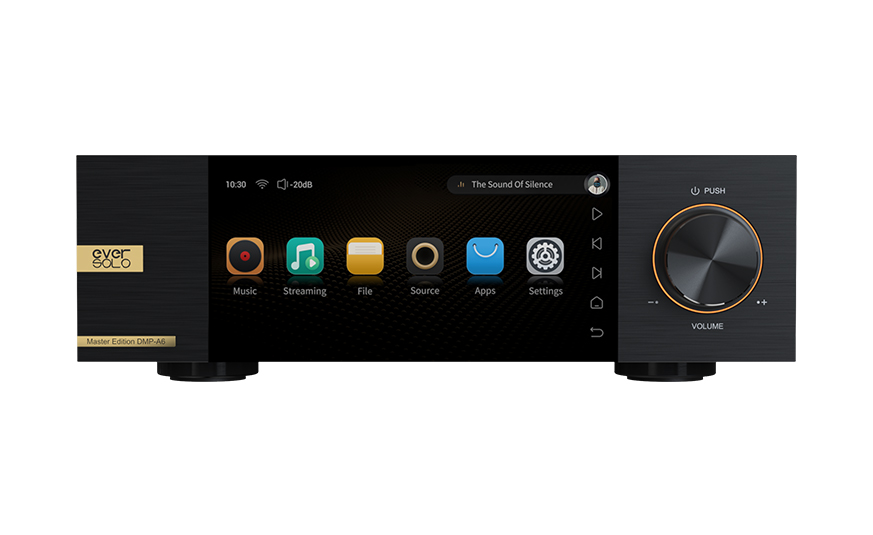
Founded in 2017 and integrated into the Zidoo Technology group, Chinese brand EverSolo Audio has made a stunning entry into the hi-fi market in recent months with its DMP-A6 and DMP-A6 Master Edition network players, since joined in early 2024 by the DMP-A8. Tested here for you, the Eversolo DMP-A6 Master Edition seems to combine build quality with top-quality audiophile components, plus highly intuitive ergonomics, all at an unbeatable price.
With its refined anodised aluminium chassis, the DMP-A6 Master Edition is a resolutely modern network player capable of playing all digital music up to 32-bit / 768 kHz resolution. It runs on a highly ergonomic Android 11 interface managed by a quad-core CPU, all of which can be controlled via a colour LCD screen or a dedicated application for smartphones and tablets.
PREMIUM DESIGN Extremely well made from components often found in much more expensive products, it features a 3rd generation Xmos USB interface with a 16-core processor, a very low noise switching power supply, and an already very ambitious balanced preamplifier stage, which allows it to be connected directly to a power block, including the one recently presented by the brand, the AMP-F2. For conversion, the player uses two Sabre ES9038Q2M DAC chips to separate the left and right channels, ensuring low crosstalk and optimum playback at up to 32-bit / 768 kHz PCM resolutions, as well as stereo or multi-channel MQA and DSD files. In addition to its 32GB of internal storage, the player is equipped with an M.2 SSD slot for installing an SSD drive of up to 4TB for additional storage that’s both fast and silent. Compared with the ‘standard’ DMP-A6, it has a different finish with gold-plated inserts, OPA1612 amplifiers with improved noise and distortion performance, and above all a high-precision dual Femto Clock that ensures perfect data addressing while reducing jitter to very low levels. To connect to the network, the DMP-A6 Master Edition uses WiFi and Ethernet links like its little brother, and incorporates a practical, high-quality Bluetooth 5.0 chip (Qualcomm) that supports the AptX HD codec, making it compatible with the majority of audio streaming services and network protocols.
FULL CONNECTIVITY Located at the rear of the player, the comprehensive connectivity means that the DMP-A6 can be used as a pure DAC, with two USB ports (one USB 3.0 and one USB-C), an optical input and a coaxial input; it can also be used to connect a CD player, which can also be used to rip CDs to the SSD. On the digital output side, the Eversolo offers optical, coaxial, USB 3.0 and HDMI connectivity, the latter enabling transmission of PCM 192 kHz or DSD64 5.1 multichannel streams to a home cinema amplifier. The analogue output stage comprises an unbalanced RCA output and a balanced XLR output. The level of the latter can be fixed or variable, allowing the player to be used as a source or directly as a pre-amp with one or two power amplifiers. In this plethora of connections, only the headphone and subwoofer outputs are missing, leaving a little breathing space for the few remaining competitors in this price range!
THE SOUND
Listening to the Eversolo DMP-A6 Master Edition reveals itself to be an extremely musical network player, with a relatively neutral soundstage and accuracy well above the average for its range. The implementation of ESS 9038Q2M chips delivers a warm result that doesn’t colour the sound, opting instead for a transparent and linear rendering, without being overly analytical or ever bland, with the great advantage of adapting to most musical styles. First used with various streaming sources such as Qobuz or Tidal, with compressed files as well as PCM or DSD Hi-res, the Eversolo’s reproduction is always very fine and precise, open and without any aggressiveness, even in Bluetooth. No detail is left in the dark, and even the sound quality is surprising for a product at this price. Even when paired with speakers and amplifiers from much higher ranges, the treble is diffused delicately up to very high levels, the midrange opens up with great fluidity and substance, and the bass offers roundness and tension with a very good foundation. When played back from a CD player or the internal disc, the sound retains all its qualities without the addition of disruptive mechanical noise or latency. The result is a particularly clear and detailed reproduction, devoid of any harshness or brilliance. The result is a musical experience that is richly harmonic and tonal, highly detailed and yet never distorts the rendition, whatever the quality of the files or sources used.
CONCLUSION With the DMP-A6 Master Edition, the Chinese manufacturer already making a name for itself with its Z6 and Z8 DACs has come up with one of the most accomplished and complete network players on the market today, capable of competing with much more expensive products that are less complete and less ergonomic, particularly when it comes to the numerous parameters available, which can be easily modified using the excellent application and the 6-inch touchscreen on the front panel. Highly versatile, it excels in every domain with mastery and flexibility, its priority compared with Zidoo audio-video devices remaining totally focused on musical performance, with balanced reproduction and a soundstage bursting with nuance and detail.
ORIGIN CHINA PRICE 1 299 € DIMENSIONS 187 x 90 x 270 mm WEIGHT 4.7 kg Type: network player/server/DAC/digital preamp Pre-amplification circuit: Op TI OPA1642 amplifiers Android 11 system and quad-core ARM Cortex-A55 processor with 4 GB DDR memory Display: 6-inch HD colour LCD touchscreen Storage: 32 GB eMMC SSD, M.2 SSD expansion port (up to 4 TB supported) Network connections: RJ45 Ethernet, dual-band WiFi Digital inputs: USB-C, RCA S/PDIF, Toslink optical, Bluetooth AptX HD, USB-A OTG for external support Digital outputs: HDMI (management of PCM and DSD streams in stereo or multichannel), USB-A, Toslink optical, RCA S/PDIF Analogue outputs: stereo RCA and XLR Conversion: dual-DAC, ESS Sabre ES9038Q2M chipset Formats supported: PCM 32-bit/768 kHz, DSD512, MQA Network protocols supported: AirPlay, DLNA, Spotify Connect, Roon Ready, Tidal Connect, Qobuz Connect…
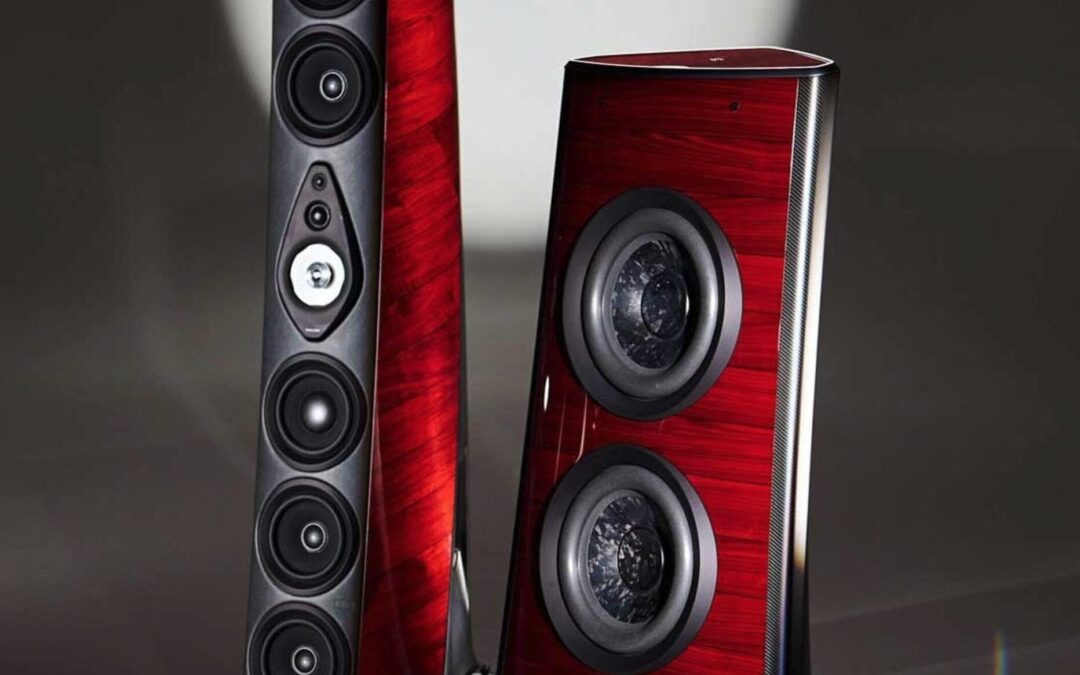
Six months after the launch of the Stradivari V2, Sonus Faber presents one of the world’s most ultimate loudspeaker systems. Named Suprema and designed to celebrate the 40th anniversary of the Italian brand that first appeared in 1983 in Arcugnano – not far from Venice -, this new project consists not only of two columns, necessarily linked to one or two large subwoofers and an active crossover placed in an independent box. Already more than enough to compete in the category of the best loudspeakers ever made, the two columns measure 1.9m (6.25 inch) high with a maximum width of 65cm (2.13 inch) and a depth of 88cm (2.88 inch) ; they weigh no less than 110kg (242.5lb) each. Designed as four-and-a-half-way speakers, they feature ten drivers, with a 0.8″ (20mm) silk-dome super tweeter, a 1.5″ (38mm) silk-dome tweeter, a 6.5″ and an 8″ midrange, and four 8″ woofers with sandwiched paper cones. At the rear, a 1.10” (28mm) silk dome tweeter and a 4” paper cone for the midrange are added. All these drivers are energized by neodymium magnets, with frequencies cut at six points to offer an already ample response range without the addition of subs, from 45Hz to 40kHz.
But to take things even further, the Italian luthier adds one or two subwoofers with two 15″ (38cm) carbon-fiber membranes, integrated into a natural wood cabinet for a total of 103kg (227lb) to choose from in four colors: intense red, graphite, wenge or walnut – colors also found on the two main speakers behind a luxurious black leather front panel, as well as on the active crossover box. With these elements, frequency response goes down to 16Hz, and cuts are then managed with active and passive crossover technologies, which always consist in freeing each diaphragm as much as possible from any non-reproducible pressure. Recommended to be amplified by power amplifiers from 100 to 2000 watts (this system is presented on the same time than an ultimate power amp system from Sonus Faber’s parent group, McIntosh), Suprema is available with a choice of one or two subwoofers and fit into the category of the ultimate high-fidelity products, with prices of €725,000/$680,000/£625,000 (Suprema 2. 1) or €800,000/$750,000/£695,000 (Suprema 2.2).
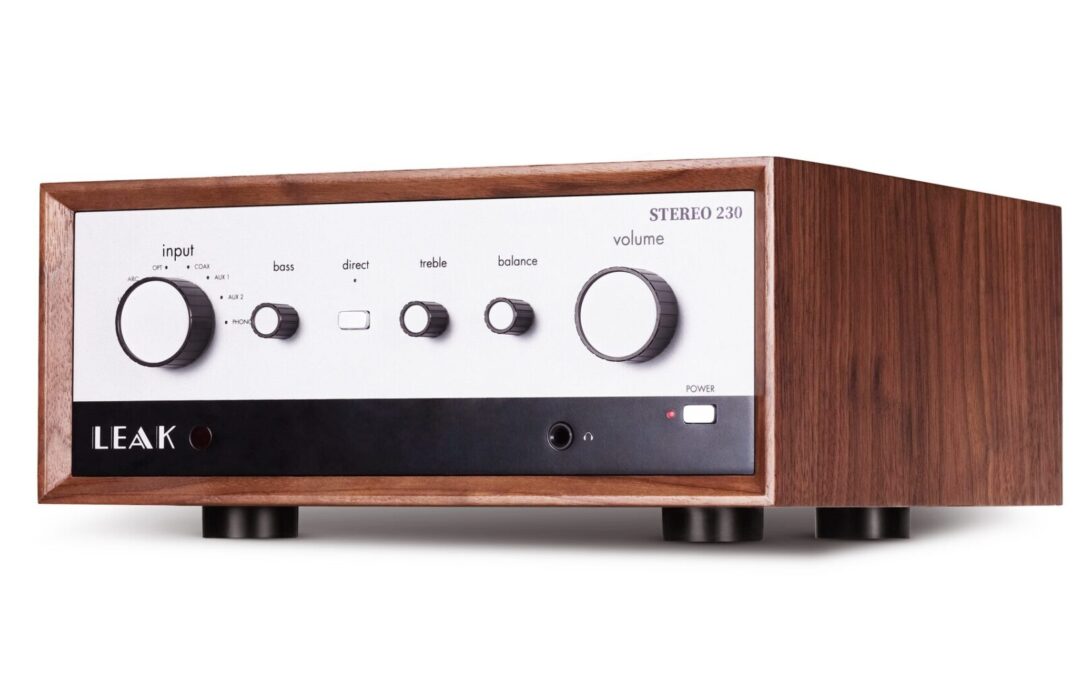
Founded in London by Harold Joseph Leak in 1934, LEAK disappeared in 1979 after failing to adapt to the age of mass-market hi-fi. Despite the death of its founder in 1989 and the destruction of the factory in 1996, IAG Group decided to relaunch the brand in 2020, presenting the STEREO 130 integrated amplifier and the CDT digital player in a deliberately retro design, each with a purely metal version and another integrated into a walnut cabinet, in a style reminiscent of Aurorasound devices.
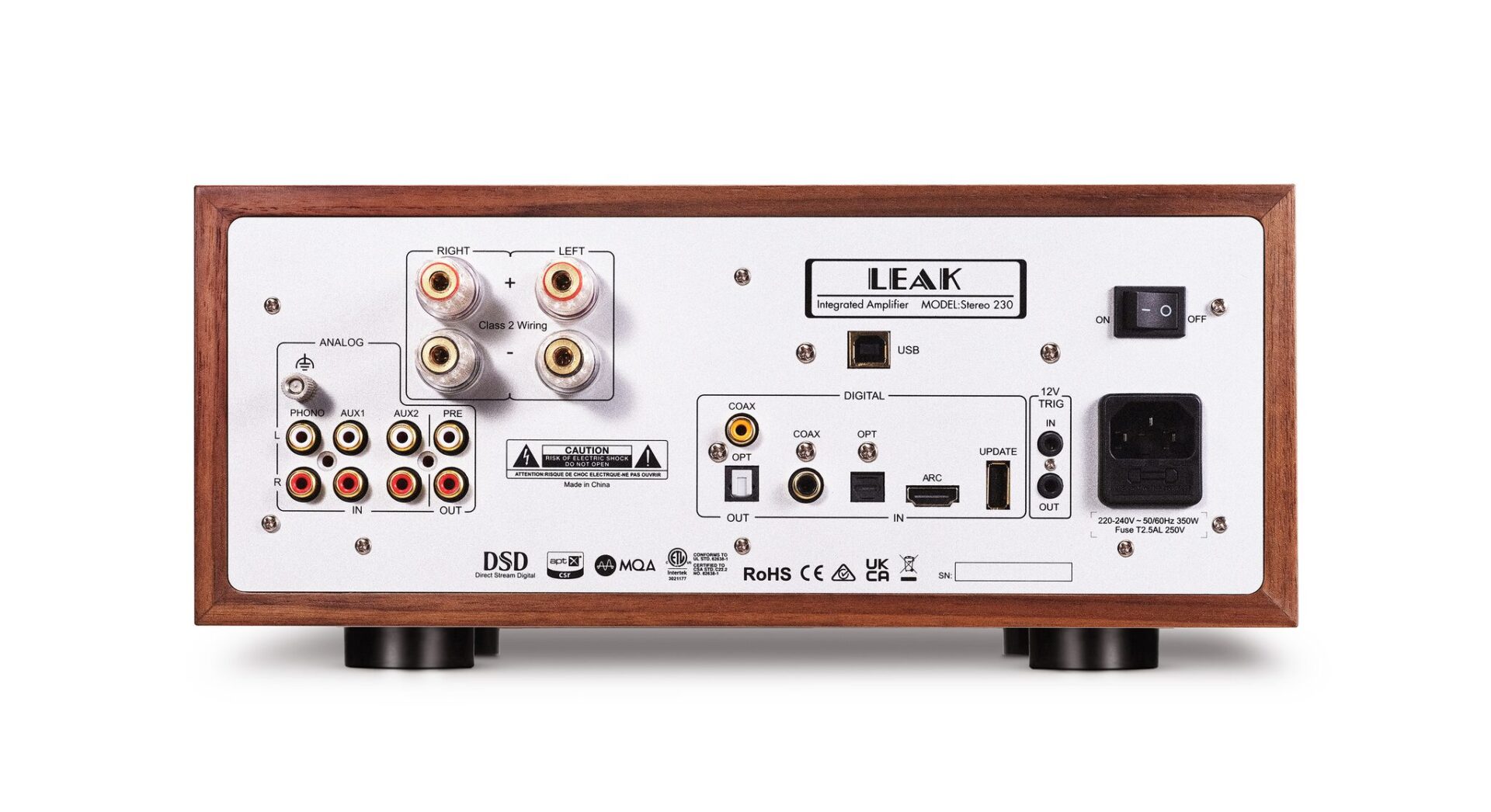
Now back on the market for three years, it’s time for LEAK to expand its product catalog, which it has done at the end of 2023 with the presentation of a new amplifier, the STEREO 230, a more powerful and therefore larger version of the STEREO 130, which goes from 2 x 45W at 8 ohms/2 x 65W at 4 ohms to 2 x 75W at 8 ohms/2 x 115W at 4 ohms. Harmonic distortion is also improved (now below 0.003%), as are many components, starting with the internal DAC card, which still offers seven inputs/outputs, but switches from an ESS Sabre ES9018K2M digital-to-analog conversion chip to the more powerful ES9038Q2M. Complete, this lovely British amplifier also offers a headphone jack as well as three unbalanced analog RCA inputs, including an MM phono on RIAA curve, and a pre out input.
Available from today, the LEAK STEREO 230 is only available with walnut cabinet, priced at $1 695 in the USA and €1 499 in Europe.
TAD’s most recent presentation was a column speaker named Evolution Two, rather classic in style and almost moderate in price (€17 000/$20 500), compared with what the Japanese manufacturer has accustomed us to. Today, it returns to the top of the same series, with a new pair of Grand Evolution One column speakers. Coded TAD-GE1, this 3-way bass-reflex model with three drivers develops the CST technology already used on the Reference series, and covers a frequency range from 250Hz to over 100kHz, thanks to a 3.5cm (1.25″) beryllium dome inserted in the middle of a 14cm (5.5″) magnesium cone, integrated into the cabinet using ISO technology for optimum management of back waves. Below, two 18cm (7″) MACS II (Multi-layered Aramid Composite Shell second generation) woofers are tuned to a patented ADP (Aero-Dynamic Port) two-way downward bass-reflex system, whose air exits through a vent cut into the 15mm aluminum base.
With an impedance of 4Ω, this 1.21m-high (4 ft.) three-way speaker is cut by a high-end crossover at 250Hz (bass to midrange) and 1800Hz (midrange to tweeter) and weighs no less than 64kg (141.1 lb.) apiece, built in a varnished MDF and real wood cabinet, on which the black side bracing is hand-polished for hours to create a true mirror effect. Bi-amplifiable, the GE-1 integrates two pairs of terminals and can handle amplifiers up to at least 250W with a sensitivity of 88 dB (at 2.83V, 1m). The only fly in the ointment: the TAD-GE1 costs €58,000 in Europe and $65,000 in the USA.
After presenting the Reference Jubilee at the start of the year, at a price of more than €25,000, the German turntable manufacturer Clearaudio updates its entry-level, the Concept, with a new Concept Signature model. Based on the Concept, which has sold more than 20,000 units since 2009, the Signature Concept is still designed on an MDF chassis, optionally available with wooden inserts. The suspension of the belt motor is decoupled by a new O-rings system from the Reference Jubilee, but its most important new innovation is clearly the speed self-calibration technology, patented TSC “Tacho-Speed-Control », real electronic control with real-time speed feedback, to considerably improve the quality of rotation compared to the Concept model.
In order to set it apart from the Concept, the Concept Signature incorporates a new speed control dial, still adjustable in 33, 45 and 78 rpm, but now backlit and allowing the speed to be finely adjusted, verified in permanence by the TSC. Adaptable as a pack to MM and MC cells, as well as to arms (from Concept/Verify to Profiler), the Concept Signature can be further improved with an external power supply from the brand. It will be sold in Europe from €2,500, or €750 more than the classic Concept version.