Artist: Jehnny Beth Album: You Heartbreaker, You Label: Jehnny Beth Link: https://www.jehnnybeth.com/ Style: Rock, Hard Rock, Metal
Camille Berthomier was born in Poitiers (France) into a family where art played an important role. Her father, a theatre director, passed on his interest in theatre and cinema to her, and she has appeared as an actress in a dozen feature films and in the series Hostage. But music was not left behind, as she started playing the piano at the age of eight and, influenced by rock and punk during her teenage years, she made a name for herself in several bands, including the duo John & Jehn and the band Savage. She has also participated in prestigious collaborations with bands such as Idles, Tindersticks, The XX and Rone.
For You Heartbreaker, You, her second solo album, she further emphasizes a rock sound that is clearly harder, which can at least be likened to hard rock or even second-generation nu metal. On most of the tracks, there are also obvious influences from industrial rock, reminiscent of the work of artists such as Marilyn Manson and Trent Reznor of Nine Inch Nails. This is particularly evident on the single ‘No Good For People’, where we hear music full of rage, violence and tension, a veritable electric shock carried by devastating guitar riffs.
A mixture of instrumental textures obtained through hardcore playing and industrial sounds, the sound of this album is as raw and rough as it gets. The treatment of the vocals, which are sung exclusively in English, gives them a compressed feel – far from what audiophiles might expect – but above all a rich, catchy texture that fits perfectly with the devastating style of the rock anthems that make up this hard-hitting album. The lulls in the opening bars of a few tracks are only there to prepare for the explosion that follows, so there’s no risk of boredom when you put this record on your turntable.
Artist: Feu ! Chatterton Album: Labyrinthe Label: Universal Music Link:http://feuchatterton.fr/ Style: French chanson
Feu! Chatterton’s career path is fairly classic: three members of the band meet at school, their first songs are released on internet, they play support slots and win various awards. However, when you live in France, it seems unlikely that you haven’t heard one of their songs or heard about them in the media. This is due to the well-deserved success of their previous album, Palais d’Argile, released in 2021, which was of unusual magnitude. But such critical and public acclaim can also weigh on artists’ creativity. Perhaps this is why it took them four years to deliver their new studio album, Labyrinthe.
Feu! Chatterton’s music centers around Arthur Teboul’s lyrics and distinctive interpretation. His recognizable voice and phrasing invite comparison with the great names of French chanson. Instrumentation-wise, the band has taken a much more modern direction, with rock infiltrated by hints of psychedelia and, on this album more than on previous ones, electronic elements that sometimes take the lead. This emphasis is evident on the track ‘Labyrinthe’, which shares its name with the album. While this change may be disconcerting, it would be a shame not to continue the adventure offered by this record, which combines maturity and lyricism.
The vocals and their controlled flights of fancy are the band’s trademark. This is still the case here, with a clear and detailed mid-range. The accompaniment is subtle, laying down a heady carpet for Arthur Teboul on ‘À Cause ou Grâce’, and, in general, the balance between electronic sounds and the pop/rock approach is joyfully successful. The production creates a stable and structured soundstage, the width of which varies depending on the track, adding interest to testing your system on this criterion. It is also pleasant to differentiate the timbres of the synthesizers and other drum machines from those of the acoustic instruments.
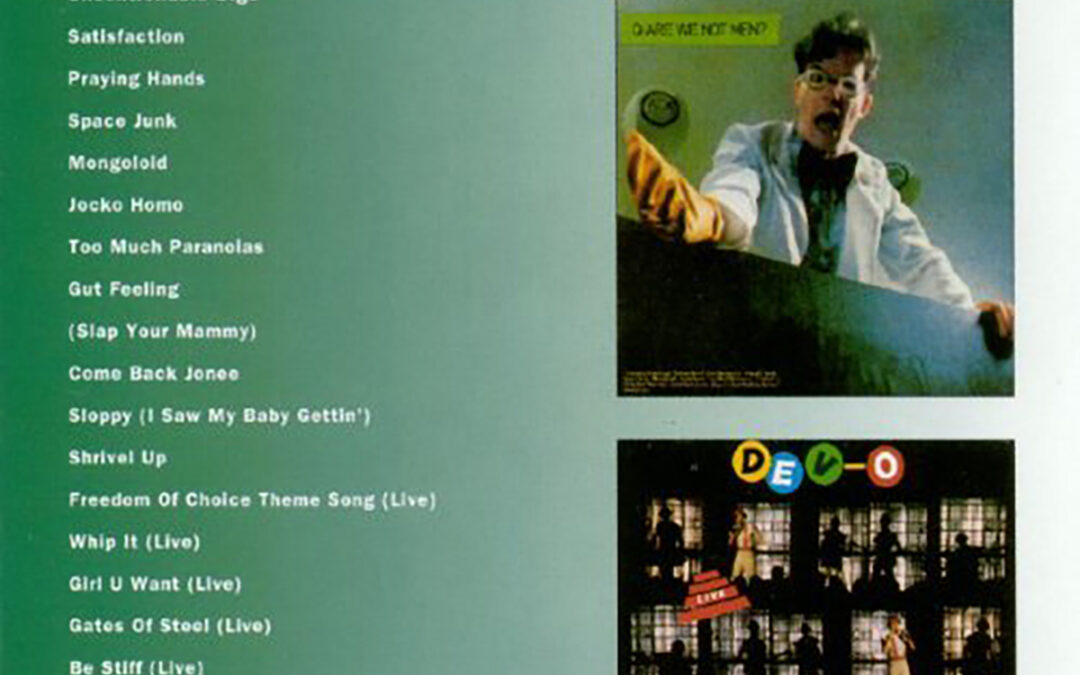
Artist: Devo Album: Q: Are We Not Men? A: We Are Devo / Devo Live Label: Virgin Records Link: https://clubdevo.com/ Style: Pop/Rock
Like many bands working in the pop rock style, Devo was formed when a group of students attending the same university got together. In this case, it was Kent State University in Ohio, the very same university where Nixon sent in the National Guard to suppress a student demonstration, leading to the military opening fire on 4 May 1970. Nine students were wounded and four were killed. Music lovers know that this tragic event inspired a song by Neil Young, but fewer people associate it with the political awareness of the members of Devo. The latter, who were art students, initially used drawing and painting to express their ideas. With the help of a teacher’s advice, they conceptualized the principle of D-Evolution, a kind of programmed decline of modern societies.
It was not until 1972 that these artists really began to use music as a means of expression. If you listen to them objectively, their style, with lyrics that are often misunderstood, can easily make them seem like entertainers who only retain the anti-conformist side of Dadaism. However, as mentioned above, their message is much deeper and more sophisticated, as you can see clearly in a recent documentary available on Netflix. Returning to the box set, it includes Devo’s first album (1978), plus a live recording made a few years later. Using instruments that they have greatly modified themselves, the musicians incorporate choruses that are chanted and repeated like slogans to atypical, frenetic and bouncy rhythms. The bass, which also retains its originality, can be likened to funk, while the energetic guitar shares quirky melodies with the interventions of a dissonant synthesizer. Many of their tracks are perfect for getting stuck in your head and following you around all day, like their version of ‘Satisfaction’, approved by Mick Jagger himself.
Largely due to their excessive originality, but also because of their love/hate relationship with the commercial machine surrounding music and the specialized media – MTV in particular, which nevertheless reveled in these pioneers of the music video in its early days – Devo’s success was short-lived. The interest they received therefore never matched their talent and originality. On the most defined systems, the sound recording of the first album lags behind more audiophile productions. Listening with headphones, particularly Sennheiser HD 800S headphones, clearly reveals this aspect, whereas entry-level headphones tend to smooth out the slightly muffled sounds. However, this sound is not perceived as a limitation to the listening experience and is in keeping with the offbeat style of the music, which is very catchy. Here, the live performance is more expansive and dynamic, returning to higher production standards, this time with a noticeable difference and therefore greater enjoyment if the listening system is of high quality.
Artist: David Helbock & Julia Hofer Album: Faces Of Night Label: ACT Music Link: https://www.davidhelbock.com/ Style: Contemporary Jazz
A classically trained pianist, Austrian David Helbock studied at the conservatory in his hometown before embarking on a course in jazz, during which he ended up playing alongside his teacher Peter Madsen and became involved in his various projects. He recorded as part of a trio before embarking on a solo career, often drawing inspiration from pop music. Julia Hofer, also Austrian, is a cellist, double bassist and electric bassist who divides her time between teaching at the Gustav Mahler University in Klagenfurt, the Jam Music Lab in Vienna and online, and playing in both classical ensembles and pop-oriented groups.
In addition to sharing the same nationality, the two artists have similar backgrounds and a common interest in non-academic music. It is therefore no surprise that they met, and naturally at the confluence of jazz and classical music. With Faces of Night, they still manage to preserve an accessible vision of modernity by avoiding overly abstruse directions. So, despite the great technical skill of the two musicians and their guests, it is still possible to listen without intellectualizing. Accompanying them in this approach are trumpeter Lorenz Raab, guitarist Mahan Mirarab and singer Veronika Harcsa, who feature on some of the tracks.
The clear and light arrangement of the album allows the listener to appreciate the timbres and the expert touch of the instrumentalists. And to influence their tones, Julia Hofer changes instruments throughout the album, switching from cello in ‘Woman’s Dance’ or ‘Theme From Schumann’s Piano Concerto’ to an electric bass verging on funk in ‘Sexy M.F.’. The acoustics of the recording venue and the recording itself remain neutral, allowing the notes to shine, whether they are spread out freely in ‘Round Midnight’ or more lively and percussive, as in the exchange between piano and guitar in ‘Dancing To Another Space’.
Taking simply her initials as her stage name, Ciara Mary-Alice Thompson imagined herself pursuing a career as a professional musician from a very young age. With this in mind, she left her native Ireland to settle in Manchester with the band she was part of at the time. Following a songwriting workshop, she met singer Charli XCX, who encouraged her to change her musical style. Happily following her advice, she returned to Ireland and released tracks online before her debut album in 2022. The album was a huge success, reaching the top of the sales charts in her country.
Euro-Country is CMAT’s 3rd album, with a title full of meaning. It reminds us that Ireland plays a major role in the European origins of country music, but also that the country is part of the Eurozone, unlike Great Britain. With lyrics that are both humorous and quite committed, the singer denounces the hidden side of her country’s economic success. The cover, which is unapologetically kitsch – see her website – hides a pop sound that strikes a nice balance between a certain format and the artist’s artistic choices. It’s a nice alternative to Sabrina Carpenter’s overly calibrated latest album.
Although country elements are more prominent on certain tracks, such as ‘When A Good Man Cries’, they do not dominate the album. Closer to commercial pop, this disc fortunately retains an appeal in its compositions and a momentum that is perfectly rendered by fairly exemplary production. Everything is in its right place, especially the lead vocals and backing vocals. The tempo changes are perfectly negotiated by impeccable rhythm, and the instruments – piano, violins and guitars – take turns coming to the fore depending on the track, maintaining a real connection between them while each retaining its own distinctive character thanks to the beautiful definition of their timbres.