
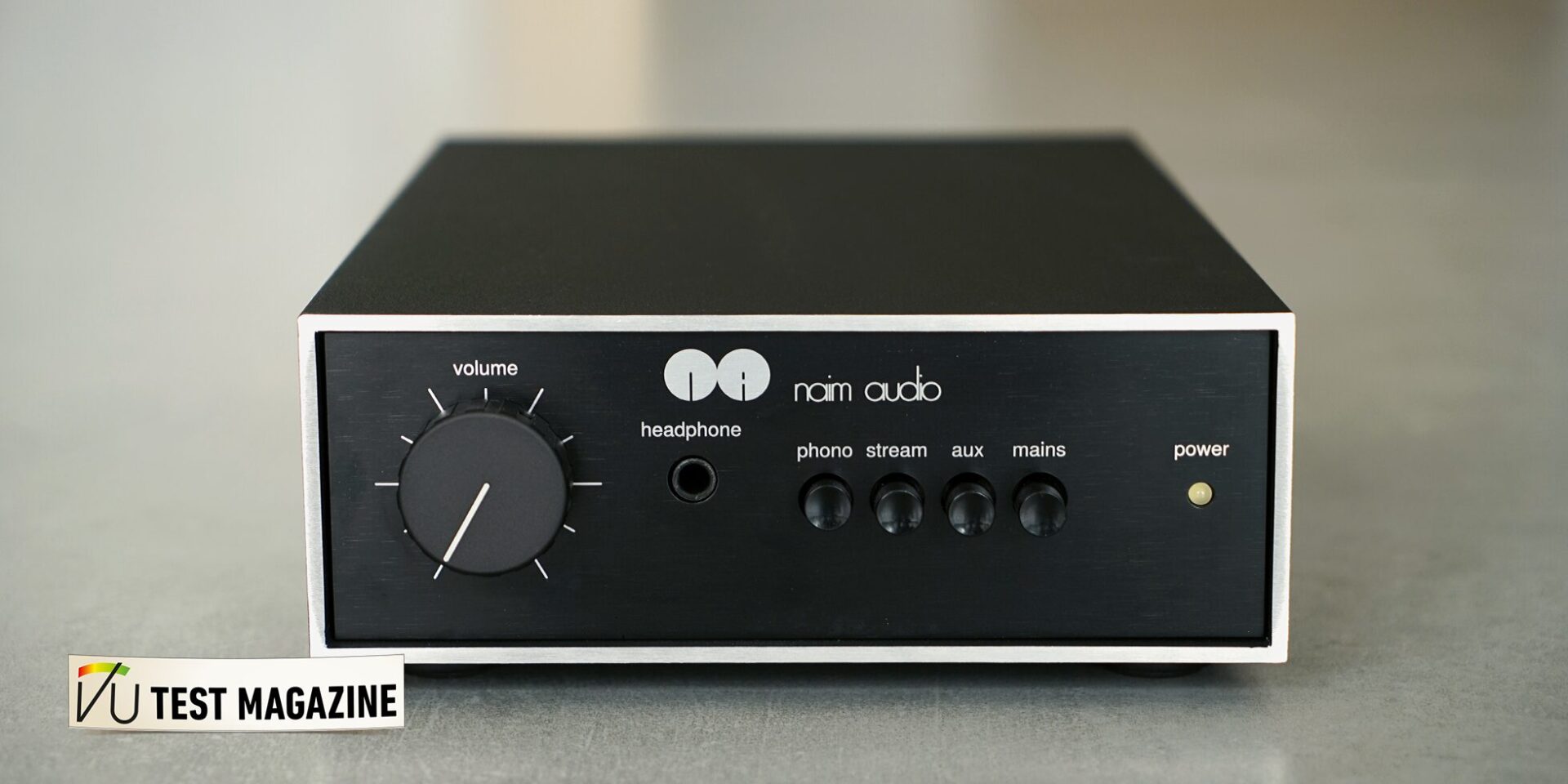
Created as a commemorative symbol for the 50th anniversary of the Naim brand, the NAIM NAIT 50 is produced in a limited edition of 1,973 units, the date on which the brand was created by Julian Vereker. That was all it took to pique our curiosity, as long-time fans of the British manufacturer!
Founded in 1969 in Salisbury by young Julian Vereker, Naim Audio Visual quickly made a name for itself with the quality of its amplifiers. The first model marketed by the brand was the NAP160, in 1971. The NAP250, launched in 1975, became a classic. Its amplification circuit was used in all subsequent Naim amplifiers until the launch of the NAP500 in 2000. The brand’s first integrated amplifier, the NAIT, appeared in 1983. NAIT is an acronym for Naim Audio InTegrated.
Unveiled in 2023 at High End Munich, the NAIT 50 is a “reissue” of the 1983 NAIT. The R&D experts in Salisbury have carefully recreated this iconic product with the legendary Naim chrome front panel design.
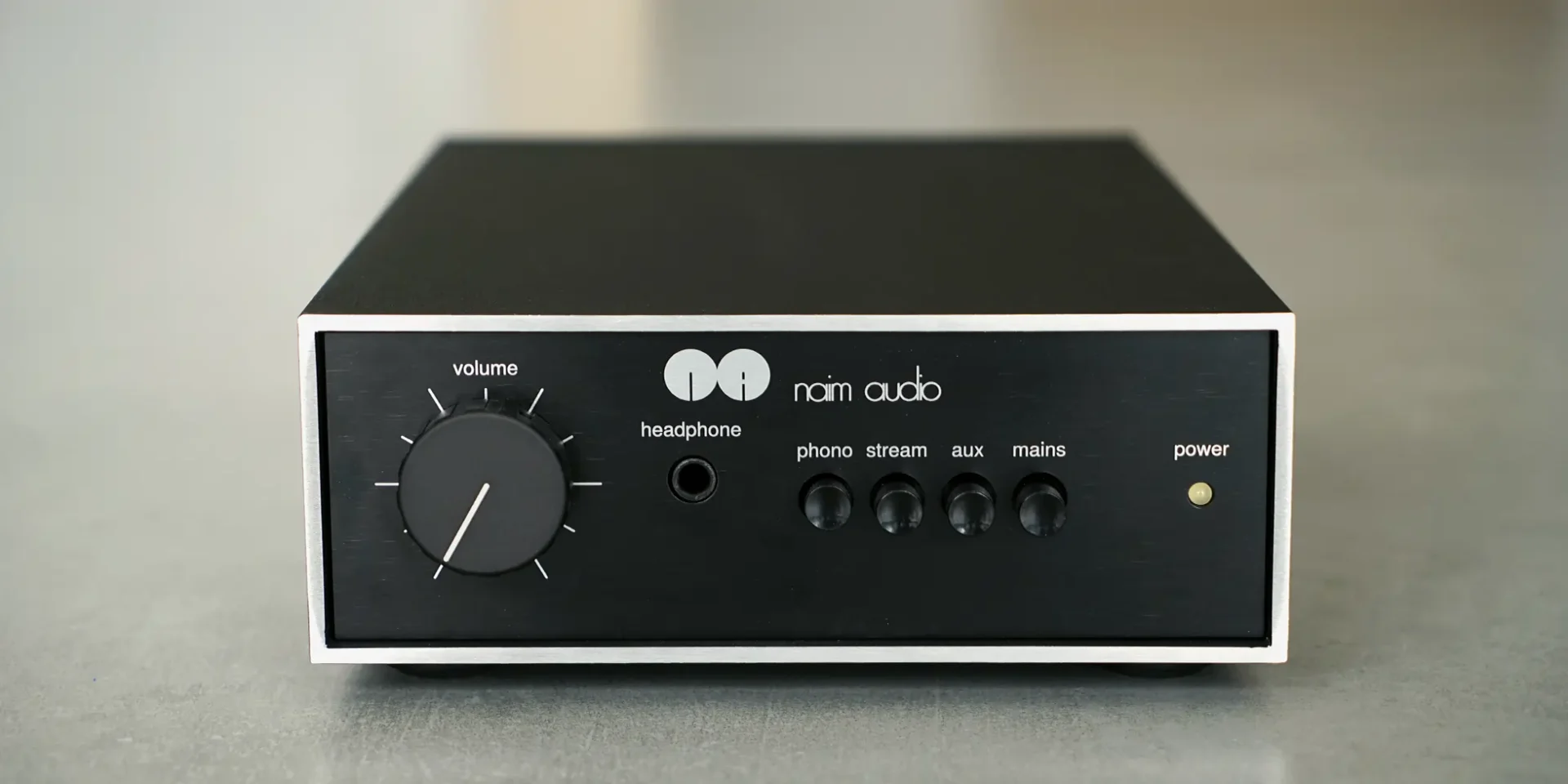
The front panel is virtually identical, with only the original balance control replaced by a jack-format headphone output. This is a welcome change, as the balance control is not absolutely essential on this type of device. The headphone circuit, which is completely independent from the rest of the amplifier, provides 16 dB of gain and has been borrowed from the Naim component bank.
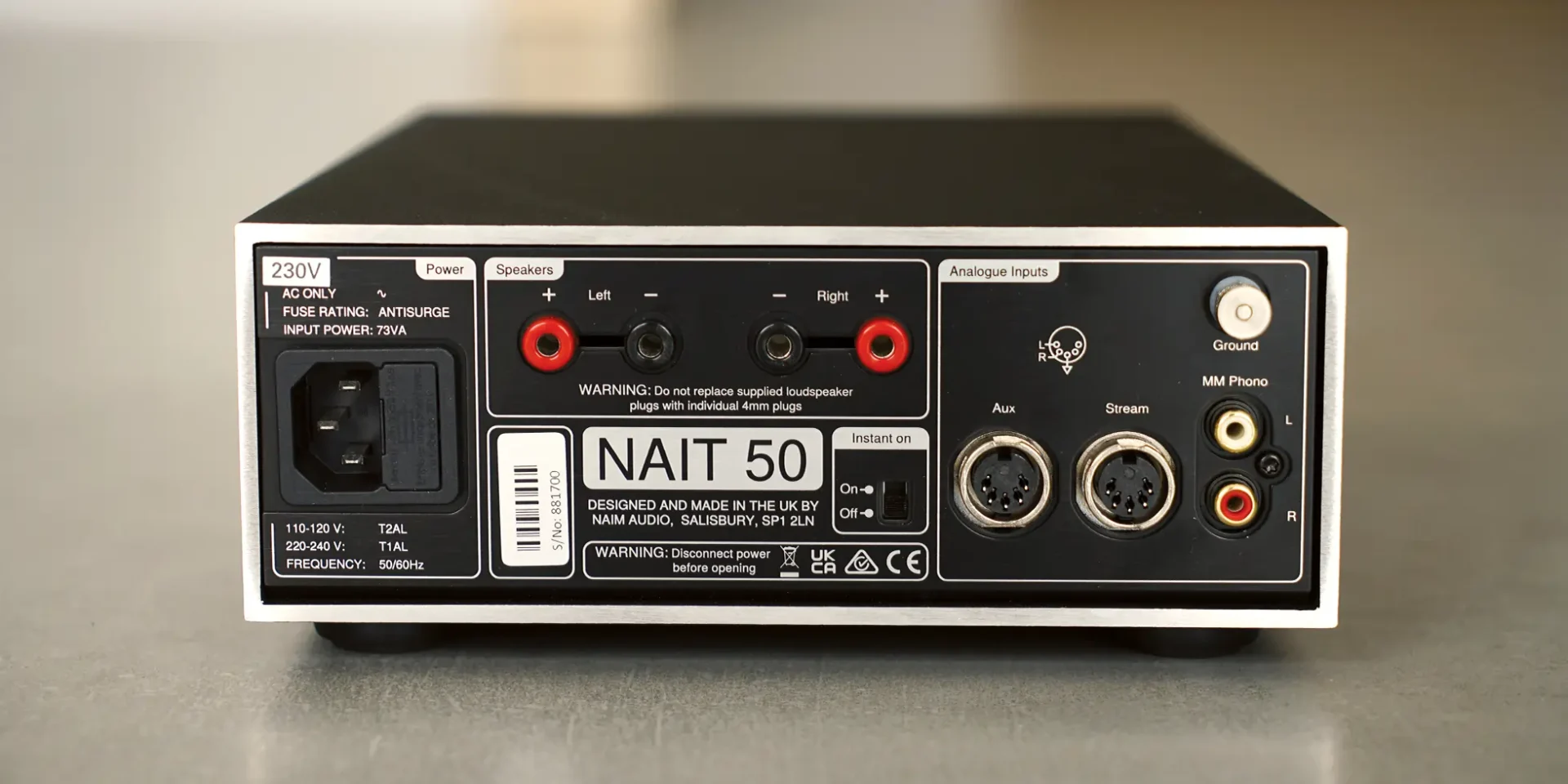
Apart from the screen printing, the rear panel is also identical to the original. The only concession made to comply with CE standards is that the power cord is now detachable, which explains the presence of the IEC socket.
Disassembly is as easy as ever: simply remove the four feet and a large Allen screw that secures the sub-chassis to the outer case. Then, all you have to do is rotate the former out of the latter! Careful observation reveals that the 50 is different on the inside and much more in line with current electronics standards. Nevertheless, the basic structure has a number of similarities.
For example, the size of the toroidal power transformer and the two main capacitors is almost identical. The diagram is that of a class AB amplifier, even though the first Naim amplifiers were genuine class B. The power output has increased from 15 to 25 W.
The power stage itself is quite similar. However, the preamplification section has changed significantly, particularly in terms of the input stages and source selection. This control has been considerably improved compared to the NAIT 1, thanks in particular to precision relays. The same applies to the new MM phono stage, which is built using discrete components.
In the same vein, the British manufacturer has opted for a combination of two internal power supplies. The first, dedicated entirely to the audio stages, uses a large toroidal transformer and two main capacitors. The second is a highly efficient SMPSU switching power supply with a consumption of 0.5 W in standby mode. Naim offers a soft start sequence to minimize the inrush current when powering up and an automatic shutdown after 17 minutes, which can be disabled.
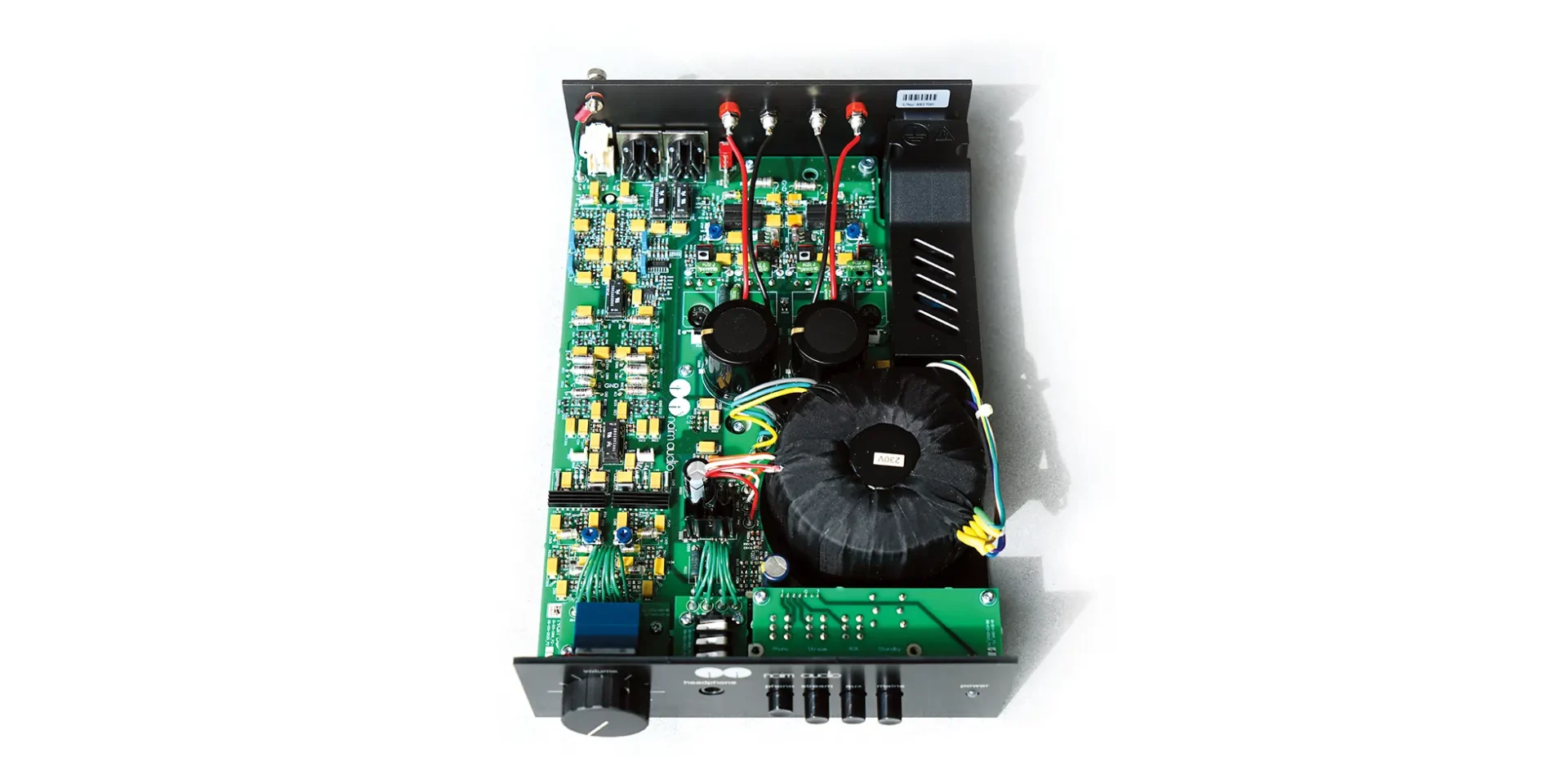
These small additional features explain the presence of an op-amp, which was obviously absent from version 1. In terms of welcome new features, we loved the 5 mm domed white LED.
Side by side, the two chassis show us that the density of the 50 is greater than that of the 1, despite the use of numerous SMDs. But as the available surface area is not expandable, we can well imagine that the design engineers had to work hard to achieve this efficient signal routing. We are pleased to note that the two large filter capacitors have been moved a little further away from the fragile phono stage than in v1.
Ultimately, all this adds up to an extra €3,000, which is not surprising given the high-end manufacturing in the United Kingdom.
THE SETUP OF THE NAIM NAIT 50
On paper, this amplifier only delivers 25W into an 8-ohm load, a figure that rises to 40W into 4 ohms. According to current standards, where any Class D amplifier starts at 100W, this is not much. But we should be wary of the figures, because the subjective power of the NAIT 50 is much greater.
We were able to connect it to a large number of speakers without any major difficulties, even in a large room. We achieved a very good match with the Totem Bison Twin Tower, among others. So there is no risk regarding pairing.
Second observation: the connectors. Only banana plugs are allowed for connecting speakers.
For us, this isn’t a problem, especially since the sockets are high quality. It’s less straightforward for modulation once you’ve solved the RCA phono problem. Because there’s no alternative to DIN here. But you just need to take your pick from the catalog of British manufacturer Chord Co and you’ll be fine.
THE SOUND OF THE NAIM NAIT 50
To say that we were waiting for it with bated breath would be an understatement: the NAIT 50 has been scrutinized with particular attention since its release. Because succeeding an icon is no easy task. Let’s get straight to the point: if you were expecting a replacement for the original NAIT, look elsewhere.
The 50 clearly belongs to its own era, and ultimately that’s a good thing. It makes no attempt to do the same thing as its prestigious predecessor. It sounds like a Naim of today. It is clearer, more transparent, more precise, and can express itself more powerfully. It is less “midrange,” less “warm,” and more incisive in a good way.
It is a contemporary, efficient, and pragmatic machine. The width of the reproduced sound spectrum is greater, particularly with tighter and very well-structured bass. The high register also gains in variety and finesse, while retaining a very beautiful tonal persistence. What has not changed, however, is the magnificent dynamic behavior, which is still as persuasive as ever for such a small box.
Like its predecessor, the 50 easily powers just about any conventional-sized speaker, with a very good sense of drive and swing. The rhythmic tracking is as successful as ever, capable of giving any type of music an energy and spontaneity that the British manufacturer has been highlighting for 50 years now. Recorded music is lively, engaging, and reproduced with a joie de vivre that is as special as ever.
On the other hand, there is a noticeable improvement in the soundstage, which is much deeper and better layered than it was 40 years ago. It must be said that this was not the NAIT 1’s strong point. A special mention goes to the MM phono input, which we really enjoyed. With our Nagaoka MP 150 cartridge, the pairing was truly excellent. There was virtually no background noise and the dynamics were remarkable.
OUR CONCLUSION
We are very happy to have had the opportunity to test this device at length, as we were very excited about its release. Two conclusions stand out. The British manufacturer had the foresight to attempt a modern version of a device whose popularity has never waned. We would like to thank the genius who worked behind the scenes.
It was a risk, but the biggest risk was to do exactly the same thing again, and Naim’s R&D team cleverly avoided that. The NAIT 50 retains the inimitable lines of the original version while substantially improving the circuitry to offer a modern version without betraying the original concept of the device.
As far as we are concerned, the sound is a success, even if it will not appeal to everyone, and probably not to NAIT 1 owners. But that doesn’t matter, because the most important thing, apart from the fact that this device is a success, is that its very existence keeps alive the flame of one of the most unconventional and creative brands on the market for 50 years now. And that’s what really matters!
Author(s): Laurent Thorin
Technical Sheet: Naim NAIT 50
- Origin: Great Britain
- Price: €2,990
- Dimensions: 207 x 87 x 321 mm
- Weight: 4.5 kg
- Output power
- 25 W 8 Ω @0.1% THD+N
- 40 W 4 Ω @0.1% THD+N
- 60 W 2 Ω @1% THD+N
- Headphone output power: 1.5 W 16 Ω
- Gain
- Phono: +40 dB (@1 kHz RIAA)
- Preamplification (and headphones): +16 dB
- Power amplifier: +29 dB
- Inputs: 1 x RCA pair (47 kΩ), MM phono level 5 mV 2 x five-pin DIN (stereo, 47 kΩ), MM line level Phono 47 kΩ and 100 pF
- Frequency response
- Line: -3dB @4 Hz to 45 kHz
- Phono: -3 dB @6 Hz to 30 kHz
- THD+N at 2/3 full power: 8 Ω @1 kHz 0.015%.
- Crosstalk
- Line: 85 dB, (at 1 kHz, 25 W 8 Ω)
- Phono: 80 dB
You might be interested: NAD M23


