
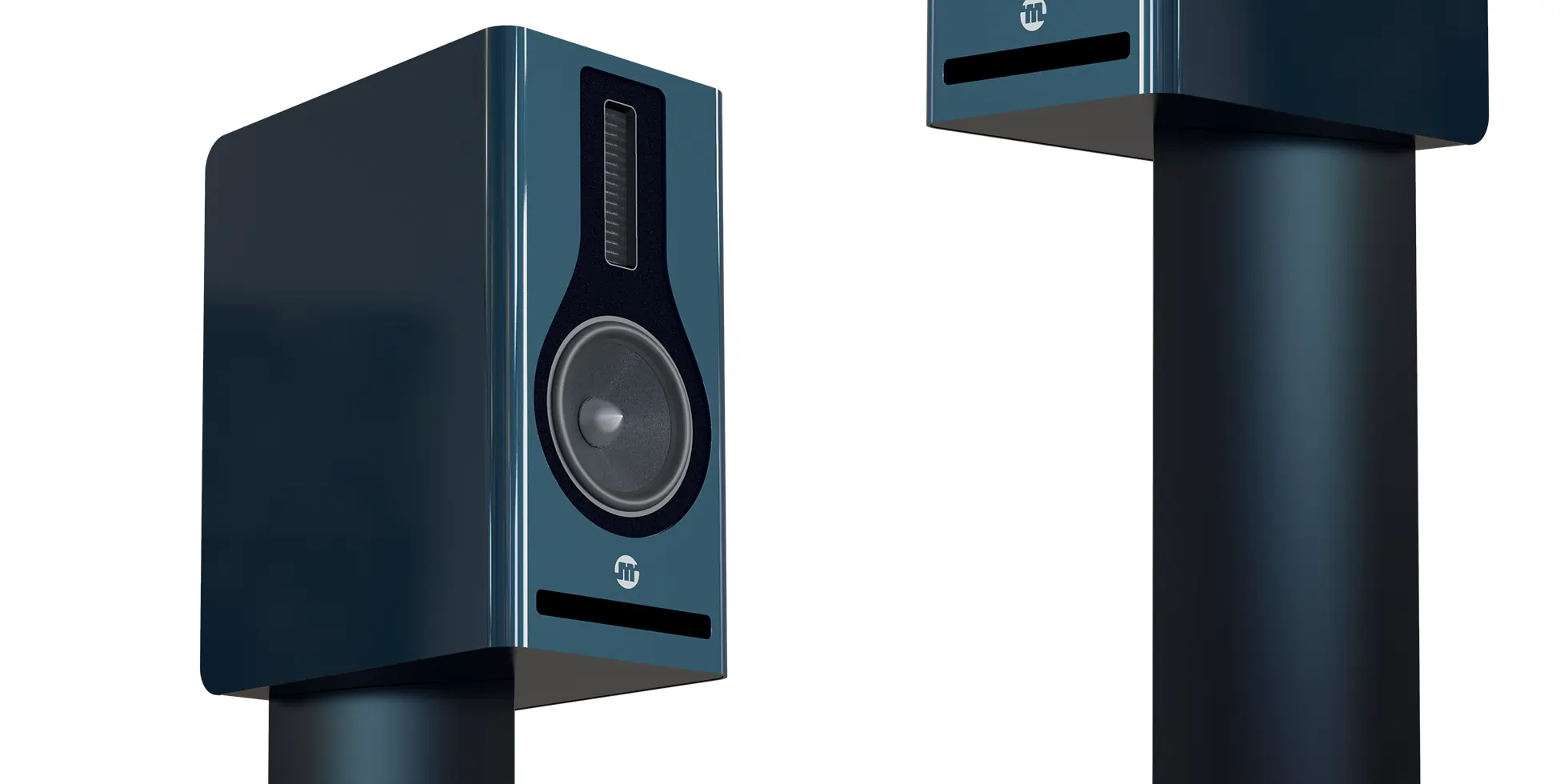
This is Studio JMR’s latest achievement, the JMR Voce Grande. While the aesthetics may distantly but vividly recall the famous Offrande, the filiation ends here. Indeed, the Voce Grande is a completely new model, designed from scratch and therefore without any reference to the past. In fact, it borrows more from Adara than from any other model in the range. That’s how ambitious it is…

The JMR Voce Grande is a fake small speaker. From a distance, you could be fooled. But as soon as you get closer, you get the impression that it’s quite imposing. Don’t be fooled by the monitor topology, which has been adopted here solely for its benefits in terms of spatial dispersion, an area in which it excels, as listening will demonstrate…
Moreover, the loudspeaker is totally integral with its specific stand, which contains all the filtering elements. This is quite practical, as it allows the connection terminals to be placed as close to the floor as possible, thus avoiding additional lengths of loudspeaker cable and, above all, an unattractive aesthetic appearance.
This two-way passive loudspeaker incorporates a device that limits the transmission of vibration energy through the use of materials of different densities (MDF-aluminum). Between these two materials, a specific polymer is inserted, fixed with a polyurethane adhesive that retains a certain elasticity to further reduce cabinet vibrations. On a purely aesthetic level, this translates into the adoption of a U-shaped folded metal sheet that forms the bulk of the carcass, i.e. the baffle and sides.
The complete mechanical decoupling of the speaker base allows the use of Teflon pads as interfaces with the floor.
The proprietary load consists of four progressively damped cavities opening onto a front laminar vent. No absorbers are used, and only certain walls are lined with viscoelastic compound or bitumen. The result is a very homogeneous and rapid group propagation time, for a very articulate, transparent and incredibly fast bass.
The AST midrange/tweeter adopts a surprisingly large 120 mm diaphragm (twice as long as that usually used on other models in the range), enabling a low cutoff frequency of 12 dB/octave at 1.2 kHz. This transducer alone covers the ear’s entire sensitivity range up to 30 kHz. The diaphragm consists of an extremely light, avionic aluminum foil on a pleated silicone backing with a Greek line running through it, surrounded by two neodymium rods exerting a very strong magnetic field. Unlike a conventional ribbon, which pushes the air in front of it, the AST pinches the air between its folds. This makes it much faster and, above all, much less fragile. Extremely high-performance, it boasts outstanding dynamic characteristics and an extremely low distortion rate. The absence of inherent resonance in the material used gives this exceptional (full-range) tweeter outstanding transparency, harmonic gradation and transient qualities.

The 180 mm woofer features a cone made of seven layers of carbon and peek (polyetheretherketone).
Its surface is then plasma-treated to give it a rough appearance. At the center of its 38 mm spool, on a fiberglass support (light and rigid), is an anti-whirling ogive turned in the aluminum mass. Its speeder is aerated with a progressive profile. This boomer features an aluminum bowl and a slow-magnetizing double ferrite magnet. Its linear displacement is very high, and its power handling is excellent, giving it a fast, low bass that’s always very articulate, with a clear sense of impact.
The two-way 12 dB/octave passive filter is centered at 1.2 kHz. It uses top-quality passive components (silver-armatured capacitors and HP1132 silver/copper cable termination, air-core coil in wide, deoxygenated pure copper foil; specific wound resistors covered by a copper tube acting as a heat sink and Faraday cage connected to the system ground). The filter is assembled by hand on an anti-vibration support and positioned outside any electromagnetic field. The components are sorted and matched with a tolerance of 1%. They are soldered directly to each other, and the internal connection is made using HP1132 silver/copper cable with a doubled cross-section.
The set up
Let’s not forget, then, that the JMR Voce Grande are speakers of a certain size, and will thrive in large spaces. Don’t confine them to a room that’s too small, or you’ll miss out on their performance. Don’t be afraid to keep them well away from side walls and rear partitions. They appreciate being installed in a free field. And if you can, don’t be afraid to place them far apart, creating a respectable distance between the two speakers. They have excellent dispersion. When it comes to amplification, you’ll need to offer both quality and quantity. A fine integrated or dedicated separated amplifier will do the trick. Final tip: the speaker cable. Of course, you can use the manufacturer’s 1132 model, but our tests showed us that you could go even further with a superior model. Whether you opt for Ul-Tim, Sonata or Aura, our French manufacturers are the best choice!

The sound
Transmission is always a difficult exercise. Even more so in a father-son relationship. And the more assertive the father’s personality, the more complicated it becomes. Jean-Claude Reynaud’s position was therefore not obvious from the outset. We won’t go back over how he subtly changed the JMR brand from the moment he took over its management. From the outset, attentive observers could see that he had made his mark with finesse but determination, proving that he was carrying on his father’s work without apeing him, or going astray. But while his achievements over the past decade or so have rightly been crowned with success, it is truly with this new Voce Grande that JCR asserts himself as a totally emancipated designer, freed from a “mission” he has long since fulfilled.
Everything about this speaker exudes freedom. You have to listen to it as part of a good system to understand how it presents recorded music with a total absence of constraint. Everything flows, everything is simple, obvious, easy. The discs follow on from one another, and there’s absolutely no need to analyze what you’re hearing, only to enjoy it. This is the absolutely cardinal quality of Voce Grande. Erudite observers of the brand have inevitably wondered about the filiation between the father’s Offrande and the son’s Voce Grande. Indeed, the latter waited a long time before tackling the “myth”. Let me tell you, these two loudspeakers have absolutely nothing in common, apart from the fact that they’re both very musical and belong in the category of “big monitors on stands”. Nevertheless, let’s be totally objective: the new one eclipses the old one in every respect.
The size of the sound spectrum reproduced is broad. It provides a wonderfully homogeneous mid/high register. There’s absolutely no break between the treble and the midrange: one is an extension of the other, and vice versa. The smoothness of this part of the spectrum is quite rare. All the more so as here, sweetness in no way rhymes with roundness or languor. To use a fashionable analogy, Voce Grande combines the qualities of both mineral and organic listening. We benefit from the aromatic persistence of a mineral terroir and the density of the juice. The result is a sensation of fullness. The bass is just as successful, as is the bass/midrange transition, although technically less easy since JCR has chosen to combine two quite different technologies that it particularly likes. The bass is surprisingly low for a loudspeaker of this size, but as usual with the Charentais, always with great tension, expressiveness, and without the slightest flattering and/or coated impression, proof that the load is impeccably controlled.
And then there’s image. Ah, the image… How many specialist reviewers have broken their teeth on this obscure concept. Until you’ve actually experienced a system capable of reproducing a true 3D image (which isn’t a frequent occurrence), it’s hard to imagine what it can do. This kind of performance is not only the prerogative of high-priced systems, but also requires careful installation. In this case, the system was very well optimized by Guillaume from CTA, thanks be to him. And it was under these circumstances that we were able to enjoy one of the finest holographic transcriptions in any price category since the start of our career. Quite simply, the speakers completely disappear as emissive objects. No matter how much you stand up and move around the room, the scene remains surprisingly stable and, above all, very well spaced out in depth. All things considered, the Voce Grande’s spatial reproduction is closer to panels than to electrodynamic loudspeakers. That’s rare enough to be worth mentioning.

Our conclusion
Alors so what, as Miles would say! Well, simply bravo. With the JMR Voce Grande, JCR has cracked the armor. As far as we’re concerned, they could simply stop there, because this speaker is a success. Not rakish or demonstrative, not in the least colorful, but endowed with a lively temperament and sharing the virtues of a chameleon, it knows how to reproduce all messages at any sound level, in a vast range of different acoustics and always with that particularly communicative lightness, finesse and energy. For us, Voce Grande is superior to Adara on a number of parameters. This may come as a shock, but that’s the way it is.
Author: Laurent Thorin
Technical sheet: JMR VOCE GRANDE
- Origin: France
- Price: €7,800
- Dimensions (free-standing): 1100 x 280 x 390 mm
- Weight: 32 kg
- Power rating: 8 ohms (minimum 6.8 ohms)
- Efficiency: 88.5 dB/W/m 2.83 V
- Second-order passive filter: 12 dB/octave centred at 1,200 Hz
- Distortion: Less than 2% from 200Hz to 18kHz at 85dB
- Bandwidth: 38 Hz to 30 kHz (35 Hz at -6 dB)
- Operating power: 40 to 180 W
- Connection: Single wire + 3rd terminal for passive filter earthing


