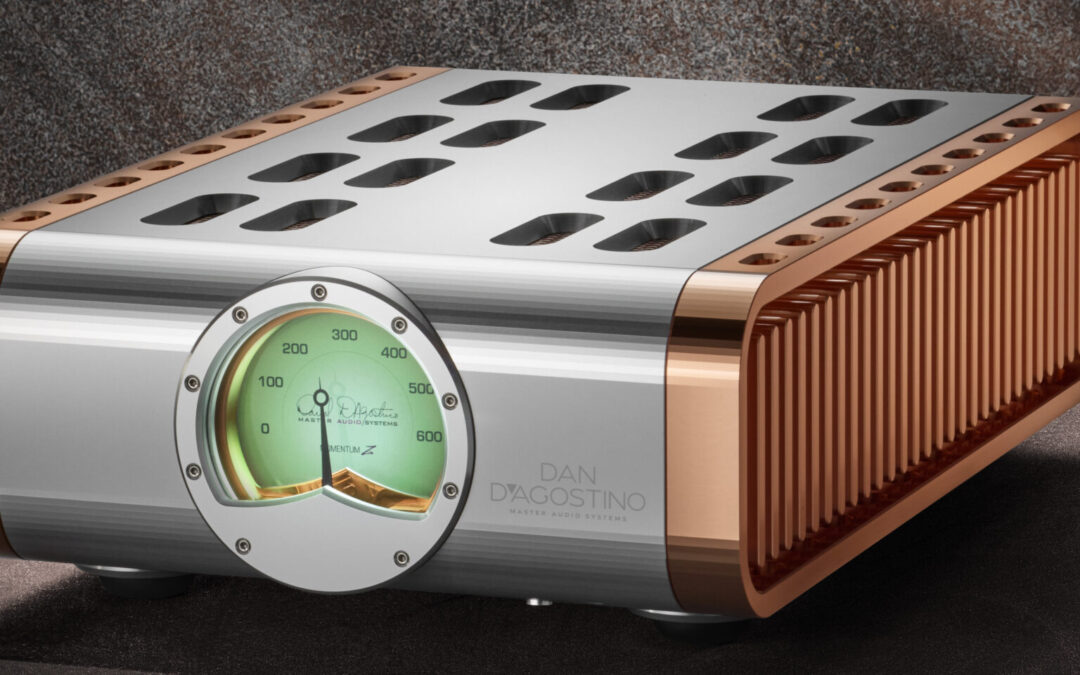
The first product launched at CES in January 2011 by Dan D’Agostino for his new eponymous brand, the Momentum monoblock amplifier, is unveiled at the start of 2026 in a new Momentum Z version.
Rather than adding an M600 above the M400 in the Momentum MvX series, Dan and his engineers preferred to revamp the entire structure to create a new device worthy of celebrating the brand’s 15th anniversary. With a power output of 500 W into 8 ohms, the Momentum Z retains a class AB amplification circuit and has a quadruple power supply that doubles its power to 1,000 W into 4 ohms and redoubles it to 2,000 W into 2 ohms. What’s more, it is Dan’s first device to feature a JFET transistor input stage.
As we saw at the Phoenix headquarters with the chief engineer and Dan d’Agostino himself (interview to be published in VU#64, FR), the Momentum Z is a continuation of the previous mono blocks, but features new, redesigned side heat sinks carved from a 19 kg solid copper plate. With thermal conductivity almost twice that of aluminum, these dissipate heat more quickly and evenly. In keeping with the same modern design, the new Dan D’Agostino retains the front panel display, with a maximum of 600 on this version, and is designed with a dual domain to provide a wealth of information on the digital LCD screen, while its analog needle reflects the elegance of Swiss watches.
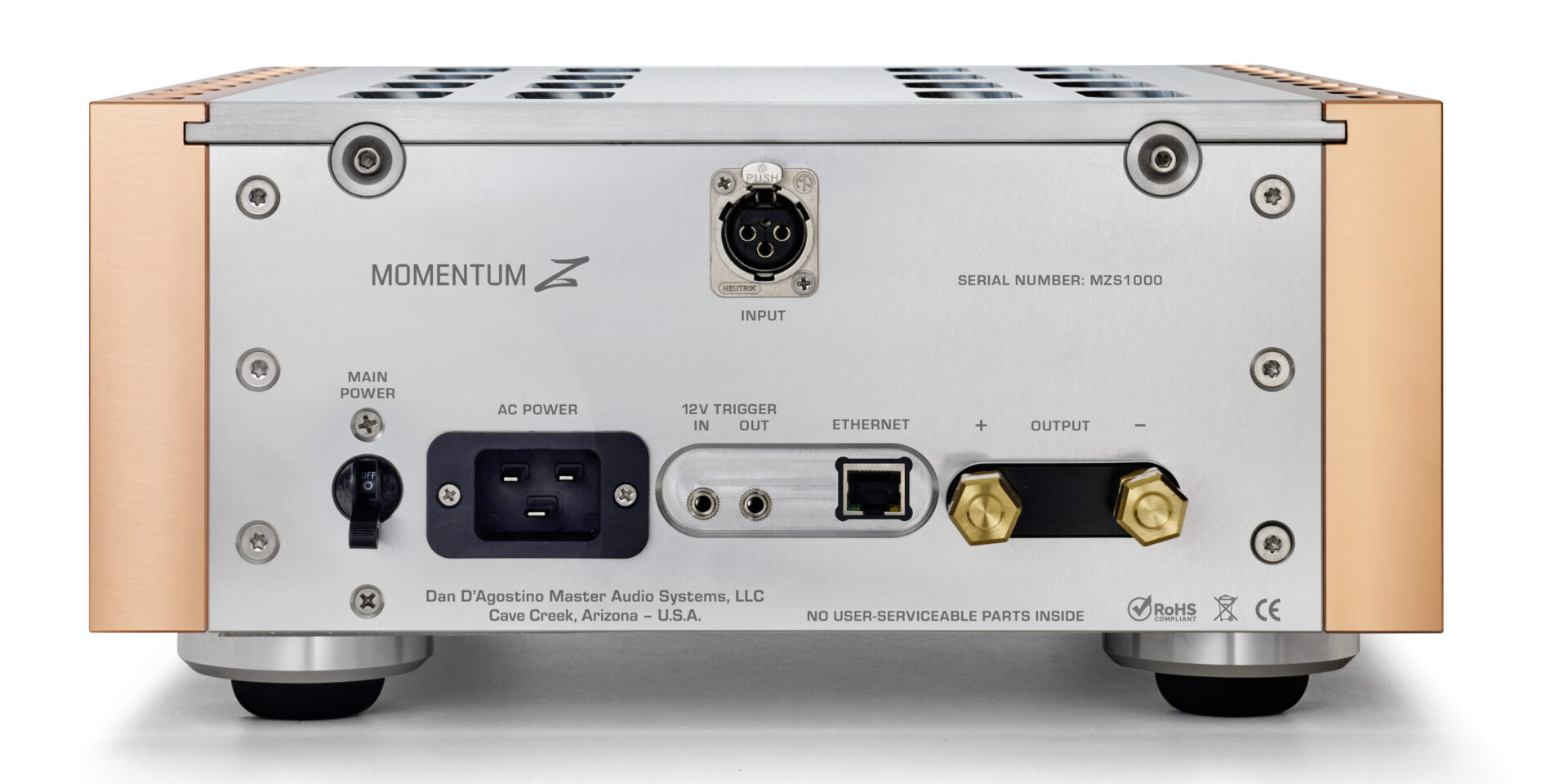
Far from being a simple mono amplifier, although it only offers one XLR input and a pair of speaker terminals, the Momentum Z also incorporates an RJ45 Ethernet connection. This allows for regular management and updates to optimize the software control system. From any web browser, you can view performance data such as operating voltages, temperature, bias, DC offset, 12V trigger status, etc. All this data is continuously monitored and displayed on devices connected via your home network. The same dashboard can be used to control the front panel display settings, with the aim of customizing the user experience as much as possible.
With sound quality comparable to the Relentless models, based on the two listening sessions we were able to conduct in Arizona (at Dan’s house and at the LMC Home Entertainment retailer), the Momentum Z is expected to arrive in Europe early this year at a price higher than that of the Momentum M400 MvX, i.e., more than 51 000 € per unit.
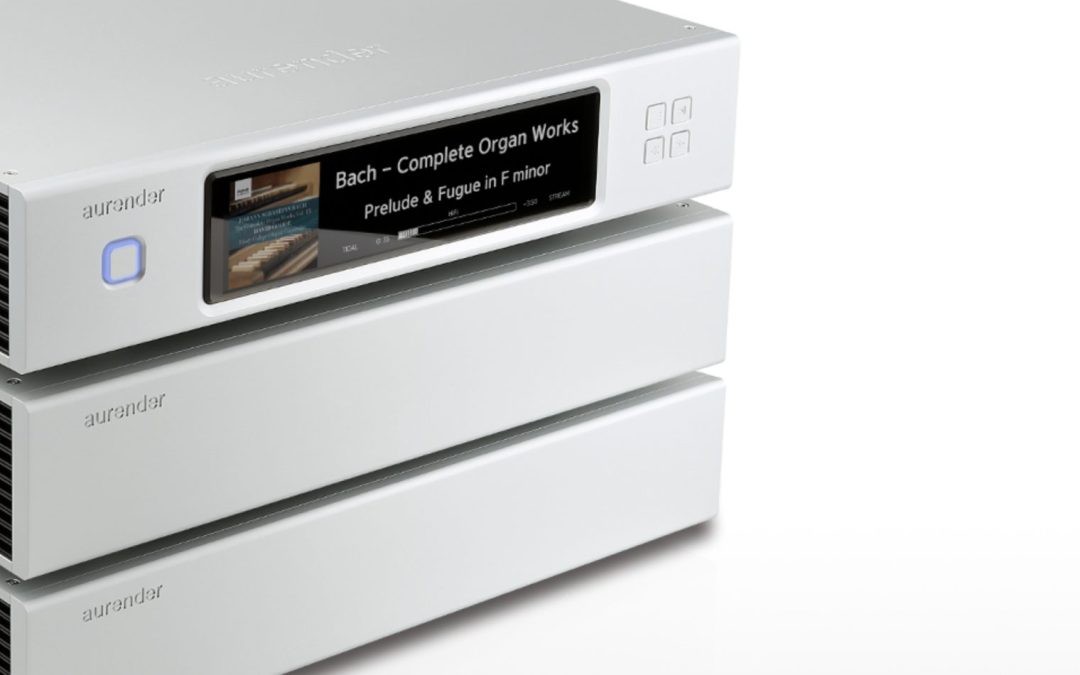
To go one step further than the N30SA (VU#51 review; Remarkable), Aurender launches the N50 server.
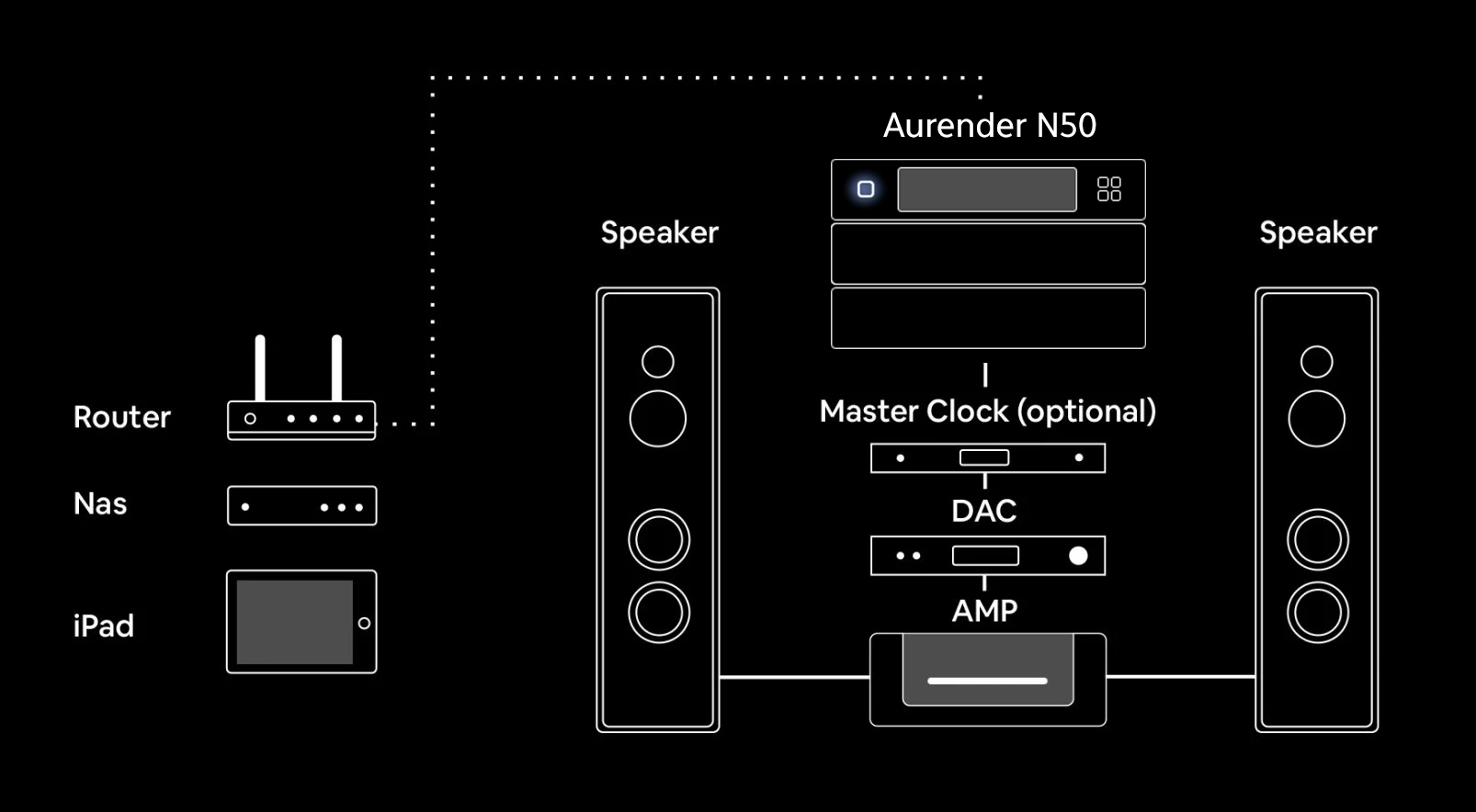
Comprising three aluminum chassis, the N50 separates the server part from the audio and power supply parts. But unlike the N30SA, where the 8.8″ IPS LCD screen is located on the power supply unit, in this new device it joins the unit dedicated solely to data flow management. Here, two USB 3.0 ports allow you to integrate NAS or external hard drive, although we would advise you to prefer internal memory to keep noise to a minimum, available by inserting two SSD disks in the slots provided. Surprisingly, the device doesn’t feature a fiber SFP port, and for the time being remains faithful to an isolated RJ45 port placed next to a USB audio 2.0 output port.
In the second chassis, the power supply is managed by two huge toroidal transformers, each designed to send current to one of the other chassis, vacuum-encapsulated and epoxy-filled under a stainless steel casing. These then benefit from multi-layer filtering on both AC and DC current, again with the aim of eliminating noise as far as possible.
The purpose of the third chassis is to transfer the audio signal from the first box to the DAC, with the most isolated outputs possible and enhanced feedback monitoring via LED. It has two AES/EBU outputs, two coaxial and one optical, plus a clock input for connecting an external clock. But more than the others, it’s the separately placed I2S output that seems best recommended, while the USB is, as mentioned above, placed directly in the first box.
With the Aurender N20 costing 13 500 € and the N30SA 25 900 €, we will leave you to estimate the price of the N50 before it is officially announced!
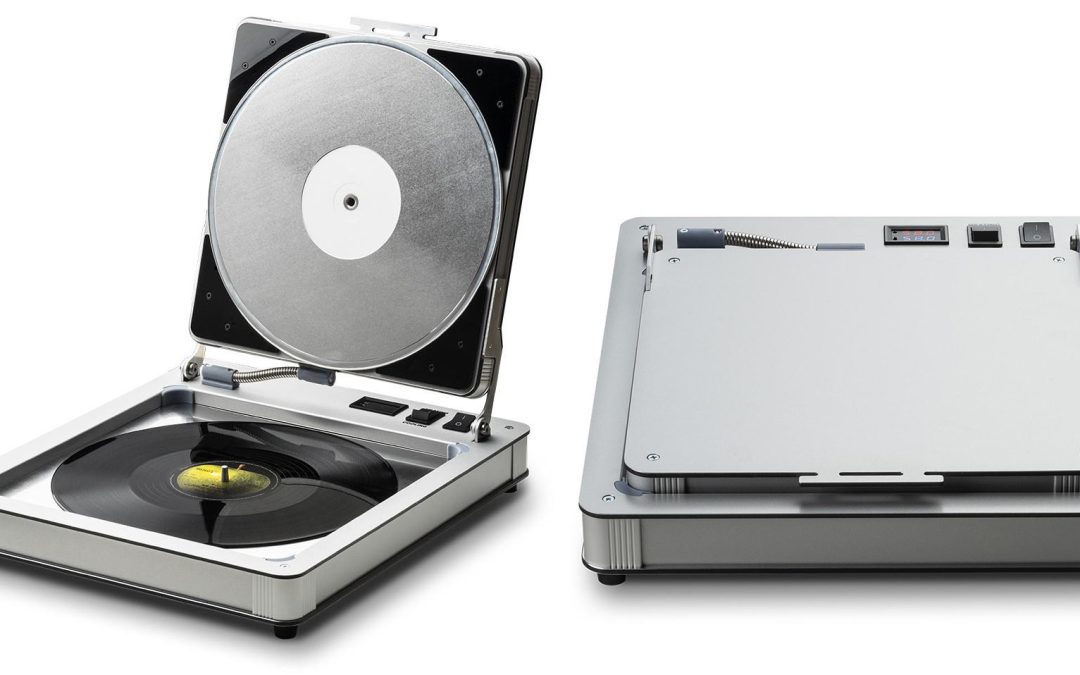
Usually reserved for specialist stores and vinyl enthusiasts with large record libraries, vinyl flatteners could be democratized thanks to Pro-Ject’s Flatten (flattener in German).
Announced a month ago but still not present on the official website, the Flatten is launched at a price of 799 €, four times less expensive than the Furutech DF-2 (3 369 €). Relatively compact, its aluminum chassis weighs a total of 4 kg and protects vinyls by gently heating them to around 60°C with a precision of 2°C, before exerting pressure to make the disc flat, without damaging its grooves.
The protective characteristics and duration of the process are not yet known, but it is clear from the Heating-Cooling switch that the Flatten uses the same solutions as its functional competitors, namely a warm-up to heat the record before flattening it, followed by a long cooling phase to avoid distorting the grooves by releasing the record. Designed for all diameters of vinyl, especially 33 rpm and 45 rpm, we don’t know if this device imposes a minimum weight for vinyl records, as the other flatteners on the market.
The Amethyst corrector preamplifier is the most sophisticated high-fidelity control electronics on the market today. The inventory of its possibilities and connectivity could certainly have inspired Jacques Prévert. Compared with the ST2-Hifi, which introduced the young French company to the world of home audio in 2010, the Amethyst unveiled in 2012 proves to be much more versatile, while retaining the lethal weapon of its predecessor, namely parameterizable acoustic correction based on Trinnov Audio’s patented technology.
As a preamplifier, converter, active crossover and acoustic corrector, the Amethyst can be controlled via the display and two facial knobs or its remote control, via a PC, Mac, smartphone, or tablet compatible with Windows, iOS or Android over an Ethernet network or Wi-Fi, via a Crestron remote control or via RS-232, no less! The Amethyst looks just like the electronics we’ve all dreamed of, but never dared to ask for. High-fidelity system owners who want to do away with the problems of cabling, room acoustics and piles of equipment, unite, or rather relax, because the Amethyst is here to simplify your audiophile life, for the better.
The room, the unknown One of the major and fundamental problems encountered by most installations is, and remains, room acoustics. The most striking example is that of trade shows, where listening rooms are generally not acoustically conducive to clean reproduction. Some exhibitors nevertheless make the effort to treat their listening rooms with absorbent or diffusing panels, but most fail to do so for lack of time. What follows are random demonstrations of room resonances, tonics, and other interferences. A profusion of resources for a sound flop when a proper acoustic treatment would undoubtedly have reversed the trend. But the pot calling the kettle black: if inquisitive visitors to trade fairs have an easy time of it, how many of them, and consequently how many of us, have implemented a plausible acoustic treatment at home? A system, no matter how high-end, will only be a shadow of its former self if the room acoustics have not been mastered. These acoustics can be treated either passively, as mentioned above, with the precise placement of panels, bass traps and other sound traps in the room, or actively with electronics such as the Amethyst.
Active correction Room acoustics are first and foremost a question of coherent sound propagation. Even before talking about treatment, it’s easier to spread sound in a healthy environment that doesn’t distort the sound or spreads it according to a precise pattern. A cinema, a concert hall, an amphitheater or, at the dawn of time, an ancient theater, all these places are or were designed in terms of proportions and materials to propagate sound according to specific criteria. A living room in an apartment or a house would be completely different. What’s more, when you install an audio system, you want to reproduce the entire audible spectrum as linearly as possible. The equation borders on the insoluble… The professional world has adopted passive and active processing through parametric analog equalization and then digital processing, a field in which Trinnov Audio has crossed its first swords. For a long time, high-fidelity speakers held back from these effective solutions, judging the acoustic panel to be unattractive and the electronic correction to be far removed from the straight line with gain. The arrival of digital correction in the early 2000s, with Tact in particular, opened up new avenues, offering tenfold adjustment possibilities. Trinnov’s ST2-Hifi had benefited from the considerable technological advances made over the last twenty years, and from the experience accumulated by the manufacturer in professional circles, to set a new consumer benchmark in active acoustic correction. The Amethyst is even more in line with music lovers’ expectations.
Hello microphone! What sets the Amethyst apart from all other corrective preamplifiers on the planet is its unique microphone, which allows measurements in all three dimensions. It consists of four capsules, each mounted at the top of a brass tube and all resting on a cylindrical body to form a tetrahedron (three-sided pyramid). Calibration measurement resolution (speaker distance, height and spacing) is plus or minus 2° in all directions. Compared with the ST2-Hifi, once the microphone has been set up in the listening position and at ear level, calibration is simplified thanks to a calibration assistance menu. This step-by-step menu guides the user through an initial optimization in just a few minutes, generating five settings – Comfort, Natural, Neutral, Precision and Monitoring – in line with the type of listening required. It all starts with the room impulse response for each speaker. The Amethyst software then calculates the filtering that will counterbalance room effects such as primary reflections and reverberation time, and speaker non-linearities. This filter proposal is then applied in real time. In any case, a correction filter acts with a sound effect, however slight, that can modify the system’s signature. So, in addition to the five basic settings, the device offers the possibility of fine-tuning the response frequency, phase, and delay of the filtering by means of twenty-nine “presets” that can be memorized by the user, aided in his choices by the initial calibration. It’s worth noting that the Amethyst’s ability to consider the overall “acoustic field” in the room helps create a correction that remains effective even if the listener moves around the sweet spot. At low frequencies, Trinnov reduces the influence of resonance modes below 300 Hz by introducing a compensation filter for each detected mode. It also analyzes the room’s frequency response for colorations generated by room reverberations in the midrange and treble. These colorations are reduced by filtering. And to make all this in-depth work a reality, the Amethyst provides a battery of measurement curves (amplitude-frequency, phase-frequency, impulse response, etc.) that can be downloaded onto a simple USB key to visualize its corrective effects. Finally, an important feature of the Amethyst is its 2D/3D Remapping technology for virtual speaker repositioning. Based on the calculation of the acoustic emission produced by each loudspeaker, and on the notion of spherical harmonics (Fourier-Bessel decomposition), the process calculates the ideal position of the loudspeakers (Ideal Radiation Matrix) in the listening room, in order to achieve coherent spatial diffusion in tune with the musical content. In the case of an unsuitable room where the speakers cannot be ideally positioned, the Amethyst defines the correction to be made to the input signal (Remapping Matrix) to recreate an ideal acoustic emission.
And the music was After acoustic optimization, it’s time to listen to the Amethyst within the system. Connectivity is extensive, with no less than eleven inputs and four outputs, both analog and digital. Knowing that the Trinnov has two internal converters, one A/D and one D/A, we can guess that it can convert an incoming signal from one format to the other, and vice versa. It also has the ability to combine analog outputs in different configurations, including one for biamplification. Hence the presence of an active filter that emulates various selectable structures in the digital domain (Bessel, Linkwitz-Riley and Butterworth up to 4th order). One of the analog inputs can be switched either to line level or to MM phono input, called HybriD Phono. The term HybriD refers to the fact that the highly innovative RIAA correction is built around an analog scheme for bass and low midrange up to 1 kHz, then digital processing with a dedicated algorithm takes care of the kilohertz aftermath. The Amethyst can also be used as a network renderer using the UPnP protocol, so it can receive PCM files (WAV, AIFF, OGG and FLAC) up to 24/192 via Wi-Fi or wired via its Ethernet port. It thus acts as a slave on the network, with the server providing its library as a master. Finally, the presence of a clock input means that the Amethyst can be synchronized by an external clock encoded on an S/PDIF or AES/EBU source to be defined in the device’s programming menu. In master mode, the Amethyst’s default mode, all data is resynchronized by the internal clock, and a buffer prevents loss of synchronization with the incoming signal. A few details before concluding. The analog and digital audio stages are supplied by a linear power supply (toroidal transformer, filtering, and regulation), while the other electronic sections are supplied by a switch-mode power supply, and inputs are switched by relays. A fine piece of work for electronics designed and built in France.
THE SET UP Contrary to popular belief, the Amethyst is extremely simple to set up, taking no more than half an hour. Purchasers can, of course, ask their dealer to carry out the operation. We were lucky enough to benefit from an on-site demonstration by Antonine Galipon, Trinnov’s highly professional ambassador, who was kind enough to explain all the subtleties of her machine to us. And once the network connection has been made, the control interface installed, and the part calibrated with the ad hoc microphone, all that’s left to do is sit back and enjoy the wide-ranging possibilities of this remarkable machine.
THE SOUND The Amethyst already behaves like an excellent preamplifier-converter, without its acoustic corrector even coming into play, and it doesn’t fall short in the least for the price it’s offered at. It features natural sound reproduction and wide bandwidth. The sound is magnificently clean, fluid and light, fast and serene. The spectrum is rendered with perfect articulation, marked presence, and above all an “invisible” transition between the different registers, much like a very good full-range amplifier. Neutrality and responsiveness. Next, we switch on the Acoustic Corrector, and enter a world we didn’t even know existed. In fact, just a few seconds before, we were already satisfied with what we heard. But thanks to 2D/3D remapping, we realize that the system’s scope for improvement is just incredible. First, the “new” listening surprises us by its anti-spectacular character. It’s as if we’d turned down many of the sliders on a gigantic equalizer. Except that in this case, the selection is masterfully judicious. All the frequencies that previously tended to color the signal are readjusted to offer an infinitely more natural, clearer, and unexpectedly accurate sound. And this analysis is carried out on a single piano disc (Alicia de la rocha, Granados)! In fact, we go back and forth several times, with and without the corrector, to analyze what’s going on. We have the same sensation as if the speakers had been positioned in an absolutely ideal way in the room, in defiance of all rules of domestic comfort, but also that the room would have been acoustically treated in an ideal way, which in both cases is incompatible with family life; 90% of systems, even top-of-the-range ones, are in living rooms!
What was obvious with a solo piano is even more obvious with a symphony orchestra. The London Symphony Orchestra performing Maurice Ravel’s Rapsodie Espagnole under the baton of Claudio Abbado is a real treat for the senses. It’s one of the very first times we’ve felt so strongly immersed in the sound recording venue. We’re in the room. The dynamic contrasts are mind-blowing. The revs are lightning-fast. And all this with astonishing smoothness, thanks to a total absence of distortion and compression. The system seems totally liberated. Moreover, while ProAc are remarkable monitors, they don’t produce any real extreme bass, and the Amethyst manages this very well too, achieving a perfect optimization between the characteristics of the room and the speakers. On a purely electronic 24-bit native range (Granite by Martin Nonstatic), the bass presence is palpable and physical. The degree of bass analysis is surprisingly precise. It’s like listening to headphones, with the added physical pressure. Of course, the Amethyst allows us to listen (much) louder, with much greater comfort. Not a good point for neighborly relations, but a particularly obvious indication of the system’s good health… We could multiply the examples and extend the list of benefits of this miraculous machine. Admittedly, at €10,000, the Amethyst isn’t cheap, BUT let’s not forget that it combines the functionalities of 4 links (preamp, DAC, network player and acoustic corrector), that it’s pretty, pleasant to use, very well made, and French to boot. So no, I tell you, the Amethyst is a DEAL.
ANALOG STEREO INPUTS 2 XLR (20K), 2 RCA line, one switchable to phono
DIGITAL INPUTS 2 XLR AES/EBU (110 ohms), 2 RCA S/PDIF (75 ohms), 2 Optic Toslink S/PDIF, 1 BNC Word Clock
ANALOG STEREO OUTPUTS 2 XLR, 2 RCA
DIGITAL OUTPUTS 2 XLR AES/EBU (110 ohms), 2 RCA S/PDIF (75 ohms), 1 BNC Word Clock
OUTPUT CONFIGURATIONS Stereo, double stereo, bi-amplification, 2.1, 2.2, 3.0 or LCR (left, right and center), 3.1, LCRS (left, right, center and surround) and quadraphonic UPnP/DLNA-compatible network input (Ethernet and WiFi)
INTERNAL PROCESSOR Intel Duo-Core 1.8 GHz, 64-bit floating-point computing, 1 GB DDR3 hard disk, cooling (computer part) via heatsink and fanManufacturer’s we
The Norman electronics manufacturer officially unveiled its new integrated amplifier at the Festival du Son et de l’Image last October at the Pullman Paris Tour Eiffel hotel. This is the IN300, the prototype of which we were able to discover in Munich in May 2016. From its name alone, it’s easy to imagine that it stands between the IN200SE, with its many years of excellent and loyal service to audiophiles, and the IN400SE, the flagship of the Brécey workshops. A glance at the data sheet confirms this positioning in the Atoll integrated range. But beyond a very popular appearance, appreciated by Atoll’s first generation of audiophiles, there are more marked similarities with the 400 series.
The two control buttons on the front panel of the IN300 bring it functionally closer to the IN400 than to other INs. The oblong window of the central display is identical to that of the big brother. A glance at the rear also reveals the presence of digital inputs, indicating the standard installation of a DAC converter, as on the IN400. The IN300 is therefore more like a small IN400, as Stéphane Dubreuil confirmed during the presentation of the device at the Son et Image festival, a device concentrating all Atoll’s know-how at a price that places it midway between the 200 and 400. The integrated range is now completely balanced, with the 300 closing the gap that had opened up between the 200 and 400.
An accessible high-end spirit You may have already noticed that the technical specifications of the IN 300 are quite similar to those of the 400, and you’re thinking, after all, why invest in a 400 when the 300 does basically the same thing? The nuance is in the “overall”. And we know the Atoll team and their design philosophy well enough not to have imagined for a second that they could design electronics that would outrageously overshadow another model in the range. At Atoll, there’s a precise place for every product reference, and the IN300 fits between the 200 and 400 without rendering obsolete. In terms of circuit topology, all Atoll’s technological attributes have been carried over to the IN300, which also benefits from certain advances introduced in the IN400SE. The symmetrical layout develops 150 W at 8 ohms per channel and around 260 W at 4 ohms from a triple push-pull output stage with Mos-Fet transistors. By way of comparison, the 400 with its quadruple push-pull power output reaches 160 and 300 W at 8 and 4 ohms respectively. We’re working on a similar energy basis, with class AB biasing at a sufficiently high quiescent current to deliver the first ten or so watts in class A. The circuit layout is a melting pot of what has already been done on the IN200 and IN400. The manufacturer has installed two toroidal transformers of over 440 VA each to supply the left and right channels independently. This is the best way to achieve optimum channel separation and lower crosstalk. Capacitive filtering exceeds 86,000 uF in a configuration of twelve electrochemical capacitors with very low ESR (equivalent series resistance), like that of the IN400. These models are manufactured to Atoll’s exclusive specifications. A shielded cable developed by Absolue Créations carries the mains from the IEC socket to the transformers, with a clear audible difference from lambda cable. As for the power transistors, they are mounted one by one on independent finned heatsinks, a technique derived from the IN200 that increases cooling efficiency and lowers cost compared to a traditional heatsink on which all the transistors would have been mounted.
High expectations As in all the manufacturer’s other models, the IN300 is reserved exclusively for discrete components. Two boards compete for circuit space, the main one grouping all analog audio as a power supply, and a second board attached to the back of the digital inputs, which is none other than the digital-to-analog conversion board. All stages upstream of the output stage are polarized in pure Class A, with a reduced overall negative feedback rate. Mundorf’s polypropylene-film link capacitors are concealed under metal shielding covers to preserve their total immunity to interference (these capacitors are housed in metal cylinders which act as true antennas). The two orange connectors on the card stand define the location of one of the two optional plug-in phono cards. Volume control is provided by digitally switched attenuation resistors. The operation is handled by a Texas Instruments LM1972 circuit, a CMOS-technology stereo attenuator with a variable step size of 1 dB between -78 and -48 dB, then 0.5 dB between -47.5 and 0 dB. As with the dual power supply, this pure and simple separation of the volume control of the two channels considerably improves their guaranteed electrical separation of over 100 dB, and consequently the stability of the stereo image and the focus of the sound sources. The digital-to-analog conversion strategy is orchestrated by an AK4490 chip, a new-generation Asahi Kasei DAC with very high resolution. This 32-bit chip accepts PCM sampling frequencies up to 768 kHz and DSD up to 11.2 MHz. Data first passes through data receivers, a Wolfson WM8805 for S/PDIF information and a USB33 series SMSC for the USB stream, which is then routed to an XMOS chip. No less than four quartz crystals synchronize the various signals. A Roving Networks RN52 module with integrated antenna ensures Bluetooth connectivity with compatible external media.
THE SET UP Weighing in at over fifteen kilograms, the IN300 is a heavyweight, and a suitable stand is essential. On our Centaure L, it has found a solid foundation, conducive to reconciling its powerful power section with its subtle digital stage. As far as cabling is concerned, the choice is quite open: Absolue Créations, Esprit and Furutech provided us with excellent results. The IN300 deserves a good power cord, and a longer initial warm-up time to bring its DAC up to temperature. Finally, when it comes to loudspeakers, the field is wide open, as this amplifier boasts a more than respectable power supply and a surprising reserve of power.
THE SOUND Over time, Atoll’s sound has blossomed naturally, achieving an undeniable balance. To put it mildly, Atoll has mastered the seductive side of neutrality. In fact, with the IN300, the Norman brand offers an amplifier with a mature, composed sound. Here’s a machine you won’t choose just for reason, but also for passion, such is its endearing character. On first listen, the fundamentals are already clear, based on a wide range of available power that expresses itself smoothly. The IN300 doesn’t try to convince: the presence it imposes on the recording is enough to be sure. We appreciate its density, full but never overloaded timbres, singing midrange and finely chiseled treble. Its strength lies in its ability to suggest real muscle, while remaining subtle. In electronic music, for example, the tension of the bass strings and the delicacy of the spatial effects in the high midrange can be perceived with accuracy. The IN300 deciphers modulation with precision, transcribing it in the clearest light! On less crystal-clear tracks, this ability to deliver a wide frequency range without a break between registers is palpable. The bass extends the high midrange with ease, without the slightest trace of drag or rupture. At the upper end of the spectrum, the IN300 delivers a freedom of expression and articulation of the highest quality. The result is a smooth, fluid listening experience, particularly in terms of sound image, where the key word seems to be “aeration”. In terms of objective qualities, the listener can’t help but be surprised by the very fine dynamic range, which confirms the ability of the power supply and analog circuits to transcribe the liveliness of any type of message.
OUR CONCLUSION We’ve said it many times, but Atoll is THE French electronics manufacturer today, and its range is expanding with a very good vision of the market. The Normandy-based company certainly has many successes to its credit, but with the IN300, it offers a highly musical, hyper-complete product that titillates the references in the niche. The greatest quality of these electronics remains their naturalness and their ability to make most of the files we’ve given them to work with sound good, without ever repeating themselves, and always finding the right angle, the right proportions, the perfect lighting… With the IN300, Atoll is undoubtedly one of the most musical manufacturers in this price range, offering nuanced, expressive listening that can be enjoyed for hours on end without the slightest auditory fatigue.
TECHNICAL SHEET
PRICE € 3000
DIMENSIONS 440 x 100 x 320 mm
WEIGHT 15 kg
RATED POWER 2 x 150 W at 8 ohms, 2 x 260 W at 4 ohms
ANALOG INPUTS 4 RCA line, one of which can be converted to phono with an optional card, 1 RCA bypass, 1 XLR line, 1 RCA Tape In
DIGITAL INPUTS 4 S/PDIF (2 RCA and 2 Toslink, PCM 24/192), 1 asynchronous USB-B (PCM 32/384 and DSD 128), 1 Bluetooth receiver
ANALOG OUTPUTS 2 RCA Pre-Out, 1 RCA Tape Out, 1 6.35 mm jack (headphones), 1 pair of speaker outputs