
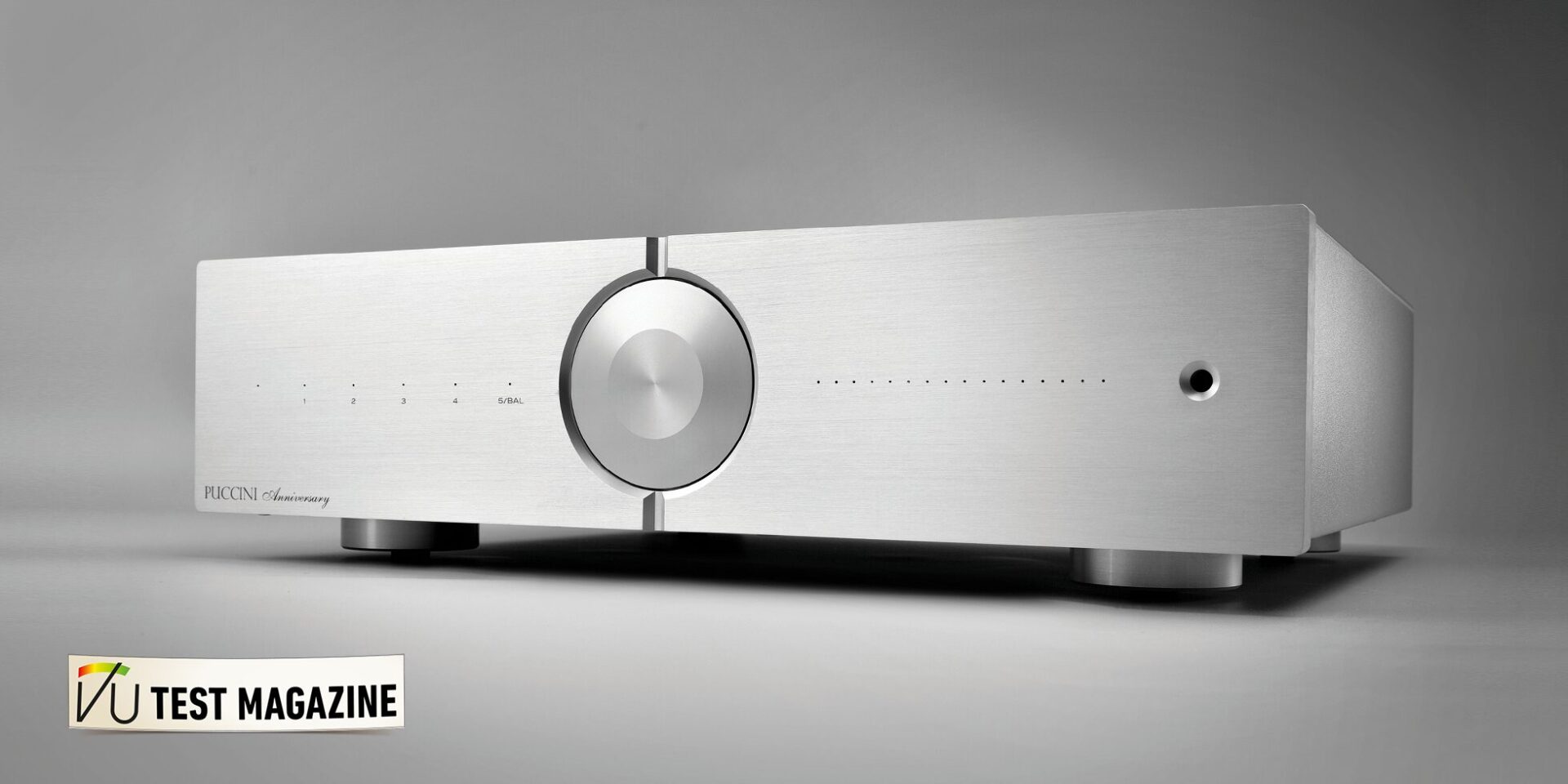
It has already been 20 years since the Italian designer of audiophile-quality electronics introduced the Audio Analogue Puccini Anniversary. The first piece of equipment produced by Audio Analogue, the Puccini also made its mark on the world of high fidelity by quickly joining the very exclusive club of equipment considered to be the benchmark in power amplification. Still in the catalog and regularly revised, the Puccini Anniversary is more than ever an amplifier to be reckoned with.
The Puccini has a little secret that enables it to deliver such high performance. It lies in the very structure of its power stages and their operating principle. The Audio Analogue Puccini is part of the extremely small family of power amplifiers without negative feedback. This idea emerged in the Airtech laboratories.
While some may consider this a minor design detail, the impact of this choice on sound reproduction is far from insignificant. This absence of negative feedback, also known as “zero feedback” architecture, significantly reduces the amplifier’s sensitivity to the type of load, or its behavior, that it is designed to drive.
This eliminates the risk of oscillation, as well as the appearance of resonance peaks in the highest frequencies or saturation of the input stages. All of these factors guarantee sound reproduction that is free from coloration or distortion.

However, this choice of a structure without counter-reaction is not enough to give the Puccini its exceptional performance. Audio Analogue has also worked hard to lower its output impedance so that it can handle even the most delicate speakers and those with the highest current requirements. To achieve this, its output stages feature a triple push-pull on each channel. The same applies to distortion reduction. On the Puccini, it reaches the limits of what is measurable. Finally, the power supply uses devices that guarantee the Puccini’s excellent immunity to external electrical interference.
It should be noted that Audio Analogue has been particularly generous in the design of this power supply. A 700 VA toroidal transformer forms its heart. This allows the push-pull power stages to express themselves fully, even when the most extreme dynamics occur.
However, in order to convey energy between the power supply and the output stages while taking full advantage of the most intense current management capabilities, it is still necessary to avoid losses in the amplifier’s internal wiring.
To meet this requirement, the Puccini features internal wiring designed around 7N purity OCC solid copper conductors.
Similarly, all printed circuit boards feature gold-plated copper tracks that are twice as thick as those found in standard circuits, in order to improve electrical conductivity. Finally, as is traditional in high-quality equipment, the Puccini adopts a dual-mono internal architecture. Each channel has its own circuitry, which significantly limits their interaction.
The Puccini has high-quality connectors for connecting to other components in the system. On the input side, it is directly compatible with the highest quality sources as it is equipped with an XLR input. For more conventional components, there are four dedicated line-level analog inputs on RCA connectors.
These connectors are directly connected to the electronic boards and the desired source is selected via relays. It is worth noting that the Puccini’s volume control uses very high-quality Analog Devices potentiometers. For speaker connections, Audio Analogue has opted for pairs of high-quality, generously sized screw terminals that can accommodate both thick cables and banana plugs or spade connectors.
Finally, the Puccini comes in an elegant, minimalist case. Its front panel is made from a 14 mm thick solid aluminum plate. Although the only visible control appears to be the volume control, the Puccini is designed to work in perfect harmony with the components it is connected to.
For example, its volume control has four selectable scales. This makes it possible to adjust its progressivity according to the efficiency of the speakers or your listening habits. Similarly, the brightness of the LEDs indicating the input in use is adjustable. They can even be completely hidden.

The set-up of the Audio Analogue Puccini Anniversary
The Puccini Anniversary’s overhead line should not obscure its weight of almost 16 kg. Therefore, a rigid support is essential. Its particularly comfortable available power will allow it to easily power a wide range of speakers in comfortable or even spacious environments.
The sound of the Audio Analogue Puccini Anniversary
There is no doubt that the designers of this Italian brand have a particular sound in mind, and it is in the realm of elegance and refinement that we find it. With many complex musical messages, the Puccini Anniversary unfolds its modulation with an innate sense of fluidity.
It seems to play with all the sonic pitfalls thanks to a clear and defined vision of the different melodic lines that make up the varied excerpts we were able to submit to it. This beautiful acuity ensures its readability at all times. Precise without being inquisitive, exhaustive without being robust, it excels in the difficult exercise of balancing lightness and density.
However, it delivers on low notes with a firmness reminiscent of its predecessor, the Maestro, albeit slightly less so. The three-dimensional space recreated by the Puccini Anniversary allows you to appreciate a deep horizon where the sections are well defined. Some listeners may prefer a more full-bodied sound, but the Italian amplifier has chosen a more refined approach to support its message.
This allows it to always be relevant, never excessive, and always in control. And to corroborate this philosophy, it strives to offer a smiling face to the musical phrase it reproduces, bathing it in light.

Our conclusion
Despite its age and long history in the catalog, the Puccini Anniversary is an amplifier that is still very much relevant today. There is no reason why the great qualities it displayed several years ago should have faded with time, proving that a well-designed and well-made product can stand the test of time.
This is fortunate and reassuring for consumers like us. And while we may regret that its price has risen, the same can be said of many other devices, especially at a time when price increases have unfortunately become commonplace. For all these reasons, we consider this amplifier to be still relevant today and believe that consumers are right to include it in their selection of integrated amplifiers in this price range.
Author(s): Pierre Fontaine
Technical Sheet: Audio Analogue Puccini Anniversary
- Origin: Italy
- Price: €5,500
- Dimensions: 445 x 120 x 390 mm
- Weight: 15.5 kg
- Power
- 2 x 80 W into 8 ohms
- 2 x 160 W into 4 ohms
- 2 x 30 W into 2 ohms
- Frequency response: 0 to 80 kHz at -0.03 dB
- Signal-to-noise ratio: 11 dB
- Output impedance: 0.17 ohms
You might be interested: ACCUPHASE E5000 vs E800: An Impressive Pair


