
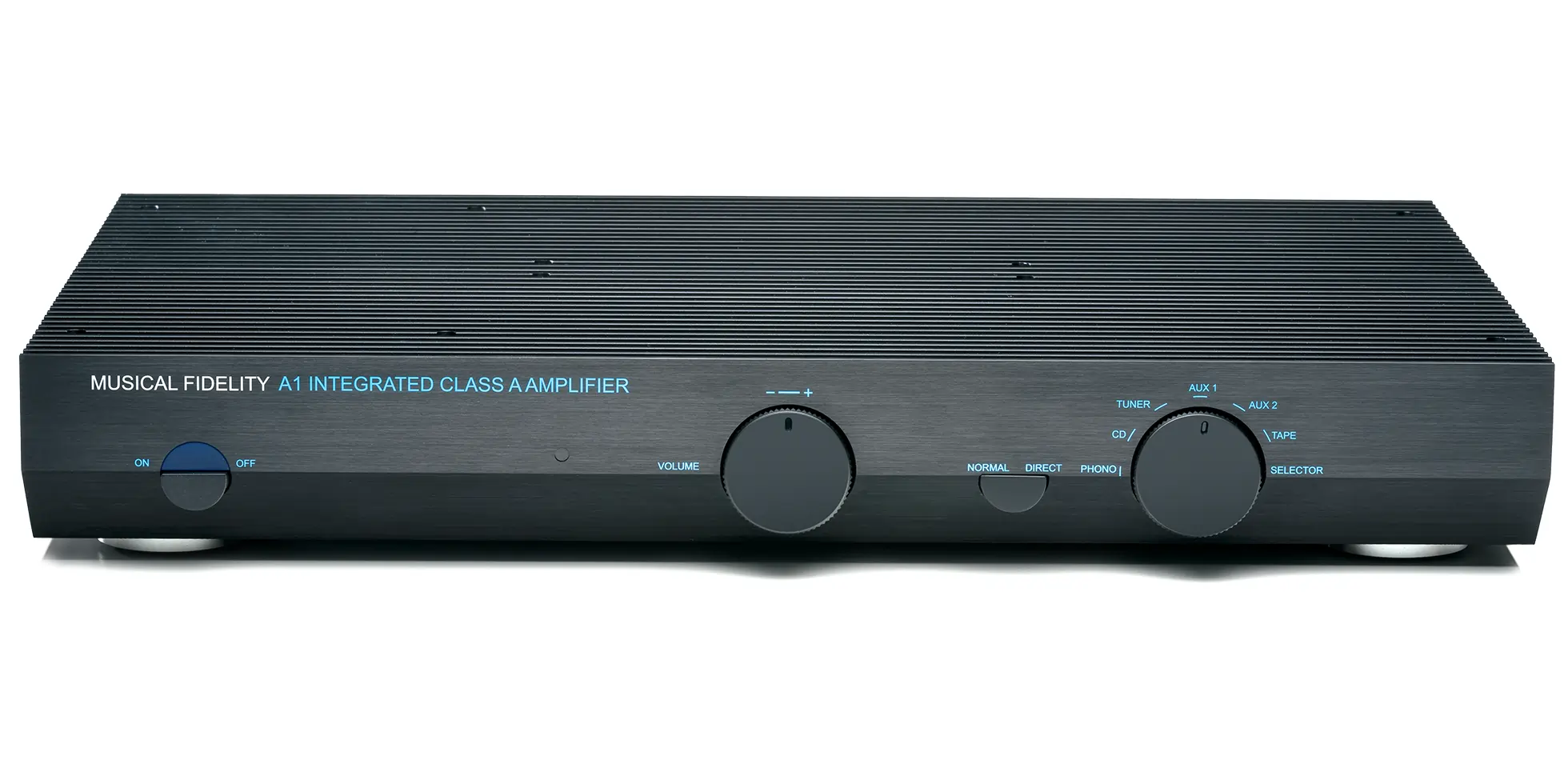
After almost 30 years, the Musical Fidelity A1 is back! This is great news for all music lovers and we must applaud the initiative of the British manufacturer Musical Fidelity for this comeback. And the other good news is that it is not a limited edition but a mass-produced item. So there will be enough for everyone.

In 1988, the arrival of this British integrated amplifier caused a great deal of ink to be spilt, particularly because its rare feature at the time was that it operated in pure class A. Needless to say, it was not something you could find on every street corner. The A1 only developed 20 W, but what watts!
At the start of the 2023 academic year, the new A1 arrives. The British manufacturer has had the intelligence to reissue it almost identically. The only visible difference is in the screen printing, the feet and the presence of a small, minimalist remote control entirely in keeping with the spirit of the device. The A1 showed that amplifiers were not limited to high power. Today, in 2023, for the first time since its initial release, here is a new version with an updated transformer, modern low-noise power supplies and components.

The Musical Fidelity A1 is therefore built around a completely discrete and symmetrical class A topology. It is capable of delivering 25 W of pure power for an 8 ohm load with a maximum output of 25 A. Although the figures may seem rather low, the ability of the output stage to power difficult speakers is a small miracle in itself, according to MF.
The amp is designed in dynamic class A, so if the class A current is exceeded, it automatically allows more. It smoothly ‘slips’ (not switches) into class B operation, temporarily allowing the additional current required.
The new A1 has been equipped with a toroidal transformer (original from 1988) with more efficient dual mono split rail windings. The amplification stages are powered by completely independent left and right power supplies for better power management and stereo imaging, and each power amplifier now has a dual power supply capability. Transformer noise and heat dissipation are reduced thanks to improved efficiency and updated components. The main power supplies are filtered for better regulation and reduced power-on surge.

The low-noise preamplifier circuit is identical to the original 1988 model and, as mentioned above, benefits greatly from the improved, fully smoothed and regulated power supplies. One of the most noticeable changes is the addition of a new direct switch in the preamplifier stage. This switch allows you to completely bypass the gain block before the volume control, which results in a gain reduction of approximately 10 dB. This feature is particularly advantageous when working with modern or high-speed digital sources, allowing you to fine-tune the range of your volume potentiometer and accommodate sensitive speakers. In addition, a significant improvement has been made to the volume potentiometer itself, which has now been replaced by a top-of-the-range model from the ALPS RK series. This high-end component guarantees superior performance and increased precision. What’s more, the potentiometer is now motorised, allowing you to adjust the volume from the comfort of your sofa using the new remote control provided.
The A1 uses a discrete current mode input stage for low-noise amplification of MC and MM cartridges. A low-noise current-to-voltage conversion stage is used for additional amplification and RIAA equalisation. Automatic input impedance matching for the selected MC input, as well as increased gain, enhance the versatility of the A1 phono stage.
The set up
This is a compact device that will take up hardly any space but, as its top cover indicates, under no circumstances should anything be placed on top of it and sufficient air must be allowed for it to be able to effectively dissipate its excess calories. Don’t be fooled by the 25 W on the technical data sheet because this small amplifier is capable of powering respectable sized column speakers. Make sure you choose neutral and transparent cabling.

The sound
In the early 1990s, audiophiles were introduced to a small integrated amplifier that was bubbling in every sense of the word. The A1 of the time was a little marvel of musicality. I can testify to that: I bought one! Warm, lively, hyper-alive, this amp was particularly appealing. Imagine our surprise this year, as we walked the aisles of High End in Munich, to come face to face with a contemporary reissue of this device! And here it is today on our shelves. The least we can say is that this device has not aged a bit, at least in its current version. It has of course benefited from the use of current components, which are much more reliable and more rigorous. So, first and foremost, there is that wonderful communicative joie de vivre. The A1 is characterised above all by its rhythmic flow. It amazes its audience with a subjective power that is much higher than the advertised 25 W.
But that, of course, is to be credited to the magic of pure class A. In fact, the timbres are of an astonishing density: the sound has substance, thickness. This is very clear on a voice, a piano or a trumpet. In the same vein, the sound stage is reproduced with a highly credible structure. What is surprising is its depth, with well-hierarchised sound levels. And it is in most of the compartments of the set that we find this notion of flesh. No, only the A1 sounds very good, but its warmth makes it completely irresistible.

Conclusion
It is impossible not to fall under the spell of this utterly charming product. The manufacturer has had the intelligence to reproduce the Musical Fidelity A1 in a way that is almost identical to the original version. Only the minimalist remote control gives it a functionality worthy of its time. The few changes are on the inside with an optimised circuit and stronger components. We warmly applaud the arrival of this device, especially as it is priced very reasonably.
In the same vein, we were thrilled by the announcement of the return of the Nait by Naim, but much less so by its price, which in our opinion is a bit excessive. Vintage is in fashion and it’s good to see it come back in a contemporary way, but let’s not overdo it. As far as we’re concerned, the A1 is a success in every respect and we salute it wholeheartedly!

Author: Laurent Thorin
Technical sheet: Musical Fidelity A1
- Origin: Great Britain
- Price: €1,599
- Dimensions: 440 x 68.3 x 283.32 mm
- Weight: 10.5 kg
- Power: 25 watts per channel at 8 ohms
- Voltage: 42.5 volts peak to peak
- Damping factor: 150
- Gain (max. volume): 32 dB (direct mode), 42 dB (normal mode)
- Signal-to-noise ratio: 82 dB
- Channel separation: 85 dB
- Frequency response: + 0, -1dB, 10Hz to 40 kHz
- Line level sensitivity: 300 mV rms nominal, 8 V rms max
- Line level input impedance: 25 kilo-ohms
- Band output impedance: 220 ohms
- Pre-output impedance: 100 ohms


