
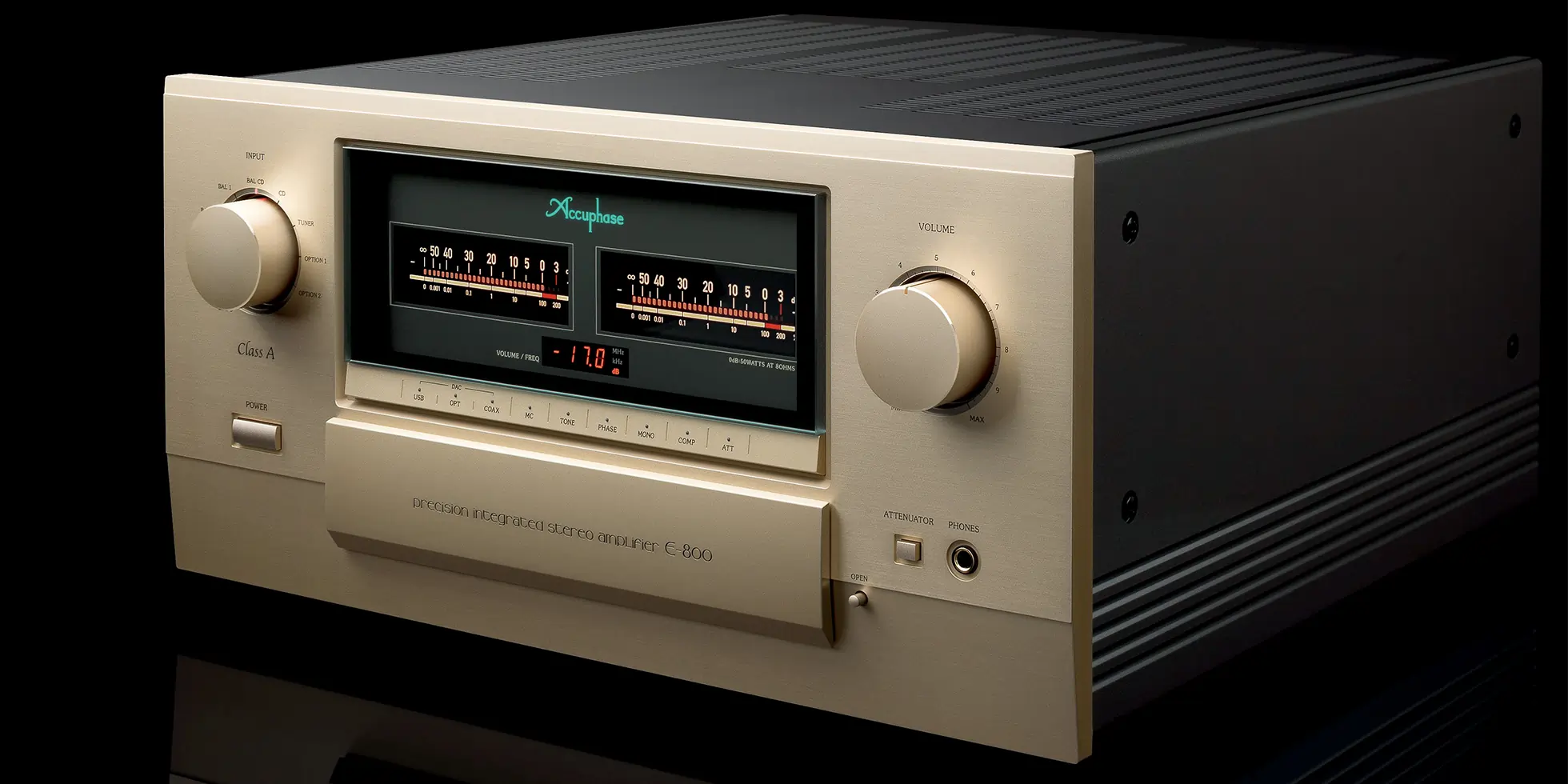
The Accuphase E800 is a masterful amplifier that tops the Japanese manufacturer’s range of integrated products. Certainly an exercise in style, this universal and versatile product is destined to work every day without ever faltering, with any loudspeaker. It’s an uncompromising achievement, whose adaptability makes it a marvel of ergonomics and handling. What’s more, it’s modular, which means it can easily become the nerve centre of a very high-end system. Musical and masterful, this is the high end favourite of this colourful autumn…
On the late morning of 1 May 2020, there was not a soul in sight in the church square of this small village in the Oise department. A deafening silence reigns supreme. However, as never before, I distinctly perceive small, furtive noises, well located in space. Usually, these are drowned out by the bustle of the villagers, the comings and goings of cars, the passing of planes (we’re not far from Roissy). At midday, the successive strikes of the twelve bells in the little church shatter the silence and startle me. With this new auditory acuity, I perceive all the subtleties of the decays of the swirling resonances that are superimposed as they escape from the bell tower’s sound-absorbing shutters (distant ancestors of acoustic lenses). This is a dazzling demonstration of the all-important concept of the signal-to-noise ratio. We cannot emphasise enough the impact of this parameter on the exact transcription of the tiniest musical nuances and on respect for true dynamics.

What does this have to do with the Accuphase E800 integrated?
This digression may seem incongruous and unrelated to the colossal Accuphase E800 integrated amplifier whose power stages work in pure class A. But think again. When we listened analytically to the E-800, for example on the track on the test CD ‘The Pulse’ – where we recorded the striking of a gigantic bell wall by an enormous wooden beam – we experienced the same auditory and… physical sensations.
The explanation lies in the exceptional performance at all sound levels (thanks to the AAVA symmetrical volume control circuits) in terms of the signal-to-noise ratio and in the current capabilities, far superior to other classes of amplification, of the power stages working in true class A. The E-800 controls the movements of the moving crew with extreme precision, right down to the lowest frequencies, without any slackness that might lead to dragging or loss of control resulting in a lack of definition.
Without going into a boring litany, the front panel has everything you’d expect from the most sophisticated preamp sections, not to mention the controls hidden behind the mechanical flip-flap. However, special mention must go to the magnificent and precise power bargraphs, the choice of numerous balanced or unbalanced sources, the very high-precision volume control and the headphone output with specific amplifiers (also remarkable when listened to).
Although purists will roll their eyes, the bass and treble controls are very well thought out to compensate for the shortcomings of many loudspeakers and come to the rescue of deficient sources. The same goes for the loudness circuit, which balances the tonal balance in the bass without bogging it down, for very low level listening.

There are :
– double’, all inputs and outputs unbalanced on Cinch and balanced on XLR (with, for the latter, a phase selection to adapt in particular to electronics of US origin),
– two sets of HP A and B outputs on colossal terminal blocks,
– two slots for optional input circuits, pluggable DAC 50 converters and AD 50 MM/MC phono preamplifiers, two inputs remarkable for their flexibility of adaptation and listening results.
Inside the very robust chassis, compartmentalised to avoid any risk of electromagnetic interference:
– in the centre, the gigantic high-efficiency toroidal transformer, fully shielded and mechanically damped, with the two 60,000 µF filter capacitors at the front;
– to the right and left, on large heat sinks that quietly dissipate the heat generated by pure class A biasing, power stages using 12 Mosfet transistors mounted in a configuration of 6 push-pull transistors in parallel. The very high bias current ensures true Class A operation without crossover distortion;
– at the rear, the input stages are in a totally symmetrical configuration.

The complex AVAA volume control circuit is mounted on the right-hand side in a shielded compartment. This latest-generation, purely analogue volume control circuit improves the signal-to-noise ratio while maintaining a perfect right/left balance with no crosstalk between channels.
It is linked to the rotary control whose mechanism is worthy of a high-precision clock. It is mounted in an aluminium block machined from solid, with the axis of rotation turning on a high-precision sliding bearing. This ensures unequalled ‘smoothness’ in its movements, an undeniable tactile pleasure. A magnificent remote control is supplied with the E-800. Its receiver circuits supply impulses to the input selector and variable voltages to the micro-motor linked to the volume control.
As usual with Accuphase, we are tempted to underline the care taken in the production, which sets new standards in the precision of assembly of the various constituent parts. As the saying goes, ‘you really get what you pay for’.
An expression that takes on its full meaning when we compare this integrated to those of certain other so-called top-of-the-range brands. It’s hardly surprising either that Accuphase electronics are so popular on the second-hand market. A point not to be overlooked, and rather reassuring in these uncertain times…

The sound
The Accuphase E800 integrated makes an indelible impression on the ear. Its stability in reproducing the stereophonic space, its timbre accuracy, its very high definition power on the small signals that are essential to the ‘musicality and emotion felt’ all reach new heights.
Listening to the E800 is never passive. It easily drives very low output systems, with complex loads and unconditional stability, as well as high output systems, without the slightest hint of aggressiveness, projection or bass restraint.
The subjective power perceived through the E-800 is out of all proportion to the advertised power of 50 W per channel. However, having measured the Accuphase A-50V power amp in its day (nearly twenty years ago), also operating in pure class A and rated at 50 W, we found 87 W on the bench, in continuous mode, without any trace of undesirable harmonics in the distortion spectra recorded at both very low and high power. When listened to, this E-800 seems to deliver a minimum of 300 W, because it never runs out of steam, even with very low output loudspeakers.
Note that the power perceived depends above all on the way in which the electronics supply their energy. The E-800 integrated, working in pure class A, delivers a power whose current component reaches an extremely high value, evenly distributed from the extreme bass to the extreme treble. This characteristic also has a direct impact on the abysmal bass, which changes everything in the impression of total immersion in the acoustics of the recording location. On numerous extracts from large organs, the E800 explores areas of the sub-bass that are totally ignored by other very high-end electronics, even though they are powerful. The Accuphase E800 never collapses; it holds the lowest notes of the organ without faltering or pumping, with uncommon smoothness and articulation, even when the other parts of the spectrum are heavily used.
The more complex the musical message, the more the E800 provides total legibility without the classic phenomena of intermodulation between instruments. Confusion is banished from its vocabulary. On large classical orchestral ensembles, each section is in its place, in a stable three-dimensional space, without any fleeting flutter, with soloists standing out perfectly.
But above all, the E-800 thrilled us with the accuracy of its timbres on voices and acoustic instruments.
It has to be said that many class AB or D electronics ‘sound’ wrong. There’s an unease about the lack of naturalness in the timbre, which isn’t necessarily noticeable on a quick first listen, but which becomes unbearable over time. This is particularly true of vocals, with a sensation of artificial sonorities that tend to harden, accentuating sibilance on syllable endings, with a veiled low midrange. However, the E-800 transcribes all the richness of the voice timbres with permanent beauty, without forcing the line or becoming disunited on the forte.
On whispered passages, the E-800, without rounding off the edges like some tube amps, lets you fully perceive the elegance of the phrasing in the pronunciation of each word, with well-placed tonal accents that are not muffled. Through the E800, the most complex choral formations ‘sing’ in the true sense of the word, with accuracy, without confusion. Great art.
We tried to push the E-800 to its limits, on accompaniment tracks or electric bass guitar solos. The E-800 delivers lightning-fast note attacks, with very pronounced pitch variations. Not only is the bassist’s specific style instantly recognisable, but so is the sound colour of the amp heads used: it’s impossible to confuse an Ampeg with a Hartke, Fender, Ashdown, etc.
The E-800 brings out the sense of rhythm, the ‘groove’ as some would say, which is lacking in a lot of very high-end electronics where you end up getting ‘bored’ (to put it politely) listening to them. The E800 shakes you up, pulls you along, invites you to tap your foot to mark the tempo, with infectious joy.
We’re not the only ones to feel this way; various listeners at our listening sessions were unanimous about the E-800’s musical bewitchment. Rarely has an electronic been so unanimously acclaimed for years!

Our conclusion
When it comes to making a choice, the E-800 truly has it all. In its majestic case, it brings together circuits that are the culmination of a real painstaking effort. For nearly fifty years, the electronics engineers at this ‘family’ firm, which has always managed to maintain its financial independence and has not been subject to the vagaries of value-seeking buyers, have also been music lovers. They know how to take their time to improve the topology of circuits, to search for components by long and tedious comparisons, bringing real advantages not only to measurements but above all to listening.
It’s certainly a big investment, but it’s worth pointing out that in addition to its captivating musicality, the E-800 is extremely flexible in use (modular inputs) and has a build quality that suggests enviable reliability. In our opinion, and we’re not kidding anyone, it’s a bargain compared to what the competition can offer in separate or integrated components, which are often twice as good value.
The E-800 restores its credentials as a true Class A product. Unless you’re completely deaf, it’s a pleasure to listen to that’s rarely equalled.
Author: Patrick Vercher
Technical Sheet: Accuphase E800
- Origin: Japan
- Price: €15,000
- Dimensions: 465 x 239 x 502 mm
- Weight: 36 kg
- Power:
- 2 x 50 W in pure class A at 8 Ω
- 2 x 100 W pure class A over 4 Ω
- 2 x 200 W in pure class A at 2 Ω
- Harmonic distortion: 0.03%Intermodulation distortion: 0.01
- Frequency response: 3 Hz – 150 000 Hz
- Damping factor: 1,000 with 8 Ω at 50 Hz
- High-level input sensitivities: 100 mV/20 kΩ (unbalanced), 100 mV/40 kΩ (balanced)
- AD-50 phono option module: MC gain 60 dB MN 40 dB
- Adjustable input impedance: 30/100/300 Ω and 47 kΩ
- DAC-50 digital option module
- USB input: DSD signal
- Sampling frequencies:
- 2.8/5.6/11.2 MHz/1 bit
- PCM 32 to 384 kHz/32 bit
- PCM optical input: 32 to 96 kHz/24 bit
- PCM coaxial input: 32 to 192 kHz/24 bit
- Symmetrical or asymmetrical high-level signal-to-noise ratio: 104 dB
- Power consumption to IEC standard: 390 W


