
In 2005, Gryphon caused a stir with the launch of its Diablo integrated amplifier, which was surprisingly powerful at 2 x 250 W into 8 ohms, with a filtering capacity of 2 x 58,000μF. Ten years later, the Diablo became the Diablo 300, the value of its new power under 8 ohms, with a complete overhaul of the components based on an overall design that was not called into question. Eight years have passed, and the Diablo 333 has been previewed by us, for a test where the speed of sound that characterises the Danish brand has appeared in an integral way with a real surplus of refinement.

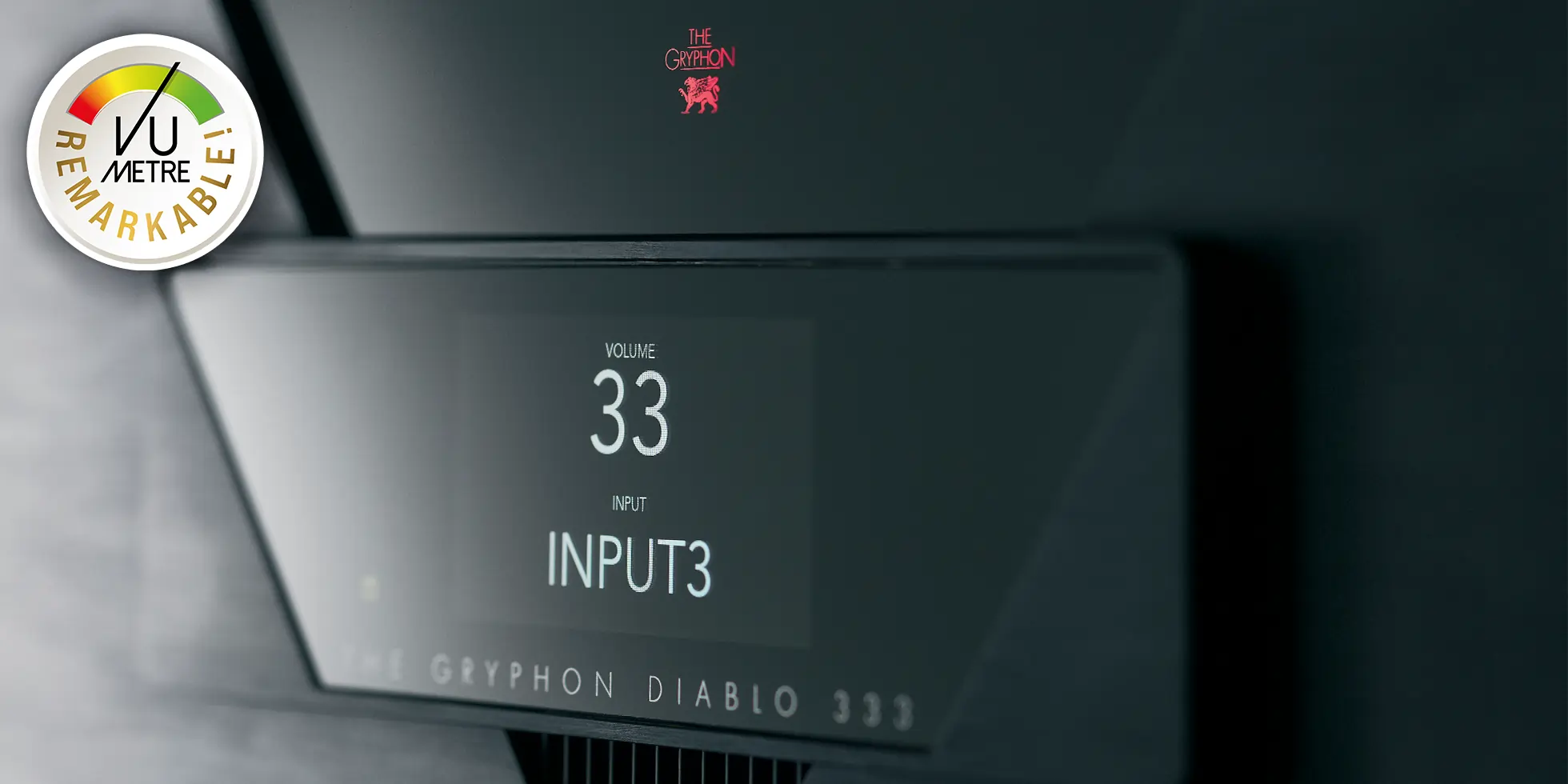
Instantly recognisable, the design of the new Diablo 333 is entirely in line with its two predecessors, the Gryphon, which sprang from the imagination of designer Flemming Rasmussen. On the front, still raised on four pointed trusses, the amplifier maintains the idea of a truncated triangle, but loses the central bar and now integrates all the information and parameters in a touch screen with a diagonal measurement of 11 cm (4.3″) in the centre under the Danish brand’s red logo. Also possible thanks to the new aluminium remote control called Commander – with it too the idea of an aborted triangular shape on the lower part – the modifications concern both the choice of volume and analogue inputs as well as the management of the two optional add-on modules. The first of the two, to be released soon and therefore not available for this test, the DAC3 module (€7,250) will will be integrated into a large upper cavity at the rear of the amplifier, which will allow numerous digital sources to be connected via USB, AES/EBU or Toslink to decode files up to DSD512, thanks to the use of Sabre’s new, very high-performance ESS9039 PRO chip.
Another module, which can also be integrated into a dedicated cavity, the PS3 phono (€5,750) will make it possible to do without an external phono preamplifier, to manage the impedance of MC cartridges from 20 ohms to 1,600 ohms and MM cartridges at 47 kiloohms, with, like the digital-to-analogue converter, a dual mono design and in pure class A.

An ever stronger Diablo
As we have said, this new Diablo 333 with its attractive grey-black anodised finish and impressive side radiators resembles the previous models, but the current facelift also allows it to fit into the new identity of the manufacturer’s highest series, more refined, discovered with the Apex power block and the Commander preamplifier, whose new integrated version incorporates some of the technologies and designs.
Designed by engineer Tom Møller on the electronic side, still fully dual-mono if we take into account that the imposing but unique Holmgren toroidal transformer is itself dual-mono, the Diablo 333 incorporates three imposing polypropylene capacitors on the side panels for each channel, then three others directly added to the central circuit, which, like all the other circuits in the device, is treated in four layers, with significant amounts of copper in each of them.
In total, the filtering capacity now peaks at 2 x 68,000μF, which is 10,000 μF more than the first Diablo. The latest model also offers 83 W more power per channel at 8 ohms than the first, and 33 W more than the Diablo 300, now reaching 333 W at 8 ohms, or 666 W at 4 ohms and 1,100 W at 2 ohms. To achieve this, it uses ten output transistors on each side, in addition to shunt regulators to constantly monitor the quality of the supply voltage. Volume control is achieved by means of balanced relays on 43 levels, controlled by microprocessors, associated with one or two resistors in series per level. This discreet volume control never produced any clicking noise during our tests, as is normally heard with products using relay-resistor technology.
With ultra-limited internal cabling, the amplifier always chooses the shortest possible signal paths, in particular by incorporating the analogue inputs directly on its primary circuit, to be preferred over the two pairs of gold-plated Neutrik XLR sockets, which are otherwise available asymmetrically with a pair of RCA terminal blocks (input 3). Next to it, the brand has also placed a gold-plated phono input (Tape In) and output (Tape Out) pair with Teflon insulation, intended for a rather obsolete function, namely that of recorder return.
A final RCA pair is used to output directly through the preamplifier section, for example to drive another power block or a subwoofer. Two pairs of huge red and black terminal blocks allow a pair of speakers to be integrated without getting the wiring wrong, while a trigger socket and a USB 2.0 for updating the microprocessor complete the diabolical device, from which emerges on a final low part, again with the idea of a cut triangle, the mains socket and a terminal for connecting to the earth.

The set-up
Seen and heard at the Paris Audio Video Show in one of the most convincing rooms of the exhibition, connected to the Gryphon Eos 2 speakers which were recently reviewed in our columns (VUmètre n°47; Remarkable), with the very high-end converter from Ideon Audio as the digital source and the Brinkmann Taurus turntable and a DS Audio cartridge with EMM Labs phono preamp as the analogue source, the Gryphon 333 was subsequently re-verified with other combinations. Impressive in size but still relatively modest compared to other products in the Danish catalogue, it should be noted that this integrated amplifier weighs 50.6 kg and therefore needs to be placed on a high-end hi-fi cabinet capable of supporting its full weight, distributed over its four spiky pods. Fast, although increasingly refined in its rendering, it can be perfectly matched with speakers from the same parts of Europe, starting with the Børresen speakers we are discussing in this issue, while it will have the capacity to bring out the best in the best sources, for which you should not hesitate to choose precise and dense devices in terms of the information transferred.

The sound
Listening to it, it seems obvious that it is indeed a Gryphon, with the same fast and dynamic sound. But if we were used to the punch of previous generations, sometimes almost a little hard, the new Diablo 333 seems to have matured and calmed down. Infernal with its monstrous amplification of 333 W per channel under 8 ohms, it can still power any speaker, but now offers more roundness and less nervousness, to deliver a more refined sound, even more refined when you listen to calm jazz. This sound still comes from the North, in that it is clear while retaining a real elasticity, already available at very low volume, where the notes last a long time before fading, as on Lou Reed’s piano in ‘Vanishing Act’.
In the living room, listening to HughMasekela’s famous ‘Stimela’ on audiophile vinyl and then on a HiRes file showed that, at a comparable price level, an analogue system still wins out a little over the volume of the stage and the naturalness of the timbres compared to digital, well reproduced in this respect by the Gryphon. The bass can go very deep, taut without ever overflowing or hitting, as we remember when listening to the first Diablo (albeit with a less good source). The soundstage is also very wide, the depth more concentrated with the Gryphon speakers, and more extended with the Dali speakers, to the detriment of the hushed character of certain intimate music, but to the advantage of large orchestral masses such as that of Dvorák’s 9th Symphony by Fritz Reiner. The dark stage without the slightest parasitic distortion allows each detail to be seen, as on Eric Clapton’s most famous live album, where the slightest string friction becomes perceptible as if we were glued to his guitar.
Our conclusion
Because it is indeed a Gryphon, the Diablo 333 still offers the high sound speed that has made the Danish manufacturer’s mark, very dynamic and tense. The gain in refinement makes this new amplifier even more versatile than before, with even higher and better contained power, particularly superb when listening to rock and jazz music, or even reggae. As is often the case today, the price has risen accordingly; it has gone from €17,500 to €25,950 for this new generation, without the two optional digital and phono modules. But if you can afford to spend that amount on an audio system, you should compare the musicality of this integrated system with the separate components of the Danish brand in the same range, as well as the competition, to see if this new devil isn’t ready to take us to heaven!

Author: Vincent Guillemin
Technical sheet: GRYPHON Diablo 333
- Origin: Denmark
- Price: €25,950
- Dimensions: 468 x 245 x 472 mm
- Weight: 50.6 kg
- Amplification type: class A/B
- Rated power
- 2 x 333 W at 8 ohms
- 2 x 666 W at 4 ohms
- 2 x 1,100 W at 2 ohms
- Frequency response: 0.1 Hz-350 kHz; -3 dB
- Gain: +38 dB
- Options
- DAC3 module: €7,250
- PS3 phono module: €5,750


