
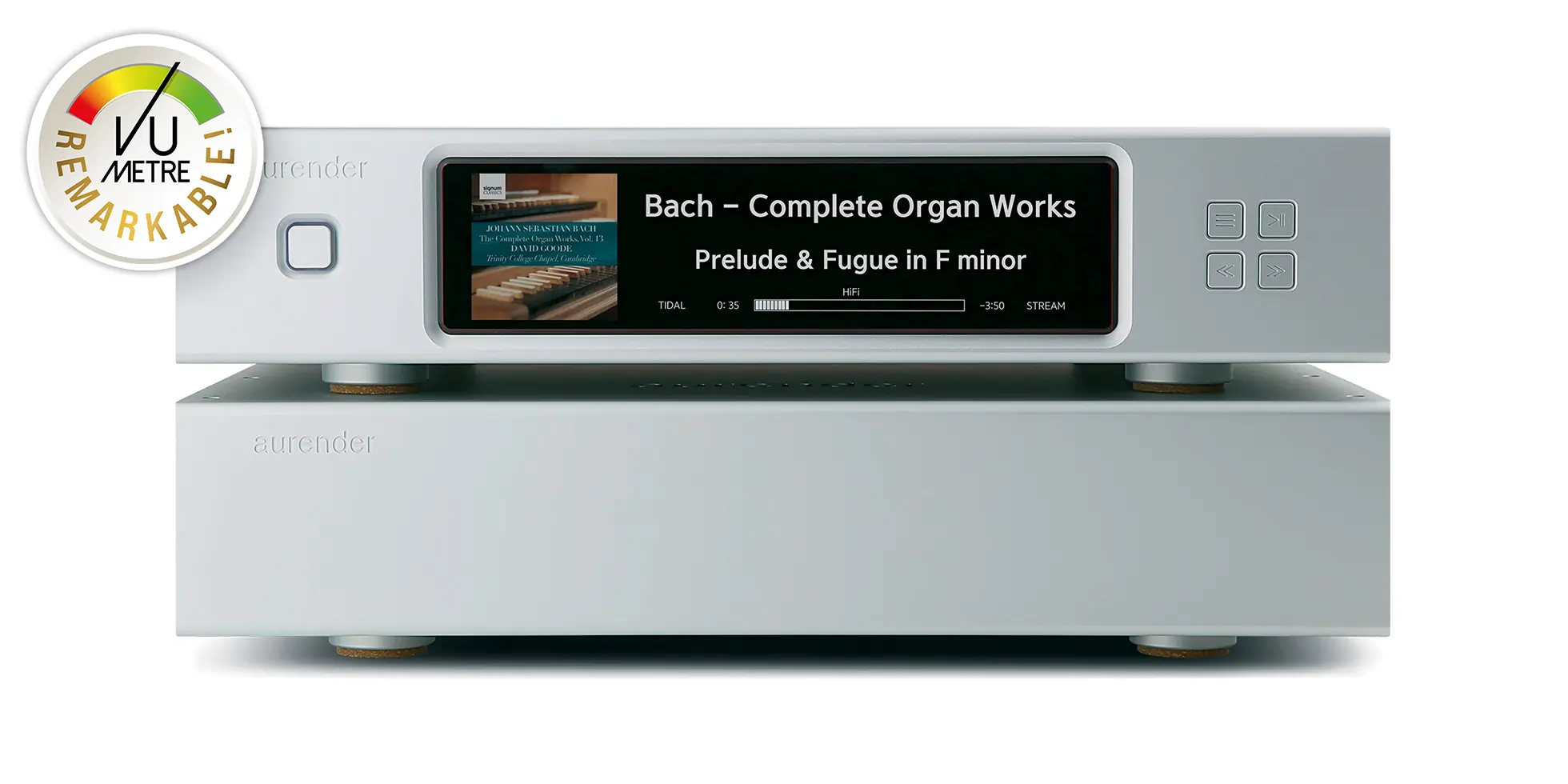
By taking the N30SA out just after the W20SE, in two chassis and with an even more extreme approach, Aurender has quite simply sought to create the best possible digital transport by challenging the entire architecture applied so far to its music servers. After listening on a very high-end system, during which we were able to verify the qualities of the device both in streaming on a platform and with files stored in its 8 TB internal SSD memory, we compared the N30SA to other players in the Aurender range and can only agree with the South Korean brand: we are indeed in the presence of one of, if not the best network transport in the world.
With the SE version of the W20 presented in 2020, it was thought that Aurender had taken current digital network playback technologies as far as possible thanks to an applied revision of the previous model, with the aim of making the new model and its battery to power all audio components even more perfect. However, barely a year later, the N30SA was presented, the result of parallel development and the culmination of ten years of research. This new model was even more cutting edge thanks to a design that was no longer integrated into a single large box, but rather two aluminium boxes, 430 mm wide, 107 mm high and 356 mm deep, both well filled.
This highly innovative two-chassis structure is not a usual separation between a power supply in the first and the audio part in the second, as seen in many manufacturers’ products, sometimes even in their entry-level products. With the N30SA, Aurender has developed a much stronger concept: placing all the disruptive and noise-creating elements in the same case, and leaving the other one as quiet as possible to handle only digital audio data.

So, in the chassis with an 8.8’ IPS LCD screen, which one would expect to be the one delegated to the purely digital part, , on the contrary, all the interference-generating elements are located, including not only the components dedicated to operating the screen, but also the linear power supply based on three large transformers under plastic covers, four imposing capacitors as well as a backup battery and a low-power Intel Quad Core processor, to which are added the 8 TB internal SSD memory and the 480 GB SSD RAM. Also on this chassis, a cavity can be used to add another hard drive to further expand the storage space, in addition to the two USB 3.0 ports for inserting external drives and the double-insulated Ethernet LAN port to filter out as much Internet noise as possible.
Much more understated with its simple aluminium plate on the front, on which anyone would have thought at first glance to find the power supply, the N30SA carries in the second box only a hybrid secondary power supply with a filtering system and current regulation by inductance, intended to further purify the electricity coming from the other box. But above all, it is in this part that the audio card is inserted between shielding plates, created on the basis of an FPGA with one of the most powerful chips on the market, in addition to a reference OXCO MV197 clock.
Integrated into this chassis, the two coaxial outputs and the AES/EBU are separated from each other at critical distances to best insulate them, alongside a BNC coaxial socket designed for an external clock (75 Ω – 10 MHz, 12.8 MHz, 44.1-48 kHz) such as the brand’s MC20 (€32,500), and a USB Audio module that is also shielded. Here too, the latter is not intended for inserting external hard drives as in the other chassis, but to be used as the most data-prolific audio output to connect the DAC.
Protected by an 11 mm aluminium top plate and a bottom plate with four cork-topped feet, the two N30SA chassis are completely stackable and must be connected by two cables of 0.5 m and 1.5 m, as far apart as possible via the sockets at the back of the devices, in order to minimise electromagnetic interference and crosstalk as much as possible. The cable on the left transfers power from the power supply to the audio box, while the second one on the far right transfers digital data.
With this array of weapons, the N30SA is ready to deliver encoded file data in the most perfect way possible, up to 32 bits/384 kHz or DSD512 via USB, and up to PCM 32 bits/192 kHz and DSD64 with coaxial and AES/EBU outputs. One might just regret not finding a fibre Ethernet input for the future, as on the Rose Hifi RS130 or the Linn Klimax DSM/3, but we know that, unlike the young Korean or Chinese brands that want to move fast, the more mature Aurender integrates new Japanese-style technologies, i.e. only when the engineers are completely sure that they fully understand the design, and that the products put on the market are immediately useful.
The set-up
Even if it were possible to receive the N30SA in one of our auditoriums for a few weeks, it wouldn’t make much sense, even on our best test system, as our in situ comparables are not in the same league. So we went to listen to it in one of the most upmarket shops in Paris, Music Hall, which had prepared one of its finest systems for the occasion. Having recently received the Sonus Faber Serafino, already broken in for more than two hundred hours, Martial had simply had the idea of bi-amplifying them by integrating the Accuphase A-300 mono blocks to the midrange and tweeters, in addition to the new A-80 class A stereo block connected to the bass speakers. For the preamplifier, there was nothing other than the best product from the Yokohama manufacturer, the C-3900, and for the digital-to-analogue converter, its best DAC, the DC-1000, not far from a Dave Chord.
With this competition system, one of the finest to be heard in France, we were able to compare the N30SA on its digital inputs and in its results against different conversions, but also to test it against other Aurender players, unfortunately without having the W20 SE to hand, but in comparison with the N200 and especially the N20. Refocusing on the N30SA, we used Tidal and Qobuz files to compare them to those of its internal SSD memory, encoded up to DSD512. To process these files, we only used the proprietary application, knowing that playback can also be done in UPnP/DLNA, so for example with Audirvana.
The sound
During our test of the Børresen X3 in the same auditorium for the previous issue, we could hear the difference between a file played on Tidal and Qobuz, even though they had the same encoding and were normally taken from exactly the same source from the original labels. So it was this first test that we did on the N30SA and while the difference didn’t seem as obvious to us as it did on the N200 two months ago, we still favoured Qobuz after two or three checks, for the superior fluidity of the files played from this platform.
Then, we were able to discover sound of a rare purity from the source, free of any interference and with a superbly black soundstage, for example, allowing us to enjoy the slot machine noises of Pink Floyd’s ‘Money’. With such a system, we could hear absolutely everything at a level far superior to any listening sessions carried out in recent months, so for example the rock recording style of the 1970s, which stands out for the grain and the sound ambience captured by the microphones, or just after that on a Mahler symphony by Bernstein (Sony), the studio atmosphere with a placement of the microphones that leaves more air and concentrates the elements less than in most recent recordings.

Both for the rock singers and with the voices of the jazz singers we adore, we simply had the impression of inviting the artists and seeing them in front of their microphones facing us, with a precision that made us feel as if we were directly participating in the studio recording itself. But if we thought we were at the pinnacle of what we perceived, we were not expecting the result when listening to a file available directly on the N30SA’s SSD memory.
Then the noise was minimised even further to deepen the soundstage a little more, resulting in even better defined and more nuanced elements, an extraordinary quality of harmonics, difficult to find even in a concert hall, for example when we compared Bernstein’s ‘Mambo’ to the one heard the day before at the Radio France auditorium, or Rachmaninov’s Sonata No. 1 by Geniušas to his performance at the Salle Cortot a few weeks earlier, where we were in seventh row in front of the Steinway. Even more than in the hall, the dynamics and harmonics unfold at infinitesimal levels, with an incredible purity of timbre, in this configuration even more in line with the density of a DAC like the DC-1000 than with the clarity of the Dave.
On DSD256 or DSD512 files, we were immersed in the middle of the orchestra or live in the middle of rock bands, only to be transported into the mystique of churches listening to masses by Poulenc or motets by Arvo Pärt, with an even more refined soundstage. In a completely different style, the electronic sounds of Daft Punk’s ‘Get Lucky’ offered an equally impeccable rendering on all registers, in addition to an impression of breathing, without ever over-lighting, but on the contrary remaining on the neutral rendering referring to Aurender.
Although this time we were unable to hear the W20SE (€23,250), whose great finesse we were familiar with, connecting the N20, which is almost half the price (still €13,500), instead of the N30SA did not give the impression of a collapse in overall quality, since it already brings with it many of the aforementioned characteristics. However, the ear quickly discovers that there are no longer quite the same nuances or the same sound openness, inevitably found by reusing the largest music server.
Our conclusion
Although we know that the ultimate has never been reached and that what we hear today, especially in digital terms, will undoubtedly be surpassed in the future, it seems that the N30SA digital network transport has reached a level that is difficult to surpass to date, and for which we have no comparable model in mind, except perhaps the Linn Klimax DSM/3 with converter.
With an almost perfect design thanks to its two-chassis structure, which is unprecedented in the way it separates components, Aurender’s largest transport and music server goes even further than the South Korean brand’s other top-of-the-range models. and while in a system costing less than €70,000 the majority of impressions can be rendered thanks to the excellent N20, the most fortunate listeners in search of the exceptional will inevitably have to turn to the N30SA, which must be connected to the DAC via USB to take full advantage of its qualities, if possible with a maximum of music recorded internally in DSD.
Author: Vincent Guillemin
Technical sheet: Aurender N30SA
- Origin: South Korea
- Price: €25,900
- Dimensions: 430 x 356 x 107 mm (per chassis)
- Weight: 22 kg (total of both chassis)
- Digital outputs
- 2 x USB Audio;
- 1 x AES/EBU,
- 1 x coaxial SPDIF BNC,
- 1 x coaxial SPDIF RCA,
- 1 x optical/TosLink SPDIF
- External clock input: coaxial BNC 75 Ω – 10 MHz, 12.8 MHz, 44.1-48 kHz
- Internal memory
- 8 TB SSD (serial);
- storage drawer for optional memory
- Formats played
- USB: Up to 32 bits/384 kHz;
- DSD128 (DoP);
- DSD512 (Native);
- MQA
- SPDIF & AES/EBU: PCM up to 32 bits/192 kHz;
- DSD up to DSD64 via DoP
- WAV, FLAC, AIFF, ALAC, M4A, APE


