For the last time, hi-fi’s most important trade show was held at Munich’s Event Center Messe (MOC), before being relocated by the High End Society to the larger (26 000m2) Austrian Center Vienna (AVC), in the center of the Austrian Capital from 2026.
For this latest edition, over 10 000 trade visitors and 11 000 individual visitors made the trip to enjoy the systems of over 500 exhibitors, divided over 4 halls and 3 floors, as well as in some rooms of the Motorworld located just opposite.
During this 2025 edition, the show showed more reason than in the previous two years, with products that were often geared towards the high-end, but also towards the search for ever greater improvements in listening conditions and precision. This dynamic was felt not only in the ultimate systems from certain brands (CH Precision 10 Series, Wilson Audio WAMM, YG Ultimate Gemini, Esprit Lisa & L’Esprit, Aurender N50, Stenheim Reference), but also in the new products presented by the majority of companies, starting with our French « belles » Atoll, Absolue Créations, Davis, Diptyque, Esprit, Jadis, Kora, Metronome/Audirvana, Solen, Totaldac and Qobuz and its new Qobuz Connect application, present throughout the show.
An opportunity to celebrate some major anniversaries (65 years of Audio Technica, 100 years of Luxman), this edition also saw the reappearance, thanks to historic distributors, of Koetsu cells (interview VU#60) and the Platine Verdier. In just over 230 pages, we invite you to take part in this journey, where dreams go hand in hand with the very finest engineering, with the same goal in mind: to enjoy the greatest music recordings in the best possible conditions.
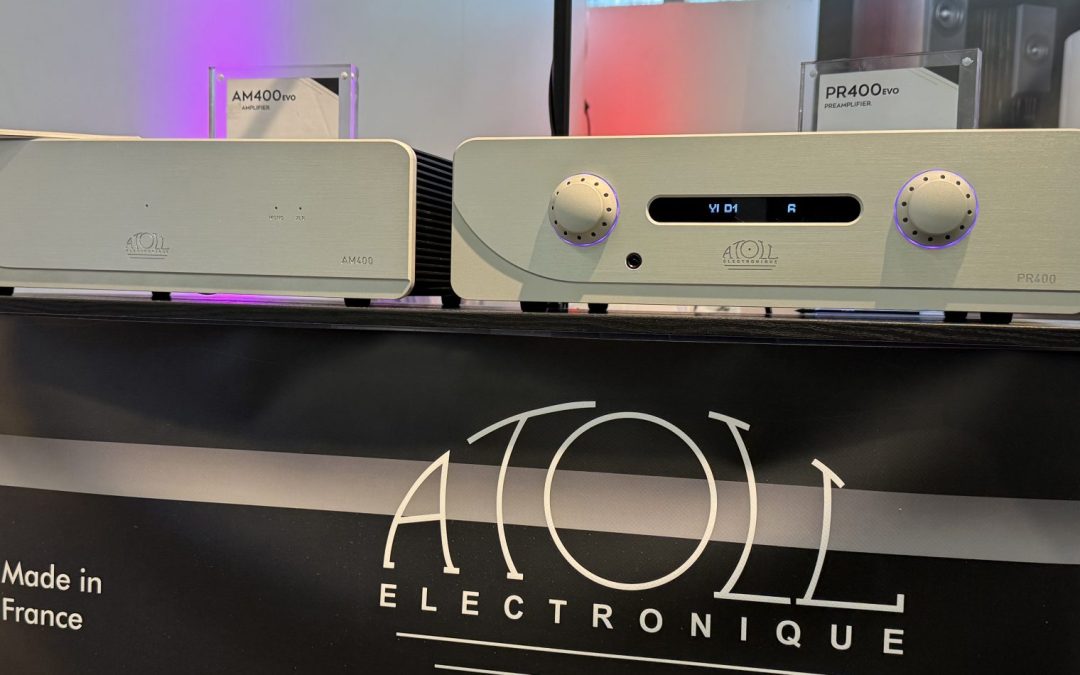
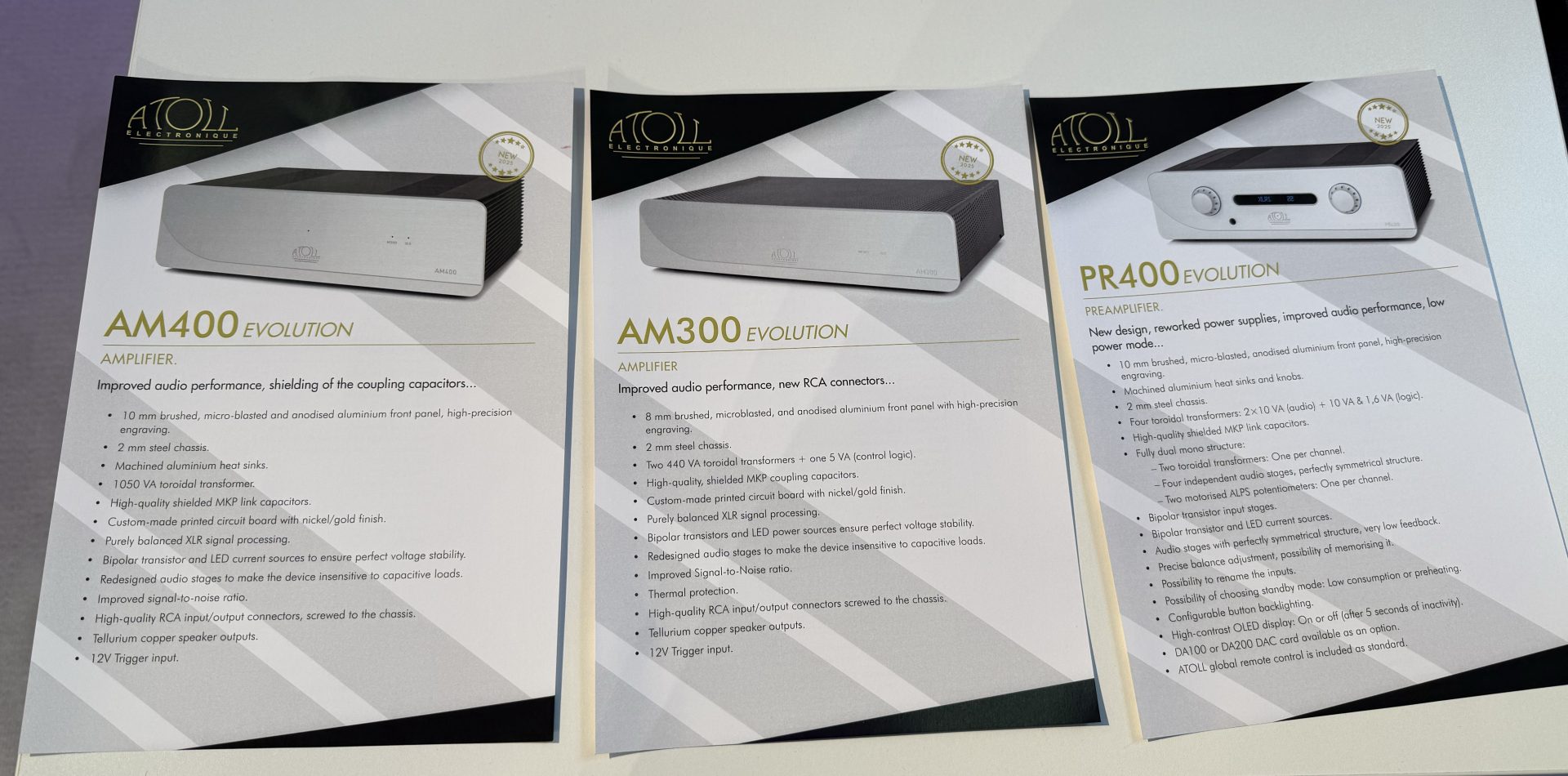
Following on from the IN400 (VU#56; Remarkable) and CD400, French manufacturer Atoll continues to transform its highest series by upgrading the Signature models to Evolution versions.
Like the integrated amplifier and CD player, the AM400evo power amp and PR400evo preamplifier have been softened in their curves, bringing them closer to the design of the 300 series, although the preamplifier retains the specific aluminum rotary knobs of the previous version (and of the IN400evo), and the solid aluminum plate is 10 mm thick.
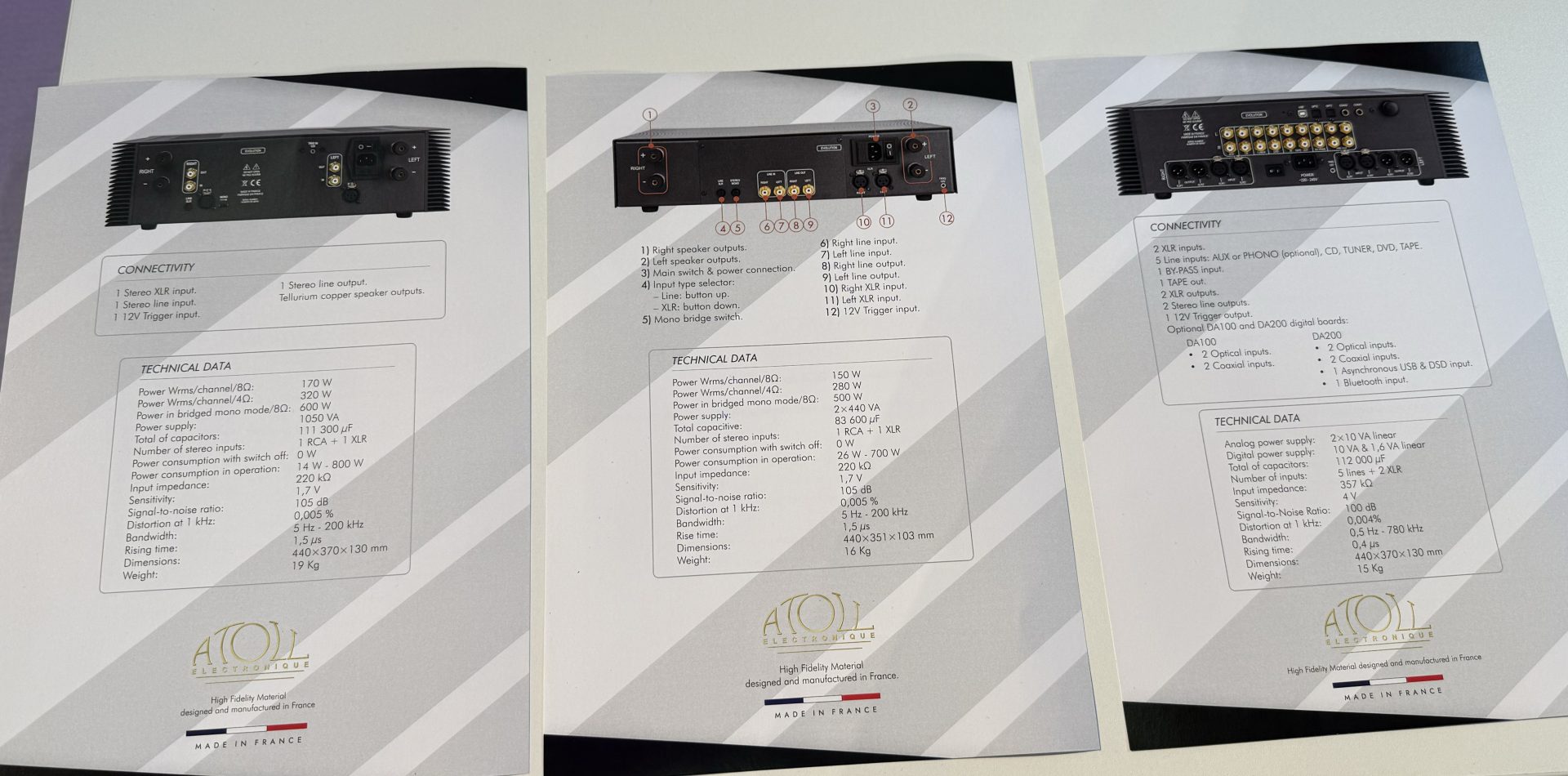
The rear panels are virtually unchanged: the AM400evo retains two pairs of speaker outputs, a pair of RCA and XLR inputs and a pair of RCA outputs. The PR400evo retains its multiple RCA inputs (with optional phono), five digital inputs (2 optical, 2 coaxial, 1 USB Audio), Tape Out, two pairs of RCA outputs and two pairs of XLR inputs and outputs, for signal transfer to two or even four bridged AM400evo (or in bi-amp mode).
Weighing in at 15 kg, the PR400evo’s power supply has been upgraded to make it even quieter; it is still filtered by capacitors with a total capacitance of 112 000 µF. For its part, the AM400evo still weighs 19 kg and has also had some components reworked, in addition to new shielding for the moving capacitors. It gains 10 watts at 8 ohms and 20 watts at 4 ohms, to reach 170W and 320W peak power respectively at these impedances. Total capacitance is in the same order of magnitude as its acolyte, at 111 300 µF.
The release date is announced for the end of June, with a slight increase of 300 € over the Signature versions, for a PR400evo now priced at 4 900 € and the AM400evo at 5 200 €.
After creating a surprise in 2024 with the presentation of two loudspeakers, the French cable manufacturer Esprit continues to expand its range with an even more imposing version.
At Munich’s High End 2025, the wooden stand has been further enhanced, and is visible from afar thanks to a handsome orange cube with the brand’s name and logo, placed just above it. But if in the middle of the stand you will find modulation cables that have obviously been redesigned in terms of connector quality compared to the G9 that we know, this year’s highlight is once again a loudspeaker.
Presented for listening in the manufacturer’s showroom, the Lisa becomes a three-way designed to surpass the Amelia floorstanding, from which it takes the drivers and tweeter technologies. But whereas the Amelia has a single mid-woofer, with a 20 cm-diameter NEXTEL-treated paper cone and an ALNICO motor, the Lisa uses two in a perfectly symmetrical structure, with the top one devoted to midrange and the bottom one cut to handle bass, up to 28 Hz. The AMT ribbon in the center measures 160 cm and is designed to deliver high frequencies up to 30 kHz.
As meticulous as ever, the cabinet’s thickness has been increased from 30 to 40 mm, in an MDF-bitumen-MDF sandwich structure designed to combine rigidity and flexibility. The filter circuits have been redesigned to differentiate the three channels, and are still made from the finest materials on the market, incorporating copper/tin Duelund capacitors and pure copper Mundorf coils, while the internal cabling is, of course, Esprit.
Placed on a decoupled feet structure to keep vibrations to a minimum, the Lisa also adds the option of integrating a plate at the rear to control frequency response in complex environments. Its two speaker terminals do not currently allow bi-amplification. Available in Satin Black, High Gloss White and Walnut, the Esprit Lisa is positioned at the very top of the range, priced at 38 000 € per pair. We will let you know more as soon as we see her!
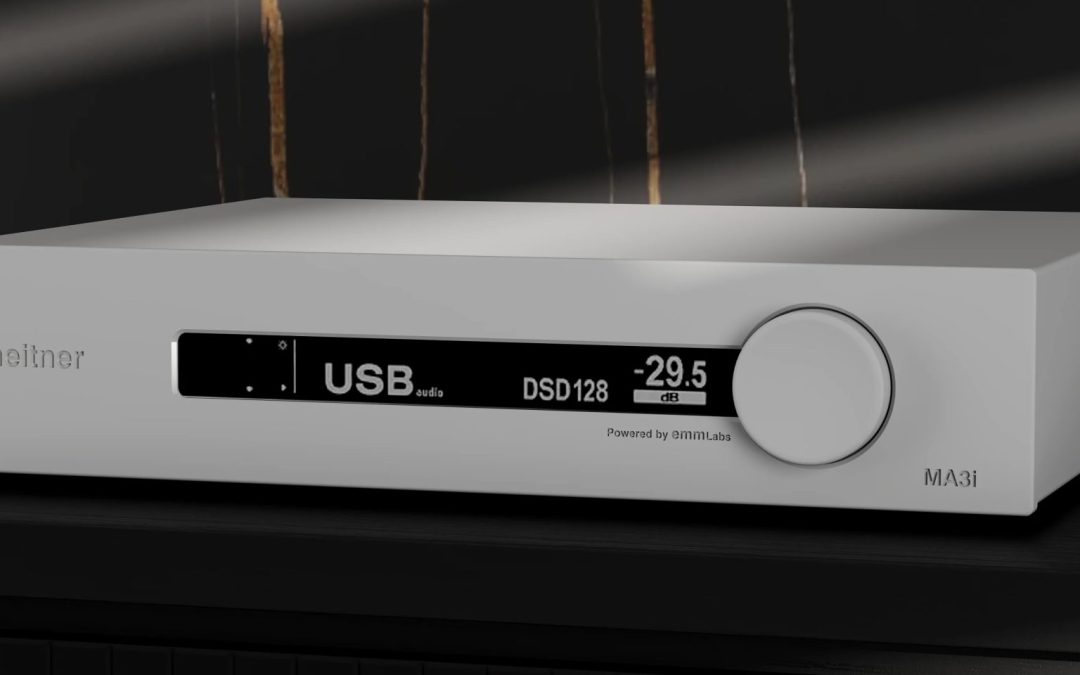
It’s not as big news as the EmmLabs brand, but this news is an opportunity for us to wish creator Ed Meitner a happy 80th birthday!
Based on the MA3i, available with the front panel in black or silver on a black chassis, the MA3i SE becomes entirely silver over the entire chassis, obviously still made from high-quality Canadian aluminum using precision machinery. Like the other, this version uses in-house MDAC2™ converters and an MDAT2™ DSP, able to read DSD128 or 2xDSD or DXD media, as well as MQA or PCM files up to 192 kHz / 24-bit rates.
Also a streamer and preamplifier, the MA3i SE uses a similarly proprietary volume control (VControl™) and manages jitter from an MFAST™ system based on an MCLK3™ asynchronous clocking process. Even though it’s very complete, it remains above all a very high-end DAC, offering five digital inputs, including USB audio and a USB port for integrating a hard disk.
Beneath its new, more refined gray exterior, the Meitner MA3i SE still boasts all the musical assets discovered in recent years. However, this comes at a price, with this limited edition priced at 12 500 €, compared with 11 500 € for the standard version.
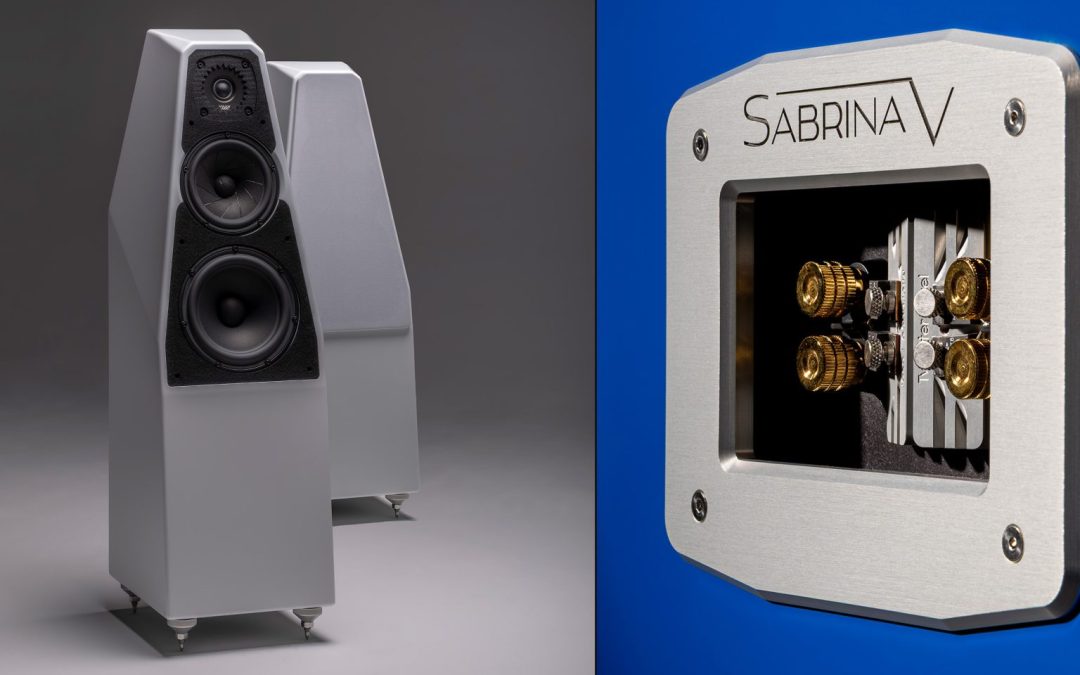
Announced for the 3rd of July on the Wilson Audio website, the Sabrina V could be seen at the Munich Show alongside a Sabrina X, placed side by side on the same spinner as two WATT/Puppy (old and new) last year.
In fact, the new Sabrina could have been called Sabrina H rather than V, as it is this new high-density composite material that it incorporates in place of X on the front end, around the loudspeakers. Just as rigid as X, H material is slightly softer and promises a gain in midrange musicality.
The drivers have all been revised, with the integration of the CSC (Convergent Synergy Carbon) dome tweeter from the Alexx V, a 7“ QuadraMag AlNiCo (Aluminum-Nickel-Cobalt) midrange (vs. 5.3/4” on the previous model) already present on most top speakers, and the 8″ woofer already heard on the Sasha V and WATT/Puppy (VU#58 test). As you will see in our Munich 2025 dossier – to be downloaded freely from our site shortly – the Sabrina V’s size evolves very slightly upwards, at the same time as it becomes slimmer in width.
The insulating feet gain a new patented V-MCD technology and the vents are revised in size and geometry, while the resistor panel becomes more accessible with four screws, whereas the two speaker terminals remain on the bottom. We look forward to hearing more on it the 3rd of June!