

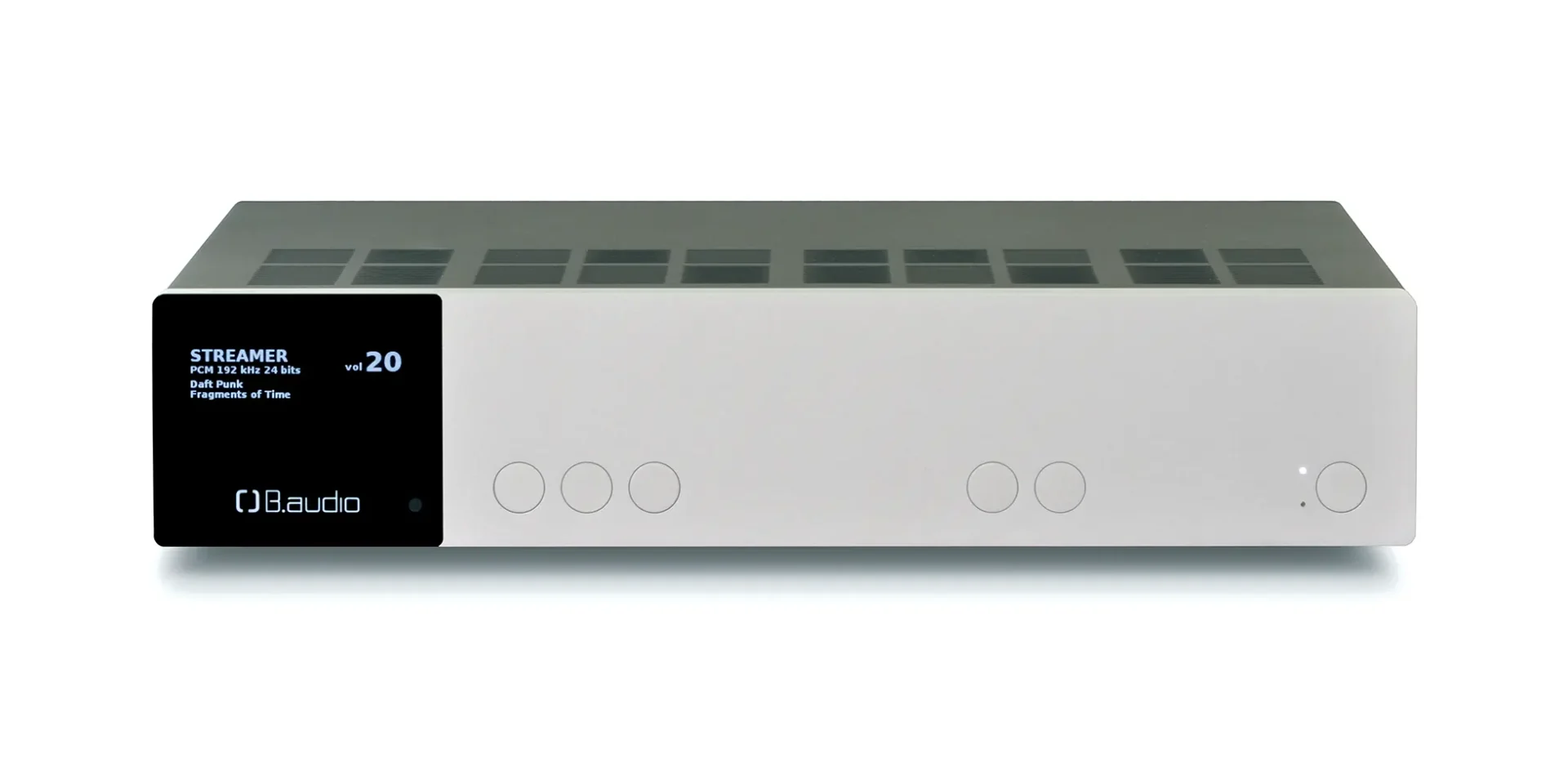
Founded in 2016, B.Audio is still run from Saint-Hippolyte by Sébastien and Cédric Bermann. After making a name for itself with its very first DAC, the Haut-Rhin-based manufacturer expanded its product line by creating a more affordable series called One, which included a DAC that could be paired with a preamp section and a network card, followed by a power amplifier. Today, the combination of these devices makes it possible to introduce a groundbreaking all-in-one unit—a combination of a DAC, preamplifier, and network player with an amplification section—to create the B.Audio Alpha One. Self-contained, this device simply needs to be connected to a pair of speakers to enjoy its full finesse and purity of sound.
As streamlined versions of the B.Dac and B.Dpr, the B.Dac One and B.Dpr One are only slightly less robust in terms of their power supplies and a few components, delivering approximately 85% of the performance of the Reference line at a price about 35% lower. Offering some of the best value for money in the very high-end segment, the products in B.Audio’s One series subsequently expanded into amplification with the B.Amp One power amplifier, directly derived from the B.Amp Reference stereo amplifier (switchable to mono), with a later B.Amp Mono version further refining the design.
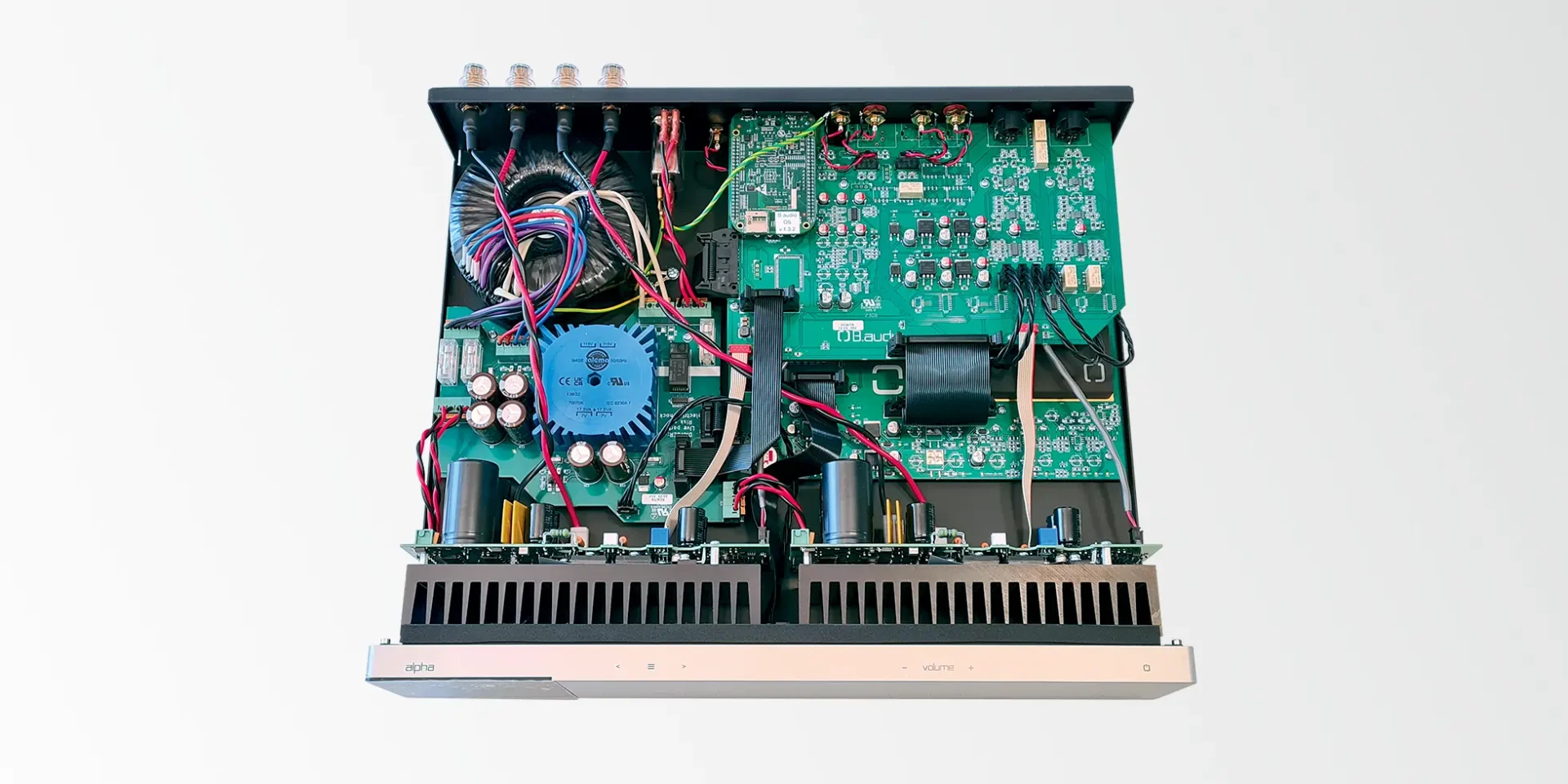
B.DPR ONE EX + B.AMP = B.AUDIO ALPHA ONE
Released very recently, two years behind the initial schedule—such was the extent of the development efforts to create the best possible product—the Alpha One is the latest addition from the Haut-Rhin-based brand and combines all the features of the aforementioned models.
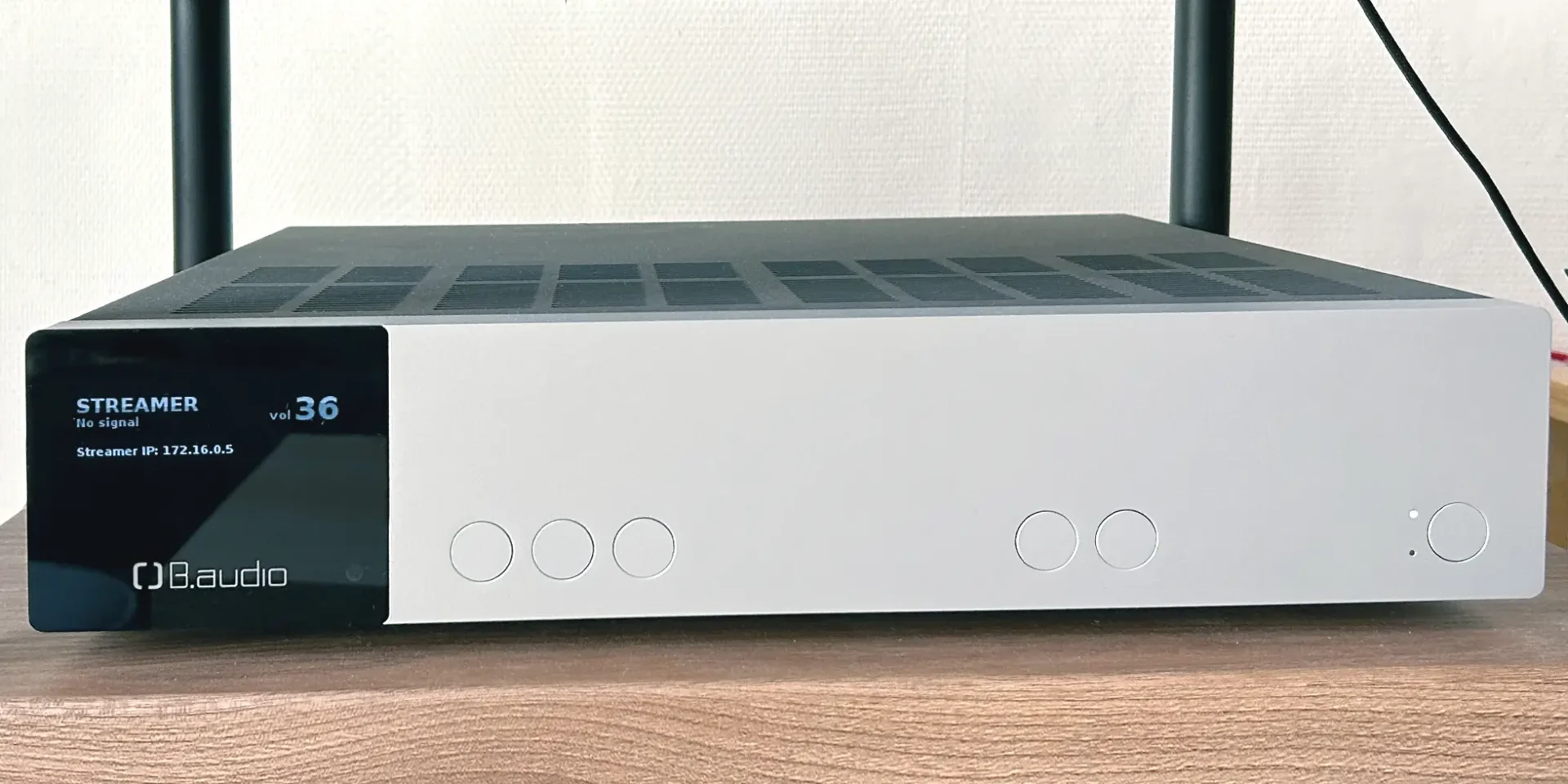
In a chassis with an anodized aluminum front panel that remains as sleek as ever, slightly redesigned to accommodate more control buttons, this new all-in-one combines the B.Dpr One Ex player-preamplifier with a B.Amp stereo power amplifier, the latter slightly scaled down to fit within a width of 45 cm, a depth of 39.5 cm, and, most importantly, a height of just 10.2 cm.
ANALOG AMPLIFICATION AND PREAMP
Based on IOD (Intelligent Output Drive) technology, designed to minimize the crossover distortion typically found in Class AB output stages, the amplification circuit follows the B.Amp design with Class A transistors—four rather than six to achieve greater compactness—positioned between the voltage gain stage and the output transistors. To also limit feedback, particularly return currents from the speakers, local loops are integrated, combined with a high output impedance relative to the preceding stages to maintain high linearity in the output stage’s operation.
For the preamplification stage, the technology is identical to that of a B.Dpr One: a perfectly symmetrical stage without a coupling capacitor, in which the ASP (Analog Symmetrical Preamplifiers) patent allows for the addition of a circuit outside the signal path, featuring four discrete resistor networks (compared to six in the Reference series) switched by relays; one network for each positive and negative point per channel.
To allow for the integration of unbalanced sources, active balancing is incorporated before the input selection stage; this enables the addition of two pairs of RCA terminals on the rear panel in addition to the balanced XLR pair, which serves as a reference given the Alpha One’s dual-mono preamplification structure. To further limit interference, the entire analog section is powered by a large toroidal transformer, while the second, smaller transformer from Talema powers all the digital sections.
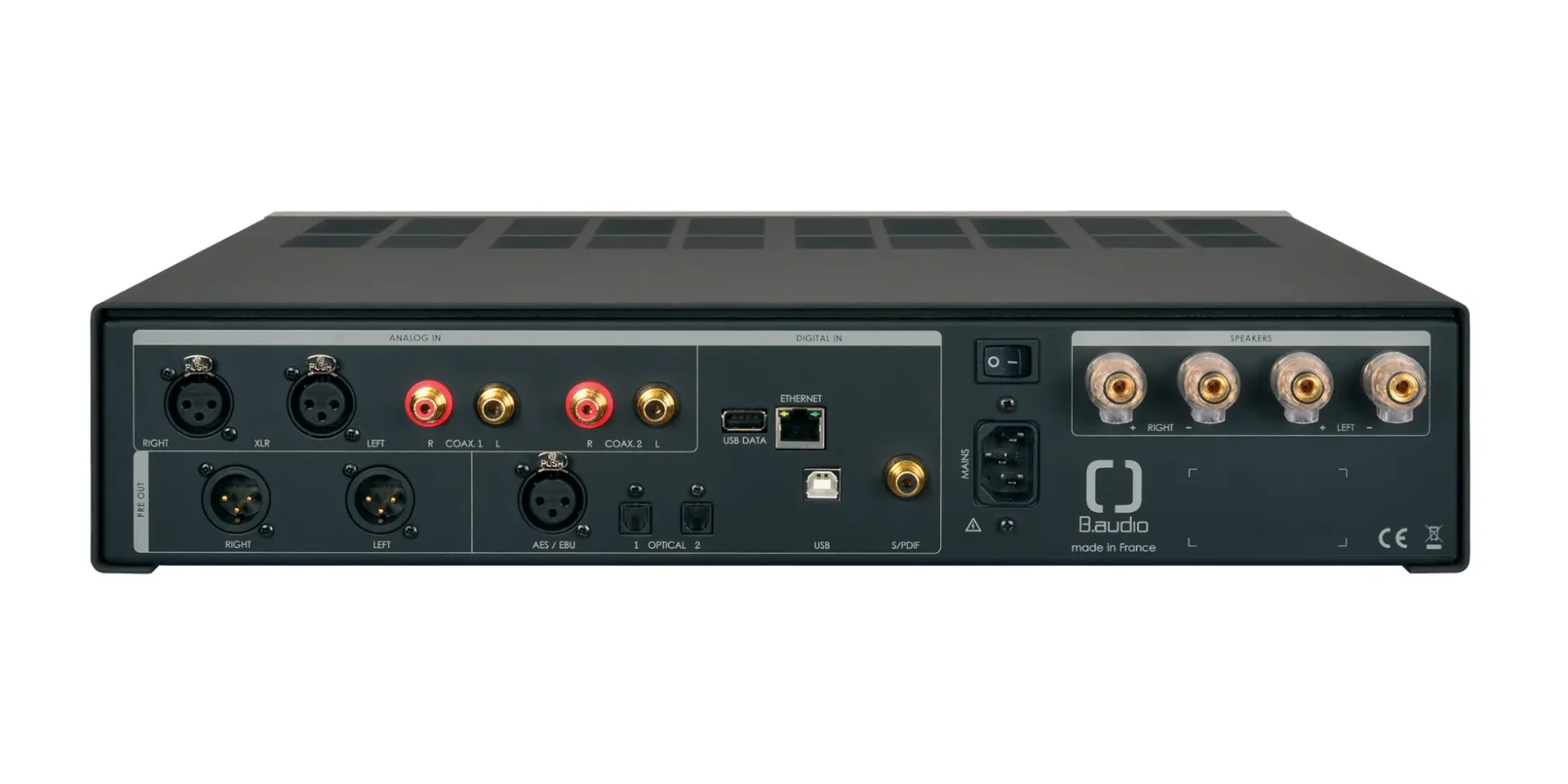
DIGITAL BOARDS
Already well-known for its DACs, the digital-to-analog conversion section stands out not so much for the conversion itself—which is based on a DSP chip whose algorithms have been refined over several years by Cédric Bermann—but for its proprietary jitter elimination technology.
Called SJR (Source Jitter Removal), this technical patent builds on existing technology and combines the use of PPL phase-locked loops with proven oversampling technology, while allowing the source data retrieved by a control algorithm to remain intact, while generating a clock signal decoupled from the input signal, designed to directly drive the D/A conversion before the analog signal is sent to the output stage. This has the advantage of never being affected by source jitter and allowing the output signal to be maximally purified by the clock, resulting in a more supple and airy sound.
Integrated since the EX versions, a network playback card benefits from the same clock processing, allowing the B.Audio Alpha One to connect directly to the Internet via an RJ45 port, through which data can be transmitted with a sampling quality of up to—as with USB audio—PCM 384 kHz, DXD, and DSD256.
The standard optical inputs (two of each), SPDIF, and AES/EBU allow playback of files up to 24-bit/96 kHz PCM for the former and 24-bit/192 kHz for the latter. With just one fewer coaxial input than the B.Dpr One EX, the Alpha One retains a USB Data input for connecting external hard drives, and loses the pair of RCA terminals on the analog output, keeping only the balanced XLR output. The need to route the signal to a power amplifier is becoming almost obsolete anyway, since amplification is inherently integrated into the all-in-one unit.
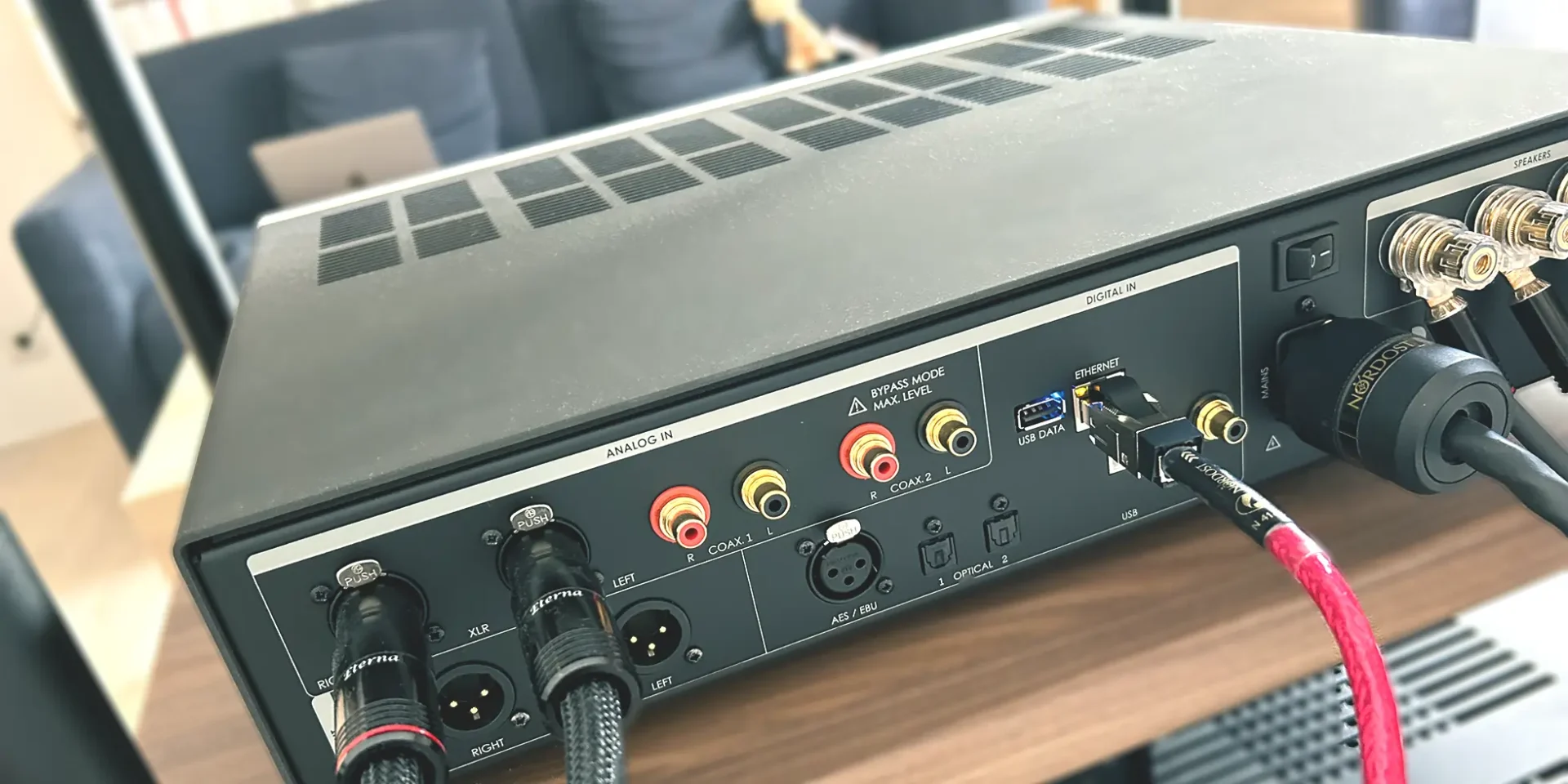
USE OF THE B.AUDIO ALPHA ONE
Unveiled at the 2023 Munich High-End Show alongside the new Dyptique panels, the Alpha One was recently tested on one of our reference systems for several weeks before being put through its paces with amplification-hungry speakers such as the ATC SMC50 PSLT and the EgglestonWorks Andra III at Concert Home.
Used primarily as an all-in-one system via its digital network player, it was also successfully paired with the CH-Précision P1 phono preamp, with which it shares a genuine philosophical alignment regarding sound neutrality and purity, and was compared in its digital-to-analog conversion capabilities to the Idéon Ayazi MKII and Mark Levinson 5101. The preamplifier section was also connected via XLR outputs to Accuphase (Class A) and Spec (Class D) amplifiers. However, the fact that we did not have a B.Amp One available at the same time prevented us from testing bi-amping, although the gain and output power of this unit are the same as those of the Alpha One, allowing them to be paired if necessary.
THE SOUND OF THE B.AUDIO ALPHA ONE
Typical of the B.Audio sound, the Alpha One is a synthesis of what the Bermann brothers have managed to create in less than ten years. As always, the benchmark digital-to-analog conversion of the B.Dac One is integrated here into a device that does everything—and does it all extremely well.
Initially connected to compact speakers, the all-in-one device from Alsace demonstrated its flexibility along with great purity, perfect for rendering all the clarity and detail of the violin sections in the opening of “La Nuit” from Richard Strauss’s Alpensinfonie (Thielemann’s version with the Vienna Philharmonic, DG) or to hear the Berlin Philharmonic’s decay down to the very last note in György Kurtág’s “Stele” (Abbado’s version, DG) for even longer than at the Berlin Philharmonie a few days earlier with Kirill Petrenko.
Very well defined but without being overly sharp, the textures unfold with tonal nuances consistently well-highlighted, benefiting almost as much from the Qobuz Hi-Res files streamed via Audirvana as from HD files sourced from an external hard drive connected via USB.
The very airy soundstage does not appear dark as with other converters, but rather a perfectly pure whiteness, which gives it a volume ready to expand as soon as the musical masses grow. With grand operas, but also noticeable on an album by Drake or The Weeknd, the bass explodes with great control at the lower end, without ever spilling over.
Even more impressive is the amplification, which we knew was limited compared to that of a B. Amp One, however, proves more than sufficient for very large speakers, such as the ATC SCM50—which are notoriously difficult to drive—or even better with the Eggleston Works Andra III, which, under the Alpha One, maintain a surprising fluidity alongside control across the entire spectrum, with excellent handling of each register across the various drivers.
Equally interesting, the pairing with the CH.Precision P1 phono preamp proved to be an unexpected match, as this Swiss device, much like the Alsatian all-in-one, strives to excel as much as possible in the neutrality and purity of the musical signal’s reproduction.
OUR CONCLUSION
Seven years after the founding of B.Audio and the release of the brand’s first DAC, Cédric and Sébastien Bermann have once again made a major impact with their first all-in-one, the Alpha One, for which it would be difficult to find a competitor as pure and refined in this price range.
Still a benchmark in terms of conversion and the quality of its resistor-relay preamplification, this model—directly derived from the B.Dpr One EX—manages to pack amplification comparable to that of the B.Amp One into a chassis that hasn’t been enlarged. With the same signal-processing technologies and a Class AB output power of 2 x 120 W into 8 ohms, the Alpha One is more than sufficient for high-sensitivity speakers, to which it delivers a sound that is consistently refined while being beautifully smoothed by every stage of the signal chain.
At €15,990, this all-in-one system is certainly not for everyone, but it easily replaces a source-amp pair in the same price range or higher, while also eliminating the need for any interconnect cables and serving as a NAS with the simple addition of an external hard drive. Discreet thanks to its modest height and refined by its design and anodized aluminum front panel, it will blend seamlessly into any environment to deliver a listening experience that is consistently ethereal and remarkably luminous.
Author(s): Vincent Guillemin
Technical Sheet: B.Audio Alpha One
- Origin: France
- Price: €12,200
- Dimensions: 255 x 1000 x 265 mm
- Weight: 18 kg
- Frequency Response: 40 Hz to 30 kHz
- Sensitivity: 86 dB
- Country of Origin: France
- Price: €15,990
- Dimensions: 450 x 395 x 102 mm
- Weight: 15 kg
- Output power
- 120 W into 8 ohms
- 200 W into 4 ohms
- Audio inputs and outputs: 1 x XLR; 2 x RCA; 1 x SPDIF; 2 x Toslink; 1 x AES/EBU; 1 x USB Type B; 1 x RJ45; 1 x USB DATA
- Harmonic distortion (THD+N): <0.001% (1–100 W, 8 ohms)
- Sampling
- PCM up to 24-bit/192 kHz (AES/SPDIF);
- PCM up to 384 kHz/DXD/DoP/native DSD up to DSD256 (USB Audio; RJ45)
You might be interested: Etsuro introduces the Gin-nezu cartridge